Postal Service releases special edition bald eagle stamps for America's 250th


Eagle Stamps

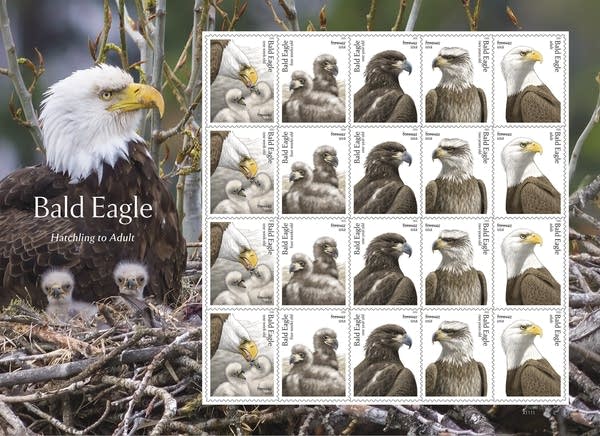
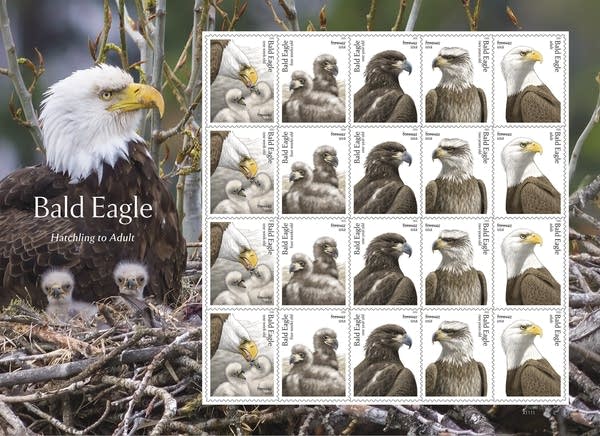
For America's 250th birthday, the U.S. Postal Service is releasing special edition stamps featuring one of the nation's icons: the bald eagle.

The stamps unveiled Thursday at the National Eagle Center in Wabasha, Minnesota, showcase the bird across five major life stages, from a fuzzy hatchling to the iconic white-headed adult depicted on the country's seal. They were available for immediate purchase across the United States.

“The fact that we’re seeing the eagles in all different stages of its life, it’s sort of making us look back at the stages of the life of our country,” said Steve Kochersperger, a historian at the Postal Service. “At one time, we were just fuzzy little hatchlings, too.”

The bald eagle has been a national emblem since Congress adopted the Great Seal in 1782, though it wasn't designated the national bird until 2024.

The bird has long symbolized American values like strength, freedom and independence, said Kochersperger. At the top of the food chain, the bald eagle dominates in the sky alone with its impressive wingspan and sharp talons.

Some believe Benjamin Franklin wanted the wild turkey to be the national bird because the eagle steals food from other birds, but Kochersperger said that's a myth.

There's another reason why it makes a strong American symbol: the bald eagle is a major conservation success story. In the 1960s, eagles became a rare sight in the U.S. because of poisoning by the pesticide DDT.

But that decline was reversed, thanks to a 1972 DDT ban and the bald eagles' listing as an endangered species in 1978.

“The public relations campaign brought greater awareness that, ‘Hey, this is our national symbol, but they may all be gone if we don’t change our ways,’” Kochersperger said. “And that turned out to be very effective.”

In 2007, the bald eagle was removed from the endangered list, and there are now more than 300,000 eagles in the continental United States, according to the U.S. Fish and Wildlife Service.

David Sibley, the Massachusetts-based artist and bird watcher behind the stamp collection, said the conservation story is part of what makes him think of the bald eagle as a symbol.

“Maybe seeing a bald eagle on the stamp as a bird, living its life from nestling to adult, will hopefully make people think about the natural world and how important things like eagles are, not as a symbol but as part of the ecosystem around us,” he said.

Sibley spent nearly a year working on the digital illustrations for the collection. As someone who usually draws life-sized birds, the tiny stamp size was perhaps the biggest challenge, so he chose to focus on the bald eagle’s head to show as much detail as possible.

Postage stamps have long served as a way to celebrate holidays and highlight American culture, but they can also be educational, if you look closely.

“A stamp does not demand your attention, but it rewards it,” Kochersperger said. “A tremendous amount of planning and effort went into producing that tiny little piece of paper.”




Source link

Leave a Reply

Subscribe to Our Newsletter

Get our latest articles delivered straight to your inbox. No spam, we promise.

Recent Reviews


If your team meetings look the same as they did last year, they need an upgrade.

How great are your team meetings?

For most founders, the answer is… not very.

As your company grows, meetings become the primary way your vision stays alive inside the business.

A bad team meeting isn’t just wasted time; it’s another week of misalignment.

Here are seven techniques my CEOs are using to improve their team meetings:

1. To improve quality, have AI review the reports before the meeting.

Your leaders might be using AI to draft their updates, but that’s not enough to ensure clear thinking.

Ask your team to use AI to critique their own reports before they present them:

  • Where could it be clearer?
  • Where is the logic weak?
  • What question is a founder likely to ask that this doesn’t yet answer?

This is one of the easiest and most helpful AI rituals you can embed into your culture. The result is stronger reports and a higher quality of conversation in the meeting.

2. To improve mindset, start with wins and praise.

Most people enter team meetings with a list of “blockers”. Blockers are places where they feel stuck. However, feeling “stuck” isn’t the resourceful mindset you want to start with.

Start by asking everyone to share a personal win or recognise someone else’s help. This generates a feeling of progress and puts people in a positive frame of mind.

Teams resist this at first. Finding genuine praise feels like effort. By making it a norm, it creates the social pressure needed to actually do it. And everyone appreciates it once it’s done.

3. To improve alignment, read together in silence.

Reading reports requires concentration, and that’s hard when you’re on your own with notifications to distract you every 5 seconds. 

But for some reason, it’s easier to concentrate on a report when the whole team does it at the same time. 

Amazon understood this when it introduced a concept called ‘Study Time’ into its meetings.

At the start of every meeting, all participants spend 20-30 minutes reading each other’s memos. They add comments and questions in other people’s sections, and keep an eye out for questions they can answer.

If you want everyone to be aware of what’s happening in other people’s areas, there is no better way to achieve this.

This gets the room onto the same page, literally.

4. To improve the format, end with a feedback survey.

People want to leave a long, boring, useless meeting as quickly as possible.

However, without a proper feedback loop, no meeting will ever improve.

Create a short feedback survey to complete it at the end of the meeting. I ask these questions:

  • What was your number one takeaway from this meeting?
  • How would you rate the meeting out of ten?
  • What’s one idea to improve it?

It takes less than 60 seconds, and the data tells whether your meetings are getting better or worse. It works for any meeting, even board meetings.

5. To improve dynamics, use AI to interrogate the transcript.

Many teams use AI to create transcripts of the meeting. However, after taking their own action items, they fail to extract the full insight the transcript captures.

Feed the meeting transcript into your favourite AI and ask:

  • What’s your critique of the meeting structure?
  • What team dynamics are at play here?
  • What are your recommendations on how each participant can improve?

If you have a support team, this is easy to delegate, and the insights are often good enough to substitute an expensive executive team coach.

6. To improve follow-up, build an accountability agent.

Actions that get agreed in one meeting are often forgotten by the next one. Some CEOs create spreadsheets to aid with follow-up. But smart teams take it one step further.

Build an agent that follows up automatically. I created a Cowork agent to:

  • Take the transcript
  • Captures to-do lists for every leader
  • Follow up by email and provide support
  • Share tips to improve their next presentation

Agents have transformed the way I run my team, and they’re set to transform all our companies over the next few months.

7. To improve focus, set up a meeting Slack channel.

If you’re like most founders, your mind is full of questions and ideas for your team. It can be a major distraction if your team feel like they have to respond immediately. 

The team meeting is often the ideal place to address questions and ideas. Realising this, one of my clients creates a channel for each recurring meeting where anyone can ask questions and share ideas.

Here’s the catch is: There’s no obligation to respond to questions and ideas until the meeting. 

The Slack channel provides a place for non-urgent questions and discussion topics—an open agenda—and reduces distraction between meetings. Pretty smart.

Here’s a recap:

  1. Have AI review the reports before the meeting.

  2. Start with wins and praise.

  3. Read together in silence.

  4. End with a feedback survey.

  5. Use AI to interrogate the transcript.

  6. Build an accountability agent.

  7. Set up a meeting Slack channel.

Which of these techniques can you apply to improve your team meetings?

Take what’s useful and give your meetings the upgrade they deserve.

Related Reading: 


Originally published on March 4th, 2026


How do top founders actually scale?

I’ve coached CEOs for 10,000+ hours—here’s what works.
Join 17,000+ founders learning how to scale with clarity.

Unsubscribe any time.


Source link