
Income investors are typically focused on dividends, but they should also be concerned with generating high total returns over time.
One way to do this is to focus on dividend stocks with market-beating yields, combined with low valuations.
Combining low starting valuations with dividends can generate high total returns over time. For this reason, income investors should also incorporate value investing into their process.
The following three stocks all pay dividends, and their expected returns above 10% annually over the next five years make them 3 of the best dividend stocks for May 2026.
Dividend Stocks for May
FactSet Research Systems (FDS)
FactSet Research Systems, a financial data and analytics firm founded in 1978, provides integrated financial information and analytical tools to the investment community in the Americas, Europe, the Middle East, Africa, and Asia-Pacific. The company provides insight and information through research, analytics, trading workflow solutions, content and technology solutions, and wealth management.
On March 31st, 2026, FactSet Research Systems announced Q2 2026 results, reporting non-GAAP EPS of $4.46 for the period, which beat market consensus by $0.08. Revenue grew 7.1% to $611 million. Organic revenue growth held at 6.8%, while Annual Subscription Value (ASV) a key gauge of recurring demand reached roughly $2.45 billion, up 6.7% from a year ago.
Management also raised its full-year outlook, now guiding for revenue between $2.45 billion and $2.47 billion.
FactSet has grown its earnings-per-share with a compound growth rate of 7.2% over the last 10 years. The company’s investments and improved product offerings could lead to significant margin expansion in the following years. We estimate EPS of $17.70 by 2026, matching the midpoint of the analysts’ estimates, and we reaffirm our 8.5% annual earnings growth forecast for the next five years.
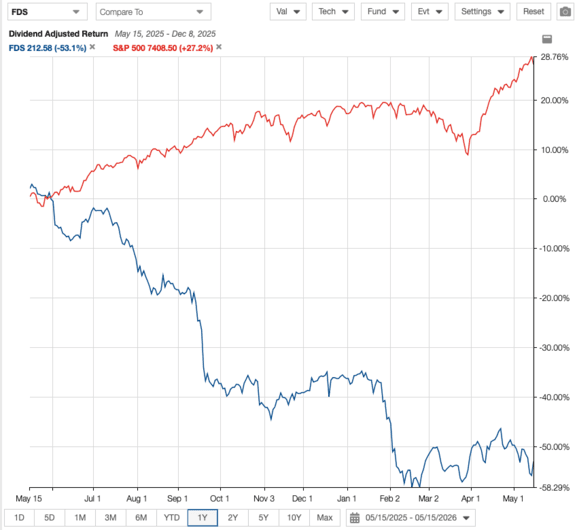
FactSet has increased its dividend for 26 consecutive years, making it a Dividend Aristocrat. Shares are currently yielding 2.1%. We estimate total returns above 27% per year for FDS stock.
Becton, Dickinson & Co. (BDX)
Becton, Dickinson & Co. is a global leader in the medical supply industry. The company was founded in 1897 and has 75,000 employees across 190 countries. The company generates about $20 billion in annual revenue, with approximately 43% of revenues coming from outside of the U.S.
On November 6th, 2025, BDX increased its quarterly dividend 1.0% to $1.05, extending the company’s dividend growth streak to 54 consecutive years. BDX is a Dividend King.
BDX also announced results for the first quarter of fiscal year 2026, which ended December 31st, 2026. For the quarter, revenue improved 1.5% to $5.25 billion, which topped estimates by $100 million. Adjusted earnings-per-share of $2.91 compared unfavorably to $3.43 in the prior year, but this was $0.10 more than expected.
For the quarter, Medical Essentials was down 0.6% on a currency neutral basis to $1.6 billion as gains in U.S. Vascular Access Management and the BDX Vacutainer portfolio were more than offset by order timing in China.
BDX has increased earnings-per-share 5.9% per year over the past decade, and has grown earnings in 7 out of the last 10 years. We now forecast that BDX can grow earnings at a rate of 5% per year through fiscal 2031, down from 8% previously, as this is more in-line with the long-term average.
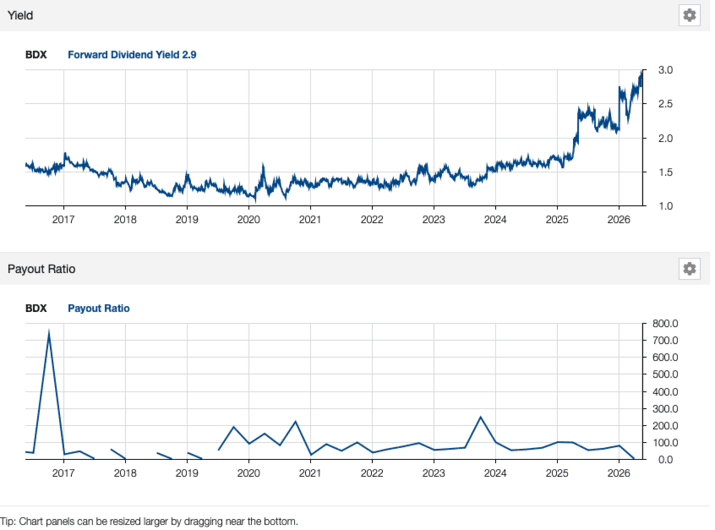
According to Stock Rover, BDX stock currently yields 2.9%. We estimate total returns of 18% per year over the next five years.
Target Corporation (TGT)
Target is a retail giant that consists of about 1,850 big box stores, which offer general merchandise and food, as well as serving as distribution points for the company’s burgeoning e-commerce business. Target should produce more than $105 billion in total revenue this year.
Target posted fourth quarter and full-year earnings on March 3rd, 2026, and results were better than expected. The company saw revenue fall 1.5% year-over-year to $30.45 billion for the quarter, which met expectations.
However, earnings came to $2.44 per share on an adjusted basis, which beat estimates by a massive 28 cents. The management team noted advertising revenue was higher, as well as good results in beauty and food & beverage.
Sales were weaker in most of its major categories, however, resulting in the 1.5% drop. Comparable sales were down 2.5%, slightly worse than expected, as transactions fell 2.9% and average ticket rose 0.4%.
The company expects sales to grow at about 2% for this year, reflecting a small increase in comparable sales, new stores, and non-merchandise sales contributing to growth.
Earnings are expected between $7.50 and $8.50 per share on an adjusted basis. Strength in earnings could come from higher sales and operating margins expected to be 20 basis points above fiscal 2026. We expect the company to grow its earnings-per-share by 7% per year over the next five years.
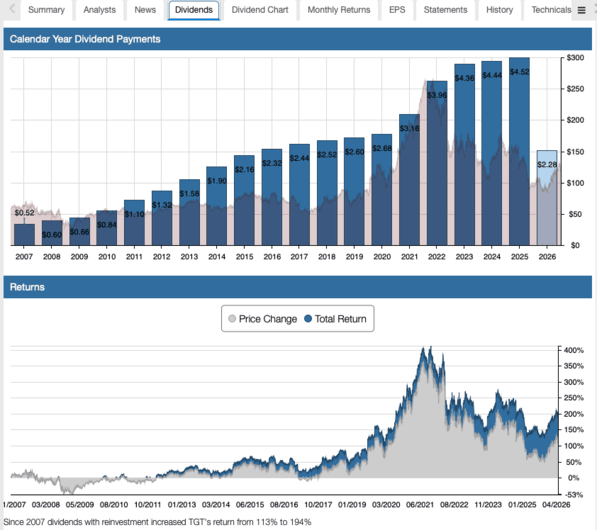
The company also sports an extremely impressive dividend increase streak of 57 years. TGT shares are currently yielding 3.7%. Total returns are expected to reach 12.7% per year over the next five years for TGT stock.
Related Article on Target on Dividend Power
Disclosure: No positions in any stocks mentioned.
Related Articles on Dividend Power
Here are my recommendations:
Affiliates
- Simply Investing Report & Analysis Platform or the Course can teach you how to invest in stocks. Try it free for 14 days.
- Free Dividend Kings Spreadsheet from Sure Dividend, complete with Buy/Hold/Sell recommendations, dividend histories, and much more. It is an excellent resource for DIY dividend growth investors and retirees.
- Stock Rover is the leading investment research platform with all the fundamental metrics, screens, and analysis tools you need. Try it free for 14 days.
Receive a free e-book, “Become a Better Investor: 5 Fundamental Metrics to Know!” Join thousands of other readers !
*This post contains affiliate links meaning that I earn a commission for any purchases that you make at the Affiliates website through these links. This will not incur additional costs for you. Please read my disclosure for more information.
Bob Ciura
Bob Ciura is President of Content at Sure Dividend. Bob has worked at Sure Dividend since October 2016. He oversees all content for Sure Dividend and its partner sites. Prior to joining Sure Dividend, Bob was an independent equity analyst. Bob received a bachelor’s degree in Finance from DePaul University, and an MBA with a concentration in Investments from the University of Notre Dame.

Nicole Byers is an entertainment enthusiast! Nicole is an entertainment journalist for the Maple Grove Report.