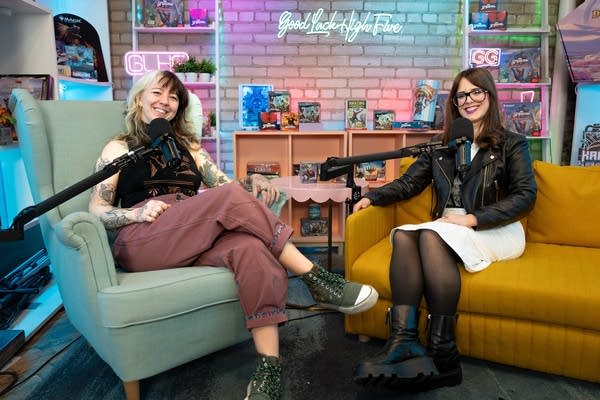
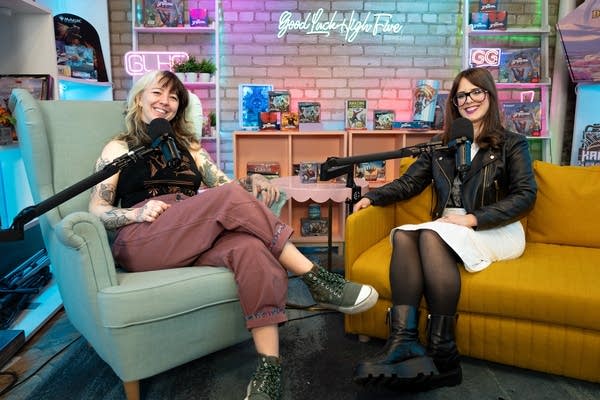
In a studio workshop inside the Northrup King Building in Minneapolis, Maria Bartholdi adjusts microphones and cameras while her cohost Meghan Wolff climbs up on the bright colored table to adjust the lighting. Wolff uses a tried-and-true method: duct tape and cardboard.
When you’re running a podcast and YouTube channel, you use what you have to make it work.
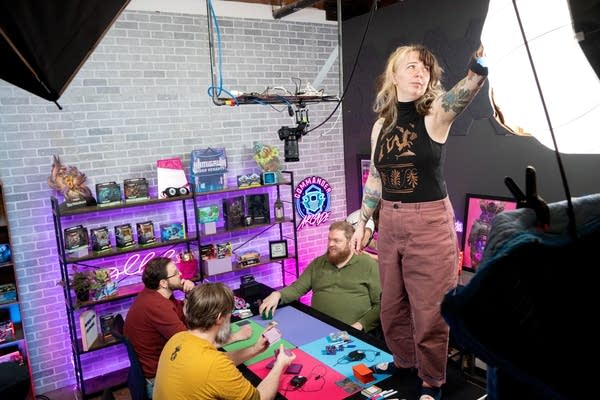
While their guests for the night chat about the latest cards and games they plan to play, Bartholdi and Wolff bounce between lights, cameras and the set to prep for their game night, which will eventually be shown to thousands of fans.
The pair are the cohosts for a show called “Good Luck High Five,” a podcast focused on the popular and complicated card game: Magic: The Gathering.
The podcast — where the hosts talk about the various facets and news of the game — has over 13,000 listens per month. And their new “Commander Arcade” YouTube show — where the two invite guests to play a game with them — averages nearly 32,000 views a month on YouTube.
Through their work on the podcast, the two have also become a large influence in expanding the hobby’s reach beyond the white-male demographic that the game is known for, encouraging women and femme-presenting players to shuffle their best decks for complex strategy competitions at the national level.
Friendship, laughs and a love of a game
The friendship preceded the podcast, when Wolff and Bartholdi met at a comedy improv show audition.
“I was like ‘I’m going to make this person my friend,’” Wolff said. The two even set up a shared Google document they used to secretly chat while at work.
They also shared a love of games, and a mutual friend at a board game night showed Wolff and Bartholdi “the best game.”
“He did phrase it like that,” Wolff said.
“It turned out it was Magic: The Gathering. And sure enough, we became immediately addicted to it,” Bartholdi said. “We played on the floor of various parties, ignoring everybody else in the room, just playing Magic. The bug had bit us hard.”
The game has several different formats that can be played by two or four players, but they tend to use 60- or 100-card decks with cards featuring creatures, sorceries and enchantments. Players take turns trying to whittle down their opponent’s health points to zero and be the last player standing.
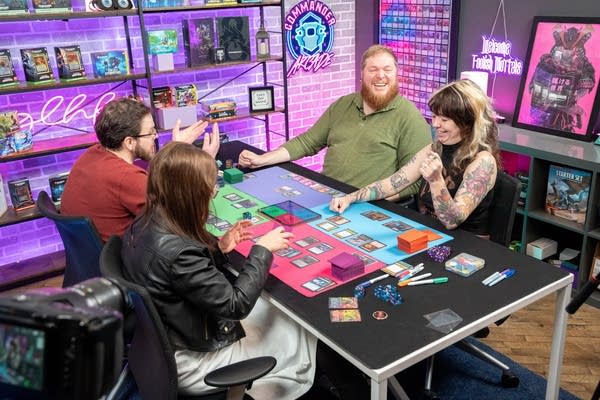
Each card can have different effects, and players build their cards to craft different strategies. Bartholdi also said the five colors that are a pinnacle of the game design —– white, blue, black, red and green —– have various themes underlining their cards, allowing players to express their identity.
“Like black is all about ambition and control, and blue is about using your intellect to outsmart your opponents, and green is about smashing face with big monsters,” Bartholdi said. “So you can kind of craft a deck that feels in line with your personal identity, which is also something I don't think you can get in any other game that exists.”
The two launched the podcast soon after, first under a different name — Magic the Amateuring — before rebranding as Good Luck High Five. Bartholdi had a background in media production, so they set up microphones on a kitchen table.
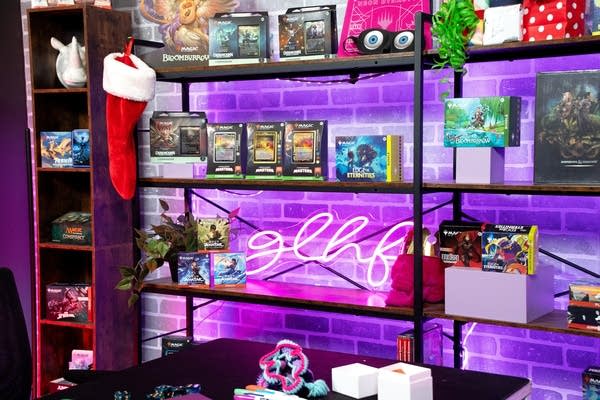
While there were other podcasts focused on the game, Wolff and Batholdi saw an opening with a show focused on new players hosted by women and trained with a comedy background.
“Aside from being an all-female podcast, and my memory is not perfect here, but maybe the first all-female Magic podcast, they brought a level of professionalism to the craft that really leveled up everyone around them,” Blake Rasmussen, the director of communications for Magic: The Gathering, said.
“The thing I always appreciate about them is they are very focused on newer players. That's not to say they don't do content for experienced players, but they always do content with the newer player in mind. And I don't think that's as common in the community as it maybe should be.”
Thirteen years and nearing 700 episodes, plus nearly 50 YouTube videos of their new show “Commander Arcade,” the two have created a media company based on the 32-year-old trading card game. They also added a third host on the team, Tyler Mills.
And there are few other shows that can claim the same staying power.
“Many Magic podcasts have come and gone over the years. I feel like there's only one which has been consistently running longer than we have,” Bartholdi said.
The ‘sigh’ that opened doors
Ten years ago, Wolff wrote an article about the challenges of being accepted into the hobby’s community, based on both her and Bartholdi’s observations.
“I wrote an article for a Magic website that was like ‘hey, there’s not a lot of women playing Magic. And here are some experiences that we’re having. It boils down to, people don’t treat you well. So hey, consider treating women better when they’re playing Magic: The Gathering in these spaces,’” Wolff said. “It… didn’t go over great.”
“This article lit a match, and then we threw gasoline on that match by recording a podcast episode about it as well,” Bartholdi said, “which became our most listened to episode of all time.”
It also caused Wizards of the Coast, the company that owns Magic, to pay attention. The company reached out to the pair, asking for advice.
“We had a meeting with them, and we said, ‘Well, you can hire women to be in your Magic event coverage.’ And they're like, who?”
They offered a few names to Wizards, women who made content or had played competitively. At first, they didn’t offer their own names.
“There's no reason why we didn't put our own names on it, except that sometimes, when you're socialized as a woman, you don't put yourself out there like that,” Wolff said.
Fortunately, they reached out and said “actually, us too.”
And Wizards went with them, along with a few other content creators.
Now, both Wolff and Bartholdi are involved in professional event hosting with pro tournaments, travelling around the globe.
“Anytime you tune into a Pro Tour, you’re very likely to see Maria on the broadcast,” said Rasmussen. “She brings that high-level professionalism to the broadcast. And Meghan, who you don’t see on camera, is often working on a lot of our social and web content to bring that to life. Both have been part of the Pro Tour ecosystem for quite some time.”
Since they released the episode about the barriers for women to play in tournaments, Wolff and Bartholdi have seen changes in the hobby, with organizations promoting inclusion, tournaments for players who are marginalized, and people who show up at events to provide safe spaces.
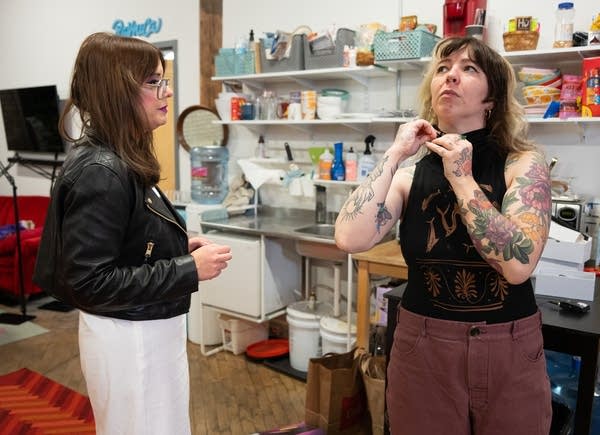
Wolff recently went to a tournament event in Baltimore and was struck by how much the scene has changed.
“It would literally be you'd walk into this room of 1,000 players, and it would be like, I can count the number of like, femme-presenting people here on one hand.” Wolff said. “And I walked into [this event] in Baltimore, and I’m walking around the tables. I had a real moment about it, because the landscape looked so different. There’s so many femme-presenting people playing at this event.”
“Just the change in overall attitude is night and day between 10 years ago and now, not to say there's not more work to be done,” Bartholdi said “Because, of course there is. But it's truly incredible, in that short amount of time, how much headway that we've collectively made.”
Content creation career for a niche hobby
As the podcast grew and the work continued for tournament coverage, Wolff was laid off from a job in 2016. She realized that the work she was doing on the podcast was the same workload as a full-time job.
For Bartholdi, there were tournaments to cover, episodes to record and edit, flights around the world, then rolling into her job right after a flight, sometimes with a suitcase in tow.
“It was exhausting.” Bartholdi said. “So we had to make a decision.”
The two decided on becoming freelancers, with the GLHF podcast and Magic being the main focus.
But that still means playing the cards the economy deals you. Changes in health care policy, being reliant on a product from a completely independent company and being in tune with an audience that donates funds to support their content.
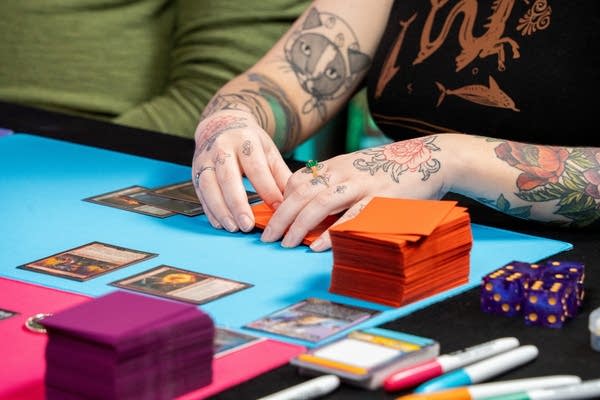
“Ever since we've been freelancing, I have been more in tune with what is happening in the American economy than I ever have in my life,” Wolff said.
“When people think about Magic: The Gathering, if they're not familiar, a lot of them will think of the ‘90s, but the truth is that Magic: The Gathering is bigger now than it has ever been,” Bartholdi said.
According to reports, Wizards of the Coast generated $547 million in operating profits in 2021, and its parent company Hasbro reported that Magic: The Gathering became the company’s first billion-dollar brand in 2022.
That’s even before a huge year in 2025, when sets of cards featuring new characters and art from the long-running Final Fantasy video game series , brought new players to the table. That release generated $200 million in revenue in a single day. The company has also branched out into cards made with intellectual properties with cross-promotional appeal, like Lord of the Rings, Teenage Mutant Ninja Turtles and Marvel Comics.
“In 2026 [there] is going to be the most Magic sets released of all time,” Bartholdi said, “Which is good for us as content creators, because there’s a lot of material to work with.”
Wolff said the internet also demands authenticity, so they have to walk a fine line between being excited and being honest about the cards that come out.
“It's a delicate dance,” Wolff said. “We're talking about Magic because we love the game, and we always, at the end of the day, want to be producing a show that is about the joy of the game. We have to balance that with the fact that we also are going to be honest with people. If Wizards makes a bad product that people don't like, we're not going to go out and pretend to like it, because that would be disingenuous.”
But Bartholdi adds that growth in the interest of the game doesn’t mean their shows are secure. She worries that listeners can feel burned out on their hobby — or economic pressures cause hobbyists to pull back on spending.
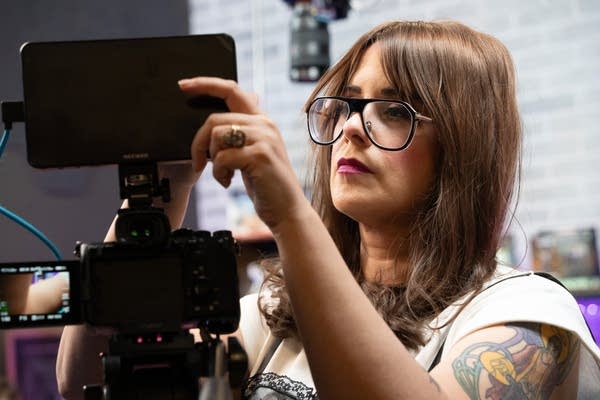
Even with the success of the podcast, the YouTube channel, and being a tournament announcer, Bartholdi worries about how long it will last.
“Being a woman in an esports space, or even a sports space, who's over 40 is kind of a terrifying prospect, because once again, you have to see it to be it, and you don't see a lot of it,” she said.
She’s also acutely aware that the same standard is never applied to her male counterparts.
“So I’m like, what does that mean for the future? Can you be a woman on the internet past 40? I don't know, but I'm going to try.”
Wolff, with a chuckle, pipes in to reassure her co-host.
“I'm gonna beat the snot out of anyone who tries to tell you otherwise,” she says, laughing with her co-host.
The podcast releases new episodes every Thursday, with new “‘Commander Arcade”’ videos twice a month.