
Hilton Honors: Complete loyalty program guide


Hilton Honors is one of the largest hotel loyalty programs, with over 9,000 participating properties across 25 brands. I appreciate that the program offers excellent opportunities to earn Hilton points, valuable cobranded credit cards and multiple pathways to secure elite status.

Although Hilton Honors isn’t my primary hotel loyalty program, I maintain Hilton elite status through a cobranded credit card and stay at Hilton properties at least quarterly to maximize my Hilton statement credit available through The Business Platinum Card® from American Express (enrollment is required; separate Hilton for Business enrollment is also required).

So, whether you stay at Hilton properties weekly or annually, here’s what you should know about the Hilton Honors program.

What is Hilton Honors?

Hilton Honors is the hotel loyalty program for Hilton hotels and resorts. It provides benefits and earnings on eligible stays at 25 Hilton brands, from full-service luxury brands like Waldorf Astoria and Conrad to select-service brands like Hilton Garden Inn and Hampton by Hilton. The Hilton Honors program also offers various ways to earn and redeem Hilton points, including many options beyond hotel stays.

Waldorf Astoria Los Cabos Pedregal in Mexico. CARLY HELFAND/THE POINTS GUY

When you book directly with Hilton, you’ll earn points and benefits based on your membership tier. For the rest of this article, I’ll assume you book through Hilton (not an online travel agency or other method) when discussing benefits and earnings.

Related: The 22 best Hilton hotels in the world

Hilton Honors membership tiers

You’ll progress up the Hilton Honors membership tiers as you stay at Hilton properties each calendar year. Once you’ve earned a specific membership tier, you’ll enjoy its benefits for the rest of the calendar year in which you earned it, as well as the entire next calendar year. You can also snag Hilton Honors elite status through a status match or as a cardmember of select American Express cards.

Hilton Honors member

Once you join the Hilton Honors program, you’ll be a member. The primary benefits of being a Hilton Honors member are:

  • Access to book the Hilton Honors discount rate
  • Waived resort fees when you pay for your stay using solely points or a promotional free night reward
  • The ability to choose your room from available rooms up to 24 hours before check-in
  • The ability to earn points on stays

Reward your inbox with the TPG Daily newsletter

Join over 700,000 readers for breaking news, in-depth guides and exclusive deals from TPG’s experts

It’s free to join the Hilton Honors program, so you might as well join now if you aren’t already a member.

Hilton Honors Silver

You’ll earn Hilton Honors Silver status after you stay four times, stay for 10 nights or spend $2,500 in a calendar year. Eligible spending includes room rates (excluding taxes) and charges billed to your room (such as spa, dining and other incidental charges) from bookings made directly with Hilton or approved channels.

Conrad Tokyo. CLINT HENDERSON/THE POINTS GUY

The primary benefits of Hilton Silver status include:

  • A 20% bonus on base points earned through stays
  • Two complimentary bottles of water per stay at select hotels
  • A fifth night free on standard reward stays of five consecutive nights or more (up to four free nights per stay, and only when you book solely with points)

You’ll also enjoy Hilton Silver status as a cardmember benefit of the Hilton Honors American Express Card.

Hilton Honors Gold

You’ll earn Hilton Honors Gold status after you stay 15 times, stay for 25 nights or spend $6,000 in a calendar year. The primary benefits of Hilton Gold status include:

  • An 80% bonus on base points earned through stays
  • A choice of a My Way on-property benefit on each stay (which may include the option to select a daily food-and-beverage credit or continental breakfast)
  • Space-available room upgrades to preferred rooms (including up to executive floor room types) at select brands and properties

You’ll also get Hilton Gold status as a cardmember benefit of the Hilton Honors American Express Surpass® Card, The Hilton Honors American Express Business Card, the American Express Platinum Card® and The Business Platinum Card from American Express (enrollment may be required). You can also earn Gold status through the end of the next calendar year if you spend $20,000 on eligible purchases on the Hilton Honors American Express Card within a calendar year.

Related: Your complete guide to breakfast benefits at Hilton Honors hotels

Hilton Honors Diamond

You’ll earn Hilton Honors™ Diamond status after you stay 25 times, stay for 50 nights or spend $11,500 in a calendar year. The primary benefits of Hilton Diamond status include:

  • A 100% bonus on base points earned through stays
  • Executive lounge access when available
  • Premium Wi-Fi access during stays at select brands
  • Space-available room upgrades to preferred rooms (including up to junior, standard or one-bedroom suites) at select brands and properties

You can also obtain Hilton Diamond status as a cardmember benefit of the Hilton Honors American Express Aspire Card. Cardmembers of the Hilton Honors American Express Surpass Card or The Hilton Honors American Express Business Card can also earn Diamond status through the end of the next calendar year if they spend $40,000 on eligible purchases on their card in a calendar year.

Room at the Hilton Niseko Village in Japan
Hilton Niseko Village in Japan. KATIE GENTER/THE POINTS GUY

You’ll secure lifetime Hilton Diamond status once you’ve earned Hilton Diamond status for 10 years (the years don’t need to be consecutive) and either stay 1,000 nights (paid and reward nights count) or spend $200,000 across your account’s lifetime.

Hilton Honors Diamond Reserve

You’ll earn Hilton Honors Diamond Reserve status after you stay 40 times or 80 nights and spend $18,000 in a calendar year. The primary benefits of Hilton Diamond Reserve status include:

  • A 120% bonus on base points earned through stays
  • 4 p.m. guaranteed late checkout
  • Premium club access, including access to the expanding collection of premium clubs
  • A confirmable upgrade reward, which lets you confirm a premium room upgrade (up to a suite) at the time of booking for a stay of up to seven nights

Related: Elite status battle: What happened when we tested Hilton’s new Diamond Reserve versus Diamond status

Hilton status match and challenge

Hilton Honors usually offers a status match and challenge to select elite members of other hotel loyalty programs. To request a Hilton Honors status match, you must submit proof of your status in another program via an online form.

If Hilton approves your request, you’ll get Hilton Gold status for 90 days. You can keep Gold status through March 31, 2028, if you stay for six nights during your 90-day trial period. Meanwhile, if you stay 12 nights within your 90-day trial period, Hilton will upgrade you to Diamond status through March 31, 2028.

Related: Complete guide to airline status matches and challenges

Milestone bonuses and status gifts

Hilton offers its members several additional benefits based on the number of eligible nights they stay each calendar year.

Once you stay 40 eligible nights in a calendar year, you’ll get 10,000 bonus points. You’ll then earn an additional 10,000 bonus points for every additional 10 eligible nights (up to 180) in a calendar year.

Plus, you’ll earn an additional 30,000 bonus points once you stay 60 eligible nights in a calendar year. And once you stay 120 eligible nights in a calendar year, you can choose a confirmable upgrade reward or 30,000 bonus points.

hotel exterior
Embassy Suites by Hilton Orlando Sunset Walk. TARAH CHIEFFI/THE POINTS GUY

If you stay 60 eligible nights in a calendar year, you can gift Hilton Gold status to another member. But if you stay 100 eligible nights in a calendar year, you can gift Hilton Diamond status to another member. However, you can only gift status to one other member per year.

How to earn Hilton points

As you interact with the Hilton Honors program, you’ll learn many ways to earn points. For a detailed discussion, I highly recommend checking out our guide on earning Hilton points, but here’s a quick overview of your options.

Hotel stays

One of the easiest ways to earn Hilton points is through hotel stays. On eligible stays, you’ll usually earn as follows on charges to your folio from up to four rooms:

  • 3 points per dollar spent at LivSmart Studios properties
  • 5 points per dollar spent at Home2 Suites, Homewood Suites, Spark, Tru and Apartment Collection properties
  • 10 points per dollar spent at other Hilton brands

Graduate Hotel Princeton guest room
Graduate by Hilton Princeton in New Jersey. ERIC ROSEN/THE POINTS GUY

Of course, as I mentioned above, you’ll earn additional bonus points on stays if you have Hilton elite status. Plus, you may earn bonus points through current Hilton promotions.

Related: 8 best Hilton all-inclusive resorts

Hilton credit cards

Hilton Amex cards are also a great way to earn points. Here’s a look at the earning rates, welcome offers and annual fees on some of our favorite Hilton credit cards.

Card Welcome offer Earning rates Annual fee

Earn 175,000 bonus points after spending $6,000 on purchases in the first six months of card membership.

  • 14 points per dollar spent on eligible purchases made directly with hotels and resorts in the Hilton portfolio
  • 7 points per dollar spent on select travel, including flights booked directly with airlines or amextravel.com and car rentals booked directly with select car rental companies
  • 7 points per dollar spent on dining at U.S. restaurants, including takeout and delivery
  • 3 points per dollar spent on other eligible purchases

Earn 130,000 bonus points after spending $3,000 on purchases in the first six months of card membership.

  • 12 points per dollar spent on eligible purchases made directly with hotels and resorts in the Hilton portfolio
  • 6 points per dollar spent on dining at U.S. restaurants, including takeout and delivery; groceries at U.S. supermarkets; and gas at U.S. gas stations
  • 4 points per dollar spent on U.S. online retail purchases
  • 3 points per dollar spent on other eligible purchases

$0 introductory annual fee for the first year, then $150 (see rates and fees)

Earn 130,000 bonus points after spending $8,000 on purchases in the first six months of card membership.

  • 12 points per dollar spent on eligible purchases made directly with hotels and resorts within the Hilton portfolio
  • 5 points per dollar spent on other eligible purchases (on the first $100,000 in purchases per calendar year, then 3 points per dollar thereafter)

$0 introductory annual fee for the first year, then $195 (see rates and fees)

Earn 100,000 bonus points and a $100 statement credit after spending $2,000 on purchases in the first six months of card membership.

  • 7 points per dollar spent on eligible purchases made directly with hotels and resorts in the Hilton portfolio
  • 5 points per dollar spent on dining at U.S. restaurants, including takeout and delivery; groceries at U.S. supermarkets; and gas at U.S. gas stations
  • 3 points per dollar spent on other eligible purchases

I have the Hilton Aspire Card and find it offers far more value than its annual fee since I maximize its benefits. Plus, earning 14 points per dollar spent on purchases at Hilton properties is unbeatable. But if you don’t maximize the annual free night reward and don’t fully use the up to $400 Hilton resort statement credit (up to $200 statement credits semiannually) each year, the Hilton Aspire may not be the right card for you.

Related: Hilton Surpass vs. Hilton Aspire: Do you want Gold or Diamond status?

Transfer rewards to Hilton

You can also earn points by transferring rewards to Hilton Honors. Specifically, you can transfer American Express Membership Rewards points to Hilton Honors at a 1:2 ratio, meaning 1,000 Amex points could become 2,000 Hilton points. You can also transfer Bilt Points to Hilton Honors at a 1:1 ratio.

You can usually get more value by transferring these points to other loyalty programs, so I wouldn’t transfer my Amex or Bilt points to Hilton Honors. But even if you plan to transfer Amex or Bilt points to Hilton, waiting until you’re ready to book your stay is usually a good idea.

Related: How (and why) you should earn transferable credit card points

Hilton partners

You can earn Hilton points when shopping or interacting with several partners. For example, you can earn points on eligible Alamo, Enterprise and National car rentals. You can also earn extra points at participating restaurants through the Hilton Honors Dining program. Additionally, you can opt in to earn Hilton points on Lyft rides.

Hilton Honors event planner program

Hilton Honors members can earn 2 points per dollar spent on guest rooms, meeting rooms and more (on up to $100,000 spent) through the Hilton Honors event planner program when holding a qualifying event at a participating Hilton property.

Buy Hilton points

Finally, you can buy Hilton points to boost your account balance. TPG’s May 2026 valuations peg the value of Hilton points at 0.4 cents per point, and during the best sales, you can buy Hilton points for around 0.5 cents each. So, you’ll usually only want to buy Hilton points when doing so lets you book a high-value redemption.

How to redeem Hilton points

Just as there are many ways to earn Hilton points, there are plenty of ways to redeem your points. Check out our guide on redeeming Hilton points for all the details, including some low-value redemption options that I won’t discuss here. Here’s an overview of the best ways to redeem Hilton points.

Free night awards

Hilton Honors doesn’t publish an award chart and uses dynamic award pricing. However, there seems to be an unpublished award pricing cap for each property. These unpublished caps have increased, and are likely to continue to increase, without notice. However, standard award nights currently top out at 250,000 points, even at the most luxurious properties.

If you want a good deal, consider using the Points Explorer tool to see point ranges at various properties over the next 30 days.
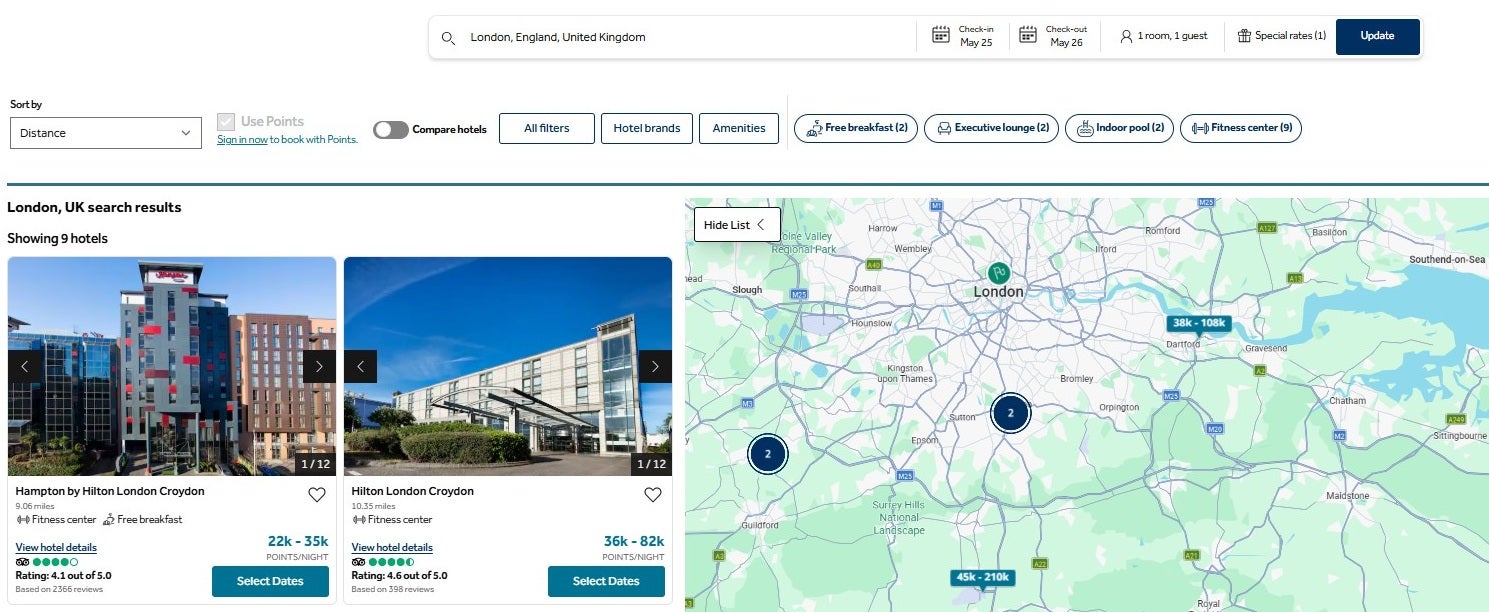
Hilton Points Explorer
HILTON

Likewise, you can see monthly award pricing for a specific property by selecting “Shop by price” instead of stay dates.

Hilton award calendar
HILTON

To get the best value when redeeming Hilton points, book an award stay for a standard room for five, 10, 15 or 20 nights. Assuming you have Hilton Silver status or higher, you’ll get every fifth night free when redeeming points for a stay of five nights or longer.
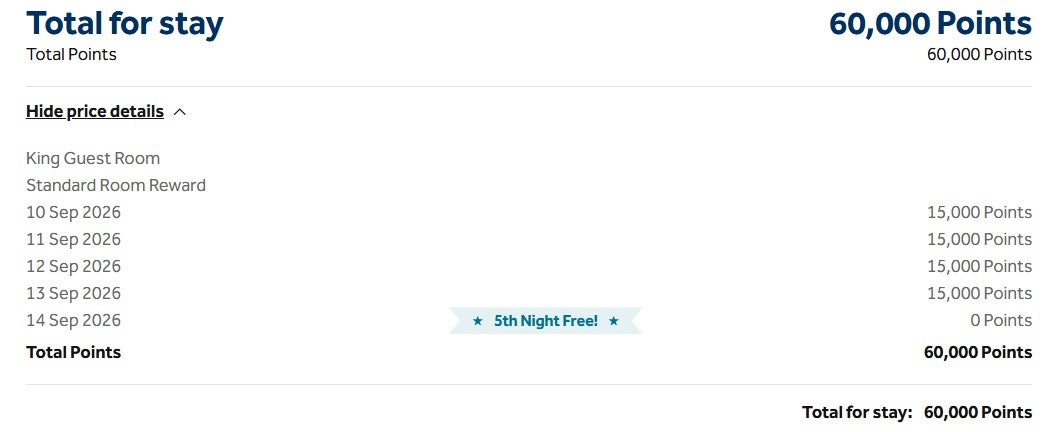
Redeem Hilton points with a fifth night free
HILTON

Check TPG’s current valuations and try to get at least our valuation of Hilton points on your redemption. Although you can redeem Hilton points for premium rooms, doing so will usually not provide good value.

Related: 6 ways to maximize Hilton Honors redemptions

Points & Money rewards

You might want to book a Points & Money reward if you run short on points. This booking method lets you redeem any combination of points and cash for a stay. For example, click through a few combinations for a stay that would otherwise cost 60,000 points or $236.

You’ll earn points on the money portion of Points & Money rewards stays at participating hotels.

Pool or transfer Hilton points

Hilton Honors is generous in allowing its members to pool and transfer points at no cost.

You can pool or transfer points in increments of 1,000 points up to 500,000. Each Hilton Honors member can send up to 500,000 points and receive up to 2 million points via combined pooling and transfer transactions each calendar year. However, each member can only make up to six transfers to other accounts and up to six points pooling transactions each calendar year.

Waldorf Astoria Costa Rica Punta Cacique. CARLY HELFAND/THE POINTS GUY

Finally, new Hilton Honors members can only pool, transfer or receive points 30 or more days after enrollment if they have account activity. Otherwise, they must wait at least 90 days after enrollment before pooling, transferring or receiving points without account activity.

Hilton Honors Experiences

Redeeming points for Hilton Honors Experiences has offered me strong value in the past. As such, I periodically check to see whether any experiences are appealing in my upcoming destinations.

Hilton Honors Experiences
HILTON HONORS

Be sure to check the paid rates, when available, before booking to determine whether redeeming points for the experience will provide good value.

Bottom line

The Hilton Honors program offers easy-to-earn status via its credit cards and ample opportunities to earn many points. However, getting good value when redeeming Hilton points can be difficult, and many elite benefits are subject to availability and vary significantly by property. As such, you may have some wonderful stays as a high-tier elite member, but you may also have some stays where elite status doesn’t provide many incremental perks.

For rates and fees of the Hilton Honors Amex, click here.
For rates and fees of the Hilton Amex Aspire, click here.
For rates and fees of the Hilton Surpass, click here.
For rates and fees of the Hilton Business Amex, click here.


Source link

Leave a Reply

Subscribe to Our Newsletter

Get our latest articles delivered straight to your inbox. No spam, we promise.

Recent Reviews


Business owners have choices in how to fund their corporations. Should they contribute cash? Property? Perhaps a promissory note?

There may be some benefit of using a promissory note. You get stock in your company without immediately parting with cash or other assets. The promissory note sits on the company’s books as a receivable, and you control when (or if) it gets paid. Ultimately, when you do this, this leads to questions about your tax basis in the stock.

This question matters when you later sell the stock. Higher basis means less taxable gain (or a deductible loss). So if you contribute a $500,000 promissory note for stock, you get a $500,000 tax basis that reduces your gain on sale of the company.

Not surprisingly, the IRS frequently challenges these transactions. The tax treatment of promissory notes exchanged for stock in controlled corporations has resulted in numerous tax disputes over the years, this is in addition to other similar contribution arrangements involving promissory notes, such as stuffing a corporation with assets before a corporate sale without issuing stock.

The recent case Alioto v. Commissioner, T.C. Memo. 2025-125 gets into this issue. The case invovles a shareholder’s promissory note and the question of what the tax basis is in the stock received from the controlled corporation.

Facts & Procedural History

Alioto incorporated, Probity, an Ohio corporation focused on transportation and logistics consulting. Alioto served as Probity’s sole director and owned all 1,000 shares of stock. By 2014, Probity was receiving program fees and commission income.

In June 2014, Alioto entered into an employment agreement with Probity (signed by his wife as Treasurer) that promised him $550,000 in compensation that was payable in a lump sum on January 31, 2018. Alioto never received this compensation.

The stock ownership then went through several transfers. These transfers are important for this case as Alito takes the position that these transfers establish his tax basis in the stock shares. Alioto transferred 501 shares to his wife for $5.01 (a penny per share) in August 2014. A week later, she transferred 376 shares back to him for the same price. The next day, she transferred the remaining 125 shares to Probity itself.

On February 3, 2015, Alioto signed a promissory note to “purchase” those 125 treasury shares from Probity for $500,000. The note required payment (with 3% annual interest) by February 5, 2018. Alioto himself valued the shares at $4,000 each. His wife signed on behalf of Probity. The note gave Alioto the right to offset the $500,000 obligation against amounts Probity owed him under the employment agreement. Alioto made no payments on the note, asserting it was offset by his unpaid salary.

Between March and November 2015, Alioto sold 298 shares of Probity stock to family members and business associates for $142,720. The sales progressed from $130 per share in March to $260 per share in May and July, and finally to $2,000 per share between August and November.

On his 2014 tax return, Alioto had reported a negative adjusted gross income for 2014 and he never filed a 2015 return to report the 2015 transactions.

The IRS audited his 2014 return and then added the 2015 year. It issued a notice of deficiency determining unreported income for both years. The IRS also examined Probity’s returns as well to ensure that the income and expenses of Alioto are properly reported.

One of the issues on the audit was the income from the transfer of the stock in 2015. During the audit, Alito argued that he held two groups of stock with different tax basis: 875 shares with $0.01 basis per share (“penny stock”) and 125 shares with $4,000 basis per share (the treasury stock acquired via the promissory note). According to Alioto, he sold 36 of the high-basis shares in 2015, which would have produced a capital loss rather than a capital gain. The IRS determined capital gain income of $142,170. Alioto petitioned the U.S. Tax Court.

Section 351 and Nonrecognition Treatment for Corporate Contributions

Section 351(a) of the tax code provides that “no gain or loss shall be recognized if property is transferred to a corporation by one or more persons solely in exchange for stock in such corporation” if immediately after the exchange those persons control the corporation. Control means ownership of at least 80% of the total combined voting power and 80% of the total number of shares of all other classes of stock. The policy behind this rule makes sense. When business owners are simply changing the form of their ownership (from direct ownership of property to indirect ownership through corporate stock), Congress decided not to impose an immediate tax.

This nonrecognition treatment extends beyond contributions of tangible property. It applies when shareholders transfer cash, equipment, real estate, patents, and yes, even promissory notes to their corporations in exchange for stock. The question isn’t whether Section 351 applies to such transactions. It almost always does when the control requirement is met. The real question is what happens to the shareholder’s basis in the property contributed.

Section 351 transactions are very common in business. A shareholder contributes property worth $100,000 (with a $60,000 basis) to their wholly-owned corporation in exchange for stock. Under Section 351(a), they recognize no gain on the contribution, even though the stock they receive is worth $100,000. But what’s their basis in that stock?

Basis Determination Under Section 358

Section 358(a)(1) answers the basis question. It provides that “the basis of the property permitted to be received under section 351 without the recognition of gain or loss shall be the same as that of the property exchanged.” This is called “substituted basis” or “exchanged basis.” The shareholder’s basis in the stock received equals their basis in the property they contributed.

This rule preserves the built-in gain (or loss) for later recognition. Using the example above, the shareholder contributed property with a $60,000 basis and $100,000 value. Under Section 358(a)(1), their stock basis is $60,000. If they later sell the stock for $100,000, they’ll recognize the $40,000 gain that was deferred when they made the contribution. The tax hasn’t been forgiven, just postponed.

The substituted basis rule applies regardless of what type of property the shareholder contributed. Real estate, equipment, inventory, intellectual property—the shareholder’s basis in the stock equals their basis in whatever they put in. This leads to a logical question: What’s a shareholder’s basis in a promissory note they create and contribute to their controlled corporation?

When Does a Promissory Note Create Basis?

The Tax Court in Alioto relied on Alderman v. Commissioner, 55 T.C. 662 (1971), for the proposition that “a taxpayer incurs no cost in making such a note and that the basis to the taxpayer is zero.” This makes intuitive sense. You’re writing an IOU to yourself (or rather, to your company that you control). You haven’t parted with anything of value. You haven’t incurred any economic cost. Therefore, you have zero basis in your own promise to pay.

Under Sections 351 and 358, this zero basis carries over to the stock received. The shareholder exchanges property (the promissory note) with zero basis for stock. Under Section 358(a)(1), the stock basis “shall be the same as that of the property exchanged”—which is zero.

This result frustrates business owners who want to create basis through paper transactions. But it reflects sound tax policy. Allowing shareholders to create basis by giving IOUs to their own controlled corporations would let them manufacture tax losses at will. They could contribute a $1 million promissory note for stock, claim $1 million of basis, immediately sell the stock, and generate a tax loss without any real economic investment or loss.

The problem gets worse in closely held corporations where the shareholder controls both sides of the transaction. There’s no arm’s-length negotiation. No real expectation of payment. No genuine economic substance. Just paper shuffling designed to create tax benefits.

The Peracchi Exception: Notes Backed by Business Risk

But what if the promissory note isn’t just paper? What if there’s genuine risk that the shareholder will have to pay? That’s the question the Ninth Circuit addressed in Peracchi v. Commissioner, 143 F.3d 487 (9th Cir. 1998) and that the court in this case distinguished in a footnote in the case.

In Peracchi, a shareholder contributed both cash and a promissory note to his corporation in exchange for stock. The Ninth Circuit held that the note could create basis equal to its face value because it was “contributed to an operating business which is subject to a non-trivial risk of bankruptcy or receivership.” The court reasoned that if the business failed, creditors could enforce the note against the shareholder personally. This created real economic risk and real economic cost.

The Peracchi exception makes economic sense. If a shareholder gives their corporation a $500,000 promissory note, and the corporation later goes bankrupt with creditors who can enforce that note, the shareholder faces genuine liability. They might actually have to pay $500,000 to satisfy creditors. That’s a real economic burden, not just paper shuffling.

The Ninth Circuit emphasized that the exception applied because the note was contributed to “an operating business” with real bankruptcy risk. This wasn’t a shell corporation or passive investment vehicle. It was an active business with operations, creditors, and the possibility of financial failure. That business risk made the promissory note meaningful.

Peracchi created a circuit split. The Ninth Circuit allows basis in promissory notes when there’s genuine business risk of enforcement. Other circuits have not adopted this exception. The Tax Court noted in Alioto that Peracchi represents the minority view. Most courts follow Alderman and hold that a shareholder’s promissory note to their controlled corporation creates zero basis, period.

For taxpayers in the Ninth Circuit (which includes California, Oregon, Washington, Alaska, Hawaii, Arizona, Nevada, Idaho, and Montana), Peracchi remains good law. Business owners in those states can potentially claim basis in promissory notes contributed to their corporations if they can show genuine business risk. But the exception is narrow and one has to document the transfers, which many taxpayers fail to do.

Why Alioto’s Note Failed the Peracchi Test

The Alioto court distinguished Peracchi on several grounds. First, and most fundamentally, Alioto retained the ability to “unilaterally extinguish his debt by offset” with the employment agreement. The promissory note required Alioto to pay Probity $500,000 (plus interest) by February 5, 2018. But his employment agreement provided that Probity owed him $550,000 on January 31, 2018—just five days earlier. The note explicitly gave Alioto the right to offset one obligation against the other.

This offset provision destroyed any claim of genuine debt. Alioto controlled both obligations. He decided whether Probity would pay him under the employment agreement. He decided whether to exercise his right to offset the note. The entire arrangement was “wholly in Mr. Alioto’s control and exceedingly unlikely” to result in any actual payment by anyone. This wasn’t a note backed by business risk. It was a circular arrangement designed to cancel itself out.

The court also found several other deficiencies that showed the note lacked economic substance. There was no payment schedule for principal or interest. Probity had “no clear source of income that might assure” it could pay the employment compensation that Alioto would then use to pay the note. The whole structure suggested that “the parties did not contemplate that the obligation would be met.”

Most tellingly, Alioto’s own testimony “suggests that the two agreements were meant to cancel each other out, with no indication that Probity planned to pay Mr. Alioto anything under the employment agreement or that Mr. Alioto planned to pay under the promissory note.” When the taxpayer himself admits the arrangements were designed to offset each other, it’s hard to argue there’s genuine debt with genuine risk.

The court applied “special scrutiny” to the transaction, as required for dealings between closely held corporations and their shareholders. The Court cited Electric & Neon, Inc. v. Commissioner, 56 T.C. 1324, 1339 (1971), for this principle. When a shareholder controls all aspects of a transaction with their corporation—deciding what the corporation pays them, what they pay the corporation, and whether to offset one against the other—courts examine such arrangements skeptically.

Even if Alioto had been in the Ninth Circuit (he wasn’t—he was in Ohio, which falls under the Sixth Circuit), he couldn’t satisfy the Peracchi exception. Peracchi requires “non-trivial risk of bankruptcy or receivership” that would force the shareholder to pay creditors on the note. Alioto had no such risk. He could unilaterally eliminate his obligation through the offset provision. No creditors could force him to pay. No bankruptcy would make him write a check. The note created no real economic burden.

The Takeaway

This case highlights the stock basis questions that come up when promissory notes are given by shareholders to their controlled corporations. This can result in zero basis in stock received, even when structured as formal transactions with interest and maturity dates. As in this case, when shareholders retain the ability to unilaterally extinguish their debt through offset provisions or other control mechanisms, courts will find the notes lack economic substance and create no basis. The Peracchi exception remains available in the Ninth Circuit for notes contributed to operating businesses with genuine bankruptcy risk, but that exception is narrow and one has to document the transaction to prove it. Business owners capitalizing their corporations must ensure that debt instruments reflect real economic obligations with realistic prospects of payment, not just paper transactions that cancel themselves out through related party agreements.

Watch Our Free On-Demand Webinar

In 40 minutes, we’ll teach you how to survive an IRS audit.

We’ll explain how the IRS conducts audits and how to manage and close the audit.  


Source link