
Hilton Honors: Complete loyalty program guide


Hilton Honors is one of the largest hotel loyalty programs, with over 9,000 participating properties across 25 brands. I appreciate that the program offers excellent opportunities to earn Hilton points, valuable cobranded credit cards and multiple pathways to secure elite status.

Although Hilton Honors isn’t my primary hotel loyalty program, I maintain Hilton elite status through a cobranded credit card and stay at Hilton properties at least quarterly to maximize my Hilton statement credit available through The Business Platinum Card® from American Express (enrollment is required; separate Hilton for Business enrollment is also required).

So, whether you stay at Hilton properties weekly or annually, here’s what you should know about the Hilton Honors program.

What is Hilton Honors?

Hilton Honors is the hotel loyalty program for Hilton hotels and resorts. It provides benefits and earnings on eligible stays at 25 Hilton brands, from full-service luxury brands like Waldorf Astoria and Conrad to select-service brands like Hilton Garden Inn and Hampton by Hilton. The Hilton Honors program also offers various ways to earn and redeem Hilton points, including many options beyond hotel stays.

Waldorf Astoria Los Cabos Pedregal in Mexico. CARLY HELFAND/THE POINTS GUY

When you book directly with Hilton, you’ll earn points and benefits based on your membership tier. For the rest of this article, I’ll assume you book through Hilton (not an online travel agency or other method) when discussing benefits and earnings.

Related: The 22 best Hilton hotels in the world

Hilton Honors membership tiers

You’ll progress up the Hilton Honors membership tiers as you stay at Hilton properties each calendar year. Once you’ve earned a specific membership tier, you’ll enjoy its benefits for the rest of the calendar year in which you earned it, as well as the entire next calendar year. You can also snag Hilton Honors elite status through a status match or as a cardmember of select American Express cards.

Hilton Honors member

Once you join the Hilton Honors program, you’ll be a member. The primary benefits of being a Hilton Honors member are:

  • Access to book the Hilton Honors discount rate
  • Waived resort fees when you pay for your stay using solely points or a promotional free night reward
  • The ability to choose your room from available rooms up to 24 hours before check-in
  • The ability to earn points on stays

Reward your inbox with the TPG Daily newsletter

Join over 700,000 readers for breaking news, in-depth guides and exclusive deals from TPG’s experts

It’s free to join the Hilton Honors program, so you might as well join now if you aren’t already a member.

Hilton Honors Silver

You’ll earn Hilton Honors Silver status after you stay four times, stay for 10 nights or spend $2,500 in a calendar year. Eligible spending includes room rates (excluding taxes) and charges billed to your room (such as spa, dining and other incidental charges) from bookings made directly with Hilton or approved channels.

Conrad Tokyo. CLINT HENDERSON/THE POINTS GUY

The primary benefits of Hilton Silver status include:

  • A 20% bonus on base points earned through stays
  • Two complimentary bottles of water per stay at select hotels
  • A fifth night free on standard reward stays of five consecutive nights or more (up to four free nights per stay, and only when you book solely with points)

You’ll also enjoy Hilton Silver status as a cardmember benefit of the Hilton Honors American Express Card.

Hilton Honors Gold

You’ll earn Hilton Honors Gold status after you stay 15 times, stay for 25 nights or spend $6,000 in a calendar year. The primary benefits of Hilton Gold status include:

  • An 80% bonus on base points earned through stays
  • A choice of a My Way on-property benefit on each stay (which may include the option to select a daily food-and-beverage credit or continental breakfast)
  • Space-available room upgrades to preferred rooms (including up to executive floor room types) at select brands and properties

You’ll also get Hilton Gold status as a cardmember benefit of the Hilton Honors American Express Surpass® Card, The Hilton Honors American Express Business Card, the American Express Platinum Card® and The Business Platinum Card from American Express (enrollment may be required). You can also earn Gold status through the end of the next calendar year if you spend $20,000 on eligible purchases on the Hilton Honors American Express Card within a calendar year.

Related: Your complete guide to breakfast benefits at Hilton Honors hotels

Hilton Honors Diamond

You’ll earn Hilton Honors™ Diamond status after you stay 25 times, stay for 50 nights or spend $11,500 in a calendar year. The primary benefits of Hilton Diamond status include:

  • A 100% bonus on base points earned through stays
  • Executive lounge access when available
  • Premium Wi-Fi access during stays at select brands
  • Space-available room upgrades to preferred rooms (including up to junior, standard or one-bedroom suites) at select brands and properties

You can also obtain Hilton Diamond status as a cardmember benefit of the Hilton Honors American Express Aspire Card. Cardmembers of the Hilton Honors American Express Surpass Card or The Hilton Honors American Express Business Card can also earn Diamond status through the end of the next calendar year if they spend $40,000 on eligible purchases on their card in a calendar year.

Room at the Hilton Niseko Village in Japan
Hilton Niseko Village in Japan. KATIE GENTER/THE POINTS GUY

You’ll secure lifetime Hilton Diamond status once you’ve earned Hilton Diamond status for 10 years (the years don’t need to be consecutive) and either stay 1,000 nights (paid and reward nights count) or spend $200,000 across your account’s lifetime.

Hilton Honors Diamond Reserve

You’ll earn Hilton Honors Diamond Reserve status after you stay 40 times or 80 nights and spend $18,000 in a calendar year. The primary benefits of Hilton Diamond Reserve status include:

  • A 120% bonus on base points earned through stays
  • 4 p.m. guaranteed late checkout
  • Premium club access, including access to the expanding collection of premium clubs
  • A confirmable upgrade reward, which lets you confirm a premium room upgrade (up to a suite) at the time of booking for a stay of up to seven nights

Related: Elite status battle: What happened when we tested Hilton’s new Diamond Reserve versus Diamond status

Hilton status match and challenge

Hilton Honors usually offers a status match and challenge to select elite members of other hotel loyalty programs. To request a Hilton Honors status match, you must submit proof of your status in another program via an online form.

If Hilton approves your request, you’ll get Hilton Gold status for 90 days. You can keep Gold status through March 31, 2028, if you stay for six nights during your 90-day trial period. Meanwhile, if you stay 12 nights within your 90-day trial period, Hilton will upgrade you to Diamond status through March 31, 2028.

Related: Complete guide to airline status matches and challenges

Milestone bonuses and status gifts

Hilton offers its members several additional benefits based on the number of eligible nights they stay each calendar year.

Once you stay 40 eligible nights in a calendar year, you’ll get 10,000 bonus points. You’ll then earn an additional 10,000 bonus points for every additional 10 eligible nights (up to 180) in a calendar year.

Plus, you’ll earn an additional 30,000 bonus points once you stay 60 eligible nights in a calendar year. And once you stay 120 eligible nights in a calendar year, you can choose a confirmable upgrade reward or 30,000 bonus points.

hotel exterior
Embassy Suites by Hilton Orlando Sunset Walk. TARAH CHIEFFI/THE POINTS GUY

If you stay 60 eligible nights in a calendar year, you can gift Hilton Gold status to another member. But if you stay 100 eligible nights in a calendar year, you can gift Hilton Diamond status to another member. However, you can only gift status to one other member per year.

How to earn Hilton points

As you interact with the Hilton Honors program, you’ll learn many ways to earn points. For a detailed discussion, I highly recommend checking out our guide on earning Hilton points, but here’s a quick overview of your options.

Hotel stays

One of the easiest ways to earn Hilton points is through hotel stays. On eligible stays, you’ll usually earn as follows on charges to your folio from up to four rooms:

  • 3 points per dollar spent at LivSmart Studios properties
  • 5 points per dollar spent at Home2 Suites, Homewood Suites, Spark, Tru and Apartment Collection properties
  • 10 points per dollar spent at other Hilton brands

Graduate Hotel Princeton guest room
Graduate by Hilton Princeton in New Jersey. ERIC ROSEN/THE POINTS GUY

Of course, as I mentioned above, you’ll earn additional bonus points on stays if you have Hilton elite status. Plus, you may earn bonus points through current Hilton promotions.

Related: 8 best Hilton all-inclusive resorts

Hilton credit cards

Hilton Amex cards are also a great way to earn points. Here’s a look at the earning rates, welcome offers and annual fees on some of our favorite Hilton credit cards.

Card Welcome offer Earning rates Annual fee

Earn 175,000 bonus points after spending $6,000 on purchases in the first six months of card membership.

  • 14 points per dollar spent on eligible purchases made directly with hotels and resorts in the Hilton portfolio
  • 7 points per dollar spent on select travel, including flights booked directly with airlines or amextravel.com and car rentals booked directly with select car rental companies
  • 7 points per dollar spent on dining at U.S. restaurants, including takeout and delivery
  • 3 points per dollar spent on other eligible purchases

Earn 130,000 bonus points after spending $3,000 on purchases in the first six months of card membership.

  • 12 points per dollar spent on eligible purchases made directly with hotels and resorts in the Hilton portfolio
  • 6 points per dollar spent on dining at U.S. restaurants, including takeout and delivery; groceries at U.S. supermarkets; and gas at U.S. gas stations
  • 4 points per dollar spent on U.S. online retail purchases
  • 3 points per dollar spent on other eligible purchases

$0 introductory annual fee for the first year, then $150 (see rates and fees)

Earn 130,000 bonus points after spending $8,000 on purchases in the first six months of card membership.

  • 12 points per dollar spent on eligible purchases made directly with hotels and resorts within the Hilton portfolio
  • 5 points per dollar spent on other eligible purchases (on the first $100,000 in purchases per calendar year, then 3 points per dollar thereafter)

$0 introductory annual fee for the first year, then $195 (see rates and fees)

Earn 100,000 bonus points and a $100 statement credit after spending $2,000 on purchases in the first six months of card membership.

  • 7 points per dollar spent on eligible purchases made directly with hotels and resorts in the Hilton portfolio
  • 5 points per dollar spent on dining at U.S. restaurants, including takeout and delivery; groceries at U.S. supermarkets; and gas at U.S. gas stations
  • 3 points per dollar spent on other eligible purchases

I have the Hilton Aspire Card and find it offers far more value than its annual fee since I maximize its benefits. Plus, earning 14 points per dollar spent on purchases at Hilton properties is unbeatable. But if you don’t maximize the annual free night reward and don’t fully use the up to $400 Hilton resort statement credit (up to $200 statement credits semiannually) each year, the Hilton Aspire may not be the right card for you.

Related: Hilton Surpass vs. Hilton Aspire: Do you want Gold or Diamond status?

Transfer rewards to Hilton

You can also earn points by transferring rewards to Hilton Honors. Specifically, you can transfer American Express Membership Rewards points to Hilton Honors at a 1:2 ratio, meaning 1,000 Amex points could become 2,000 Hilton points. You can also transfer Bilt Points to Hilton Honors at a 1:1 ratio.

You can usually get more value by transferring these points to other loyalty programs, so I wouldn’t transfer my Amex or Bilt points to Hilton Honors. But even if you plan to transfer Amex or Bilt points to Hilton, waiting until you’re ready to book your stay is usually a good idea.

Related: How (and why) you should earn transferable credit card points

Hilton partners

You can earn Hilton points when shopping or interacting with several partners. For example, you can earn points on eligible Alamo, Enterprise and National car rentals. You can also earn extra points at participating restaurants through the Hilton Honors Dining program. Additionally, you can opt in to earn Hilton points on Lyft rides.

Hilton Honors event planner program

Hilton Honors members can earn 2 points per dollar spent on guest rooms, meeting rooms and more (on up to $100,000 spent) through the Hilton Honors event planner program when holding a qualifying event at a participating Hilton property.

Buy Hilton points

Finally, you can buy Hilton points to boost your account balance. TPG’s May 2026 valuations peg the value of Hilton points at 0.4 cents per point, and during the best sales, you can buy Hilton points for around 0.5 cents each. So, you’ll usually only want to buy Hilton points when doing so lets you book a high-value redemption.

How to redeem Hilton points

Just as there are many ways to earn Hilton points, there are plenty of ways to redeem your points. Check out our guide on redeeming Hilton points for all the details, including some low-value redemption options that I won’t discuss here. Here’s an overview of the best ways to redeem Hilton points.

Free night awards

Hilton Honors doesn’t publish an award chart and uses dynamic award pricing. However, there seems to be an unpublished award pricing cap for each property. These unpublished caps have increased, and are likely to continue to increase, without notice. However, standard award nights currently top out at 250,000 points, even at the most luxurious properties.

If you want a good deal, consider using the Points Explorer tool to see point ranges at various properties over the next 30 days.
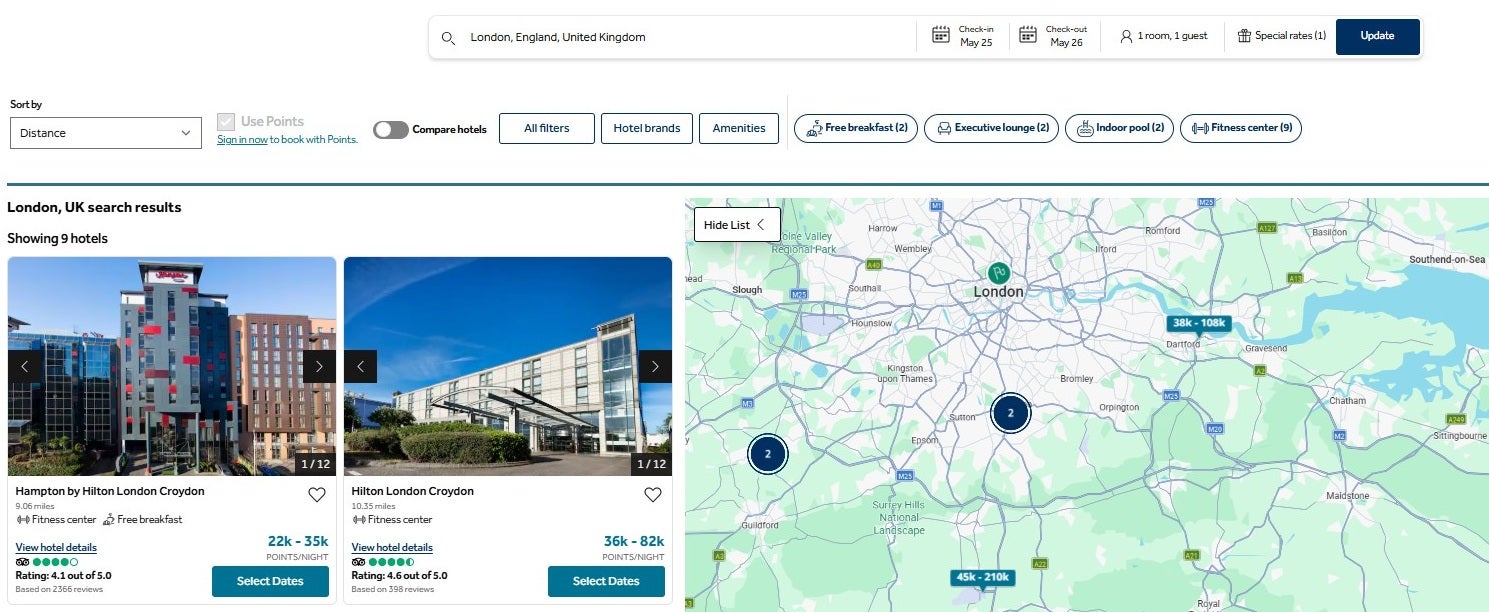
Hilton Points Explorer
HILTON

Likewise, you can see monthly award pricing for a specific property by selecting “Shop by price” instead of stay dates.

Hilton award calendar
HILTON

To get the best value when redeeming Hilton points, book an award stay for a standard room for five, 10, 15 or 20 nights. Assuming you have Hilton Silver status or higher, you’ll get every fifth night free when redeeming points for a stay of five nights or longer.
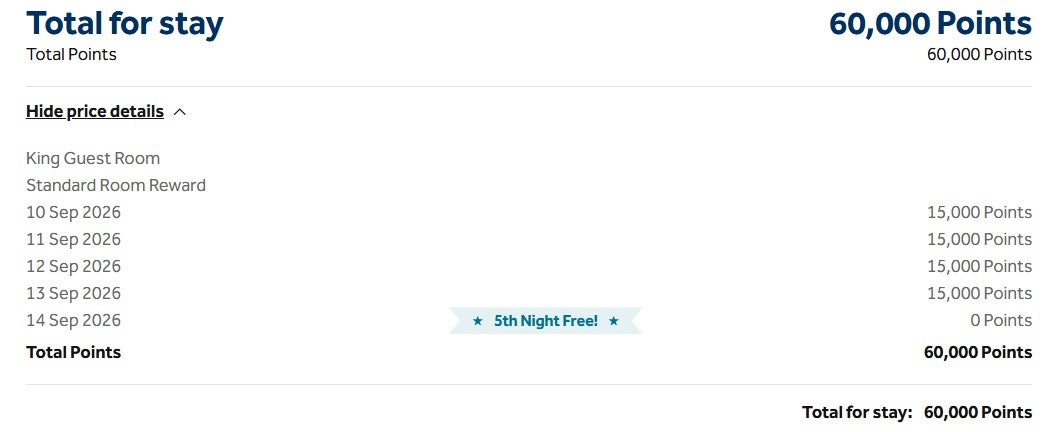
Redeem Hilton points with a fifth night free
HILTON

Check TPG’s current valuations and try to get at least our valuation of Hilton points on your redemption. Although you can redeem Hilton points for premium rooms, doing so will usually not provide good value.

Related: 6 ways to maximize Hilton Honors redemptions

Points & Money rewards

You might want to book a Points & Money reward if you run short on points. This booking method lets you redeem any combination of points and cash for a stay. For example, click through a few combinations for a stay that would otherwise cost 60,000 points or $236.

You’ll earn points on the money portion of Points & Money rewards stays at participating hotels.

Pool or transfer Hilton points

Hilton Honors is generous in allowing its members to pool and transfer points at no cost.

You can pool or transfer points in increments of 1,000 points up to 500,000. Each Hilton Honors member can send up to 500,000 points and receive up to 2 million points via combined pooling and transfer transactions each calendar year. However, each member can only make up to six transfers to other accounts and up to six points pooling transactions each calendar year.

Waldorf Astoria Costa Rica Punta Cacique. CARLY HELFAND/THE POINTS GUY

Finally, new Hilton Honors members can only pool, transfer or receive points 30 or more days after enrollment if they have account activity. Otherwise, they must wait at least 90 days after enrollment before pooling, transferring or receiving points without account activity.

Hilton Honors Experiences

Redeeming points for Hilton Honors Experiences has offered me strong value in the past. As such, I periodically check to see whether any experiences are appealing in my upcoming destinations.

Hilton Honors Experiences
HILTON HONORS

Be sure to check the paid rates, when available, before booking to determine whether redeeming points for the experience will provide good value.

Bottom line

The Hilton Honors program offers easy-to-earn status via its credit cards and ample opportunities to earn many points. However, getting good value when redeeming Hilton points can be difficult, and many elite benefits are subject to availability and vary significantly by property. As such, you may have some wonderful stays as a high-tier elite member, but you may also have some stays where elite status doesn’t provide many incremental perks.

For rates and fees of the Hilton Honors Amex, click here.
For rates and fees of the Hilton Amex Aspire, click here.
For rates and fees of the Hilton Surpass, click here.
For rates and fees of the Hilton Business Amex, click here.


Source link

Leave a Reply

Subscribe to Our Newsletter

Get our latest articles delivered straight to your inbox. No spam, we promise.

Recent Reviews


You own two businesses. They work in similar spaces, but are distinct businesses. One of them has financial troubles and gets behind on its bills. You decide to have the other business acquire the assets of the failing business.

You start thinking about taxes. You think ahead when you go to do the tax returns for the businesses, you note that the cost to acquire the assets is generally capitalized and deducted over time. You prefer an immediate tax deduction. The businesses are also in the same space, so they want to protect themselves from liability from the failing business’ creditors. Can you structure the asset acquisition whereby the business pays the debts of the failing business and lists those payments as cost of goods sold on its tax return? If so, that could be an immediate deduction.

The case of Temnorod v. Commissioner, Docket Nos. 5114-19, 13634-19, 14053-19, 14462-19, 14464-19 (T.C. Dec. 8, 2025), gets into this type of fact pattern where a buyer settles a seller’s debts as part of an asset acquisition in bankruptcy.

Facts & Procedural History

The taxpayers in this case are shareholders of an S corporation that provided telecommunications services to customers. The principal shareholders formed their own competitive carrier in 2004 as a related entity. This related carrier was wholly owned by a holding company in which the principal shareholders held significant ownership interests.

The related carrier entered into a service agreement with the S corporation’s operating subsidiary in 2008. Under this agreement, the related carrier would accept call traffic from the S corporation’s customers and route the calls to their destinations through interconnection agreements with AT&T and Verizon. Payment disputes arose because the related carrier maintained it was providing information services through internet connections, while AT&T and Verizon insisted the traffic constituted long-distance services subject to higher rates. These disputes created growing payment differentials that the related carrier never passed through to the S corporation despite having contractual rights to do so.

By early 2011, AT&T threatened service disconnection unless the related carrier immediately escrowed approximately $3 million. The related carrier filed for Chapter 11 bankruptcy protection in October 2011. AT&T submitted unsecured creditor claims totaling approximately $10.2 million, and Verizon submitted claims totaling approximately $13.9 million.

Through the bankruptcy proceedings

Through the bankruptcy proceedings, a wholly owned subsidiary of the S corporation purchased substantially all of the related carrier’s assets. The Asset Purchase Agreement provided that the buyer would pay $1.6 million to the seller and $1.6 million directly to Verizon. The agreement also specified that the seller would use some of the cash it received to pay $1.5 million to AT&T. These payments to AT&T and Verizon settled their bankruptcy claims and were conditions for assigning the related carrier’s interconnection agreements to the buyer.

On its 2012 Form 1120S

On its 2012 Form 1120S, the S corporation included $1.5 million (roughly equal to the AT&T payment) and the $1.6 million Verizon payment—totaling $3 million—as cost of goods sold. This treatment contributed to the S corporation reporting a loss of $7 million for its 2012 tax year. The shareholders reported their pro rata shares of this loss on their respective 2012 Forms 1040. Some shareholders carried portions of their losses back to their 2010 tax returns.

The IRS audited the S corporation’s 2012 return. The IRS audit resulted in the proposed disallowance of the $3.1 million in cost of goods sold. The IRS then examined each shareholder’s returns and issued Notice of Deficiency letters to each petitioner. The taxpayers petitioned The U.S. Tax Court, and the cases were consolidated for trial.

Cost of Goods Sold: What It Is and What It Isn’t

We have previously addressed cost of goods sold in various articles. This includes this article about the Texas state tax planning for COGS.

Cost of goods sold is a tax accounting concept. It is not a deduction from gross income as one normally thinks of for tax deductions, but, rather, is a subtraction from gross receipts in determining gross income. The distinction matters because it affects how a business calculates its starting point for taxable income.

Section1.61-3(a) of the regulations explains that in a manufacturing, merchandising, or mining business, gross income means total sales less the cost of goods sold, plus any income from investments and incidental operations. This reduction happens before reaching the gross income figure that appears on a tax return. Cost of goods sold thus never shows up as a deduction on the return because it already reduced the gross receipts to arrive at gross income.

Service providers operate under different rules. When a business primarily provides services rather than manufacturing, merchandising, or mining goods, the business’s gross receipts constitute gross income without any reduction for cost of goods sold. So, instead, service businesses incur deductible business expenses in providing their services.

The distinction between cost of goods sold and service bu…

The distinction between cost of goods sold and service business expenses determines timing. Cost of goods sold matches against the revenue from selling goods in the same period. Service business expenses get deducted under section 162 when paid or incurred, assuming they meet the requirements for ordinary and necessary business expenses. But neither treatment applies when costs must be capitalized under section 263.

In this case

In this case, the taxpayers acknowledged that the S corporation was in the business of providing telecommunications services, not manufacturing or selling goods. Despite this concession, they initially argued the creditor payments constituted cost of goods sold. The court quickly dispensed with this argument, noting that service providers usually cannot reduce gross receipts for cost of goods sold.

Section 162: The General Rule for Business Expense Deductions

Section 162(a) allows a deduction for “all the ordinary and necessary expenses paid or incurred during the taxable year in carrying on any trade or business.” This provision represents one of the tax code’s most important deduction rules. The deduction reduces gross income to arrive at taxable income.

The statute requires that an expense be both ordinary and necessary. “Ordinary” means the expense is normal, common, or accepted in the taxpayer’s trade or business. “Necessary” means the expense is appropriate and helpful to the business, though not indispensable. Courts have interpreted these requirements broadly, recognizing that business owners need flexibility in operating their enterprises.

Section 162 deductions provide immediate tax benefits. The taxpayer recovers the full cost of the expense in the year paid or incurred. This immediate recovery accelerates the tax benefit compared to capitalization, where the taxpayer must spread the cost recovery over multiple years through depreciation or amortization.

The timing advantage of section 162 treatment creates an incentive for taxpayers to characterize payments as deductible expenses rather than capital expenditures. A $3 million deduction today is more value than the same $3 million capitalized and amortized over fifteen years. The present value difference can be substantial, particularly for high-tax-rate taxpayers or S corporation shareholders who can use the losses to offset other income.

Section 263: The Capitalization Requirement

Section 263(a)(1) prohibits a deduction for any amount paid out for new buildings or for permanent improvements or betterments made to increase the value of any property or estate. This language, though focused on buildings and improvements, extends more broadly to many types of capital expenditures. The capitalization requirement ensures that costs creating long-term benefits get matched against the income those benefits produce over time.

The Supreme Court addressed the scope of section 263 in INDOPCO, Inc. v. Commissioner, 503 U.S. 79 (1992). The Court explained that the primary effect of characterizing a payment as either a business expense or a capital expenditure concerns timing. Business expenses are currently deductible, while a capital expenditure usually gets amortized and depreciated over the relevant asset’s life. Where no specific asset or useful life can be ascertained, the capitalized amount gets deducted upon dissolution of the enterprise.

The INDOPCO Court emphasized that the tax code endeavors to match expenses with the revenues of the taxable period to which they properly belong. This matching produces a more accurate calculation of net income for tax purposes. The opinion noted that deductions are exceptions to the norm of capitalization, not the other way around. Deductions are specifically enumerated in the statute and thus are subject to disallowance in favor of capitalization.

This priority given to capitalization stems from the prin…

This priority given to capitalization stems from the principle that income tax deductions are matters of legislative grace. Taxpayers bear the burden of proving entitlement to claimed deductions. When doubt exists about whether an amount should be deducted or capitalized, the tie goes to capitalization.

What Costs Must Be Capitalized in an Asset Acquisition?

The costs requiring capitalization in an asset acquisition extend well beyond the purchase price paid to the seller. Buyers have to capitalize various ancillary costs directly related to acquiring the assets. These additional capitalizable costs include legal fees, accounting fees, appraisal costs, brokerage commissions, and other professional fees incurred in connection with the purchase.

The general rule is that an expenditure has to be capitalized when it creates or enhances a separate and distinct asset, produces a significant future benefit, or is incurred in connection with the acquisition of a capital asset. The phrase “in connection with” means the expenditure was directly related to the acquisition.

For asset-related expenses where the origin of the expenses is in the process of acquisition itself, the courts apply a “process of acquisition test.” This test considers whether an expenditure was somehow related to an asset acquisition and whether the expenditure was directly related to that acquisition.

Assumed liabilities also require capitalization. When a buyer assumes the seller’s obligations as part of an asset purchase, those assumed liabilities increase the buyer’s basis in the acquired assets. Thus, the payment of an obligation of a preceding owner of property by the person acquiring such property—whether or not such obligation was fixed, contingent, or even known at the time the property was acquired—is not an ordinary and necessary business expense. Rather, when paid, such payment is a capital expenditure that becomes part of the cost basis of the acquired property.

This rule applies regardless of what the tax character of…

This rule applies regardless of what the tax character of the payment would have been to the prior owner. If the seller could have deducted the payment as a business expense, that fact does not allow the buyer to deduct it. The buyer must still capitalize the payment because it relates to acquiring assets.

The Priority of Capitalization Over Deduction

Section 161 provides that in computing taxable income, there shall be allowed as deductions the items specified in Part VI of Subchapter B of Chapter 1, which includes section 162, subject to the exceptions provided in Part IX, which includes section 263. Coordinately, section 261 provides that in computing taxable income no deduction shall in any case be allowed for the items specified in Part IX.

The Supreme Court interpreted these priority-ordering directives in Commissioner v. Idaho Power Co., 418 U.S. 1, 17 (1974). The Court held that an expenditure incurred in acquiring capital assets must be capitalized even when the expenditure otherwise might be deemed deductible under Part VI. The case involved equipment depreciation incurred during construction of capital facilities. Even though section 167(a) allowed a deduction for depreciation, section 263(a)(1) required capitalization because the depreciation related to constructing capital assets.

This priority rule means that when a payment falls under both a deduction provision and a capitalization provision, capitalization wins. The taxpayer cannot avoid capitalization by pointing to some aspect of the payment that would support deduction treatment. If the payment meets the requirements for capitalization, that determination controls.

A priority rule allows taxpayers to choose between deduction and capitalization based on which characterization saves more tax would undermine the matching principle, in theory. It would let taxpayers accelerate deductions for costs that produce long-term benefits. The government would collect less revenue in early years while the taxpayer enjoys those benefits.

This opens the door for tax planning as creative structur…

This opens the door for tax planning as creative structuring is needed to transform capitalizable costs into deductible expenses. This sets up the dispute, as it opens the door for the IRS to argue about the substance of the transaction and how that controls over its form.

When Are Debt Settlements “Directly Related” to Asset Acquisitions?

This brings us back to this case. The U.S. Tax Court’s analysis focused on whether the payments to AT&T and Verizon were “directly related” to the acquisition. This question determined whether the payments had to be capitalized even if they might otherwise qualify as deductible business expenses.

The taxpayers’ theory rested on dual purposes for the payments. They acknowledged that the buyer purchased the seller’s assets. But they argued that $3.1 million of the total purchase consideration served a different purpose—settling potential claims that AT&T and Verizon might have brought directly against the buyer’s corporate group. Under this theory, the payments forestalled two threats. First, AT&T and Verizon might have sued to hold the buyer liable for the seller’s debts under successor liability or other theories. Second, the creditors might have pushed to convert the seller’s Chapter 11 bankruptcy into a Chapter 7 liquidation, in which case a trustee might have pursued the seller’s contractual rights to collect the payment deltas from the buyer.

The taxpayers argued these potential liabilities made the $3.1 million payments defensive rather than acquisitive. The payments bought peace from creditors who threatened the buyer’s business operations. Without the bankruptcy settlement, AT&T and Verizon might have terminated the interconnection agreements that the buyer needed for its telecommunications services. The taxpayers characterized these as payments to protect existing business operations under section 162, not payments to acquire new assets under section 263.

This argument had surface appeal

This argument had surface appeal. The buyer did face real exposure. The service agreement between the entities gave the seller the right to pass through charges from AT&T and Verizon to the buyer. The seller had never exercised this right during the years when the payment differentials accumulated. But in bankruptcy, a trustee might have pursued these contract rights to generate cash for creditors. AT&T and Verizon might also have claimed that the buyer bore some direct liability for the disputed charges.

The IRS countered by pointing to the Asset Purchase Agreement’s express terms. The agreement stated that the purchase price consisted of three components: the cash purchase price, the assumed liabilities (including the Verizon payment), and the buyer’s waiver of its unsecured claims against the seller. The agreement defined “Assumed Liabilities” to include the Verizon payment. Another section listed the Verizon payment among the liabilities that the buyer would assume as part of the purchase.

The court assumed for argument’s sake that the payments resolved the buyer’s potential liabilities to AT&T and Verizon. Standing alone, such payments might qualify as ordinary and necessary business expenses under section 162.

But the payments did not stand alone. They occurred as part of the buyer’s purchase of the seller’s assets. The payments were conditions of that purchase. They settled obligations that the seller owed to its creditors. The settlement enabled the buyer to take assignment of the seller’s interconnection agreements, which were valuable assets that the buyer needed for its telecommunications business.

The court invoked the priority rule from sections 161 and…

The court invoked the priority rule from sections 161 and 261. When a payment falls under both a deduction provision and a capitalization provision, the capitalization provision prevails. Idaho Power established this principle clearly. An expenditure incurred in acquiring capital assets must be capitalized even when the expenditure otherwise might be deemed deductible.

The Takeaway

This case has significant implications for structuring business acquisitions. It shows that buyers cannot avoid capitalization by identifying defensive or protective purposes for payments that relate to acquiring assets. The directly-related test asks whether the payment connects to the acquisition, not whether the payment also serves other business purposes. Multiple motivations do not create an exception to capitalization requirements.

To avoid this result, one might structure separate transactions that are truly independent. For example, if a buyer first settles potential claims with the seller’s creditors through a standalone settlement agreement, then later purchases the seller’s assets in an unrelated transaction, perhaps the settlement payments could be deducted under section 162. But such structuring invites scrutiny under step transaction and substance-over-form doctrines, as noted in this case.

Watch Our Free On-Demand Webinar

In 40 minutes, we’ll teach you how to survive an IRS audit.

We’ll explain how the IRS conducts audits and how to manage and close the audit.  


Source link