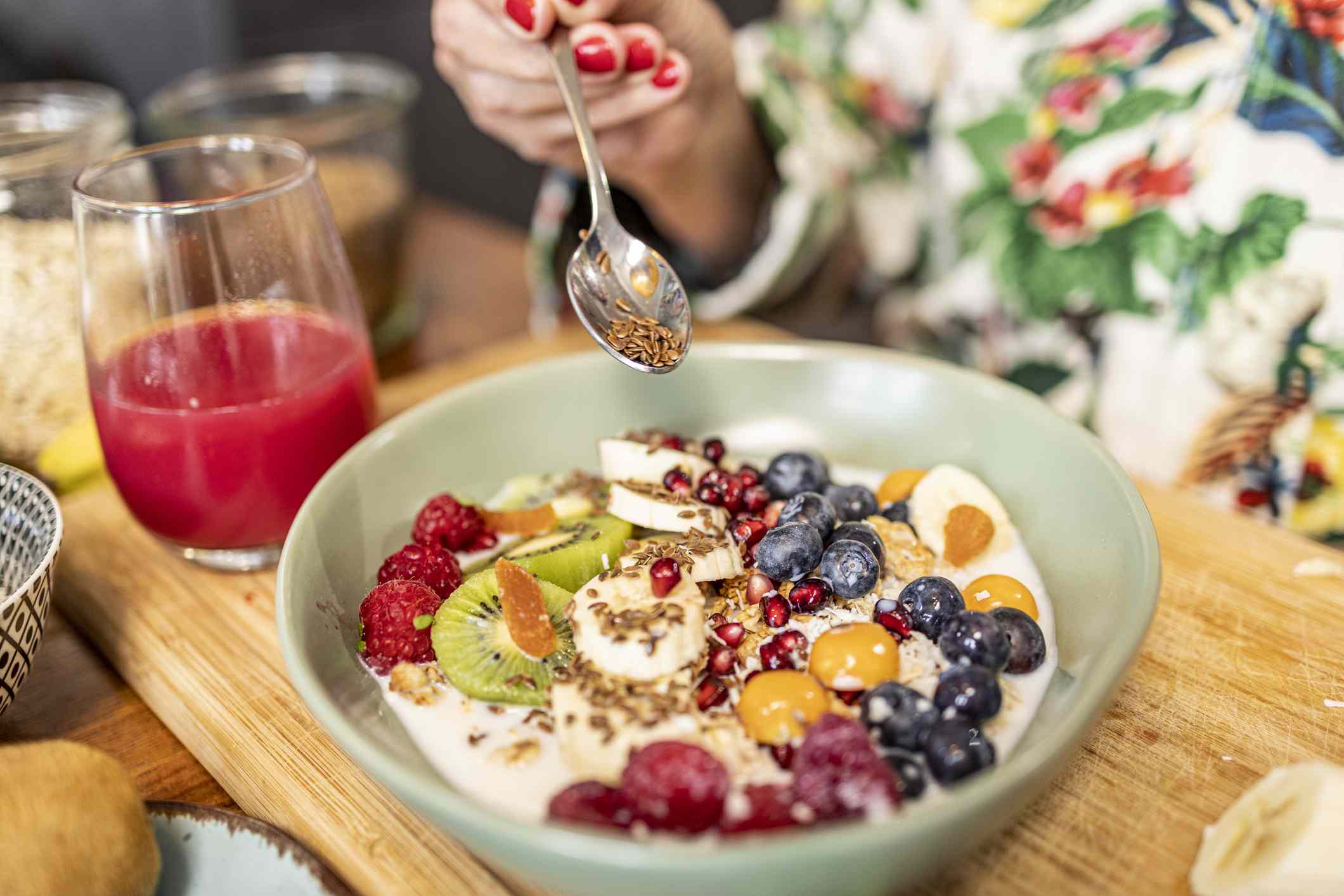
Some foods like spinach, chia seeds, and peanut butter, are naturally high in magnesium. Credit: EMS-FORSTER-PRODUCTIONS / Getty Images
Magnesium supports sleep, muscle recovery, energy, and stress, and many people can meet their needs through food.
Foods like seeds, beans, leafy greens, and even dark chocolate are naturally rich sources.
Experts say eating a varied, whole-foods diet is the easiest way to boost magnesium without relying on supplements.
Magnesium is an important mineral that supports better sleep, energy production, muscle recovery, and stress management. It is also essential for muscle and nerve production, bone health, brain health, and blood sugar regulation. Eating a nutritious, whole-foods diet will naturally support your daily magnesium intake. To help you get on the right path, here are 10 of the best magnesium-rich foods recommended by nutrition experts.
1. Pumpkin Seeds
Credit: Johner Images / Getty Images
Magnesium content per standard serving: Roasted pumpkin seeds contain 156 milligrams (mg) of magnesium per 1-ounce serving.
Health benefits: Pumpkin seeds are rich in magnesium and beneficial for supporting a healthy immune system.
How to eat it: To reap the nutritional benefits of pumpkin seeds, sprinkle them over salads and yogurts or add them to smoothies.
2. Spinach
Credit: MSPhotographic / Getty Images
Magnesium content per standard serving: Boiled spinach has 78 mg of magnesium per half-cup serving. Raw spinach has about 23 mg per cup.
Health benefits: Spinach is a great source of magnesium, a mineral that helps regulate the heartbeat, keeping it at a steady pace.
How to eat it: Use spinach as a leafy base for salads, add some to sandwiches or smoothies, or sauté spinach with garlic and olive oil.
3. Almonds
Credit: Tanja Ivanova / Getty Images
Magnesium content per standard serving: Dry-roasted almonds contain 80 mg of magnesium per 1-ounce serving.
Health benefits: Almonds are a good source of magnesium, which is beneficial for regulating sleep and improving sleep quality and duration.
How to eat it: “Try tossing almonds or pumpkin seeds into salads or yogurt,” Grace Derocha, RDN, CDCES, a spokesperson for the Academy of Nutrition and Dietetics, told Health.
4. Black Beans
Credit: Krit of Studio OMG / Getty Images
Magnesium content per standard serving: Cooked black beans contain 60 mg of magnesium per half-cup serving.
Health benefits: Black beans offer an ample source of magnesium, which is beneficial for stress management. While magnesium deficiency has been linked to an increased risk of stress disorders, studies show that stress itself can lead to decreased magnesium levels.
How to eat it: “Try using beans in grain bowls or soups, or as part of an omelette,” said Derocha.
5. Soymilk
Credit: manusapon kasosod / Getty Images
Magnesium content per standard serving: Plain soymilk has 61 mg of magnesium per 1-cup serving.
Health benefits: Soymilk and soy-based foods are high in magnesium, which is helpful for bone formation and bone health. Although further study is needed to explain whether magnesium can help prevent and manage osteoporosis, studies have found a positive association between enough magnesium consumption and bone mineral density.
How to eat it: Antonella V. Schwarz, PhD, LAT, ATC, CSCS, CISSN, assistant professor of Exercise Science at Barry University, recommends pairing soymilk with whole-grain cereal, which is another good source of magnesium.
6. Avocado
Credit: Kate Wieser / Getty Image
Magnesium content per standard serving: Avocado has 22 mg of magnesium per half-cup serving.
Health benefits: Magnesium, found in foods such as avocados, contributes to energy production within your body.
How to eat it: “You could start your morning with avocado on whole-grain toast,” said Schwarz.
7. Peanuts and Peanut Butter
Credit: Helen Camacaro / Getty Images
Magnesium content per standard serving: Peanuts have 48 mg of magnesium per 1-ounce serving. Peanut butter has 49 mg of magnesium per 2-tablespoon serving
Health benefits: Peanuts and peanut butter are both great sources of magnesium, which helps regulate blood sugar levels. Maintaining healthy blood sugar levels is important for curbing cravings and preventing chronic diseases such as type 2 diabetes.
How to eat it: “You can make a shake with ingredients such as peanut butter, plant-based milk or yogurt, banana, and berries, and have a very magnesium-rich shake,” Dana Ellis Hunnes, PhD, MPH, RD, a senior clinical dietitian at UCLA Health, told Health.
8. Banana
Credit: Luc TEBOUL / Getty Images
Magnesium content per standard serving: One medium banana contains 32 mg of magnesium per serving.
Health benefits: Bananas are a good source of magnesium and potassium, which support normal muscle and nerve function.
How to eat it: Enjoy on its own or add slices of banana to oatmeal or yogurt.
9. Dark Chocolate
Credit: Marilena Ghezzo / Getty Images
Magnesium content per standard serving: Dark chocolate (70 to 85% cacao solids) has 65 mg of magnesium per 1-ounce serving.
One important detail: Backpacks are actually banned at the stadiums.
FIFA’s Stadium Code of Conduct prohibits backpacks of any size or material at all 16 host venues. Clear backpacks, small backpacks, hip packs that might be interpreted as backpacks – if security considers it a backpack, it stays outside. Most stadium security lines exceed 30–60 minutes pre-match – not the best moment to discover your bag isn’t compliant.
But there’s so much more to the World Cup 2026 experience – fan festivals, city exploration, dining, shopping–that are best done with the right bag. Not to mention traveling to and from the host cities.
Whether you’re navigating multiple flights, visiting several countries, or just exploring the host cities, finding the best travel backpacks for World Cup 2026 can be a challenge.
Understanding the World Cup Backpack Split
Every World Cup traveler needs to think in two bags:
The Travel Backpack – Your airport bag, transit bag, city day bag, and between-match carry. This is where everything lives: laptop, camera, layers, water bottle, snacks, chargers, packing cubes. Goes on the plane, goes to the city, stays at the hotel on match day.
The Clear Stadium Bag – Your 12″ x 6″ x 12″ compliant clear bag for match day. Phone, wallet, keys, portable charger, sunscreen. This goes to the stadium. The travel backpack does not.
This guide focuses on the travel bag to maximize your World Cup experience outside of the stadium.
The Cotopaxi Allpa is the most consistently top-rated carry-on travel backpack. The clamshell opening makes it genuinely easy to find what you’re looking for without repacking everything.
Both sides of the main compartment have mesh pockets that keep items in place. A padded hip belt handles heavier loads and removes if you prefer clean carry. Lockable zippers add security. Made with recycled materials.
At 35L it hits the carry-on sweet spot – big enough for a 7-10 day trip, small enough to fit in overhead bins internationally. The 42L version exists for longer trips. For most World Cup travelers, 35L handles a full tournament.
Who it’s for: Most World Cup travelers who want a reliable, well-organized carry-on that handles airport transit, city days, and everything between matches.
If you’re doing the World Cup out of a single backpack, no checked luggage, no rollaboard, the Osprey Farpoint 40 is the right call. The LightWire frame, load lifters, and padded hip belt create a suspension system borrowed from backpacking packs – meaning 25+ pounds feels manageable across a full transit day.
The shoulder straps and back panel stow cleanly behind a panel for airport check-in. At 40L it’s larger than the Cotopaxi but still carry-on compliant at most international airlines when not over-packed.
The Farpoint rewards disciplined packers. Add packing cubes and it becomes a highly organized system. Without them, it’s a big open space.
Who it’s for: One-bag travelers, fans doing 3+ host cities who want to avoid checked luggage entirely.
The Black Hole Mini MLC packs Patagonia’s legendary durability into a 30L travel pack with three carry options – backpack, over-the-shoulder, or briefcase. The recycled polyester ripstop exterior with TPU film handles rain without flinching.
For World Cup city days – exploring Miami’s Wynwood, Mexico City’s historic center, Vancouver’s waterfront – it’s the right size and the right material. Not bulky enough for a full multi-week trip, but perfect as a dedicated city day bag if you’re traveling with a separate larger pack or suitcase.
Who it’s for: Fans who have a primary piece of luggage (roller or large travel backpack) and want a dedicated city day pack for exploring between matches.
The Peak Design Travel Backpack is the most intelligently organized travel backpack available. The dividers create a fully customizable interior – switch between clothing layout and camera cube configuration without removing anything. The top closure expands and compresses without a secondary zipper.
Shoulder straps and hip belt stow completely for checked travel. Multiple independent testers named it their all-time favorite. At $300 it’s the most expensive World Cup travel backpacks on this list – and the most capable.
For World Cup content creators traveling with camera gear, the Peak Design handles the Sony FX3/FX30 plus lenses plus laptop plus clothing in one carry-on-compliant bag. The filet-style main compartment opening is slightly awkward for on-the-go access, but for organized packing and air travel, nothing matches it.
Who it’s for: Content creators, photographers, fans traveling with cameras, anyone who wants the best-organized travel backpack available and doesn’t mind the premium price.
Osprey’s Daylite Carry-On delivers the core features of travel backpacks twice its price: laptop sleeve, dedicated organization pockets, compression straps, durable materials, and a lightweight build that won’t count against your carry-on weight allowance.
It works as a personal item under the seat on many flights, fitting a full weekend’s worth of gear. For budget-conscious World Cup fans attending one or two matches in a single city, this handles everything without the premium spend.
Who it’s for: Budget-conscious fans, single-city attendees, travelers who want a quality Osprey without the full price tag.
Stuffs into its own internal pocket. Packs down to roughly the size of a water bottle. 100% recycled nylon. When you arrive in Guadalajara with your main travel backpack and need a light bag for exploring the city before the match – this is what you pull out. 27L when unfurled.
A zippered exterior pocket handles everything you need through security. Not a serious load-carrier, but for day-trip city exploring with a jacket, water bottle, and a few snacks, it’s unbeatable at this price.
Who it’s for: Fans who want a dedicated packable daypack that disappears inside their main luggage and deploys for city days.
The Pacsafe Venturesafe has the best anti-theft features of any travel backpack tested – integrated lock system, slash-resistant panels, lockable zippers, and RFID-blocking pockets.
For fans attending matches in Guadalajara, Mexico City, or Monterrey, where city-center exploration involves crowded markets, historic districts, and transit systems, these features provide meaningful peace of mind.
The harness is well-padded for comfortable day carries. Not the flashiest bag, but for travel in environments where security is a genuine consideration, nothing on this list beats it.
Who it’s for: Fans attending Mexican host city matches who’ll be exploring busy city centers and want anti-theft protection beyond a zip.
The World Cup 2026 Backpack System
This is how to use your travel backpack across the full World Cup trip:
Travel days (flights, trains, rideshare): Main travel backpack carries everything. Laptop accessible for security. Packing cubes keep clothing organized for rapid repacking between cities. Your clear stadium bag is inside – ready to be pulled out on match day.
City days between matches: Swap your main travel backpack for the packable daypack (or use the travel backpack if you need more capacity). Water bottle, jacket, camera, snacks. Explore the city. Leave the heavier gear at the hotel.
Match day: Travel backpack stays at the hotel. Clear stadium bag comes out. Phone, wallet, keys, portable charger, sunscreen, and anything else that fits in 12″ x 6″ x 12″. This is the only bag that goes to the stadium.
Post-match night: Clear stadium bag or a small crossbody for evening. Backpack stays at the hotel.
Carry-On Size: What You Need to Know
The international carry-on standard is 22″ x 14″ x 9″ including all straps and handles. For international flights on non-US carriers (Air Canada, Aeromexico, European connections), limits can be stricter – 21″ x 15″ x 9″ or smaller, plus weight limits of 7–10kg.
All the backpacks in this guide are carry-on compliant at US domestic standard. The Cotopaxi Allpa, Osprey Farpoint, and Osprey Daylite have been specifically tested for international compliance. The Peak Design 45L is borderline on international carriers when fully packed – compress it before boarding.
Never expand a travel backpack beyond its base dimensions at the gate! Compression straps cinched, profile as slim as possible. Gate agents at international airports are stricter than domestic.
Biggest Backpack Mistakes at World Cup 2026
Bringing your backpack to the stadium – FIFA’s clear bag policy bans backpacks at ALL 16 venues. Clear backpacks are also banned. If you arrive at the stadium gate with a backpack, you’re not getting in with it. Leave it at the hotel on match day.
Buying a backpack that doesn’t meet international carry-on specs – Several popular travel backpacks marketed as “carry-on” fail strict international airline size checks. Verify dimensions against your specific carrier – especially for flights on Air Canada or Aeromexico to Canadian and Mexican host cities.
Packing without packing cubes – Multi-city World Cup travel involves repacking frequently – often late at night before early flights. Packing cubes mean you’re lifting and transferring blocks of clothing, not repacking individual items at midnight. Buy them before you travel.
Using the travel backpack as your city day bag every day – A 40L backpack for a city day walk is more than you need and draws unnecessary attention in crowded markets and transit systems. The packable daypack option ($89) solves this – it lives inside your main bag and deploys when you need it.
Forgetting the two-bag system – Travel backpack + clear stadium bag. Both serve different purposes. The travel backpack doesn’t go to the stadium. The clear bag doesn’t need to carry everything you own. Understand the difference before you pack.
Conclusion
Your World Cup travel backpack is your lifeline. You’ll carry this bag through airports, cities, and borders. And although it won’t go to the match, it makes everything around the match work. From size-approved carry-on bags during air travel to daypacks while exploring on-the-ground, these are the best options for bringing everything you need.
Choose it well. Pack it smart. And don’t forget: leave it at the hotel on match day.
No. FIFA’s Stadium Code of Conduct prohibits backpacks of any size or material at all 16 host venues. This includes clear backpacks. Leave your backpack at the hotel on match day and use your compliant clear stadium bag.
What size backpack fits international airline carry-on requirements?
The US standard is 22″ x 14″ x 9″. International carriers (Air Canada, Aeromexico) may enforce 21″ x 15″ x 9″ or smaller, with weight limits of 7–10kg. All bags in this guide are compliant at US standard – verify with your specific carrier for international legs.
Do I need packing cubes?
For multi-city World Cup travel – yes, strongly recommended. Packing cubes make repacking between cities significantly faster and more organized. For single-city trips, they’re helpful but optional.
What’s the best backpack for content creators at the World Cup?
The Peak Design Travel Backpack 45L. The FlexFold divider system handles camera gear and clothing in one carry-on-compliant bag better than anything else tested. The Cotopaxi Allpa is an alternative option if the price is a concern.
Can I use a travel backpack instead of a rolling suitcase for the whole trip?
Yes – and many World Cup fans prefer it for increased mobility while navigating between host cities. A 35–40L travel backpack moves faster through airports, transit, and crowded post-match corridors than a rolling bag. The trade-off is comfort on long carry days. The Osprey Farpoint 40 handles this better than most at the price.
As a Manchester City fan, he made it his mission to catch matches at legendary stadiums from Camp Nou to the Etihad. But Nick’s travels go beyond football. He’s explored 20+ countries across Europe, Africa, and the Caribbean, always chasing authentic experiences over tourist traps. Nick lives by a simple rule: the best stories come from saying yes to the unexpected. And TravelFreak is his biggest yes yet.
To provide the best experiences, we use technologies like cookies to store and/or access device information. Consenting to these technologies will allow us to process data such as browsing behavior or unique IDs on this site. Not consenting or withdrawing consent, may adversely affect certain features and functions.
Functional
Always active
The technical storage or access is strictly necessary for the legitimate purpose of enabling the use of a specific service explicitly requested by the subscriber or user, or for the sole purpose of carrying out the transmission of a communication over an electronic communications network.
Preferences
The technical storage or access is necessary for the legitimate purpose of storing preferences that are not requested by the subscriber or user.
Statistics
The technical storage or access that is used exclusively for statistical purposes.The technical storage or access that is used exclusively for anonymous statistical purposes. Without a subpoena, voluntary compliance on the part of your Internet Service Provider, or additional records from a third party, information stored or retrieved for this purpose alone cannot usually be used to identify you.
Marketing
The technical storage or access is required to create user profiles to send advertising, or to track the user on a website or across several websites for similar marketing purposes.

:max_bytes(150000):strip_icc():format(jpeg)/Health-GettyImages-DietitiansRecommendMagnesiumFoods-30ec0ed838f64a74b7d4ad4cae26dcf7.jpg "Healthy breakfast plate with yogurt and fruits")