Early voting starts Friday. What do you need to know?


Election Day

Early voting for the 2026 primary election starts Friday and election officials are expecting a spike in turnout.

While Minnesota has famously high turnout in general elections, primaries always have fewer voters. Still, turnout increases “where there’s a lot of action and competitiveness on the ballot,” said Minnesota Secretary of State Steve Simon. “And we certainly have that this year.”

The last time Minnesota had an open governor’s race was 2018. That year, turnout in the general election was about 64 percent of eligible voters and 23 percent in the primary, which featured competitive nominating contests in both parties.

After both major parties largely failed to unite around candidates during their endorsing conventions last month, multiple high-profile races are set to have competitive primaries this summer.

The primary election is Tuesday, Aug. 11, but before then voters can vote early by mail or in person.

What’s on the ballot?

The primary ballot has candidates for both partisan and nonpartisan races. For example, the gubernatorial race is partisan so candidates declare a party affiliation. Other offices like county commissioner or county attorney are nonpartisan.

Check out example ballots for the general election and the primary here.

There is a seven-candidate race to determine the Republican nominee for governor. The top three contenders are:

  • Former healthcare executive Kendall Qualls, who won the party convention endorsement

  • Minnesota House Speaker Lisa Demuth

  • My Pillow CEO Mike Lindell

The DFL also has seven candidates in its gubernatorial primary. Among them:

  • U.S. Sen. Amy Klobuchar, who has the DFL endorsement and is the heavy favorite

  • Former Capitol staffer Kobey Layne, the sole convention challenger to Klobuchar

One of Minnesota’s two U.S. Senate seats is up for election because Sen. Tina Smith is retiring. Both parties have a crowded field of candidates — six DFLers and nine Republicans.

The top two Democrats are:

  • Lt. Gov. Peggy Flanagan, who won the party endorsement

  • U.S. Rep. Angie Craig

The top three Republicans are:

  • Former Navy SEAL Adam Schwarze, who won the party endorsement

  • Former professional basketball player Royce White

  • Former sports broadcaster Michele Tafoya

Are there races that won’t be on all ballots?

Yes. Candidates for local offices, the Minnesota Legislature and the U.S. House will be on the ballots of voters only in their districts or jurisdictions.

Every congressional district has a primary race in one party or the other — or both. But the most competitive is in Minnesota’s 2nd Congressional District, an open seat. Six DFLers are competing to face state Sen. Eric Pratt, R-Prior Lake, in November.

The top three DFL contenders are:

  • Former Lakeville mayor and former state Sen. Matt Little, who won the DFL endorsement

  • Physician and state Sen. Matt Klein

  • Flight attendant and state Rep. Kaela Berg

The entire Minnesota Legislature is up for reelection. Sixteen state Senate races feature primaries, including some involving incumbents. There are 20 state House primaries.

Do I need to declare a party to vote in the primary?

No. In open primary states like Minnesota, voters don’t need to affiliate with a political party and they can vote in any primary. However, in partisan races Minnesota voters have to vote for candidates of only one party so they can’t hopscotch between party candidates in different races.

How do I vote early? Absentee vs. new ‘early voting’

Forty six days before an election Minnesota voters can start voting absentee, which this year means voting starts Friday for the primary. Voting absentee means you mark your ballot and place it into an envelope for it to be verified by a ballot board and counted later. You can request an absentee ballot be mailed to you and then you can mail it back or submit it in person. You can also go to an absentee voting location, fill out an absentee ballot application and submit your ballot then and there.

New this year, voters can participate in what the state calls “early voting” — though it starts later than absentee voting — up to 18 days before the election. That’s when you go to a polling location, mark your ballot and then place your completed ballot directly into a tabulator machine.

Steve Simon poses in his temporary office
Minnesota Secretary of State Steve Simon poses in his temporary office in the Veterans Service Building on June 10.
Cait Kelley | MPR News

“I think it will be quite popular and that voters will really like it, because it's more like the election day or game day experience,” Simon said.

Absentee ballots can be verified and processed before election day, but the actual counting of votes for each candidate happens after polls close Aug. 11.

When are mail-in ballots due?

Most absentee ballots must be returned to the correct elections office or ballot drop box by 5 p.m. on election day. However, qualified agents delivering marked ballots on behalf of nursing home residents, hospital patients and others in need of assistance have until 8 p.m.

In Minnesota, what matters is the ballot being physically received by that deadline, not when it was postmarked.

Do I need an excuse to vote early?

No, Minnesota is part of the majority of states that has no-excuse absentee voting.

Michelle Blue, the director of elections for Dakota County, said people have many reasons for voting early. Some voters have mobility challenges that make voting by mail more accessible. Others may work long hours and can’t make it to the polls on election day. And “a lot of people just prefer the convenience,” Blue said.

Whatever your reason, you don’t have to justify why you want to vote absentee to the state.
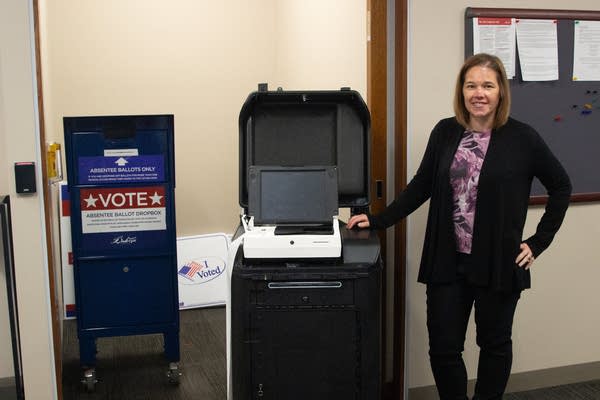
A woman stands next to a voting machine.
Michelle Blue, the director of elections for Dakota County, presents an absentee ballot box and a brand-new tabulator machine for counting votes at the Dakota County Administration Center June 8.
Cait Kelly | MPR News

What is an election judge and can I be one?

Election judges are volunteers or temporary paid employees who are required to oversee certain aspects of elections to make sure the law is being followed. Election judges are party balanced to make sure election oversight is fair.

“Our elections would not work without them,” Blue said. “Please come see the process up close and personal for yourself.”

To be an election judge you must be eligible to vote in Minnesota and must be able to read, write and speak English.


Source link

Leave a Reply

Subscribe to Our Newsletter

Get our latest articles delivered straight to your inbox. No spam, we promise.

Recent Reviews


What is Web 3.0 – Table of Content

In this article, you will learn about what Web 3.0 is and its various aspects.

What is Web 3.0?

Web 3.0 or Web3 is the next generation of the internet which is new, improved, and based on blockchain technologies. It will also use the technologies like AI, ML, and DLT that make it more powerful. Web 3.0 is the latest phase of Internet evolution, which is fully based on developing a free ecosystem where there will be no single authority. It will change the internet world by leveraging the power of ML, AI, and emerging technologies like blockchain. The use of blockchain technology will change the way we use the internet now.

Further, Web 3.0 is also considered the third generation in the evolution of the internet, marked by decentralization and AI. Web3 allows users to connect in private or public securely. It ensures that no personal data will be exposed to third parties, which can endanger them. So, it offers easy participation without any authority.

Why is Web 3.0 important?

Web 3.0 is a budding technology in its development stage, but it is essential for businesses. It streamlines the operations of businesses by eliminating intermediaries. Web3 connects computers and users directly. Moreover, Web 3.0 applies to environments like Metaverse, Blockchain-based gaming, DeFi, etc. Further, Web 3.0 uses ML, AI, NLP, and Blockchain tech stack to offer users smart apps.

Web3 offers many opportunities to users that help to customize many web products and services based on their needs. It will help companies to maintain a better balance between their privacy and realization. Also, it offers a great framework to Metaverse, a virtual 3D world that allows developing “avatars,” digital portraits of people, to interact and develop business virtually. It is not present now but will likely exist, relying on Blockchain technology.

This way, Web 3.0 will develop the latest features and change the internet’s future.

Wish to make a career in the world of Digital Marketing Start with Digital Marketing training !

Digital Marketing Certification Training

  • Master Your Craft
  • Lifetime LMS & Faculty Access
  • 24/7 online expert support
  • Real-world & Project Based Learning

Features of Web 3.0

The following are the potential features that Web 3.0 gives the understanding of the next-gen internet.

Decentralization

The earlier generations of the web were completely centralized regarding applications and management. But Web3 is completely decentralized as there is no authority to manage it. It will deliver applications and services based distributed system.

Blockchain Technology

Blockchain plays a great role in Web 3.0. It enables distributed services and apps where data is distributed across the web through peer-to-peer networks. Moreover, it allows an immutable ledger through which transaction processing becomes highly secure and safe. Also, it develops trust over blockchain users through verification.

Become a Blockchain Certified professional by learning this HKR Blockchain Training !

Machine Learning and AI

Web 3.0 will also use ML and AI technologies that imitate human intelligence using data and algorithms. It will learn from the past and data and improve itself. Further, in the Web 3.0 world, computer devices can follow information like humans using technologies like the Semantic Web and NLP (natural language processing). Hence, these capabilities of computers will allow them to generate results much faster and more relevantly. It will be helpful in the areas of medical and other latest materials.

Want to Become a Master in Machine Learning? Then visit here to Learn Machine Learning Training !

Ubiquity

Through Web 3.0, the availability of information and content will be ubiquitous, and it wil be more connected. With the growing number of connected devices, it will be accessible by multiple devices.

Automation

Web 3.0 follows AI-powered automation features. It allows websites equipped with AI to filter the required data and present it to the individual users who need it. Thus, it will present the required data in a limited time.

Generals, what-is-web-3-0-description-0, Generals, what-is-web-3-0-description-1

Subscribe to our YouTube channel to get new updates..!

Advantages and Disadvantages of using Web 3.0

There are some pros and cons of using Web 3.0. The following are some advantages and disadvantages of Web3.

Advantages

  • The end-users will get great control and privacy over their data. Web 3.0 will ensure data security through data encryption.
  • Users can access data on any device from any location in the world with an internet facility.
  • Web 3.0 enables better transparency with greater visibility into transactions.
  • It is highly resilient as the apps and transactions delivered through decentralized networks are less prone to dangers. There will be no single point of failure.
  • Web 3.0 uses AI and ML, offering predictive intelligence and customized features. Therefore, the web becomes more responsive to the end-users.
  • Moreover, Web 3.0 can be helpful in many problem-solving tasks.
  • The decentralized data storage allows users to access data in any situation and location.
  • There will be no middlemen between the companies and customers. With blockchain-based technology, users can directly interact with the data they want.
  • With AI-based Web 3.0, sellers would understand the buyers needs better. They will present the products and services only in the buyer’s interest.

Disadvantages

  • Once Web 3.0 enters the internet space, all websites built on Web 1.0 technology will become outdated.
  • All existing websites need to be updated.
  • The lack of central authority may bring regulatory concerns. The safety of users while using online commerce (shopping) and other web activities may be prone to dangers.
  • It will be required to upgrade the quality and capabilities of the devices to make Web3 technology accessible to a larger audience.
  • It will be more complex to understand for beginners.

Web 3.0 Use Cases

The following are the multiple use cases and examples of Web 3.0 technology.

DeFi

DeFi, or Decentralized Finance, is at the top of the Web 3.0 use cases. This emerging blockchain technology will be the basis for decentralized financial services offered by Web 3.0 technology. It is highly secured and based on the DLT system.

NFTs

NFTs, Non-Fungible Tokens, are digital or Cryptos representing a digital asset and a unique item’s ownership. It allows art creators to tokenize their art, collectibles, digital real estate, etc. These tokens exist on the blockchain and cannot be duplicated by anyone

Wish to make a career in the world of  Full Stack Web Developer Start with Full Stack Web Developer Job Guarantee Program

Digital Marketing Certification Training

Weekday / Weekend Batches

dApps

dApps are Decentralized Applications built on top of Blockchain technology. They use smart contracts to deliver the service. They run on a distributed network rather than on a single device. Popular examples of dApps include self-performing financial contracts, social media platforms, etc

Smart Contracts

Smart contracts are a type of dApp that is stored on a blockchain. They are executed based on some fixed conditions. In other words, smart contracts are digital agreements between entities or individuals. They are programmed to run automatically when certain conditions are met. If there is any error, then it will not execute.

Cryptocurrency

Cryptocurrencies, like Bitcoin, are digital currencies based on blockchain, which differs from traditional fiat cash. It is a digital currency that uses cryptography, which is highly secure and impossible to alter in any condition and is highly secure.

Metaverse

It is another example of Web3. Metaverse is a network of shared virtual worlds and an AR (Augmented Reality) platform that allows users to connect with others, play, work, shop, etc. It gives an interactive experience to the users integrating the real world with the virtual environment.

Blockchain Games

Another prominent example of Web 3.0 technology is blockchain games. These games will provide the flexibility to the players to transfer the in-game objects digitally to other games. They also provide tailored economies where players can digitally own the in-game assets. It represents the future of gaming based on Web 3.0 principles. Thus, it will be a new gaming platform for new players.

Bottom Line
Web 3.0 is the next generation of the internet, allowing people complete control and privacy over their data. Blockchain technology will run behind all this. It will change the future of the internet. Further, Web 3.0 will speed up the use of user data much more clearly, providing customized search results and other growth aspects. Thus, the future of the internet will be more captivating and engaging for the users. Stay tuned for more articles in this space.


Source link