Fargo-Moorhead project preserves local LGBTQ+ history


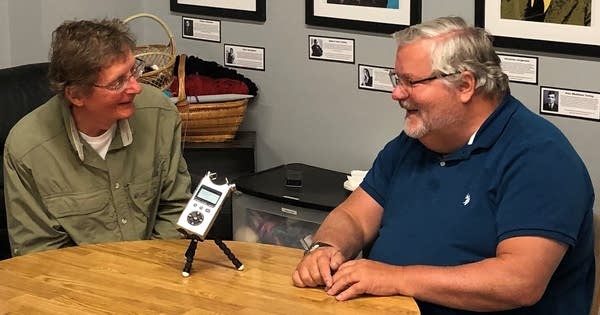
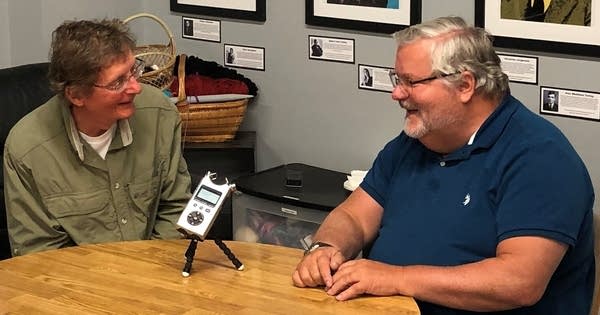
Two men talk at a table

When Larry Peterson set out to interview LGBTQ+ people in Minnesota and North Dakota, he felt a sense of urgency.

“When we first started, we made a list of the 10 people who are most likely to die,” he said.

Peterson worried that if those stories were not recorded soon, they might disappear forever. Historically, many LGBTQ+ people near Fargo-Moorhead had to hide who they were.

“It was a very much hidden community, and that seemed to be quite true for quite a few years,” he said. “When the first gay rights group started here, Dignity/Lutherans Concerned, in their first newsletters people would not use their last names, they would just [be] ‘Joe W.’ or ‘Mark C.’”

Peterson, a historian who spent much of his career with North Dakota State University, has been heading The Red River Rainbow Seniors’ oral history project for about nine years. He and other interviewers go into people’s homes, and for hours they talk about their lives, their upbringing, and the stories of how they came out to their loved ones.

Since 2017, over 200 people have been interviewed for the project.

“One of the reasons we actually talked about very early on, was that lonesome young kid in a small town who wonders, ‘[Are there] people like me and have they made it?’” he said. “And [they] might be able to find this on the internet and say, ‘Oh my god, here’s somebody in their 60s who’s happy and led a full life.’”

Two people pose for a photo
Valerie Nelson and Diane Gira pose for a photo in 1989, which is now stored in the Institute for Regional Studies at North Dakota State University in the Red River Rainbow Seniors Collection.
Courtesy photo

One of his favorite interviews was with a North Dakota couple, Valerie Nelson and her wife Diane, who met in Moorhead in the 1970s. In the interview, Nelson talks about how she wasn’t able to tell her mother that they were more than friends until after her father died in the 1990s.

“I went and visited with my mom and had the discussion, and it was so hard, as much as she loved me and loved Diane,” Nelson said. “I was still fearing rejection, but it didn’t happen. What she said to me that night was, ‘Your father and I have always known, and it didn’t matter. We love you.’”

man's headshot smile
Josh Boschee is the mayor-elect of Fargo.
Courtesy of the North Dakota Legislative Branch

Even though they started with older interviewees, the project now includes stories from adults of all ages. Josh Boschee is the mayor-elect of Fargo. He’ll be the city’s first openly gay mayor and was the first openly gay North Dakota state lawmaker.

He was interviewed for the oral history project a few years ago and was the chair of Fargo-Moorhead Pride when the group helped fund the project.

“It’s integral to, especially our region, our community,” he said. “A lot of times, when we hear about LGBT history, it’s about things happening in major cities, or on the coasts — you know, San Francisco, New York City — but we have our own history”

The project is already being used to get a better sense of the past. Peterson said graduate students of North Dakota State University have used the interviews for research.

Though he’s retired from his days as a professor, the project is also fueling his own research. He recently submitted a paper on early gay rights groups in Fargo-Moorhead and has written about the history of same-sex dancing in the area.

All of the group’s interviews are transcribed by Tammy Lanaghan. Like Peterson, she has an academic background and has been using the information from the interviews to map out the historic hubs of LGBTQ+ activity in Moorhead, like bars and other organizations.

“I’m looking at where did they meet, as opposed to Larry [Peterson] thinking much more about what were they doing,” Lanaghan said.

“The amount of energy and the amount of commitment that the LGBTQ community has had to our region has been extraordinary, and how they have shaped our region and our history is extraordinary,” she added. “There is no way to know that unless you dig deep into their experiences, and so I feel much more a citizen of this region than I did before.”

Despite the progress made in the area over the decades, there are still challenges to collecting stories. After a lifetime of hiding who they are, it’s hard for many, particularly older people, to open up.

A photo of two people and a baby
Valerie Nelson and Diane Gira pose for a photo with their son Madison in 1998. The photo and an interview of the three of them is now stored in the Institute for Regional Studies at North Dakota State University in the Red River Rainbow Seniors Collection.
Courtesy photo

“If you’ve spent your whole life being hidden and worried about revealing who you are, because you're going to risk losing family, friends, and community, then you're not going to be very forthcoming, and it becomes a lifelong habit,” Lanaghan said.

Plus, there’s a chilling effect, as support for LGBTQ+ issues has been declining in recent years.

“We had a case just last summer, a gay guy I’ve known for 30 years, and he was set to do an interview,” Peterson said. “And because of what's happening with the current administration and kind of tamping down on things, he said, ‘I’m afraid if I give an interview, that … you know, will someone come after me?’”

And Peterson said that makes it harder to record these stories before it’s too late.

“If we don't capture these stories soon we won’t get them,” he said. “Twenty-three people that we've interviewed have died subsequently after being interviewed, and there’s probably almost another 20 who are on a list of people we would like to have interviewed but died before the project started, or before we got connected with them.”




Source link

Leave a Reply

Subscribe to Our Newsletter

Get our latest articles delivered straight to your inbox. No spam, we promise.

Recent Reviews


In this blog, you will learn about Java full-stack developer skills in depth. But before you dive into this blog, you should know about full-stack web development in brief.

What is Full Stack Web Development?

Full Stack web development is the process of end-to-end software app development. It includes front- and back-end development, designing, testing, and deploying the software. Here, the front end is related to the user interface, and the back end is related to business application workflows.

Skills To Become A Java Full Stack Developer 

Java full stack developer is an expert programmer who uses the popular coding language Java to write programs for application development. A full-stack Java developer has extensive skills in designing, developing, and maintaining Java-based programs. In other words, a Java full-stack developer is a web developer who uses the robust Java language to develop the whole application. So, a Java developer should master a variety of skills.
The following are the key skills a Java full-stack developer must master.

  1. JavaScript
  2. HTML and CSS
  3. Back-end Technologies
  4. Web Hosting Platforms
  5. Web Storage and Databases
  6. Git and Github
  7. DevOps Tools
  8. HTTP and REST
  9. Design Patterns
  10. React
  11. Software Design
  12. Java Servlet Pages (JSP)
  13. Front-end Frameworks

Enroll in our Liferay Training program today and elevate your skills!

Java Certification Training

  • Master Your Craft
  • Lifetime LMS & Faculty Access
  • 24/7 online expert support
  • Real-world & Project Based Learning

1. JavaScript

It is one of the top scripting languages with object-oriented features. To add multiple features to web-based apps, JavaScript is popularly used. So, knowing JavaScript is more than essential for a Java full-stack developer. This knowledge helps him to add different features to the web page rather than only text. Also, it is one of the popular client-side coding languages useful to enhance user interaction with the app. Moreover, besides client-side coding, JavaScript is also useful for writing front-end, back-end, and server-side code. Further, it offers several libraries and frameworks, such as React, Angular, JQuery, Ionic, etc., which a Java developer must master.

2. HTML and CSS

A full-stack Java developer should be well-versed in the front-end development skills like HTML, CSS, JavaScript, etc. HTML stands for Hyper Text Markup Language, and CSS stands for Cascading Style Sheets. These are the key skills to develop attractive web pages and to build an effective web presence. Further, these skills help in the web development process and data styling. HTML is a language that helps to present the documents within the web browser. It is one of the building blocks of web designing.

On the other hand, CSS describes the way the elements of HTML work to display web pages. It includes the fonts, colors, page layout, etc., of our web page. The developer will use CSS to make the web page compatible with different screen sizes and devices.

3. Back-end Technologies

The server side of the website will cover the back-end coding part. It is invisible to the clients and users. It ensures the storage and data ordering in the back end to make the website work smoothly in the front end. A Java full-stack developer must be skilled in various back-end techs and frameworks, including managing APIs, building libraries, etc. Some coding languages support the back-end development of a website.

  • Java is a highly scalable and popular coding language useful across all platforms.
  • C++ is a popular and highly versatile coding language useful in back-end development.
  • Python is the essential language in back-end development that helps developers work quickly and integrate systems easily without any issues.
  • PHP is also a widely used scripting language for server-side apps.
  • Solid skills in back-end languages like C#, Scala, etc., will be beneficial.

4. Web Hosting Platforms

The knowledge of web hosting platforms like AWS, Google Cloud, and MS Azure will be an added advantage. These platforms allow the developer to deploy the software product on a cloud service provider. It will give access easily through the web.

5. Web Storage & Databases

A Java full-stack developer should have good knowledge of databases and web storage. The database provides a repository of data to store it for future access and use. Further, a database is managed by DBMS. Data within the database is arranged in multiple rows, columns, and tables, which makes it easier to access, manage, and update. To understand the creation and manipulation of queries within databases, a developer should understand them.
Moreover, web storage is the feature that allows developers to store data on the client side within the browser. This data will not expire because it is locally stored and will remain available even if the browser is closed.

Acquire CCSP certification by enrolling in the HKR CCSP certification Training program in Hyderabad!

HKR Trainings Logo

Subscribe to our YouTube channel to get new updates..!

6. Git and Github

These skills are also essential for a full-stack developer. A full-stack Java developer should know about the version control systems that help to manage and keep track of the changes made within the source code. Git is a popular VCS (version control system) that allows you to manage various changes made within the apps, websites, or code regarding the app development. Further, Git is a tool that helps to manage multiple versions of source code edits.

On the other hand, Github is an open-source web-based repository that offers free hosting services. It allows the developer to track the minor changes to be made in the application. So, having a Github profile with Git experience will add more value to the full-stack Java developer’s profile.

7. DevOps Tools

DevOps combines development and operations, streamlining the project in a complex environment. DevOps tools and techniques help to simplify the development process. They help to enhance productivity and efficiency by automating complex manual tasks. Teams working on large-scale projects can use DevOps’s help to speed up the software development and delivery process. Further, a full-stack Java developer should have the DevOps skills such as Jenkins, Docker, Kubernetes (K8s), etc.

  • Jenkins is a popular DevOps tool that helps the project with continuous integrations.
  • Docker is also a well-known tool and software platform that allows app development, testing, and deployment quickly.
  • On the other hand, K8s is a popular open-source platform that automates deploying, scaling, and managing apps within the containerized space.

8. HTTP and REST

HTTP stands for Hyper Text Transfer Protocol which forms the base of the world wide web (www). A full-stack Java developer must acquire the skills relating to HTTP. Further, HTTP is a networking and communication protocol that helps transfer information from one device to another.
REST allows accessing documents stored within a specific area. Further, REST API is a kind of translator that helps the back end to know what is happening in the front end. Therefore, getting these skills will help full-stack developers to master front-end techs.

9. Design Patterns

In the full-stack development process, design patterns provide some solutions to issues relating to common software design while developing apps. They offer a way to resolve frequent design issues and promote the reusability and scalability of the code. A Java full-stack developer should have strong skills relating to design patterns. These include MVC, Builder, Factory Method, Singleton, etc.

Enroll in our Collibra Training in Hyderabad program today and elevate your skills!

Java Certification Training

Weekday / Weekend Batches

10. React

React is a popular framework useful in front-end development. It is an open-source library based on JavaScript that offers multiple functionalities with less coding. Further, React makes it easier to develop dynamic web apps. Also, it provides the benefit of using reusable components and virtual DOM that reduces the app development time. So, having React skills will give an additional benefit to the Full Stack Developer.

11. Software Design

The design of the software plays a key role in the app development. It is necessary to have the knowledge and skills relating to software design for a full-stack developer. Software design aims to transform user requirements into a suitable format that helps coders code and implement software.

12. Java Servlet Pages (JSP)

JSP is a web-based technology that helps develop dynamic web content and web apps. It provides the ability to build independent web pages that are flexible, scalable, and easy to maintain. Further, they are separate from the browser and server.

13. Front-end Frameworks

A Java full-stack developer should have strong skills in various front-end frameworks and libraries such as Bootstrap. These are useful in developing highly responsive and attractive UIs.
So, these are the essential skills a Java developer should possess in full-stack development. Further, having good analytical and problem-solving skills will benefit a developer.

Conclusion

A Java full-stack developer should possess all the above skills to master full-stack development. The advancing technologies and growth in the software industry can change how business is done. Therefore, the demand for full-stack developers in Java will increase, and it can shape the career of many aspirants. To get more ideas and information on full-stack development, stay tuned.

Related Article:

Socket programming in Java


Source link