10 High-Fiber Foods That Also Support Heart Health


Credit: AnaMOMarques / Getty Images
  • Fiber supports heart health by improving cholesterol, blood pressure, and weight management.
  • Some of the best high-fiber foods include oats, beans, berries, lentils, and vegetables.
  • Increase fiber gradually and drink enough fluids to help prevent gas or bloating.

Eating more fiber is one of the simplest ways to support heart health. The best high-fiber foods for heart health include oats, berries, beans, and cruciferous vegetables. These foods help lower blood pressure, reduce LDL (or “bad”) cholesterol, and support weight management.

1. Oats

Credit: fcafotodigital / Getty Images
  • Fiber content: 8 grams
  • Serving Size: 1 cup (raw)

Oats are one of the best fiber-rich foods for heart health. They contain beta-glucan, a type of soluble fiber that helps reduce low-density lipoprotein (LDL) cholesterol by limiting its absorption into the bloodstream.

Lowering LDL or "bad" cholesterol can reduce the risk of heart attack or stroke. In a new study, people who ate mostly oatmeal for two days lowered their LDL cholesterol by about 10%. The benefits lasted for up to six weeks.

2. Kidney Beans

Credit: Krit of Studio OMG / Getty Image
  • Fiber content: 13.1 grams
  • Serving Size: 1 cup (cooked)

Kidney beans are rich in soluble fiber, which helps lower cholesterol levels. According to the National Lipid Association, consuming 5-10 grams of soluble fiber per day can reduce total and LDL cholesterol by about as much as 10 points. On average, a cup of cooked beans can provide between 2-6 grams of soluble fiber.

Kidney beans are also a good source of potassium, which helps offset the effects of sodium and support healthy blood pressure.

3. Chia Seeds

Credit: HUIZENG HU / Getty Images
  • Fiber content: 9.8 grams
  • Serving Size: 1 ounce (slightly more than two tablespoons)

Along with fiber, chia seeds are rich in alpha-linolenic acid (ALA), a plant-based omega-3 fatty acid. These healthy fats have been shown to help reduce inflammation and support healthy cholesterol levels. Chia seeds also provide plant-based protein and magnesium, nutrients that may help lower blood pressure.

Adding chia to oatmeal, yogurt, or smoothies is an easy way to boost fiber intake without much effort.

4. Raspberries

Credit: alvarez / Getty Images
  • Fiber content: 8 grams
  • Serving Size: 1 cup

With 8 grams of fiber per cup, raspberries are one of the highest-fiber fruits. They are also full of antioxidants that help protect cells against damage.

Studies show that eating berries regularly may support healthy blood pressure and cholesterol levels. Raspberries are also lower in sugar than many other fruits, making them a heart-healthy choice.

5. Avocados

Credit: miniseries / Getty Images
  • Fiber content: 9.7 grams
  • Serving Size: 1 cup (sliced)

Avocados provide a unique combination of fiber and heart-healthy fats. The fiber supports cholesterol control, while monounsaturated fats (MUFAs) help improve HDL (or “good”) cholesterol levels.

They’re also a good source of potassium, which plays a role in blood pressure regulation. Adding avocado to meals can help replace saturated fats with healthier alternatives.

One study found that people who ate at least two servings of avocado per week, about one cup or one whole avocado, had a 16% lower risk of cardiovascular disease and a 21% lower risk of coronary heart disease compared to those who rarely or never ate avocados.

6. Apples

Credit: Dharmendra Yadav / Getty Images
  • Fiber content: 4.4 grams
  • Serving Size: 1 medium apple (with the skin on)

Apples are an easy, affordable way to add heart-supportive nutrients to your diet. They contain pectin, a type of soluble fiber that helps lower LDL cholesterol by binding to cholesterol in the digestive tract. Pectin is also considered a prebiotic fiber, which promotes the growth of good bacteria in the gut.

Apples also contain polyphenols, which are antioxidant compounds that help reduce inflammation. Eating apples with the skin on maximizes fiber and antioxidant intake.

7. Nuts

Credit: Jordan Lye / Getty Images
  • Fiber content: 3.4 grams (almonds); 1.9 grams (walnuts)
  • Serving Size: 1 ounce

Nuts are rich in healthy fats, fiber, and plant protein, which help support heart health. A large study found that people who ate the most nuts had a lower risk of dying from heart disease compared to those who ate the least. The strongest benefits were seen with tree nuts, such as almonds and walnuts.

Researchers also found that replacing red or processed meat with nuts was linked to a lower risk of heart-related death. Experts recommend eating a variety of nuts in moderate portions and choosing unsalted or minimally processed options for the most benefit.

8. Cruciferous Vegetables

Credit: SewcreamStudio / Getty Images
  • Fiber content: 6.6 grams (broccoli); 4 grams (Brussels sprouts)
  • Serving Size: 1 cup (cooked)

Cruciferous vegetables, like broccoli and Brussels sprouts, are high in fiber and antioxidants that protect your heart. They're also a concentrated source of vitamins and minerals, like vitamins A and C, magnesium, and folate.

In one study, eating four servings of cruciferous vegetables daily for two weeks reduced systolic blood pressure (the upper number) in middle-aged and older adults with mildly elevated blood pressure, compared with eating root and squash vegetables.

While eating a variety of vegetables is important, this research suggests that cruciferous vegetables may confer additional cardiovascular health benefits.

9. Quinoa

Credit: Westend61 / Getty Images
  • Fiber content: 5.8 grams
  • Serving Size: 1 cup (cooked)

Quinoa is a fiber-rich whole grain that provides plant-based protein. It also supplies iron and magnesium, along with B vitamins that support metabolism and nerve function.

Choosing whole grains like quinoa instead of refined grains has been linked to improved heart health outcomes. It can also help with blood sugar control and reduce the risk of diabetes.

10. Lentils

Credit: SimpleImages / Getty Images
  • Fiber content: 15.6 grams
  • Serving Size: 1 cup (cooked)

Lentils are among the highest-fiber plant foods and are especially beneficial for your heart. Their soluble fiber helps lower cholesterol, while their protein content supports fullness and blood sugar balance.

Lentils are an excellent source of plant-based protein, providing about 18 grams per cooked cup. Replacing some animal protein with plant protein has been linked to better heart health, including lower LDL (“bad”) cholesterol and improved blood sugar control.

In one study of more than 37,000 people, those who ate the most plant protein were 29% less likely to die from coronary heart disease.

How to Add High-Fiber Foods to a Heart-Healthy Diet

You don’t need to overhaul your diet to eat more fiber. Small, consistent changes can add up over time. Here are some tips:

  • Aim to include fiber at most meals by including fruits, vegetables, whole grains, and legumes throughout the day
  • Increase fiber gradually and drink enough fluids to help reduce gas or bloating as your body adjusts
  • Focus on variety to get a wide range of nutrients that support fiber intake and heart health


Source link

Leave a Reply

Subscribe to Our Newsletter

Get our latest articles delivered straight to your inbox. No spam, we promise.

Recent Reviews


What is Power BI?

Power BI is a cloud-based business analysis and intelligence agency developed by Microsoft. It is a compilation of business intelligence and data analytical techniques, such as software services, applications and data connectors. We can use data sources extracted into Power BI to visualize and analyze data using shared reports, dashboards, and apps.Power BI is a user-friendly tool that offers remarkable drag-and-drop features and self-service abilities.

Become a Power BI Certified professional by learning this HKR Power BI Online Training !

Microsoft is offering three types of Power BI platforms:

  • Desktop Power BI(A desktop application)
  • Power BIService (SaaS i.e., Software as a Service)
  • Mobile Power BI (For iOS and Android devices)

We can also deploy Power BI on both on-site and cloud platforms. 

Why Power BI?

Power BI is an integrated system with several various types of data under its supervision.There seems to be a cloud-based BI service called Power BI Services that is used to display and communicate dashboards.A desktop-based report functionality known as the Power BI Desktop.Another useful service is Power BI Embedded, which keeps running on the Azure cloud platform and can be used for reporting, ETL and data analysis.

Now we discuss why it is an important tool in the present market.

  • One can easily do real time analysis in power bi by creating direct connections with the data sets.
  • Can take the advantage of the custom visualizations.
  • Can get the quick insights of the data.
  • Power BI marketplace as on-site communications make data transfer secure and technology scalable and reliable.
  • You can attach to other services via Power BI, such as SQL Server Analysis Services (SSAS), Microsoft Excel, etc.
  • Power BI is a new age application that helps state-of-the-art technologies such as HTML 5.0, column store databases, cloud computing, mobile apps, etc. This helps to
  • keep Power BI at the top and famous, as it is continuously equipped with the latest features.

Power BI Training

  • Master Your Craft
  • Lifetime LMS & Faculty Access
  • 24/7 online expert support
  • Real-world & Project Based Learning

Now we will get into the power bi components in detail.

Power BI Components:

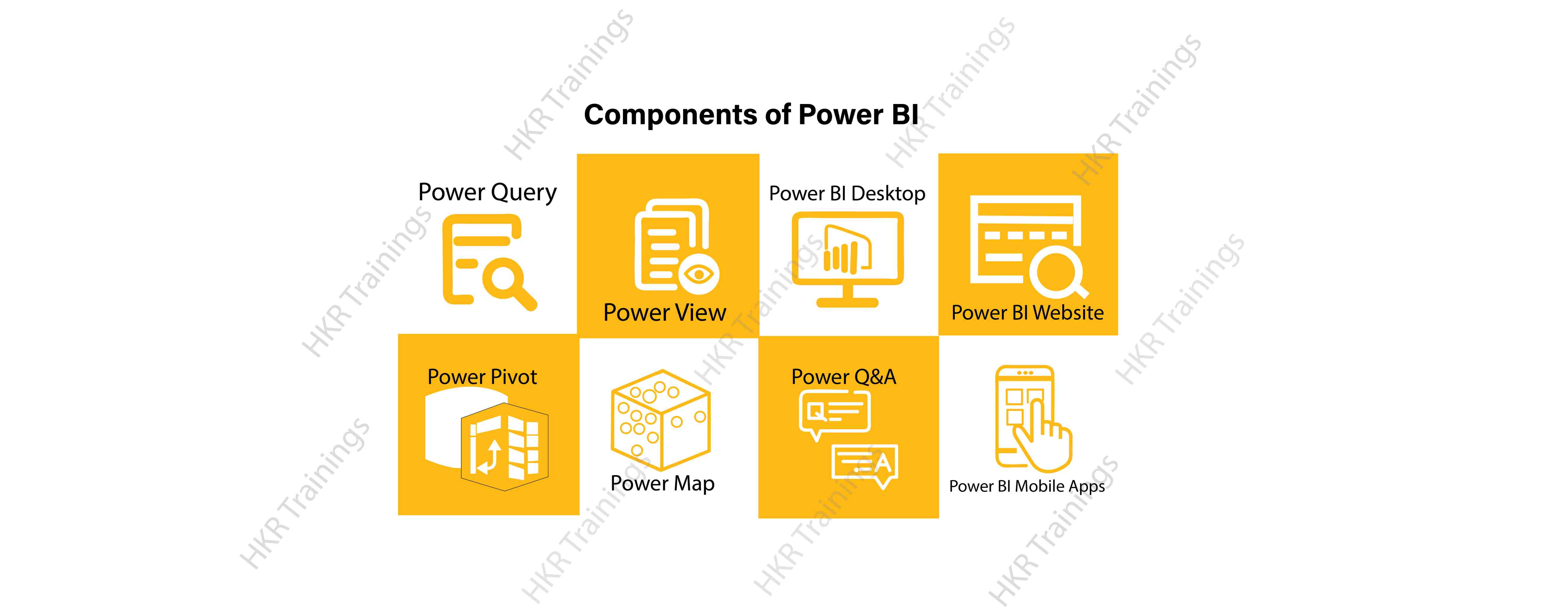
Here are the lists of power BI components. They are:

  • Power Query
  • Power Pivot
  • Power View
  • Power Map
  • Power Q&A
  • Power BI Desktop
  • Power BI Website
  • Power BI Mobile Apps

Power BI Components

Now start discussing each and every component of power BI in detail.

Top 50 frequently asked Power BI Interview Questions !

Power Query:

Power Query is one of the most essential components of Power BI. This would be included in your Excel or could be used as a Power BI Desktop component. Using Power Query, you can uninstall data from multiple data sources and retrieve data from a wide variety of different databases, such as Oracle, SQL Server, MySQL, and other databases. You can also retrieve data from records such as text files, CSV files, etc.

Power BI provides you a powerful GUI so that you really can change and use the information you need, such as date and time changes, add columns, modify types and content, and a variety of options. It includes a small language, Power Query M Formula Language, as a code that is more powerful than a GUI.Power Query Formula Language in Power BI is highly secure and optimized for the development of highly highly scalable mashup queries accessible to Power BI Desktop and Power Query. It has several features that cannot be made available by a GUI.

Power Pivot:

Power Pivot is a data designing and information technology engine. It’s being used to model static and dynamic data. You can establish or generate relations between various tables in Power Pivot and quantify values that can be considered in Pivot tables. It provides a tremendous opportunity to build your design.The language used mostly by Power BI Pivot is Data Analysis Expression (DAX), a highly functional language. 

HKR Trainings Logo

Subscribe to our YouTube channel to get new updates..!

Power View:

Power View is a major aspect of Power BI data visualization. It is an immersive device that connects to data sources and collects metadata that can be used for data collection. There are a lot of image processing blueprints in the Power View list. With Power View, you could even process the data for each visualization element or for the entire report. Slicers can be used to make better dicing of the information.Power View reports are responsive; the user can illustrate some of the data or components in Power View to communicate directly with each other.

Power Map:

Power Map is used to display spatial information in 3D mode. As soon as the visual interface is rendered in 3D mode, it offers some other dimension. In Power Map, one characteristic can be assumed to be the length of a column in 3D and another attribute to be a heatmap view. The data can be illustrated on the basis of a geographical location. Geographical locations may be a country, state, city, or street address.In order to get the best view, Power Map works with Bing Maps related to geographical latitude or longitude or country, state, city or street address data.

Power Q&A:

Power BI Q&A is a common language engine for questionnaires about your data model. After you have assembled and updated your data model on the Power BI website, you or your customers can ask questions, if any, and find solutions to those questions. There are a few shortcut keys and hints for the development of your framework so that it can respond to questions in the most effective manner possible.

For data visualization, Power Q&A works with Power View so that users can ask any questions, such as the amount of clients per state, and the question is responded in the form of a map view with numbers shown as bubbles by Power Q&A.

Want to know more about Power BI,visit here Power BI Tutorial !

Power BI Desktop:

Power BI Desktop is a continuous improvement of the Power BI suit. This is an embedded development tool for Power Query, Power Pivot and Power View. It allows you to build advanced queries, models, and reports. Power BI Desktop makes it easy to advance your BI skills and your data analytics experience.

Power BI Website:

Power BI solutions can be compiled on the Power BI website. You can generate dashboards for your news stories and share them with others, and you can also generate content directly on the Power BI website. With the Power BI website, you can conduct slice and dice online operations using a web browser, and you don’t even need any other tools.

Power BI Mobile Apps

Power BI Mobile Apps has three mobile operating system (OS) providers: Android, iOS, and Windows. These frameworks give you lots of an immersive view of Power BI reports and dashboards. You could even share them with your mobile app. A fraction of the documents can be displayed and a note can be written and shared with others. 

To gain in-depth knowledge with practical experience in Power BI, Then explore hkr’s Power BI Training In Hyderabad !

Power BI Training

Weekday / Weekend Batches

Conclusion:

In the above content, we had covered all the important components of power BI in detail. One can take a sound knowledge in the power BI technology by learning each and every components of the power BI architecture. However, the above stated information is strong enough to make you realize the importance of the power BI in corresponding to the data visualization, data analysis, etc.

Related Articles:


Source link