Sprint Medics respond faster to rural Minn. emergencies


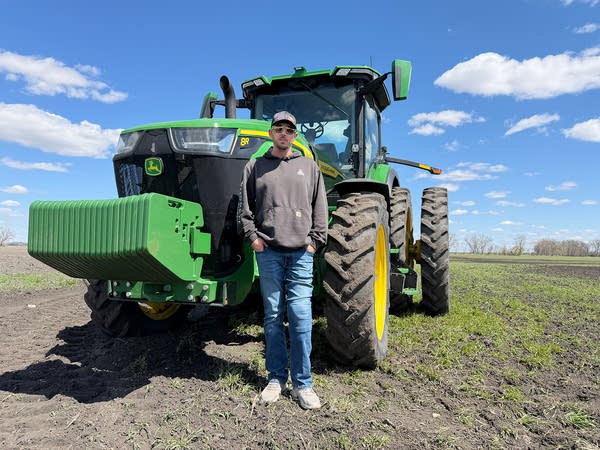
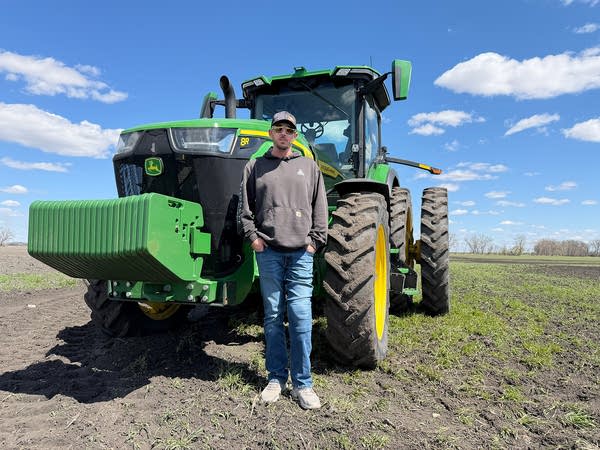
A man in a hoodie and jeans stands next to a large green tractor.

Lourens Nel, a contract farm laborer from South Africa, was working in the grain bins of a Grant County farm about 80 miles southeast of Fargo last August when he was injured in a terrible accident.

“Foot slipped and, yeah, got caught in the auger, I suppose,” Nel said. “It cut it clean off.”

Nel, 34, recalled that his teammates worked to extricate him from the machine and tried their best to stanch the bleeding while they yelled for someone to call 911. In the past, it might have taken an ambulance 20 to 30 minutes or longer to get to the scene. But within six minutes, paramedics arrived and began treating Nel. They coordinated with a helicopter, and despite an approaching storm, they were able to quickly get him transported to Fargo for surgery.

Nel is extremely grateful for that rapid response.

“It meant a great deal,” Nel told MPR News. “If they had to drive all the way from Fergus [Falls] to where I was at, it would have been, might have been a different story.”

Nearly a year later, Nel, who has returned for a sixth year to work this Minnesota farm, walks easily on his prosthetic foot, which attaches about two inches below the knee.

He recently met with and thanked the paramedics who, at the very least, prevented a more serious outcome and may have saved his life. But he might want to thank Minnesota lawmakers, too, because they authorized a pilot program in Grant County that speeds up paramedics’ response times and gets them to the site of emergencies in rural areas more quickly.
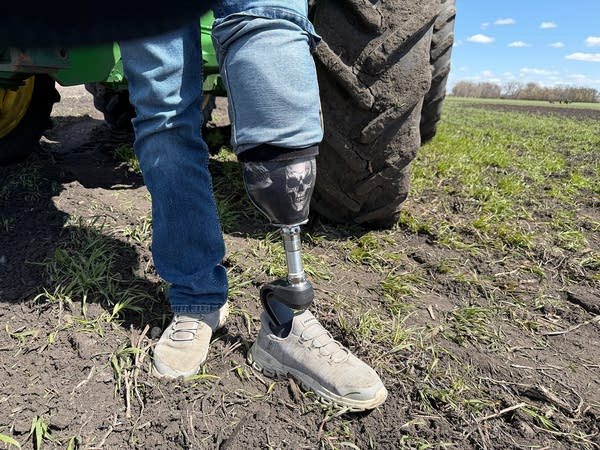
Closeup of a man's prosthetic leg, seen under blue jeans, while he stands next to a tractor.
Lourens Nel wears a prosthetic foot since his injury, and he is now able to walk on it easily after physical therapy.
Molly Castle Work | MPR News

It’s called the Sprint Medic program – a two-year state funded pilot to test the efficiency of roving paramedics in rural Minnesota. It’s part of a bill that Minnesota Gov. Tim Walz signed in 2024 to aid rural emergency medical services in the midst of long-running workforce shortages.

Ambulances are expensive to buy, staff and operate, and in rural areas, they are few and far between. Many rural communities rely on basic life support ambulances staffed by volunteer EMTs, who do not have advanced life support equipment nor the training to use it.

The sprint medic program puts full time paramedics in pick up trucks with all the advanced life support equipment they’d have in an ALS ambulance, and centrally locates them in a county or coverage area, so they can respond immediately to calls for medical help. They can often be on the scene well before the ambulance, providing immediate emergency care.

What is the sprint medic program?

Three counties are giving the sprint medic program a test run, Grant and neighboring Otter Tail County in west central Minnesota, and St. Louis County in northeast Minnesota.

Becca Huebsch, emergency medical services director for the town of Perham and surrounding communities in Otter Tail County, said that, in the past, when volunteer ambulance teams would arrive at the scene, the EMTs would need to call neighboring cities for assistance if they determined the patient needed more advanced care. That could add another 30 minutes before the paramedic arrives at the scene.

That’s why Huebsch is a champion of the sprint medic program.

“Now, the paramedic would be sitting just right about here, kind of in the middle of these service areas, and they can be there in five minutes or less,” Huebsch said.
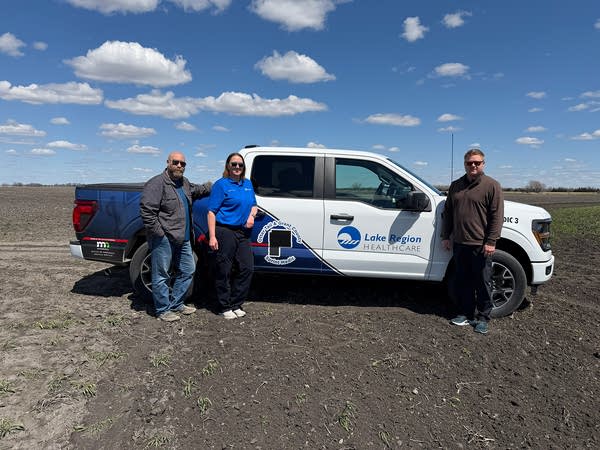
A woman and two men pose next to a white and blue pickup truck.
Grant County medics Travis Nyreen, Carrie Clauson and Aric Risbrudt stand next to the Sprint Medic vehicle after reuniting with the farmer they treated back in August, Lourens Nel.
Molly Castle Work | MPR News

Grant County had been doing a version of this program for years before the pilot, using a quick response vehicle. Carrie Clauson, one of the sprint medics that treated Lourens Nel on the Grant County farm, said the county had discovered it was easier to get to the scene faster in a pick up truck than the ambulance rig.

“There's no having to get into the garage and wait for people and get your crew all in one spot,” Clauson said. “We can go straight there. There’s been multiple times where [the pick up truck] was able to get on scene five to 10 minutes faster, and sometimes 15 [minutes faster]. That’s a huge amount of time.”

Jesse Degrote, one of the Otter Tail sprint medics, told MPR News that his coverage area is about 1,000 square miles, so he listens closely to local law enforcement dispatches and emergency alerts on his radio as he drives around the center of the county, ready to respond to calls alongside the volunteer ambulance crews.

“I can start working my way up there before they even get the ambulances stationed,” Degrote said. “It's a lot of listening and scanning of what's going on to know where you potentially could be going next.”
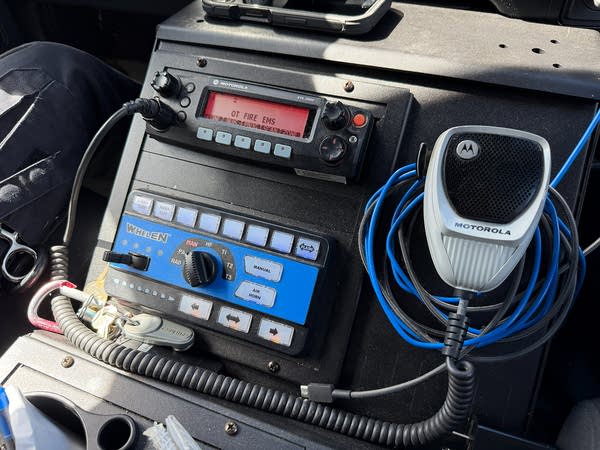
A handset and radio are seen on the dashboard of a vehicle.
Jesse Degrote pays close attention to the radio alerts coming through in his sprint medic truck so he can respond to emergency calls quickly while he roves around his coverage area.
Molly Castle Work | MPR News

Degrote said he can usually be on the scene within five minutes, sometimes beating the local volunteer ambulance teams. His job is not to transport patients to a hospital, but to deliver care on site and help the local volunteer ambulance teams determine if a transport is necessary. And sometimes the local EMTs will cancel his services if they know they can resolve the issue on their own.

Driving pick up trucks instead of large ambulance rigs allows the sprint medics to move more quickly across large regions, especially in the winter, when the vehicle must drive through snow sometimes a foot or two deep.

Mike Helle, chief of police and fire in the small town of Henning, works with Degrote often. He says the partnership with Degrote and other sprint medics has helped shorten response times in rural areas, and the program’s pick up trucks can get to places an ambulance can’t.

“Not long ago, we had a tree fall on a guy, and it's just great to be able to bring that care to the woods,” Helle said.
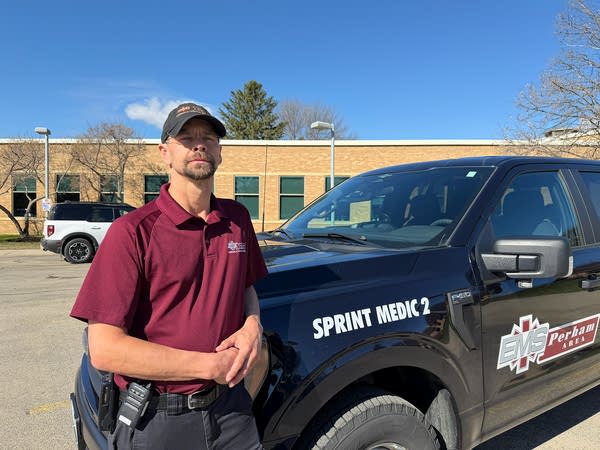
A man in a maroon polo poses next to a black pickup truck.
Jesse Degrote, one of the sprint medics in Otter Tail County, stands next to his pick up truck in Fergus Falls, Minn.
Molly Castle Work | MPR News

Helle said he hopes the program continues in Otter Tail County after the pilot ends in July 2027, and that the legislature expands it to more rural counties.

“[The sprint medic program] is a huge asset for rural America,” Helle said. “The quality of care is much better for the patient. That's what we’re here for.”

And Degrote added that it’s been a great way to train the volunteer EMTs on more advanced care, in the moment. At the end of a call, he’ll work with the volunteers – walking them through emergency scenarios, how to move patients efficiently, and how to use some of the gear paramedics use.
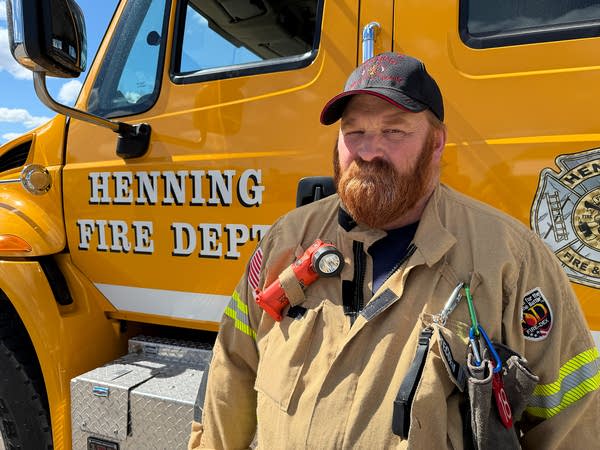
A firefighter poses for a photo next to a dark yellow truck.
Mike Helle is chief of police and fire for the city of Henning in Otter Tail County.
Molly Castle Work | MPR News

It’s unclear if lawmakers will continue the program, and Helle stressed that he and his peers need to advocate for the program if they want it to continue and hopefully expand to other parts of the state.

“It’s instrumental in my eyes that we keep it, but I’m only one line of defense,” Helle said. “We write letters a lot to help push, you know, which way we want it to go. It’s hard. It takes a lot of us, a lot of voices.”




Source link

Leave a Reply

Subscribe to Our Newsletter

Get our latest articles delivered straight to your inbox. No spam, we promise.

Recent Reviews


SAP EWM Tables – Table of Content

Introduction to SAP EWM :

SAP EWM is a crucial functional module that is pivotal in helping organizations manage their inventories and streamline the movement of goods within their warehouse operations. This advanced software solution offers a complete suite of functions. It includes handling inbound and outbound delivery processes, (GR) receipt of goods, order success, and efficient goods distribution.

SAP EWM Tables:

SAP EWM tables deal with the storage for key warehouse management and stock control data. The EWM tables play a vital role in ensuring the smooth functioning of warehouse activities. Here, we will delve into the various categories of SAP EWM tables and provide brief descriptions for each:

1) Stock

  • /SCWM/AQUA: Describes available quantity.
  • /SCWM/QUAN: Defines quant attributes.
  • /LIME/NQUAN: Details LIME quantity attributes.
  • /SCWM/STOCK_IW01: Manages stock key material (WME).
  • /SCWM/STOCK_IW02: Manages stock key material with batch (WME).
  • /SCWM/STOCK_IW03: Manages stock key material with batch and reference documents (WME).
  • /SCWM/STOCK_IW04: Manages stock key material with sales order and project (WME).

Become a master of SAP EWM by going through this HKR SAP EWM Online Training! 

SAP EWM Training

  • Master Your Craft
  • Lifetime LMS & Faculty Access
  • 24/7 online expert support
  • Real-world & Project Based Learning

2) Warehouse Task

  • /SCWM/ORDIM_C: Defines confirmed warehouse tasks.
  • /SCWM/ORDIM_CS: Specifies serial numbers for confirmed warehouse task items.
  • /SCWM/ORDIM_E: Specifies exception codes for warehouse tasks.
  • /SCWM/ORDIM_H: Manages warehouse task movements for handling unit (HU) items.
  • /SCWM/ORDIM_HS: Handles serial numbers for HU item movements.
  • /SCWM/ORDIM_L: Logs warehouse task information.
  • /SCWM/ORDIM_LS: Logs serial numbers for warehouse task entries.
  • /SCWM/ORDIM_O: Open warehouse tasks.
  • SCWM/ORDIM_OS: It handles serial number items for available warehouse tasks.
  •  

3) Transportation Unit

  • /SCWM/TU_DLV: Describes the assignment of deliveries and HUs to transportation units.
  • /SCWM/TU_DOOR: Assigns transport units to doors.
  • /SCWM/TUNIT: Defines transportation units.
  • /SCWM/TU_SR_ACT: Specifies S and R activities of transportation units.
  • /SCWM/TU_STATUS: Manages the status of transportation unit activities.
  • /SCWM/TU_VEH: Assigns transport units to vehicles.
  • /SCWM/DOOR_SRACT: Defines S & R activities of doors.
  •  

4) Wave

  • /SCWM/WAVEHDR: Manages wave header data.
  • /SCWM/WAVEITM: Contains wave item data.
  •  

5) Outbound Delivery

  • /SCDL/DB_DLVH_O: Handles outbound delivery header data.
  • /SCDL/DB_DLVI_O: Manages outbound delivery item details.
  • /SCDL/DB_PROCH_O: Oversees outbound delivery order header.
  • /SCDL/DB_PROCI_O: Manages outbound delivery order items.
  •  

6) Inbound Delivery

  • /SCDL/DB_PROCH_I: Manages inbound delivery header information.
  • /SCDL/DB_PROCI_I: Details inbound delivery item information.

Interested in learning python Join HKR Python certification training! 


7) References

  • /SCDL/DB_REFDOC: Determines reference information.
  • /SCDL/DB_REQH: Defines header information for inbound delivery notifications or outbound delivery requests.
  • /SCDL/DB_REQI: Manages item information for inbound delivery notifications or outbound delivery requests.
  •  

8) Handling Units (HUs)

  • /SCWM/HUHDR: Oversees handling unit header information.
  • /SCWM/GMHUIDENT: Manages additional handling units for goods movement logs.
  • /SCWM/HUSSTAT: Specifies individual status for each handling unit.
  • /SCWM/HUREF: Manages handling unit references.
  • /SCWM/HUSTOBJ: Details information about handling unit status objects.
  • /SCWM/GMHUSTAT: Tracks HU status from goods movement logs.
  • /SCWM/GMHUITM: Manages handling unit items.
  • /SCWM/GMHUHDR: Maintains handling unit header data in goods movement logs.
  •  

9) Storage Bins

  • /SCWM/LAGP: Provides storage bin details.
  • /SCWM/LAGPS: Offers comprehensive information on available storage bins for various execution areas and activities.
  •  

10) Master Data

  • /SAPAPO/MATKEY: Defines product details.
  • /SAPAPO/MATMAP: Manages mapping table details for products.
  • /SAPAPO/MATEXEC: This table contains product execution data.
  • /SAPAPO/MATTXT: It provides material descriptions.
  • /SAPAPO/MATLWHST: This table states the location-specific product information by storage types.
  • /SAPAPO/MATLWH: It specifies location product information for warehouse locations.
  •  

11) Physical Inventory Documents

  • /LIME/PI_DCTYTXT: It describes physical inventory procedure details.
  • /LIME/PI_DOCTYPE: It defines document types for physical inventory and internal settings.
  • /LIME/PI_DOC_IT: It manages physical inventory document items.
  • /LIME/PI_DOC_SER: This table tracks serial numbers for physical inventory document items.
  • /LIME/PI_DOC_TB: This table contains quantities for physical inventory document items.
  • /LIME/PI_IT_BIZ: Specifies business key objects for physical inventory documents.
  • /LIME/PI_LOGHEAD: It logs header data of physical inventory log entries.
  • /LIME/PI_LOGHIST: Maintains a history table for physical inventory log entries.
  • /LIME/PI_LOGITEM: This table logs item data of a physical inventory document.
  • /LIME/PI_PAR_BIZ: It manages parent objects for physical inventory document business keys.
  •  

12) Route

  • /SCMB/ROUTE: Provides route information.
  • /SCMB/ROUTET: Contains route table information.
  • /SCMB/TOENTITYT: Specifies text information about supply chain units.
  • /SCDL/TSRVLVLT: It specifies the details of shipping condition text information.
  • /SCMB/ROUTE_SC: Manages shipping conditions for routes.
  • /SCMB/ROUTE_RT: Defines request types for routes.
  • /SCMB/STOP: Offers information about route stop logs.
  • /SCMB/ZONE: Contains transportation zone details.
  • /SCMB/ZONE_D: Provides details on transportation unavailability zones.
  • /SCMB/TOENTITY: Manages the details of the supply chain unit header.
  •  

13) Location

  • /SCWM/LOC_IW01: this table specifies location table numbers and storage bin details.
  • /SCWM/LOC_IW02: This table offers details on warehouse resources.
  • /SCWM/LOC_IW03:- Provides location table warehouse views.
  • /SCWM/LOC_IW04:- Contains location table transport details.

frequently asked SAP EWM Interview Questions and Answers

HKR Trainings Logo

Subscribe to our YouTube channel to get new updates..!

14) APO Location

  • /SAPAPO/LOC:- Describes location details.
  • /SAPAPO/LOCMAP:- Manages mapping tables for locations.
  • /SAPAPO/LOCT: Offers short text descriptions for sites/locations.
  • /SAPAPO/LOCVER:- Maintains version-dependent location data.
  •  

15) RF (Radio Frequency)

  • /SCWM/TTRNS_CAT:- It specifies logical transactions.
  • /SCWM/TSTEP_CAT:- It manages steps of logical transactions.
  • /SCWM/TPRDV_CAT:- This table specifies presentation devices.
  • /SCWM/TPRES_CAT:- This table defines presentation profiles.
  •  

16) Communications 

  • TRFCQIN:- Describes TRFC queue details for inbound delivery processes.
  • EDIDC:- Contains control record details.
  •  

17) Business Partner (BP)

  • ADRC:- Provides business address server details.
  • SCDL/DB_BPLOC:- Manages partner location searches for delivery information.
  • BUT000:- Contains general data for BP.
  • BUT020:- Specifies BP address details.

[Related Article : Dell Boomi Tutorial]

SAP EWM Training

Weekday / Weekend Batches

Final Thoughts:

This detailed overview of SAP EWM tables offers valuable insights into the critical components of warehouse management and inventory control. By exploring these tables, readers can gain a more profound knowledge of the functional modules and capabilities of SAP EWM. It also equips them to excel in real-time projects with expert guidance.


Other Related articles: 


Source link