A choose-your-own-adventure even adults can love


Yoshi’s solo titles have always been a product of contrasts: lovingly crafted art styles belying somewhat thin gameplay meant to appeal to a younger audience. But after getting the chance to preview Yoshi and the Mysterious Book, it feels like Nintendo has created a cozy side-scroller that retains the accessibility of earlier titles while adding extra depth and replayability for gamers of all ages.

As you’d expect from Nintendo’s lovable green dino, Yoshi’s moveset consists of familiar techniques like his signature ground pound, egg toss, extendable tongue and jumping flutter kicks, the latter of which now last longer than ever before. Seriously, if you get enough height, you can float across entire levels. However, one new mechanic is that Yoshi now also possesses a tail flick that allows him to toss certain enemies onto his back. Not only is this a nice twist after years of often being treated as a beast of burden by Mario and co., it also allows Yoshi to use whoever he’s carrying to interact with other elements in the stage. By flicking a Crayzee Dayzee (one of the new flower characters) into his saddle, Yoshi can make plants bloom to earn stars and uncover secrets, for example.

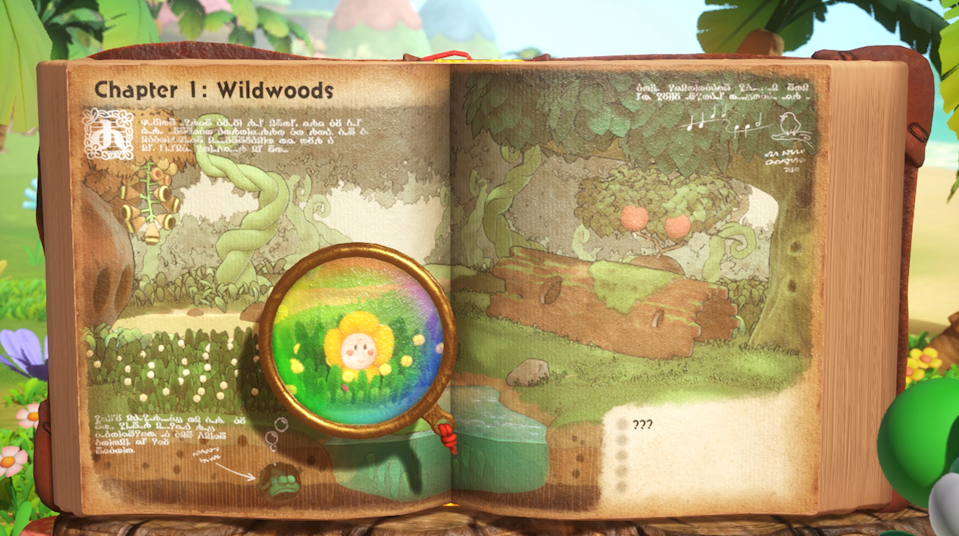
Instead of selecting a stage based on its location, in Yoshi and the Mysterious Book you choose new levels by picking which character you'd like to meet next.

Instead of selecting a stage based on its location, in Yoshi and the Mysterious Book you choose new levels by picking which character you’d like to meet next. (Nintendo)

Instead of simply remixing the gorgeous textile-inspired visuals we saw in Yoshi’s Woolly World and Yoshi’s Crafted World, Nintendo opted for a treatment that looks like a children’s bedtime story. The game looks hand-drawn, while also featuring a cell-shaded effect that adds extra depth and impact to characters and backgrounds. Animations have a sort of hitch (which I initially mistook for a bug) that gives them a stop-motion effect, as if you’re seeing the pages of a flipbook whiz by instead of frames being refreshed on a digital display.

But the biggest change in Yoshi and the Mysterious Book is that it’s not a traditional side-scrolling format. In many ways, this title plays like a mix between an adventure game and a platformer. Instead of just running to the right as fast as possible, the game encourages you to explore, experiment, backtrack and see what kind of new hijinks Yoshi can discover. Don’t do what I did and mindlessly run around and eat up every enemy you see, because there’s a good chance they are more valuable alive instead of being turned into an egg. It’s almost like Nintendo applied a similar approach to subverting expectations in Super Mario Bros. Wonder, but builds on that style of gameplay even more here.

Now Yoshi is in control of who gets to ride on his back.

Now Yoshi is in control of who gets to ride on his back. (Nintendo)

To really drive home the children’s storybook conceit, Yoshi and the Mysterious Book gives you greater control over how you unlock and explore new levels. Instead of linearly moving from one stage to the next, you actually select stages by moving a magnifying glass over a new character, allowing you to learn who they are experientially. Collect enough stars from quests and you can decide where you’ll go and who you’ll meet next, while spending tokens found throughout each level allows you to reveal hints about how to find and complete specific objectives. Then, once you finish a stage, Mr E. (who is both the titular book and acts as the game’s narrator), allows you to name each new character whatever you like.

Instead of fighting, sometimes Yoshi just needs to help out Shy Guys by flicking them on his back and bringing them back home.

Instead of fighting, sometimes Yoshi just needs to help out Shy Guys by flicking them on his back and bringing them back home. (Nintendo)

The one thing that may rub old-school sidescroller fans the wrong way though is that Yoshi doesn’t take damage — for all intents and purposes, he’s invincible. This is great for kids because they don’t need to worry about running out of lives or looking for coins to heal. But after playing through a couple of chapters, I found that the game can still be quite challenging — the learning process is just a bit more forgiving. One objective required me to bounce off the heads of a series of Croakaokes (the chubby amphibians that make sounds when you jump on them) to the tune of “Mary had a little lamb” while trying to reach a high-up platform. If you play a note out of order or miss a jump, it’s not game over, but you will need to start over from the bottom. And even without damage, enemies like Bunchabees will still chase you around and disrupt your adventuring if you try to ignore them.

Croakaokes love to sing when Yoshi jumps on their head.

Croakaokes love to sing when Yoshi jumps on their head. (Nintendo)

Yoshi’s latest adventure might not be a super traditional side-scrolling platformer, but it offers a fresh take on the genre while also providing a new level of exploration and adventure for gamers of all ages. But I suppose the real test will be if it gets my own kid’s seal of approval.

Yoshi and the Mysterious Book is available for pre-order now for the Switch 2 before official sales begin on May 21 ($70 for a physical copy or $60 for a digital download).


Source link

Leave a Reply

Subscribe to Our Newsletter

Get our latest articles delivered straight to your inbox. No spam, we promise.

Recent Reviews


Types of DBA’s – Table of Content

There are many kinds of DBAs. But the most common type is general DBA, who carries out all the administrative and data-oriented tasks. Some DBAs are specialized in building systems, while other DBAs concentrate on the maintenance and development of existing systems or on limited areas of the database management and administration. In large organizations, the responsibilities of DBAs are generally divided into different types of jobs.

Types of DBA’s include:

System DBA: DBA’s in this role concentrates on technical issues rather than that of business issues, mainly in the field of system administration. System DBA is also responsible for installing the latest DBMS versions, applying the maintenance fixes, setting system parameters, setting the OS, installation of third-party DBA tools, transaction processors, and networks to run on the DBMS, allowing DBMS to work with storage management softwares and devices, ensuring adequate storage of the DBMS and interfacing with other technology needed for database applications. 

System DBAs do not often participate in the effective implementation of applications and databases. They may help adjust applications when OS settings or complex DBMS settings need to be changed. In fact, the work of the DBA system usually only exists if the organization has no official system administration or a system programming department.

                 Take your career to next level in SQL Server DBA with HKR. Enroll now to get SQL Server DBA Certification Course Training!

Database Analyst: We don’t really have a fixed definition of this position. At times, Junior DBAs are designated as Database Analysts. In some cases, a database analyst plays a similar role as the database architect. At times, the Data Administrator is called a Database Analyst or Data Analyst. And sometimes, some companies use the term data analyst rather than a database administrator.

Data Modeler: Generally, a data Modeler is responsible for the subset of the responsibilities of a data architect. Generally, a data modeler is not considered as a DBA; however, it is not a strict rule.

SQL Server DBA Training

  • Master Your Craft
  • Lifetime LMS & Faculty Access
  • 24/7 online expert support
  • Real-world & Project Based Learning

Database Architect: Some of the organizations create separate positions as database architects to develop and implement new databases. The database architect is responsible for new design as well as development work and does not participate in the administration, maintenance, or adjustment of applications and established databases. Database architect plans new databases to support existing or new applications. The reason for creating separate positions for these duties is that the skills needed to design new databases differ from the skills needed for the maintenance of the existing database implementation. Database Architect is similar to general-purpose DBA to have expertise in data management and modeling.

Task-Oriented DBA: Large organizations may create highly specialized DBAs to focus on a particular DBA task. They are very rare outside large organizations. An example of task-oriented DBA is recovery and backup DBA, whose job is to ensure the recoverability of the databases of the organizations. However, most of the organizations do not have such a specialization. When it is possible, these task-oriented DBA’s will make sure that highly skilled specialists are engaged in important DBA tasks. 

Data Warehouse Administrator: Organizations that establish data warehouses to carry out in-depth data analytics often employ DBAs particularly for monitoring and supporting the data warehouse environment. He must be a competent DBA with complete knowledge of the differences between data warehouses and databases which support OLTP. Database Administration needs experience with business Intelligence and query tools, ETL skills, knowledge on data warehousing technologies like ETL, OLAP, etc., specialized database design of data warehousing, etc.

Enroll in our Netezza DBA Training program today and elevate your skills!

Database Management & Administrations, dba-types-description-0, Database Management & Administrations, dba-types-description-1

Subscribe to our YouTube channel to get new updates..!

Performance Analyst: Performance analysts are one particular kind of task-oriented DBA. They are more common than that of task-oriented DBA’s. They concentrate only on the performance of the database applications. They need to understand all the details and all the SQL coding nuances for performance and have the capacity to develop performance databases. They possess thorough DBMS technical knowledge in order to be able to make proper changes to the DBMS and system settings as required. But, the performance analyst is not expected to be system DBA. He should be able to reach out to application developers to assist them in facilitating appropriate program changes for performance.

The Performance Analyst is typically the most qualified and senior-most member among the DBA staff. It is a role he has grown up with because of the experience and respect he earned in past tuning efforts.

Application DBA: Unlike the system, DBA is the application DBA. The DBA application concentrates on the database design and the continuous support and administration of the databases for a particular application or part of applications. The application DBA is capable of being an expert in writing and debugging complicated SQL and understands the best ways to include database requests in application programs are. The application DBA should be able to manage database change, performance adjustment, and most other DBA roles. The main difference is that the focus of application DBA is on a particular subset of applications instead of the overall implementation of the DBMS and the database environment. 

Some organizations do not hire application DBAs. But, wherever Application DBAs are available, DBAs of general-purpose are always needed to support the entire database environment and the infrastructure. And when there are no application DBAs in the organization, general-purpose DBAs are recruited to support particular applications and also to maintain the database environment of the organization.

        Top Frequently asked SQL Sever Interview Questions & Answers for freshers & experienced professionals

SQL Server DBA Training

Weekday / Weekend Batches

Conclusion:

Obviously, there are other types of DBAs as well. The fact is that the DBA job title doesn’t involve a single job. There are a lot of jobs that come under the category of database administrator.

In this blog, we have seen various types of DBAs. These types of DBA positions exist according to the responsibilities and the tasks that are assigned to them. We hope you found the blog “Types of DBAs” useful. For more blogs, stay tuned to HKR Trainings website.

Related Article:


Source link