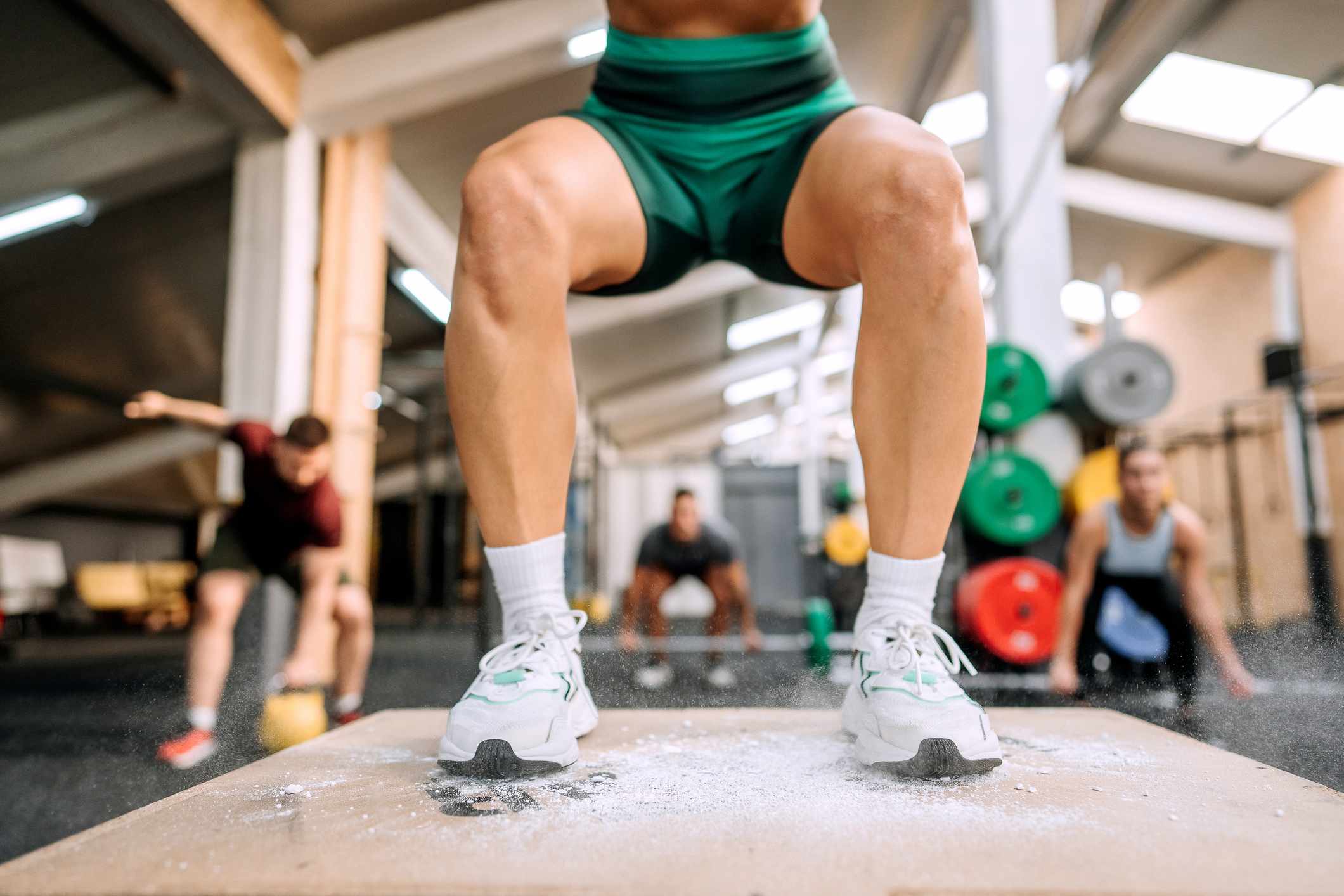
:max_bytes(150000):strip_icc():format(jpeg)/Health-GettyImages-1419581946-1434b4c398d643f080ba2d042e02cac3.jpg "Close up of a person's legs doing a squat in a gym setting")
Credit: Pekic / Getty Images
- Wall sits strengthen your quadriceps, knee caps, and quadricep tendons.
- Doing hamstring curls boosts knee strength and lowers stress and injury risk.
- Clam shells target your gluteus medius and minimus for improved knee stability.
Knee injuries are often caused by a lack of strength or stability in the joint, making it essential to train for healthy knees. Strong muscles, tendons, and ligaments around the knee help reduce strain on the joint and improve overall stability. Here are eight exercises that can help stabilize the knee.
1. Wall Sit
The wall sit is a classic isometric exercise, meaning it contracts the muscle without lengthening the muscle or moving the joints. Wall sits strengthen your quadriceps muscles, patellar (knee cap), and quadricep tendons (which connect the quads to the knee cap).
This exercise is particularly useful if you’ve had a recent injury or pain that prevents you from doing exercises that require more movement. Here’s how to do wall sits:
- Put your back to the wall and slide your feet forward so that when you squat down, your shins are near vertical.
- Keeping your back pressed against the wall, enter a sitting position with your knees bent at around 90 degrees. Hold the position for as long as you can.
- Once you feel you can no longer hold the position, gently stand up and recover.
- Complete three to four sets (one wall-sit equals one set).
2. Prone Hamstring Curl
Hamstring curls help enhance knee health by strengthening the hamstrings—a group of muscles on the back of your thighs. These muscles play a key role in stabilizing the knee joint and work together with the quadriceps to control knee movement, especially during bending and straightening.
Increasing your hamstring strength helps reduce stress on the joint and lowers the risk of injuries like ACL tears or strains. Stronger hamstrings also help with shock absorption and provide better support during activities like running, jumping, or squatting.
Using a hamstring curl machine at a gym, follow these steps to complete the exercise:
- Lie chest-side down (prone) on the hamstring curl machine, positioning the back of your ankles under the padded bar. Keep your core engaged and grip the machine handles.
- Flex your foot so your toes are pointing toward your head. This will help increase the contraction in your hamstrings.
- In one fluid motion, bring your heels toward your butt to lift the bar. Keep your back neutral and core engaged.
- Pause for a second once you hit the end range of motion and carefully control the weight back down, ensuring that you keep tension on the muscle the whole time.
- Repeat for 10-12 repetitions (reps) of the movement and perform three to four sets.
3. Hip Bridge
The hip bridge exercise targets your glutes (your buttocks muscles), which are important for stabilizing the knees. In particular, the hip bridge focuses on the gluteus maximus (the largest glute muscle), providing strength and stability to your knees.
It's essential to keep your core engaged throughout this exercise. Here's how to do a hip bridge:
- Lie on the floor with your legs bent and feet on the ground.
- Press your lower back into the floor beneath you, engage your core, and thrust your hips toward the ceiling.
- Pause when you reach full hip extension and squeeze your butt.
- Hold for a few seconds, and then lower back down with control.
- Complete several more reps and sets.
4. Clam Shell
Clam shells are another exercise for knee stability that targets your glutes. They target your gluteus medius and minimus, which are two secondary glute muscles that are often overlooked in glute exercises.
Here's how to do a clam shell:
- Step into a resistance band and place it above your knees.
- Now, lie on your side and bring your knees up to about 90 degrees.
- With your shoulders and hips stacked, lift your top knee against the banded resistance until you hit your end range of motion.
- Squeeze your glutes and return to the starting position.
- Complete three sets on each side to failure.
5. Step-Ups
This exercise is particularly useful for increasing both your glute and quad strength. It also challenges your balance and coordination, two essential aspects of healthy knee mechanics. Go slow and controlled with this exercise for maximal benefit.
Here's how to perform step-ups:
- Find a chair, box, bench, or any sturdy surface you can step onto that places your knee joint between 45 and 90 degrees when you rest your foot on it.
- Holding light weights in your hands, place one foot on the box and press through your midfoot, extending your hip, and meet your front foot at the top. You can also do this without weights if you prefer.
- Keeping the movement slow and controlled, step back down.
- Do several reps on each side before switching.
6. Leg Extension
The leg extension is an excellent knee-strengthening exercise and a staple of many physical therapy programs. It targets your quads and boosts muscle contraction.
You'll need to use a leg extension at the gym to complete this exercise. Follow these steps:
- Sit upright on the machine, adjusting the seat and lower bar so that your knees are bent at about a 90-degree angle. Keep your toes flexed towards you.
- Grip the handles on the sides of the machine, tighten your core, and extend your legs, squeezing your quadriceps (top thigh muscles) at the top.
- Control the movement as you lower your legs back down.
- Complete several reps and sets close to muscular failure or until you get a good contraction each set.
7. Romanian Deadlifts
Romanian deadlifts (RDLs) are a great exercise for your knees, even though they primarily target the posterior chain muscles. The posterior chain is the muscles on the entire backside of your body, including your hamstrings, glutes, and lower back muscles. The glutes and hamstrings help stabilize the knee joint, which can help support the overall health of your knees.
Here's how to perform a Romanian deadlift:
- Grab a pair of dumbbells that are a moderate-to-heavy weight for you, and hold one in each hand while standing with your feet hip-width apart. (You can also try the exercise a few times without weights to get the form down.)
- Engage your core and keep your shoulders slightly back as you hinge from your hips forward, allowing the dumbbells to approach just below your knees.
- Keep your knees only slightly bent (not locked) and feel the stretch at the bottom position.
- Return to the starting position by extending your hips and squeezing your glutes at the top.
- Complete three to four sets of 12-15 reps.
8. Adductor Machine
The adductor muscles are located on the inner thigh and work together with the hip abductors (outer hip muscles) and other muscles to maintain proper knee alignment during dynamic movements. The adductor machine is great for targeting these overlooked muscles.
Using an adductor machine at the gym, follow these steps:
- First, adjust the seat so that your back is flat against the backrest and your legs are spread as far out as they comfortably can.
- Now, choose an appropriate weight for your fitness level.
- Exhale and slowly bring your legs together by squeezing your inner thighs and focusing on contracting your muscles as you pull your legs inward.
- Bring your legs together until they are almost fully closed, and then control the way back out as you work against the resistance in the opposite direction.
- Complete several sets and reps, such as three sets of 15-20 reps.
Benefits of Knee Strengthening Exercises
Strengthening your knee muscles and related muscles offers several benefits, including:
- Improves joint stability and control during movement, reducing the risk of acute injuries, such as ligament sprains.
- Allows you to function and move more effectively with greater athleticism and agility.
- Helps reduce chronic injury risks like tendinitis (inflammation of a tendon from repetitive use) and other overuse injuries.
- Improves the strength of the muscles that surround the knee to alleviate discomfort in people with knee pain and provide relief during tasks of daily living.
Precautions Before Starting Exercises
Like with any exercise routine, it’s essential to make sure the movements don’t cause any pain. If they do, stop and reassess what may be causing it.
Make sure you're doing the exercise with proper form, and reach out to a professional for extra guidance if you’re unsure.
If you’ve had a recent injury, talk to a movement specialist like a physical therapist to confirm which exercises are safe and will not cause more harm.