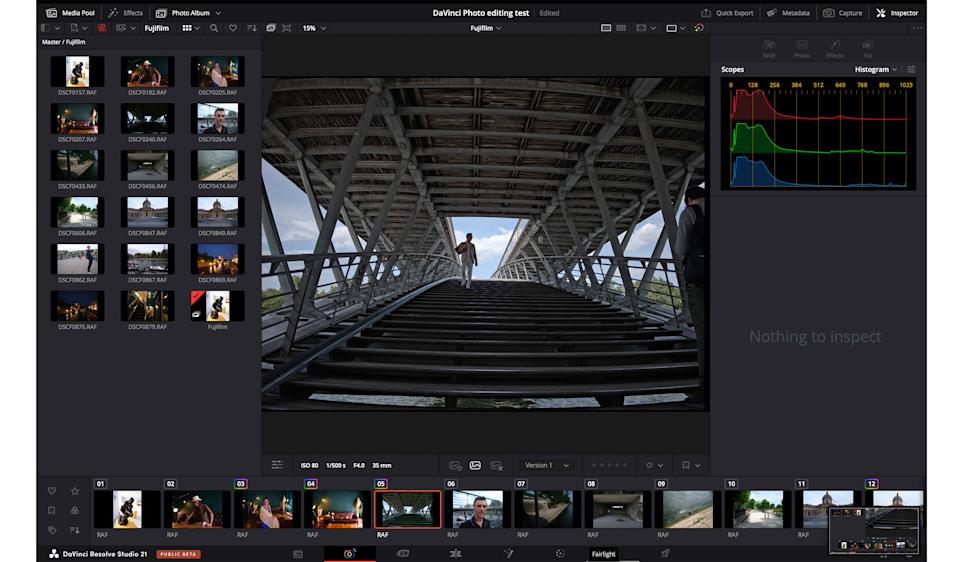

Blackmagic Design’s DaVinci Resolve is a highly capable free color grading tool with a history dating way back to the ‘80s, but it has never been thought of as a rival to Adobe’s Lightroom due to its video origins. Now, Blackmagic Design has released a new version in beta that may change people’s minds about that. The new Photo page lets you import RAW images then adjust them using Resolve’s powerful color grading tools. You even get access to advanced VFX and AI features not found in Lightroom.
When I saw the new feature, I immediately wondered if I could cancel my $20 per month Adobe Photography subscription (with Lightroom CC and Photoshop CC). Apparently, I’m not alone. After trying it out, I believe that I could do so because photos are secondary to video for me. However, photographers who’ve used Lightroom for a long time would likely find it too painful to switch — at least, for now.
The Photo page and Albums
I tested the new Photo page functions and many of Resolve’s new filter effects, but beware that the first beta is still buggy. I used it inside the $295 DaVinci Resolve Studio app (which includes free updates for life), because it has a few extra features not found in the free version.
With that said, DaVinci Resolve 21 now supports RAW photos from Canon, Fujifilm, Nikon and Sony, with other brands to follow. Blackmagic has pledged to support RAW files for new cameras shortly after they’re released like Adobe does with Lightroom. It also supports TIFFs, JPEGs, HEIFs and other photo file formats.

Steve Dent for Engadget
To organize files, you can think of Resolve’s Projects as equivalent to Lightroom Catalogs. You import photos into a Project just as you do video, by dragging and dropping photos or folders into the media pool or using the “import” function. Resolve’s dedicated Media file management page also supports RAW photos. I find Resolve’s import system to be easier and more logical than Lightroom’s, with less steps required. You can import a full or partial Lightroom catalog into Resolve as well.
Once your photos are in the media pool, you can select and organize them by file name, rating, colors, favorites and other tags. DaVinci Resolve Studio also offers a new feature called AI IntelliSearch that lets you visually identify photos based on their content using terms like “cats” or “dancing.”
Photos can then be moved from the media pool into Albums, a new feature that’s similar to Lightroom’s Collections. Albums activate several photo-specific features in the Color and Edit pages. In Edit, Albums appear as simplified, single-track timelines, with each photo shown as a two second clip. That way, you can work with photos in the Color and Fusion pages just as you do with video.
You can reframe and crop images inside Photo (either by typing in the size or dragging) and make basic RAW-style adjustments for settings like exposure, highlights and shadows. For more advanced grading (like you may do in Lightroom’s Develop), you need to jump into the Color page.
Color and Fusion
On the Color page, you get the same functions for photos as video: primary and log color correction, curves, qualifiers, power windows, noise reduction and sharpening. You can also employ Resolve’s class-leading scopes, including parades, waveforms, vectorscopes and histograms.
Once you’ve created an Album, you can select it at the top of the Color page viewer, just as you would a video timeline. You can also label and sort photos as you do in the Photo page.

Steve Dent for Engadget
Resolve’s node-based workflow really shines for photo editing. You can add nodes in series or parallel to build complex grades, then save and apply those grades to multiple images or an entire photo album. Resolve’s system for doing this via “stills” that show your grade is more visual and powerful than the one in Lightroom. You also get support for Resolve’s functions used for video like Look-Up Tables (LUTs) and the new Film Look Creator effect.
All of Resolve’s filter-style effects — like Vignette, Lens Blur and Film Damage — are available directly from the Photo page. Those include some of DaVinci Resolve Studio’s new AI effects (not available in the free version) like AI CineFocus, AI Face Age Transformer and AI Ultrafocus. This gives the app a leg up over Lightroom, which only offers comparable features via third-party plugins.
If you want even more advanced effects, the Fusion page is Resolve’s equivalent to After Effects. There, you’ll find tools like warping, lights and Paint, which lets you do Photoshop-like cloning. Resolve 21 now includes the Krokodove filters with features like warping and text animation.
This raises the question of whether you can do multi-image compositing in the Photo page like you can in Photoshop or After Effects. In short, it’s not possible as Photo only supports one image at a time. However, once you’ve adjusted a RAW image, you can drop it into a video timeline where your color adjustments and other tweaks will carry over. Then, you can stack multiple images and use any of Resolve’s compositing tools from the Edit or Fusion pages. This is pretty clunky compared to using Photoshop, but it’s the only way to combine multiple images for now.

DaVinci’s Resolve 21’s updated export page for photos (Steve Dent for Engadget)
Once you’ve finished grading and adjusting images, there are two ways to export them. One is by the Quick Export function that provides minimal settings like file type, name and resolution. The better method is via Resolve’s Deliver page, which now has dedicated photo functions when you’re working with an Album. There, you can control size parameters like short and long side, width and height or percentage. You can also change the file type, resolution and quality. This function is severely lacking compared to Lightroom though, which offers advanced settings missing from Resolve, like content credentials, watermarking and post-processing.
Finally, another new dedicated feature within the Resolve Photo page is Capture Live View for camera tethering, which only supports Canon and Sony cameras for now. It allows you to connect a camera to your PC via USB-C and control aperture, shutter speed, ISO and exposure compensation directly from the app. You can also view your images using Resolve’s scopes and tweak RAW settings like white balance, temperature, shadows, highlights and more.
Wrap-up
DaVinci Resolve’s new Photo page can do most of what Lightroom does in terms of image adjustments, while adding powerful effects tools that its Adobe counterpart lacks. It’s not yet a substitute for Photoshop, though, as it lacks the organizing, exporting, compositing and pixel-level editing tools found in that app.
For now, the Photo page is ideal for filmmakers who dabble in photo editing, along with hobbyists and power users familiar with Resolve’s formidable grading tools. However, professional photographers may want to stick with Lightroom, because Resolve still lacks certain advanced features, particularly around organization and exporting.
The new DaVinci Resolve Photo page only just launched and is bound to improve greatly over time. If you’re on the fence, download the free version and see if it works for you. A lot of video editors made the same switch from Premiere and have never looked back. Given the current grumbling about Adobe’s subscriptions, I could see many people making the same move from Lightroom to Resolve.

Stephan is the sports journalist for the Maple Grove Report.






:max_bytes(150000):strip_icc():format(jpeg)/GettyImages-2253385503-49d609f27e75489cbb35796a15282f5b.jpg "Hong Kong - November 26, 2025 : Lululemon store at Hong Kong International Airport.")