Almost the perfect floor cleaner for tiny apartments


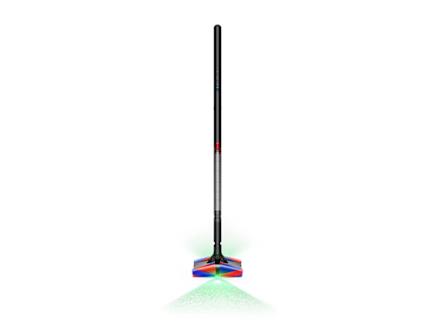
The big deal with Dyson’s new vacuum is how small it is. While “pencil” is certainly an ambitious noun to compare a floor vacuum to, the slender body of the PencilVac Fluffycones ($600) brings to mind mops and brooms rather than hulking cyclone-suction tech and connected cleaning. As we described it last year, it’s the company’s most stick-like stick vacuum yet. Dyson has been repurposing its engine tech into smaller form factors for years, such as its hair dryers. However, this is the first time it’s been utilized for floor cleaning.

Dyson recently launched the PencilVac Fluffy, with a more traditional dual-roller system, but I’m focusing on the Fluffycones iteration and will call it simply the PencilVac for brevity. It combines several delightful design features, and while surprisingly potent, it’s — predictably — not quite able to match the power of its bigger brothers. The entire vacuum weighs under four pounds, which adds to its ease of use. That said, it’s heavier than it looks, as the rod shape holds everything inside.

Image for the small product module

Dyson

The PencilVac is light, mobile and easy to use, making it great for smaller living spaces and quick clean-ups. However, it struggles with thicker carpet and rugs.

Pros

  • Easy and fun to use
  • Slick emptying system
Cons

  • Could be more powerful
  • Struggles with carpet and rugs

With a 40mm-diameter (almost 1.6-inch) handle, it’s usable even with a single hand, if you want to be extra casual in your cleaning habits. It’s also a delight to use. As with several previous Dysons, like the OmniGlide, the dual-roller system seems to help the PencilVac glide across hard floors. It can be pulled and coaxed around furniture, table legs, under low-profile credenzas and more.

When at rest, the PencilVac sits on four central wheels, but once you start cleaning, the suction creates a sort of floating effect. Those four Fluffycone heads are designed to resist hair tangles, with any captured hair bundled like yarn at the tips of each cone for easier cleaning at the center of the PencilVac. The tips of each cone mean the vacuum can reach the edges of my flooring, too. The Fluffycones aren’t really able to dig into the pile, meaning that while they can certainly pull and lift a layer of dirt and dust, anything deeper will stay there.

Dyson PencilVac Fluffycones review

Image by Mat Smith for Engadget

That said, the PencilVac is a dedicated hard floor cleaner. If your home is entirely hardwood or has lots of tile, then it’s not an issue. But if you have carpeted rooms (or large rugs), you might want to consider other models. Also, at higher suction levels, the PencilVac’s rollers would occasionally cut out while vacuuming carpets and rugs.

The PencilVac is also equipped with front and back Dyson Detect lasers, making it easier to see where you’ve missed (and how terrible your floor cleaning habits are). Compared to bigger, more powerful models like the V15 Detect, the PencilVac had a greater tendency to spit out dirt when overwhelmed by larger amounts of debris. This only happened for me when I pushed the limits of what the PencilVac could handle: a handful of garden soil on my hardwood floor.

Because it’s 2026, of course, it’s a connected vacuum, too. When I put together and charged the PencilVac, the first thing it does is project a QR code for pairing. A quick firmware update later and it was ready for use. The only feature in the MyDyson app that you might find useful is maintenance reminders (i.e., when to clean the filter). Everything else, including a battery readout, is built into the handle.

Dyson PencilVac Fluffycones review

Image by Mat Smith for Engadget

Everything else is built into the handle. Compared to Dyson’s other stick vacs, there is no removable dust canister or battery block. The collection bin is cleverly integrated, drawing in dirt and using the same suction to compact it with force. When you need to empty the compartment — which holds a surprising amount (0.8 liters, according to Dyson) — you remove the cleaning head, point the body at your garbage can and ‘slide’ the dust (compacting it further in the process) into your trash can. The collection area is also see-through, so you can see everything you’re pulling into the PencilVac build up like a sort of gauge. When emptying the stick vac, I also noticed it doesn’t produce the dust cloud you often get with vacuums, which is another nice improvement.

Unlike its other stick vacuums, Dyson’s PencilVac comes with a free-standing charging dock, instead of a wall mount. This makes storage a little more versatile. If you’re a renter, there’s no need for any drilling. I think this also speaks to how it’s meant to be used: briefly, in bursts.

To that point, battery life seemed to be around 20 minutes, depending on the power level used and how dirty the surfaces were. Running entirely on boost, I got under 10 minutes of use. This weakness is exacerbated by a sluggish charging time of over three hours. For smaller spaces and not-too-messy lives, that’s more than enough clean time, though.

Dyson PencilVac Fluffycones review

Image by Mat Smith for Engadget

The PencilVac also comes with that Dyson premium, too, priced at $600. That’s still less than the company’s other recent stick vacuums. For example, that’s $50 less than the aforementioned V15 Detect. If your home has a lot of carpeting or rugs to clean, the bigger, more powerful models might be a better choice. The newer PencilVac Fluffy has a more traditional dual-roller system and it’s also $150 cheaper.

With its minimalist form factor, the PencilVac is still an engineering marvel. Its high degree of mobility makes it easy to clean in tight corners and between furniture. I just wish it were slightly more powerful.


Source link

Leave a Reply

Subscribe to Our Newsletter

Get our latest articles delivered straight to your inbox. No spam, we promise.

Recent Reviews


UFT vs Selenium – Table of Content

What is selenium?

Selenium is an open source tool that made a sensation when this arrived in the business sector. It’s a free software with all the great features and was therefore able to quickly gain market share where QTP was a figurehead. Selenium provides various functions and is premised on larger-scale java scripting.

Become a master of Selenium by going through this HKR Selenium Training!

Why selenium?

Selenium facilitates testers to write the code to write the script in one operating system and to run the same test scripts on multiple browser platforms. WebDriver is now becoming part of the W3C standard for all browsers, thus designing browsers that will obviously support Selenium.

The important feature of this test automation tool is that it enables testers to test user experience modules, provides a wide variety of test options, results were compared and finally verifies whether or not they are consistent with the expected application behavior. Selenium’s “SENDKEYS” method equates test scripts written in different languages into Selenium in an accurate manner.

Selenium is considered as an important tool because of its attractive benefits such as transparency, platform independence, fosters continuous integration efforts, reduces the turnaround time and can be easily integrated with other automation tools as well.

Acquire Selenium with Ruby certification by enrolling in the HKR Selenium with Ruby Training program in Hyderabad!

UFT Training

  • Master Your Craft
  • Lifetime LMS & Faculty Access
  • 24/7 online expert support
  • Real-world & Project Based Learning

What is UFT?

It is one of most major trading players on the market. It primarily uses VB Scripting as its scripting language. It’s very simple to use and packed with advanced features. It uses the Object Repository to identify and capture objects. It can be easily integrated with many other automation tools, such as the Quality Center, and can update the results.

Why UFT?

UFT One/QTP is a Micro Focus automated testing testing tool that uses computerized analysis to assess glitches in a test application.UFT One is mainly used only for functional testing, regression and service testing. Using UFT One, you can optimize user behavior on a web-based or client-based software program and test and recognize bugs on the same actions for different users, different data sets, different Windows operating systems and/or different browsers.

UFT One is among the most popular commercial automation testing tools available in the market today. It is recognized for its simplicity of use and assistance by the vendor and a huge automation tester community. Due to this reason, qualified UFT One experts have always been in demand.

Brief History of Selenium

Jason Huggins developed Selenium in 2004 in Chicago. He was working at Thoughtworks as an Engineer on web app testing. Using JavaScript, Jason developed a program for testing. After using it, he realized the faults in manual testing. He named it JavaScriptTestRunner initially, but after that, he renamed it Selenium core and made it open source.

But still, there were some issues with using it. If someone uses JavaScript with a different domain name, it is forbidden to do so. For this, testers must install the Selenium Core and Web Servers, including web app testing that belongs to the same domain. Thus, another Engineer from ThoughtWorks, Paul Hammant, developed a Selenium Remote Control (RC) solution. Later, two other components, Selenium Grid and Selenium IDE, were created by two other professionals in 2006.

Brief History of Selenium

Further, in 2008 the core team of Selenium automation testing combined Selenium RC and Web Driver and brought Selenium 2. After many years changes & improvements took place in it, and it paved the way to release Selenium 3. 

Later, after a few years, Selenium became an open-source tool and has become a more powerful tool in the market. Many companies use Selenium for web automation testing of various apps. It makes web testing easier and faster.

Career Aspects 

Many organizations, especially those which are service-based, use Selenium which is now a popular open-source tool. Many companies use it for web and application testing. It is highly adaptable due to its flexibility to integrate with major programming languages. Further, there is good growth for Selenium in the future, and there are many job opportunities in this field. It is easy to learn and practice for everyone interested in web automation testing.

Brief History of UFT 

Mercury Interactive initially developed UFT in 1998, and its first version was Astra QuickTest. But later, in 2006, it was acquired by HP, and it became HP QTP. Later, in 2011, HP combined the two tools, “HP Service Test” and “HP QuickTest Professional,” and released a new device with the name “HP UFT 11.5” (Unified Functional Testing). Then, in 2016 was completely sold to another company Micro Focus which is managing and supporting UFT.

Career Aspects

UFT is a more powerful and useful tool in comparison to Selenium. Due to its huge license cost, many business entities still need to be ready to adopt this tool for automation. Moreover, UFT integrates with many tools, mostly paid tools. They are reducing their demand in the market.
For beginners in Automation, UFT is not the right fit to learn as there are only a few job opportunities for freshers. Further, it offers a free trial of 60 days, after which you need to buy the tool for further usage. It is a major drawback here. Also, there needs to be more information available on UFT, which makes it difficult to learn in-depth.

If you want to Explore more about Selenium? then read our updated article – Selenium Tutorial

Software Testings, uft-vs-selenium-description-0, Software Testings, uft-vs-selenium-description-2

Subscribe to our YouTube channel to get new updates..!

Comparison between Selenium and UFT:

Here we are going to discuss the key differences between UFT and selenium in detail.

Environment virtual support:

UFT: Deploy UFT to provide Citrix, AWS, and Azure virtual worlds, or run web and mobile tests from Docker containers.

selenium: It can also be integrated with those environments as well.

Software type:

UFT: UFT is a desktop based application.

Selenium: It is a s et of API’s

Cost:

UFT: It is a paid version, you need to purchase the license in order to use it.

Selenium: Where as selenium is an open source and free tool where you need to download and use it.

Application Type:

UFT: It supports web, mobile, API, hybrid, RPA, and enterprise apps.

Selenium: Selenium will only be used for web-based applications. It is a big downside of selenium over QTP.

Application Languages:

UFT: UFT could be used to test the functionality, the service layer and the database layer for all three layers of the application. 

Selenium: Selenium is only used to test the front end or the interface layer.

Supported Languages and Browsers:

UFT: It supports visual basic script language and chrome, firefox, safari and IE browsers.

Selenium: It supports java, python, ruby, perl PHP, javascript languages, and safari, firefox, chrome,IE, opera , headless browsers, etc.

Frequently asked Selenium Interview Questions and Answers !!

Operating systems and IDE:

UFT: Supports microsoft windows and comes with builtin UFT IDE

Selenium: Supports microsoft windows, apple OS X and linux, and comes with eclipse, intellij and other IDe that are supported by Java.

Supported technology:

UFT: Supports almost every significant software application and environment, such as SAP, Oracle, Salesforce, mainframes, embedded frameworks, headless browsers, and more.

Selenium: Selenium is struggling while automating SAP, Salesforce, mainframes applications.

Required coding skills:

UFT: You needed less programming knowledge as it provides keyword-driven testing that streamlines test creation and maintenance. Acquisition flows from the application screens and utilize UFT’s robust recording/replay capture technology.

Selenium: You need to have a good knowledge of programming language. For each Selenium binding, you need to know the programming language.

Test execution performance:

UFT: It needs more system resources. It can operate on Windows VM that uses more resources and needs more maintenance.

Selenium: Selenium requires less system resources and can be used in Windows or Linux VM applications. Linux VM is lightweight compared to Windows VM.

Tools integration:

UFT: Can be integrated with limited tools and mostly that are paid tools only

Selenium: Can be integrated with paid tools very easily.

Test reports:

UFT: Test reports are generated by default.

Selenium: For test reports these are needs to be integrated with other tools

Career Growth:

UFT: UFT offers less jobs, limited scope for expansion

Selenium: Selenium comes with more scope, more jobs in future as well.

Cost

UFT: HP UFT is a license-based testing tool that offers a trial period of 60 days to its new users. But after that, you need to buy the license, which costs much higher.

Selenium: Selenium has a good market share compared to HP UFT, an open-source tool. Many enterprises prefer to use it to manipulate the Selenium architecture as needed. Also, they can expect much better performance while conducting tests.

Join our Selenium Training In Kolkata today and enhance your skills to new heights!

UFT Training

Weekday / Weekend Batches

Conclusion

So we’ve seen so many discrepancies between UFT and Selenium. The main key driver is the automation cost. If you’ve a budget plan and you can manage QTP, it’s best because it has various characteristics. If your project has a lower budget, go to Selenium, but you need to make more effort.

Selenium is limited to the web page. If your test cases need to communicate with your desktop, such as uploading files, download files a file and checking, etc., Selenium may not function reliably in those instances, while UFT can easily streamline those contexts. Integrating Selenium with Test Management Tools is no easier than UFT. Selenium needs to be integrated with various reporting tools and managing.Selenium needs to be incorporated with various tools for reporting and managing data that are accessible in UFT by default. UFT scripts are going to be more stable than Selenium. UFT is rich in performance available to Selenium.

With the help of disitivcitve feature of UFT it can easily reduce the amount resources need in writing the scripts whereas selenium requires more resources to write lines of code.But you’re going to get less help available on UFT’s public online forums, but it has proper support as it’s a paid tool. 

Related Articles:


Source link