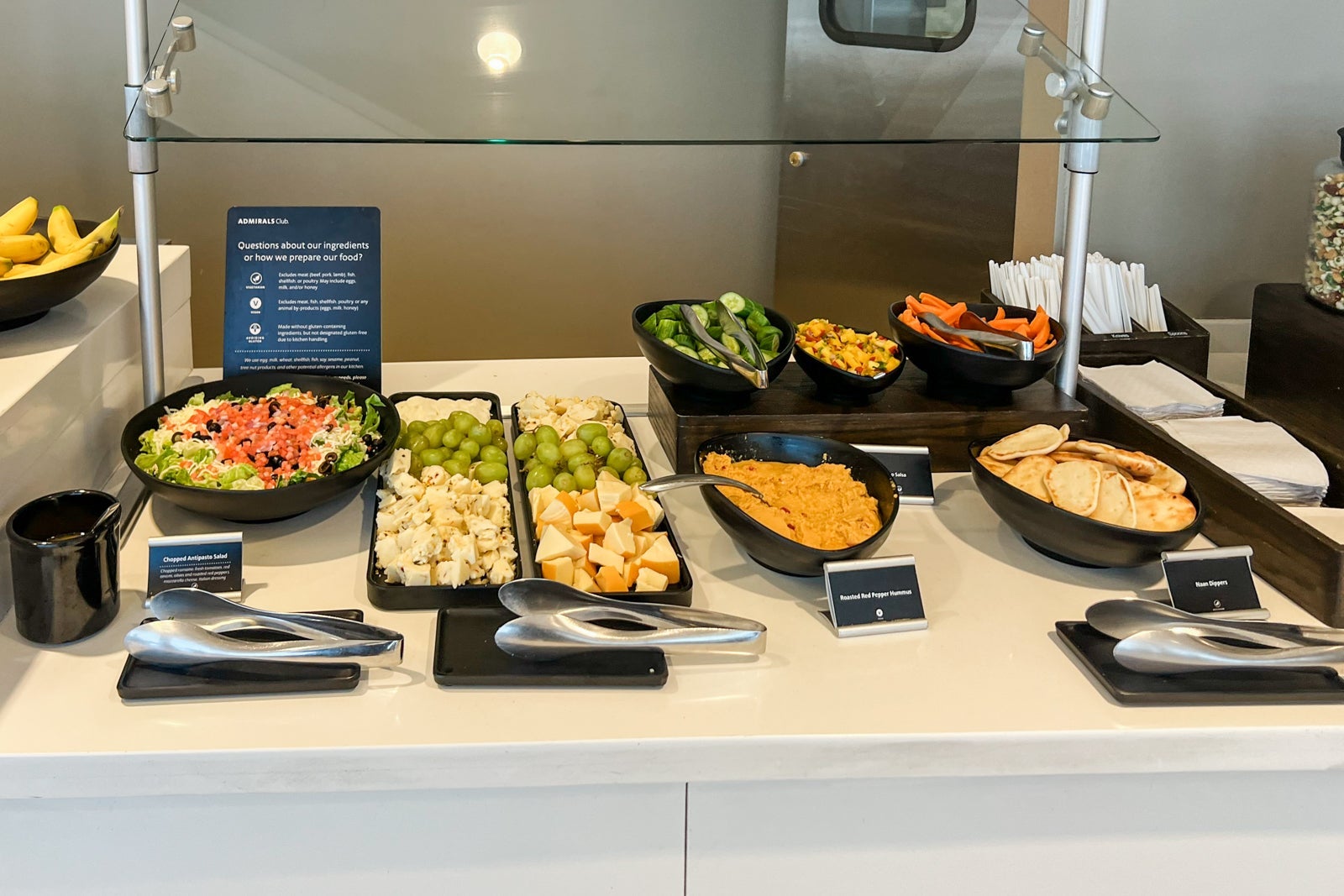
American to upgrade its lounge food with better (hot) meals


American Airlines is planning to step up its food game at its airport lounges in the coming months.

If you’ve ever grumbled about the dining offerings inside an Admirals Club, this should be good news: The airline is promising “more complete meal offerings” served with “noticeably elevated presentation.”

The move comes as American is seemingly trying to close a gap with Delta Air Lines’ Sky Club network.
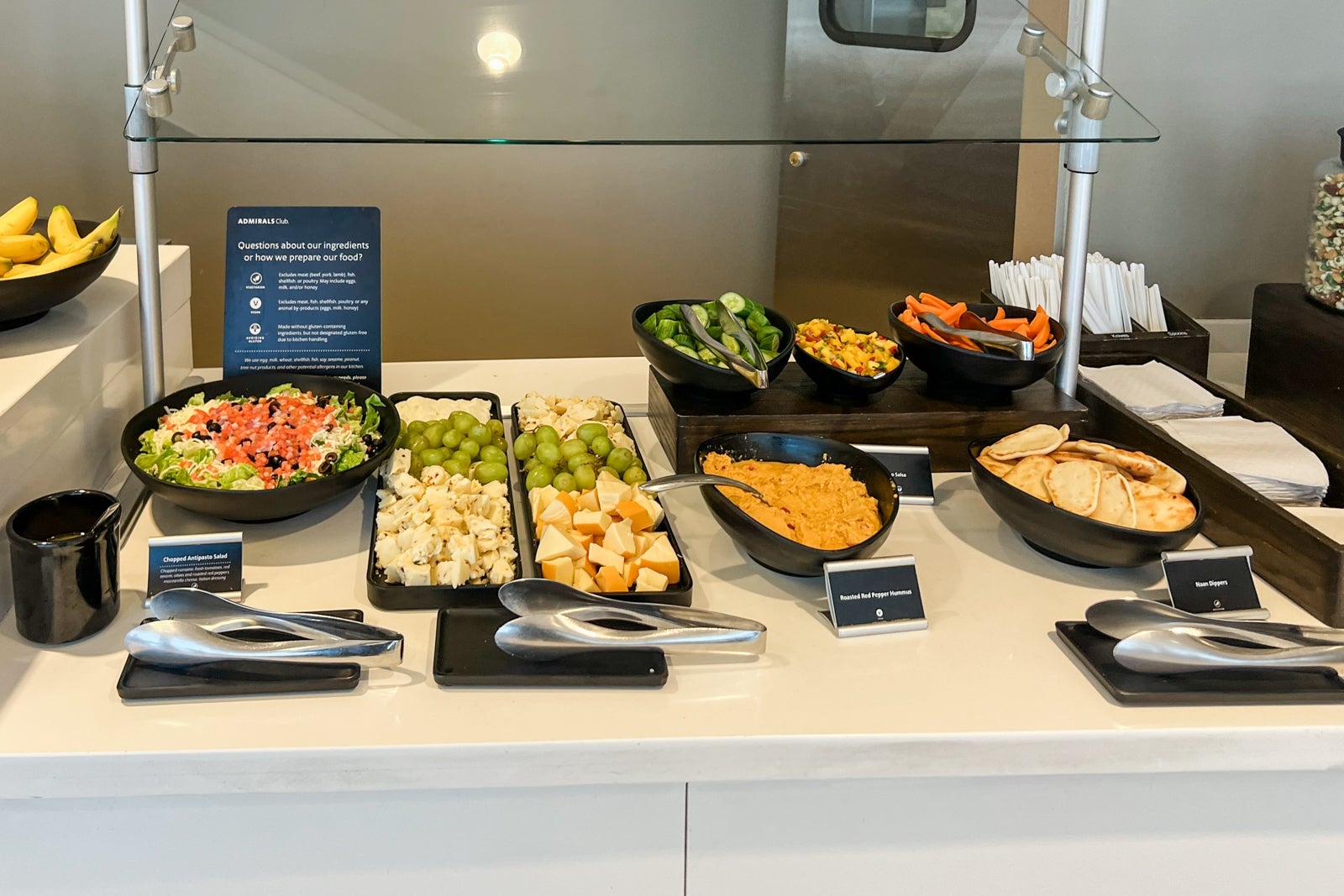
inside lounge at O'Hare
Admirals Club at O’Hare International Airport (ORD). CLINT HENDERSON/THE POINTS GUY

American’s Admirals Clubs gained recognition this week in TPG’s Best Airlines Report, where our analysis found the network offers travelers the best bang for their buck of any U.S. airline lounge portfolio.

Related: Best Airlines Report 2026

But Delta’s Sky Clubs have long offered heartier spreads than Admirals Clubs.

As part of the culinary glow-up announced for its clubs Thursday, American plans to put out two additional hot food items in its Admirals Club to help customers build a true meal. Members will also start to see an “upgraded” charcuterie station and menu items that will rotate more regularly.

American has acknowledged for months that it needs to upgrade its lounge dining options, as its competitors — airlines and credit card issuers alike — have given customers a taste for better cuisine before they board a flight.

“If you look at a decade ago, a lounge is where you went to have a cup of coffee and a snack. So it definitely has changed,” American’s chief customer officer, Heather Garboden, said in December while speaking at an industry conference.

Reward your inbox with the TPG Daily newsletter

Join over 700,000 readers for breaking news, in-depth guides and exclusive deals from TPG’s experts

“I think now you go into a lounge,” Garboden added, “the expectation is that you can order an a la carte menu.”

Flagship Lounges set for some upgrades, too

Speaking of a la carte, American isn’t just planning to up its Admirals Club food game.

The Fort Worth-based carrier also said it will roll out scan-to-order menu offerings at all of its higher-end Flagship Lounges.

American first rolled out that concept last year at the premium outpost it opened at Philadelphia International Airport (PHL). Rather than selecting their dishes from a buffet, guests can scan a QR code to order, like they would at a restaurant.
ZACH GRIFF/THE POINTS GUY

The setup isn’t quite the true restaurant-style setup Delta has brought to its top-of-the-line Delta One Lounge facilities. However, it should be a step up for travelers who can access AA’s top-tier clubs, which include business-class flyers and high-level AAdvantage elite members departing on long-haul flights.

Flagship Lounges will also get cheese monger stations in the near future.

Veuve and Caymus, anyone?

It’s not just food.

American on Thursday said it will also upgrade its wine offerings in its Admirals Clubs.

An elevated top-shelf selection — including Veuve Clicquot rose and cabernet sauvignon from well-known Napa Valley label Caymus Vineyards — will be available for sale soon (a stark contrast, I might add, from the boxed wine it’s serving these days in economy on long-haul flights).

Bottom line

American’s upgrades to the “soft product,” its lounges, come as the airline is planning some hard hat-type updates to its club lineup, too.

In the last year, the carrier has announced new Admirals Clubs for a host of cities — from Charlotte to Austin, Nashville, Chicago and Washington, D.C.

It’s also planning a new Flagship Lounge for its North Carolina hub.

Entering 2026, the American had promised a “steady stream” of lounge announcements

Related reading:


Source link

Leave a Reply

Subscribe to Our Newsletter

Get our latest articles delivered straight to your inbox. No spam, we promise.

Recent Reviews


Python Ogre – Table of Content

What is Python Ogre ? 

Python-Ogre is the Python language binding to the OGRE 3D engine. It is intended to offer the performance and the functionality of OGRE(Object-Oriented Graphics Rendering Engine) with the availability and user-friendliness of Python in a way that makes the development of 3D games easier and quick and makes the OGRE engine more available to beginners, who could otherwise be intimidated by the technical aspects of writing in C++. The Ogre engine has lower performance than the original C++ demos. However, the original OGRE engine delivers very high performance, and the Python-Ogre performance is even more than acceptable for all games, except those that are more graphics-intensive ones.

History: 

The PyOgre project started at the beginning of 2005 when a Python binding for OGRE was tried for the first time using Boost. Python of the Boost C++ library through two members of the Ogre3D community, Federico Di Gregorio and Clay Culver. This effort was ultimately unsuccessful, which led to the use of SWIG as a basis for C++ binding. This method turned out to be quite successful, offering the community a limited and error-prone implementation to some extent, but nevertheless an implementation. 

By the middle of 2006, Lakin Wecker started working on Python-Ogre based on the Boost. Python libraries, as has been attempted in the past. It was developed in parallel to the PyOgre project. He was assisted by Andy Miller, who later became responsible for the development of the project with the help of Roman Yakovenko, Joseph Lisee, and Ben Harling during the engine evolution.

PyOgre development was discontinued in the middle of 2007 and was formally replaced by Python-Ogre. In 2008, Andy Miller was actively involved in including new features to Python-Ogre, along with supporting and maintaining it. Since January 2014, python-ogre.org’s main site has been disconnected, but wiki.python-ogre.org still exists. 

Become a python Certified professional by learning this HKR Python Training !

Python Training Certification

  • Master Your Craft
  • Lifetime LMS & Faculty Access
  • 24/7 online expert support
  • Real-world & Project Based Learning

What is the use of Python Ogre? 

  • Python-ogre is cross-platform and open source.
  • Python is significantly faster in prototyping than C/C.
  • Python-ogre is going through development so that you can create an executable Windows, Linux, and Mac for distribution with some effort.

How to install python ogre?

Following are the step to be followed for the installation of Python-ogre:

  • To install Python-ogre, you need to Download Python-ogre Windows binary packages.
  • Then run Python “setup.py” install from the Python-ogre root directory(from the location you have unzipped the file)
  • Switch to the demos/xxx directory (based on what you want to execute).
  • Execute python demo_xxx.py.

Python ogre library:

Following are the libraries that are supported now or have already run with the Python-Ogre engine. Some specific libraries are indicated in each version. For all libraries listed, demos are available. But, not all the demos work because of the constant evolution of the codebase and the limited number of active developers.

Renderer

  • Ogre 1.4.9 – Legacy version
  • Ogre 1.5 – “Shoggoth” experimental software build
  • Ogre 1.6 – official release
  • Ogre 1.7 – “Cthugha” experimental build, with full DirectX 10 support.

GUI

  • Beta GUI: Compact and lightweight OGRE GUI library
  • CEGUI: Completely equipped general-purpose video game GUI library
  • Navi: OGRE GUI library based on HTML/CSS/JS
  • Quick GUI: OGRE GUI library based on Widget and user-friendly
  • Hikari: OGRE GUI library based on Flash

I/O

  • OIS: Standard OGRE input library, permitting the buffered, object-oriented input

Audio

  • Open AL: Cross-platform audio API mainly used with Ogre3D

Physics

  • Bullet: Complete physics engine with similar a feature set of proprietary libraries, providing both rigid and soft body collision detection
  • ODE: Open source rigid body with collision detection library
  • Newton: provides real-world physics simulation, in which accuracy and the real-world physical parameters are intended over performance and the latest features 
  • PhysX: high performance, proprietary, Popular, and fully featured library
  • NxOgre: Wrapper for the library – PhysX and the Ogre3D, including an editor and other useful features based on Ogre3D.

Effects

  • Particle Universe: scriptable particles will affect engines which makes it easy to create complicated particle effects.
  • Lib Noise: open-source, Portable, consistent noise-generating library
  • Caelum: Realistic weather, atmosphere, sky and lighting simulation

Acquire Websense certification by enrolling in the HKR Websense Training program in Hyderabad!

Programming & Frameworks, python-ogre-description-0, Programming & Frameworks, python-ogre-description-1

Subscribe to our YouTube channel to get new updates..!

Python ogre compatibility and Support 

Python-Ogre is compatible with all the platforms that OGRE supports:

Microsoft Windows: Binaries can be found on Python-Ogre forums.
Linux: Build instructions are available from the Python-Ogre wiki site. An Ubuntu binary is in the process of development.
Mac OS X: Build instructions are available in the Python-Ogre wiki site. Python-Ogre is based on Mac OS X 10.4 “Tiger” as well as Mac OS X 10.5 “Leopard”.
 

Support

The Python-Ogre wiki includes all the build instructions for OS Platforms like Windows, Linux, and Mac, along with the tutorials and example code snippets. Ogre3D is hosting the official Python-Ogre forum to assist developers in using the engine.

Python Training Certification

Weekday / Weekend Batches

 Conclusion :  

In this blog, we have covered all the basic concepts of Python-ogre like Python-ogre history, purpose, installation steps, Python-ogre libraries, and Python-ogre compatibility and Support. I hope you found this article helpful. For more topics on Python-ogre, stay tuned to HKR trainings. 

Related Articles:

1. Python List Length

2. Python Partial Functions

3. Python Split Method

4. Running Scripts in Python


Source link