Business and Tech Reading — $125m Law Firm “Sale” Sheds Light on Several Firm Funding Deals, MSOs Mean Big Business for Law Firms, Law Department AI Fights in Focus


Arizona Law Firm Severs Back Office for $125 Million Investment” —

  • “Rafi Law Group is separating back-office services from its legal operation to receive $125 million from an outside investor, the personal injury firm announced Monday.”
  • “Rafi’s move to create a management services organization, which separates functions such as accounting and marketing from legal offerings, is a creative approach by firms to gain outside investment while bypassing state requirements that lawyers own firms. After catching on in physician-owned medical practices, the strategy is gaining traction in the legal industry though remains rare.”
  • “‘MSOs keep that separation,’ Rafi said. ‘Attorneys maintain their independence so that they can make those decisions that are best for the clients.’”
  • “Rimon PC [California] in 2019 became one of the first law firms to sell its back office functions, now known as Briefly, to private equity firm AlpineX. McDermott Will & Schulte said in November it is in preliminary discussions about selling a stake in its law firm to outside investors, and Quinn Emanuel founder John Quinn said in an interview last month that he envisions MSOs becoming more common.”
  • “Some MSOs are entities spun off from law firms so that outside investors can take direct stakes, while others are created to offer services directly to firms. Texas-based Certum Group, which specializes in litigation finance and related insurance offerings, acquired an MSO in October targeting mass-tort firms and has already partnered with several of them.”
  • “Mass tort and personal injury firms have been described ‘ground zero’ for MSOs.”
  • “MSOs offer a different route to outside capital than Arizona’s alternative business structures. Though the firm is based in the state, Rafi said the MSO better suited the firm’s needs since there are guardrails that prevent the intertwining of outside capital into the law firm.”
  • “Alternative structures have caught the attention of legislators. California enacted a law in January that blocks alternative law firms from operating in the state through arrangements with local firms. Illinois introduced a similar bill in February, which also bans firms from sharing fees with firms operated by non-lawyers and also includes MSOs.”
  • “Rafi said he hired attorneys from Greenberg Traurig to help navigate the MSO through ethics guidelines and state regulations. He said he’ll continue to keep a close eye on legislation.”

The Back-Office Back Door to Nonlawyer Investment in Law Firms” —

  • “Managed service organizations running the back office of many medical and dental practices have already gained prominence as private equity’s structure of choice for entering the health care sector, according to lawyers brokering these so-called MSO deals. Now, investors are eyeing similar opportunities in the legal industry.”
  • “Briefly, backed with private equity capital from AlpineX, has grown by acquiring the back-office assets and personnel from distributed firms OGC, Scale and Rimon, among others, and bundling them into a single facility that now operates under the name Briefly. Federate seeks a similar trajectory.”
  • “But unlike the private equity-backed Briefly, Federate co-founder T.J. Henry, a former chief legal and growth officer at Rimon, isn’t accepting private equity capital for his newly created legal MSO venture.”
  • “Even though such an arrangement wouldn’t violate Rule 5.4 of the ABA’s professional conduct code, Henry said he wants to avoid any ‘adversarial relationships’ between lawyers at Federate’s firms and investors seeking to profit off the back office. Instead, Henry said he’s approaching various professionals in the legal industry, lawyers and nonlawyers alike, whose incentives are aligned with his.”
    ‘What we’ve learned in prior situations is that … investments from private equity come with complications because you’re beholden to fund timelines and the idea that you need to exit,’ Henry said.”
  • “Charles Rutstein, CEO of Briefly sponsor AlpineX, rejected the notion that private equity’s business model was misaligned with law firms and said fund timelines aren’t as constricting as many think.”
  • “Rutstein said Briefly is still in an initial hold period with AlpineX and it’s too early to say if or when AlpineX will sell, adding, ‘there’s no urgency’ on AlpineX’s part.”
  • “‘Businesses bought by private equity sponsors grow quickly with investment from new owners,’ he said, noting that private equity has already permeated legal services through tech vendors like Intapp. ‘Private equity brings capital, talent and experience to dramatically improve experience for attorneys that we serve,’ he said.”
    Rutstein added that, in the example of Briefly, the upshot is a sophisticated back-office operation for small firms that couldn’t provide one on their own.”
  • “The management and fee agreements between MSOs and the practices they serve are highly regulated so as to discourage unqualified management of clinical practices and the funneling of capital away from patient care, according to lawyers involved in MSO transactions.”
  • “MSOs have become a common vehicle for private equity firms to profit from clinical practices without running afoul of regulations concerning nonphysician ownership, said Ericka Adler, health care group manager at Ohio-based midsize firm Roetzel & Andress, but they are careful not to structure the fee as a de facto fee-sharing agreement.”
  • “Rutstein said Briefly and AlpineX retained legal ethics counsel to structure their agreements with firms, going to pains to refrain from interfering in the professional independence of the lawyers they serve.”
  • “Briefly’s fees are structured on a per-attorney, per-month basis to decouple it from attorney professional independence, Rutstein said, adding that ‘it makes no difference for us to take a case to trial or settle it. We don’t make a dollar less in that scenario.’”
  • “Briefly’s contracts provide it with the discretion to raise prices, but fee increases are ‘not tied to [firm] financials in any kind of direct way,’ but to inflation and Briefly’s own cost of services. This way, there’s no arguing that there’s fee-sharing with the law firm.”
  • “Rutstein said he didn’t know whether Briefly’s service agreements stipulate the division between legal and nonlegal functions, as D’Agostini said is common in the medical field. But Rutstein said he wouldn’t have a problem signing such a contract. Rutstein said AlpineX and Briefly refrain from getting involved in the business operations of the law firms they serve, such as brokering a merger between any of the firms.”
  • “While some view nonlawyer ownership of law firms as a welcome influx of capital and business acumen to a stodgy business model resistant to innovation, others see a troubling encroachment on the independence of lawyers by investors with no fiduciary duties to clients.”
  • “From the elevation of nonlawyers to C-level positions to litigating cases with financial support from nonlawyer investors to Arizona and Utah’s experimentation with nonlawyer investment and ownership, there are many ways for nonlawyer professionals to control and profit from the provision of legal services.”
  • “Eric Pacifici, founding partner of SMB Law Group, said the infusion of capital and business know-how offered by private equity should be welcomed by the industry.”
  • Attorney Stephen Younger, a former president of the New York State Bar Association, said nonlawyer profit sharing in Arizona and Utah has failed to deliver on the promise to close the access-to-justice gap and has instead funneled capital out of the practice of law to private equity and other nonlawyer investors.”
  • “There are also potential conflicts of interest if a lawyer cross-sells services of a nonlawyer partner or a nonlawyer investor pushes a trial lawyer to compromise his or her duty of care for a paycheck, Younger said.”
  • ‘If you plant a (venture capital) person at the table, there’s greater risk of them saying, ‘Just settle the case’ as opposed to saying, ‘She’ll do better next year because we’ll have a trial date next year,’’ Younger said.”
  • ‘The legal profession is governed by professionals,’ Younger continued. ‘They’ve gone to law school for three years. You can’t just ignore that and say we’re going to abolish licensing of lawyers. We need to have licensing to protect consumers. I’m all for tech companies, but … I don’t think we should be turning keys to the profession over to tech companies.’”

Legal Department Infighting Breaks Out Between AI Doubters and Devotees” —

  • “AI is causing infighting on legal teams, as lawyers with deep-seated distrust of the technology clash with those eager to leverage it for greater speed and efficiency. That was one of the findings of a new survey of 252 legal professionals on legal department AI use. The report, released by the legal staffing firm Paragon Legal, found that while AI tools have become fixtures in legal departments, skepticism about their reliability runs deep.
  • “Data for the survey was collected in October 2025.”
  • “According to the survey, 67% of legal professionals said they have had to correct AI-generated work, and only 21% said they placed ‘high trust’ in AI-generated legal work, while 42% said they had little to no trust at all.”
  • “There is little appetite among those surveyed for delegating high-stakes tasks to AI. Fifty-eight percent of those surveyed said they would not feel comfortable submitting an AI-drafted document to a regulator or court. The findings suggest that even as legal teams integrate AI into their workflows, attorneys remain reluctant to cede final judgment to the technology because of a significant trust gap.”
  • “The survey arrives as the legal industry continues to grapple with where to draw the line on AI delegation. OpenAI earlier this year moved to halt the provision of direct legal advice through its products, a signal that even the most prominent AI developers are still working through the professional and ethical boundaries of the technology in legal contexts.”
  • “‘For in-house leaders, this shift signals a need for balance, not retreat. Legal departments should continue testing AI for routine, low-risk work while reinforcing the human oversight that protects quality, compliance, and reputation. The goal isn’t to eliminate human input; it’s to deploy technology in ways that make your people more effective,’ Paragon wrote in its analysis accompanying the survey data.”
  • “The survey identified several factors dampening enthusiasm. When asked what would most increase their trust in AI systems, 41% of respondents pointed to mandatory human sign-off requirements, while 20% cited explainable decision-making and 17% called for built-in compliance guardrails.”
  • “Notably, 15% said nothing would make them trust AI regardless of safeguards, a contingent that legal technology vendors may find difficult to win over.”
  • “The top concerns of automating legal work included hallucinations and lack of accuracy, ethical concerns, liability exposure and the possibility of data breaches.”
  • “Adoption is also generating friction internally. Nearly half of respondents—47%—said AI automation had sparked conflict within their legal teams, a finding that points to unresolved questions about roles, accountability and quality control as departments scale up their use of the technology.”
  • “Paragon also asked respondents how AI has made their work better, and 69% responded that it improved the speed of their work, while 39% said it lowered costs and 31% reported it increased consistency.”
  • “Sixty-eight percent of those surveyed said their departments plan to automate new functions in 2026, with 46% saying they expected their teams’ use of AI to ‘increase moderately.’ Half of respondents said they felt pressured to appear more ‘tech forward’ by experimenting with AI, while 67% reported that they’ve already experimented with AI to write or improve internal policies.”


Source link

Leave a Reply

Subscribe to Our Newsletter

Get our latest articles delivered straight to your inbox. No spam, we promise.

Recent Reviews


SAP business workflows:

Business Workflows are used in SAP systems to execute business processes in applications. Workflows are an important component of the SAP system because they aid in the design of business processes, which can range from a simple release to a complex repeated business process such as creating a material master, among other things.

SAP Business Workflows are predefined in the SAP R/3 system, but users can also create their own. The workflow enables users to manage business processes efficiently and in accordance with compliance.

Workflows ensure that the correct information is sent to the correct person at the correct time and in the correct sequence. 

To complete a complex task in the SAP system, such as invoice approval or purchase request, several steps must be taken. These steps can be carried out manually or through formal communication channels such as email, notes, and so on. When tasks are performed manually, there are some common issues that arise, such as 

  • Tracking the task status is difficult.
  • Managing Inefficiency
  • Tracking formal communications is difficult. 
  • Keeping a deadline 

SAP workflow

The image above depicts the SAP Workflow process. It is a business process automation tool that works consistently across all applications. As you can see, it is appropriate for business processes that involve multiple people or groups of people.

Business workflows could be seamlessly implemented with Organization Management and SAP NetWeaver BI for analysis purposes, allowing you to quickly identify the business processes that are best suited to your organization.

 Become a SAP Certified professional by learning this HKR SAP Certification Training !

Why do we need sap workflows in business processes?

Workflow is required in business processes in SAP for a variety of reasons. Wait time is the longest duration in any business process.

Raising a Purchase Order, an Invoice, and a Sales Order all require approval from specific stakeholders and involve multiple steps. As a result, a significant amount of time is added to the cycle.
Auditing and Compliance – Areas at which auditing is needed or specific compliance must be based on court rules, SOX, and so on. They are difficult to manage with manual business processes.
Processes that require regular repeated steps and adhere to specific business rules are referred to as specific processes. For example, when you create a new BP, you must specify contact information, a credit limit, and other details to help you manage the process. SAP Workflow is recommended for managing these specific processes.

Companies can easily address these issues by utilizing SAP Workflows, as well as perform detailed reporting such as implementing time, wait time, and so on.

Benefits of workflow:

The workflow inside a SAP system ensures the right data is sent to the right people at the right time. SAP Workflows can be used with SAP applications such as ERP, CRM, and others. Users can easily map business processes using these workflows, which can also be edited using the workflow builder.

  • Workflow automates business processes that are composed of a series of tasks, activities, and steps.
  • Workflows make it simple to manage task dependencies and send notifications about pending actions to SAP mailboxes.
  • The use of SAP Workflows makes it simple for users to understand what tasks must be completed. Work items are delivered to the user in the form of notifications, and with a single click, it invokes the appropriate T-code and navigates to the appropriate screen in the application.
  • SAP applications include ready-to-use workflows. Users can also edit the predefined business workflows to map them to the processes of the organization.
  • Users can create a particular part of Business workflows by using different workflow wizards. The workflow builder can be used to display and modify existing workflows.
  • Workflows are not restricted to specific SAP applications and can be tailored to meet the needs of the user.
  • One of the primary advantages of using SAP Workflow is that it is consistent across all SAP applications.
  • Workflows are useful for processes involving multiple people or groups of people, a sequence of tasks, and coordination between various objects. 

SAP workflow layers:

The SAP Workflow architecture in the SAP Application system is made up of the following layers:

  • Business Object
  • Business Process
  • Organization Model 

In SAP Business Workflow, a Business Object is a collection of methods or events for an entity in the business process. Customer, Material, and Vendor are some of the most common Business Objects in the SAP system.

Business processes in SAP Workflow are defined in the Workflow Builder. Each work process is referred to as an activity, and it consists of a single step task or workflow template. Business logic is defined in Business Objects using ABAP code.

People or groups of people are responsible for taking actions in a Business Workflow in the organization model. People who are in charge of taking action are referred to as actual agents, and they are defined in the workflow activity in the Business Workflow.

Each object in the SAP system comes with a standard set of events and methods for performing actions on that object. The most common methods and events are as follows:

  • Change, Display, Get Details, and Create are all methods.
  • Created and Modified Events 

Business Objects are known in SAP systems to reduce the complexity of the SAP system by dividing it into smaller units. These properties are shared by all business objects.

  • Object Type ID It is used to identify the business object internally.
  • Object Name It is used to externally identify the business object. The external system can interact with the SAP system by using this property.
  • Super Type It is the parent object from which all of the BO’s components are inherited.
  • Name:It is a descriptive name for the BO.
  • DescriptionIt is a brief description of the type of business object.
  • Application:The application component to which the BO is assigned.
  • Program:The ABAP code of the BO is contained in the Program. 

SAP workflow Architecture:

SAP Workflow is built on a three-tiered architecture. The three layers of SAP Workflow architecture are as follows:

  • Business Object
  • Business Process
  • Organization Model 

SAP workflow Architecture

 Become a SAP FICO Certified professional by learning this HKR SAP FICO Training IN Chennai !

SAP Certification Training

  • Master Your Craft
  • Lifetime LMS & Faculty Access
  • 24/7 online expert support
  • Real-world & Project Based Learning

The lowest level in SAP Workflow architecture seems to be the business object, which is located at the bottom level. In SAP Business Workflow, a Business Object is defined as a collection of methods or events for an entity in a business process. Customer, Material, and Vendor are some of the most common Business Objects in a SAP system. All services are provided in the form of executable methods when Business Objects are used.

A Business Object Repository is an object-oriented approach for modeling Business Objects and Processes. It is a collection of Business Object and Interface types, as well as their associated attributes, methods, and events.

Business processes are at the middle level of the Workflow architecture, defining the steps to be performed as part of the Workflow. The Workflow Builder is used to define business processes.Each work process is referred to as an activity, and it consists of a single step task or the workflow template. Business logic is defined in Business Objects using ABAP code.

The top layer of the SAP Workflow architecture is the organization model. People or groups of people are responsible for taking actions in a Business Workflow in an organizational model. People who are in charge of taking action are referred to as actual agents, and they are defined in the Business Workflows workflow activity.

Using Business Object Builder, you can develop new Business Objects. Events in Business Objects are in charge of both the initial start and the termination of the workflow.Events are also used to trigger the execution of subsequent tasks in the workflow. All tasks defined in the Workflow will be executed in the order specified in the Workflow definition.

Examples of common tasks include

  • Release Document
  • After Invoice 
  • Approval Absence
  • Run the Change Material
  • Call
  • Check the report and Work 

The image below depicts how a task is carried out in SAP Workflow and how it interacts with object types and object methods, organization models, events, and texts.

SAP Workflow

Components of sap workflow:

Business processes in SAP Workflow are defined in the Workflow Builder. Each step is defined as an activity in the Workflow builder. Each activity defines a single-step task or workflow template.

  • Organizational plan
  • Workflow builder
  • Standard task and events triggering 

Each step throughout the workflow definition can be a task that points to a SAP transaction or decision. A decision may include agent specifications and deadline monitoring for a step. The workflow is initiated either manually or automatically by the system at runtime. In order for the system to initiate a workflow, the workflow definition must include a triggering event.

Whenever an event occurs, the appropriate workflow is initiated automatically. Tasks or work items describe the activities involved and can refer to methods that can be executed automatically or methods that must be executed by a user . Tasks are business objects that are coded in ABAP.

Events are activities that initiate a workflow – one or more workflows at the same time. When the workflow is triggered, the definition flowchart determines when and how work is completed. After that, work items are received and executed in MS Outlook, Lotus Notes, mySAP Workflow MiniApp, or the SAP integrated inbox.

Conversely, the workflow system will send e-mail alerts to any mail system, informing the user that they must log in to the SAP system in order to complete the task. Every work item is assigned to one or more users. When the task is completed, the work item is removed from the inboxes of the other users.

Integration to email systems:

Workflow inboxes are typically populated with executable work items. However, casual SAP users, particularly managers, may forget to check their inbox on a regular basis, so it’s a good idea to set up reminder emails, informing people via a batch job that they have work items in their inbox. Alternatively, an email with a hotlink to the Workflow can be sent directly to their Lotus Notes / Outlook account.All emails are sent out of SAP through SAPConnect, whether they are Workflow notifications, Workflow Workitems, or just a standard SAP Office memo. This provides a one-stop shop for connecting SAP and the mail server.

Transporting workflow items between SAPConnect and the mail server (whether Lotus Notes or Microsoft Outlook) has been made easier by SAP-supplied add-ons that are fully optimized for the different protocols required by each server. Lotus Notes, for example, makes use of a “pipe” known as the MTA, or Message Transfer Agent. This was created in collaboration between SAP and Lotus to provide full integration.

It is important to note that the type of transport medium used is determined by the mail server, not the mail client. In other words, if an employee uses Outlook on their computer but the mail server is a Lotus Domino server, the MTA will be used as a mail gateway. Each workflow background user’s user profile must include an email address.It is important to note that no approval or reply notification from an external mail system will be permitted in other words, external email systems will be unable to respond back to SAP for security reasons.

Creating the sap workflow:

The following are the steps in order to create the workflow. They are:

1.Define Organization Plan  (T-code PPOCE)

This transaction is the most straightforward way to define an organizational plan in the SAP system. You must enter the start date of the Organization unit and then click the Green tick mark, as shown in the screenshot below.

Creating the sap workflow

Want to gain knowledge in SAP FICO? Then visit here to learn SAP FICO Training in Marathahalli!

HKR Trainings Logo

Subscribe to our YouTube channel to get new updates..!

2. Create Workflow template: (T-code PFTC_INS) to create a basic template of workflow,

(T-code SWDD) to build the workflow in the workflow builder

Create Workflow template

Select the Workflow template in the Task type field. To create tasks: Select Standard Task from the Task type drop-down menu and click Create.

Navigate to T-Code: SWDD to begin building the workflow in the workflow builder.

Navigate to T-Code

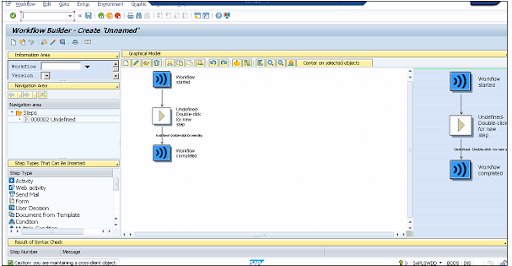
Step types are different options in the Workflow Builder that you can drag and drop and insert into the Workflow.

3. Define 1st task  (T-code PFTC_INS) (Create notification of absence)

To define the first task, navigate to T-Code: PFTC_INS

Select Standard Task in the Task type field.

Enter the following values and Save the task. Once you save the task, you will get code ID in number 93XXX989

  • In the Name field, select Form_created
  • In Abbr, select create_form
  • In Workitem text, select vik_notif_absence-create
  • In Object Type, select FORMABSENC
  • In Method field, select CREATE
  • Checkbox Synchronous object method, Object method with dialog checked 

4. Add activity > first task in the workflow

You must add an activity to your workflow in place of the undefined step in the Workflow.

 Add activity

As seen in the following screenshot, using T-Code: PFTC_INS, a Task TS99500654 has been created separately.

using T-Code

SAP Certification Training

Weekday / Weekend Batches

Step Properties allows you to select various options based on your needs. Select the checkbox – Advance with dialog, as shown in the screenshot above. It demonstrates that the workflow work item is immediately available for processing.

Because we entered WF INITIATOR in Expression under Agents, the person who will initiate the workflow is one of the workitem recipients. There is also a binding option defined that confirms absence notification is not only in this task but also in the workflow – _WI ObjectId &ABSENCEFORM&.

In graphical mode, the Workflow Builder now looks like this:

Workflow Builder

5. 1st Test in SAP Inbox (T-code SBWP)

Now that the workflow has been executed, workitems such as e-mails are created in the SAP Inbox. When it is executed, it invokes the corresponding task or transaction screen. When you run this workflow, the notification of absence form appears.

1st Test in SAP Inbox

To cancel the processing of the first notification, click Cancel. The workflow inbox contains one item for processing – creating an absence notification. Select the workitem and press the Execute button (F8). This will take you back to the “Create notification of absence screen,” where the notification of absence form will be displayed. Fill out the form with your information and save it. The Workitem will be removed from the inbox as a result of this action.

Create notification of absence screen

6. Define 2nd task  (Check notification of absence)

Using the object formabsenc-approve, the created form will be sent to the supervisor for approval. Next, use T-Code: PFTC INS to create a new task.

Define 2nd task

7. Add activity > second task in workflow

Using the task code generated in the previous step, add Task “Check Notification of Absence in the Workflow.”

Define the binding properties as well, as shown in the screenshot below.

Add activity

8. 2nd Test

The workflow will then be executed, and you will be directed to the workitem for creating notification of absence for processing. This is due to the Advancing with immediate dialog option being selected when creating a task.

Navigate to Business Workplace using the approver’s user-id to see the workitem to process and other attributes to include in the Workitem. Choose Execute after selecting the workitem for checking the notification of absence.

Reject or approve the request. Take note of the two buttons: Accept and Reject.

9. Integrate User Decision for Re-submit

If the approver rejects the leave request, you can also add the user decision to the rejected output. This gives the requester the opportunity to make changes and resubmit the request for approval.

10. 3rd Test

When a request is denied, the next step is for the user to make a decision. Because we specified (&WF INITIATOR&) as the step’s agent, the request will be sent back to us for a decision. You have two choices. Requests should be revised or withdrawn.

11. Define 3rd task  (Revise notification of absence)

For this you need to revise the notification.

12. Add activity > third task to the workflow

To add this step, you have to make the following entries −

Use FORMABSENC-UPDATE as an object.

In the binding option, enter _WI_Object_ID <= &ABSENCEFORM&

In the Agents → add &_WF_INITIATOR& in the expression field

FORMABSENC-UPDATE

13. Add 4th Customer Task (Send Notification for approval of leave)

To send a notification, you must add a new step called “Send mail.” You must drag this step to the Undefined Step – following the result of the step “Check notification of absence.”

To add this step, you have to make the following entries −

  • Select the Recipient type − Enter the Organizational object
  • Select Agents → Choose the Expression &_WF_INITIATOR&.
  • Enter the subject line as <“Leave Approved”>
  • Enter the email text as <“Approved”>

When you press the Enter key, you will be prompted to enter the task’s name and abbreviation. 

Conclusion:

In the above blog post we had clearly explained the in depth of sap workflows, architecture, features and benefits and why to choose the sap workflows. Had any doubts related to this concept drop your queries in the comment section to get them clarified. 

Related Articles

1. SAP Installation

2. SAP cyber security

3. SAP Logistic Execution

4. SAP Master Data


Source link