

Chase Ultimate Rewards is one of the most valuable rewards currencies you can have in your wallet. Aside from possibly earning 1 to 10 points per dollar spent on select Chase-branded credit cards, you can maximize their value by transferring your hard-earned Ultimate Rewards points to one of the issuer’s 14 airline and hotel partners.
Whether you want to book a flight to Europe, save on a domestic trip or stay at a high-end hotel, redeeming your Ultimate Rewards points via transfer partners can be a lucrative way to spend (and even save) your Chase points.
Here is everything to know about Chase Ultimate Rewards’ transfer partners.
Related: Why I choose to earn Chase Ultimate Rewards points over Amex Membership Rewards points
Chase Sapphire Reserve® (see rates and fees): Earn 150,000 bonus points after spending $6,000 on purchases in the first three months from account opening.
Who are the Chase Ultimate Rewards transfer partners?

You can transfer Ultimate Rewards points to 10 airline programs:
Chase also partners with four hotel programs:

Reward your inbox with the TPG Daily newsletter
Join over 700,000 readers for breaking news, in-depth guides and exclusive deals from TPG’s experts
Chase points transfer to partners at a 1:1 ratio, and transfers must be made in increments of 1,000. However, Chase occasionally offers transfer bonuses to partners, which can yield even higher value for your redemptions.
How long do Chase Ultimate Rewards transfers take?
Most transfers from Chase Ultimate Rewards to its partner programs are instantaneous. However, in our most recent testing, transfers to Singapore KrisFlyer took about 48 hours. Delays can happen when transferring your points for some simple reasons as well.
To facilitate the transfer process, ensure that the name on your Ultimate Rewards account matches the one on your loyalty program account. Additionally, make sure you have signed up for a loyalty program in advance, as transferring to a new account may also cause a delay.
How do you transfer Chase Ultimate Rewards points to partners?
You can easily transfer Chase points online. First, log in to your Chase account and navigate to the Ultimate Rewards portal. In the “Travel” drop-down menu, select “Transfer points to partners” to access the main transfer page.
You will then see the list of transfer partners and any current transfer bonuses. Select your desired transfer partner, link your external account if you have not already done so, select the number of Ultimate Rewards points you wish to transfer and then submit the transfer.
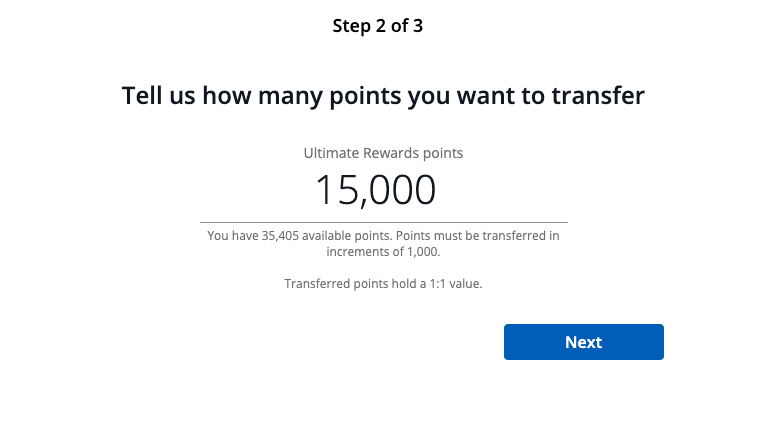
Remember, Ultimate Rewards transfers cannot be reversed, so it’s best to wait until you have a specific redemption in mind before transferring points.
Related: Chase Ultimate Rewards points: How to redeem for maximum value
What are the best Chase Ultimate Rewards transfer partners?
If you prefer to transfer your points to one of the 10 airline program partners, the best redemption options for you can vary depending on factors such as which airlines fly to and from the destinations you wish to visit and which airlines you prefer to travel on.
However, there are notable sweet spots with certain airline transfer options, especially those programs that have retained award charts.
Here are some of our favorite partners to book using Chase points.
Book a round-trip flight to Madrid via Iberia Club

Flying from the U.S. to Spain doesn’t have to set you back thousands of dollars.
Round-trip, off-peak flights from New York’s John F. Kennedy International Airport (JFK) and Boston Logan International Airport (BOS) to Adolfo Suárez Madrid-Barajas Airport (MAD) will only set you back 32,000 Avios in basic economy, 59,000 Avios in premium economy and 81,000 Avios in business class, plus applicable taxes and fees, when you transfer your Chase points to Iberia Club, though the airline sometimes runs award discounts that can mean even cheaper seats.
Considering that most airlines charge at least 60,000 miles for a one-way business-class award to Europe, an off-peak business-class flight to and from Madrid booked via Iberia Club for just 32,000 Avios round-trip is excellent value.
Book flights to Hawaii via British Airways Club
Did you know that you can book American Airlines and Alaska Airlines flights with Chase points? Though the carriers’ loyalty programs are not direct transfer partners of Chase, you can book flights on these airlines by transferring your Ultimate Rewards points to British Airways Club and then redeem British Airways Avios for award flights on its Oneworld partners.
Typically, you can find saver-level award space from American’s and Alaska’s West Coast gateways to various airports in Hawaii in economy for 44,000 Avios round-trip, or 22,000 Avios one-way, plus minimal taxes and fees.

Book lie-flat business-class seats to London via Virgin Atlantic Flying Club
Is London calling? Though Virgin Atlantic Flying Club prices its award seats dynamically, the loyalty program offers saver fares for low-demand travel dates. If you’re flexible and come across availability, you could score lie-flat business-class seats from JFK to London’s Heathrow Airport (LHR) for as few as 29,000 points with one recent deal, though note that taxes, fees and carrier-imposed surcharges of around $700 one-way are also payable.
If you’re looking to be more thrifty with your hard-earned points, you can fly the exact same route in economy for as few as 6,000 points plus about $165 in taxes and fees, depending on the direction. You can use Virgin Atlantic’s reward seat checker to find saver fares or an award booking platform like Seats.aero to search dates and prices.
However, be sure to confirm award availability with the airline prior to booking a seat.
Book a stay at a top-tier Hyatt hotel via World of Hyatt
You can also get great value from your Chase Ultimate Rewards points by transferring them to World of Hyatt. The hotel loyalty program offers a very appealing award chart, which is broken up into different categories and peak, off-peak and standard dates.
By transferring your Chase points to Hyatt, you can book some of the most luxurious Park Hyatt properties in the entire portfolio, including the Park Hyatt London River Thames, starting at 25,000 points per night during off-peak dates.

TPG values Hyatt points at 1.65 cents each (per our May 2026 valuations), so 25,000 points are worth $412.50. That’s a great deal for hotel rooms that typically sell for over $700 per night.
Note that Hyatt will substantially change its award charts for bookings made from May 20 on.
What are Chase Ultimate Rewards points worth?
TPG values Ultimate Rewards points at 2.05 cents apiece, per our May 2026 valuations, but you can find even more value by transferring points to airline and hotel partners.
However, you’ll get different values for Chase points when you pursue other redemption options.
For example, since the addition of Points Boost, Ultimate Rewards points can be worth up to 2.5 cents per point on select Chase Travel℠ bookings if you hold the Chase Sapphire Reserve or the Chase Sapphire Reserve for Business℠ (see rates and fees).
You can receive up to 1.75 cents per point through the portal if you hold the Chase Sapphire Preferred® Card (see rates and fees) or the Ink Business Preferred® Credit Card (see rates and fees).
Related: Chase Points Boost: A valuable new redemption option or a disappointing devaluation?

How can you earn Chase Ultimate Rewards points?
You can earn Chase points depending on the specific Chase credit card you carry.
The following cards earn fully transferable Ultimate Rewards points:

However, if you have an Ultimate Rewards points-earning card, you can effectively convert your cash-back rewards into Ultimate Rewards points, too. For this reason, having more than one Chase card can make sense to maximize your earning and redeeming potential.
Here are the four cash-back Chase cards that offer the opportunity to convert the cash-back rewards you earn into fully transferable Ultimate Rewards points as a cardholder of one of the above points-earning Chase cards:
Bottom line
If you value the flexibility of choosing from 10 airline partners and four hotel partners, Chase Ultimate Rewards is one of the best points programs out there.
In the age of no-notice devaluations by some loyalty programs, it is smart to earn Ultimate Rewards points via credit card welcome offers, category bonuses and everyday spending and then keep your points until you are ready to transfer and book with an airline or hotel partner, which is why earning Chase Ultimate Rewards points is an exceptionally savvy travel strategy.

Stacie Harris is a local resident and reporter of the Maple Grove area. Stacie reports on medicine and science for the Maple Grove Report.






:max_bytes(150000):strip_icc():format(jpeg)/Health-Anchovies-vs-Sardines-abf78393ed254f7fb6103ad3b603bfd0.png "Comparison between canned anchovies and sardines, side by side.")