Denodo Data Catalog | Complete Guide on Denodo Data Catalog


What are Data Catalogs?

A Data Catalog seems to be an accumulation of metadata especially in data planning and search tools that assists experts as well as other data consumers in locating the data they require, acts as a current asset of data available, and offers criteria to assess strength and conditioning data for potential purposes.

This succinct process made several locations regarding data catalogs—data management, looking, data inventory, and interpretation of data; they all rely on the central capacity to deliver a catalogue of metadata.

    Start learning Denodo Online Course from hkrtrainings to make a bright career in the world of Denodo!

What is the Denodo Data Catalog?

The Data Catalog seems to be a web-based self-service device that is included in the Denodo System that would allow technology and commercial consumers to query, lookup, and explore details and metadata saved in a Virtual DataPort server. Consumers could use this device to create knowledge and open the way for best choices.

If you want to explore the denodo server metadata, then use the dendo data catalog. Here I am going to explain how all these things happen.

Launching the data catalog:

The Data Catalog seems to be a web based application distributed as part of Denodo 8.0 that allows data analysts, enterprise customers, and app developers to search and browse data and metadata in a business-friendly way for personal exploration and predictive analysis.

To use this web tool, open the Denodo Platform Control Center and launch the Data Catalog. When the status changes to “Running,” click the Data Catalog link to launch the Web tool (by default, https://127.0.0.1:9090/denodo-data-catalog).

Login into the denodo platform with your login details.If you are logging for the first time, you will see a pop up window showing the synchronize metadata option.This must be run the first time you start the Data Catalog to make sure that it reflects the most recent state of the Denodo 8.0 server to which you are connected.

The VDP Synchronization should be performed as follows:

  • Click the Synchronize metadata now button.
  • On each Synchronization step, click Continue.
  • The views have now been synchronized, and you can begin exploring!

Using the metadata search:

The first example comes from the Data Catalog’s home page.

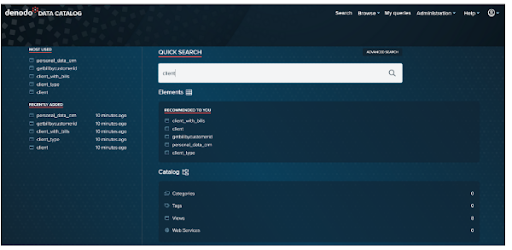
Let’s use the Business Analyst’s scenario to look at a simple use case: searching for clients by typing in client and pressing enter.
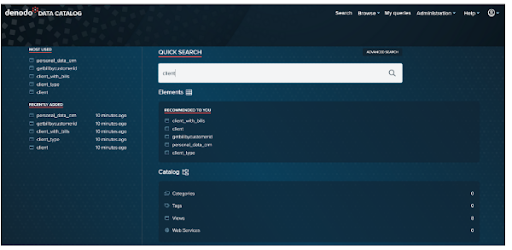
denodo data catalog

Here are the outcomes of our search. Starting with Data Catalog 8.0, this search will look for views or web services that include the query terms in the element’s metadata, such as:

  • It has a name.
  • It is described.
  • The names of the fields in which it operates.
  • The descriptions of its various fields.
  • The values of any custom properties that have been assigned to it.
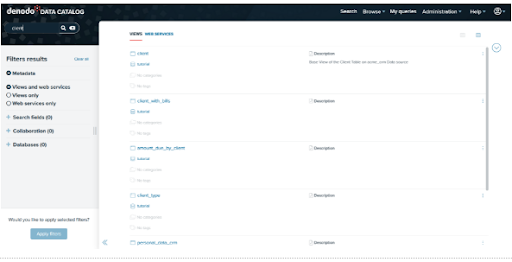
denodo data catalog 1

For instance, let’s click on the view client to go to the summary of the selected view:

denodo data catalog 2

For the time being, we have conducted a search in the Virtual DataPort metadata. In the following section, we’ll look into the Data Catalog’s more advanced features!

Denodo Training

  • Master Your Craft
  • Lifetime LMS & Faculty Access
  • 24/7 online expert support
  • Real-world & Project Based Learning

Exploring the features of Data Catalog:

We’ll now look at the features in the Data Catalog that allow for more in-depth interrogation of a view. This includes the following:

  • Filtering and querying results from a view
  • Results are being saved to a file.
  • Developing new fields
  • Queries saved
  • Investigating viewpoint relationships
  • Investigating data ancestry
  • Views with related fields can be queried

Exploration of Data Catalog Views:

We chose our client view from the previous section. We can now look through the contents of this view.

Summary Tab:

We could see a summary of the selected view under the Summary Tab. It will display the metadata of the selected view, such as the database name, the list of categories, the list of tags, and collaboration information provided by the user, such as Endorsement and Warnings. You can edit the view’s description by clicking the Edit button next to the Description option. If the view is deprecated, an indication will appear at the top of the summary tab.

Furthermore, the Summary tab includes buttons such as Add Tags/Categories , Collaborative effort possibilities further to create custom the view, and Connection URLs, Tableau to display different opportunities to link to the view/datasource.

denodo data catalog 3

Schema tab:

Under the Schema Tab, we can see the view’s schema, which includes the view description as well as all of the fields and types. We can add a field description by clicking the Edit button next to the column. We can also use the search option at the top of each section to look for fields, data types, and descriptions.

denodo data catalog 4

Query Tab:

The Query Tab is the following tab. Ad-hoc queries can be run against the view here (the query is created graphically).

Business Intelligence & Analytics, denodo-data-catalog-description-3, Business Intelligence & Analytics, denodo-data-catalog-description-6

Subscribe to our YouTube channel to get new updates..!

Select all of the following fields for our view and drag them into the Output columns area.

client_id

name

surname

Client_type

denodo data catalog 5

Click on the execute to get the results.

denodo data catalog 6

Editing of data catalog metadata:

In this segment, we would then look at the metadata characteristics of the Data Catalog. Users could use Denodo Data Catalog to append tags and categories to views, and also keep updating the view as well as field descriptions, with such a function.

In our instance, we will: (1) add explanations to the customer fields in addition to allowing for more particular discovery of such a view, (2) add tags and categories, and (3) implement those to our client view.

Data catalog Metadata:

The capacity to exhibit view metadata, such as the View Description and Field Descriptions, is a good feature of the Data Catalog. Then see how we can make that data more modifiable.

Editing view and field descriptions:

  • Browse to the Client View’s Summary page and click the Edit option beside Description.
  • Add the necessary descriptions to the View and then click Ok.
  • Similarly, you can add a description to fields by going to the Schema tab and clicking on the Edit button next to each one.
  • The new descriptions are now visible in the view. These descriptions are saved as metadata in the Data Catalog.

Adding of tags and categories in data catalog metadata:

Tags and Categories are useful for allowing users to search the Data Catalog more precisely. While the number of Data Sources and Views in our tutorial is small, maintaining good Categorization and Tagging habits will pay off in the long run by allowing users to navigate the Data Catalog more easily.

In order to add categories follow the below mentioned points.

  • Navigate to Administration > Configuration and Management.
  • Click the Categories option in the Administration window’s Catalog Management section.
  • Select the + Add Category option.
  • Make a category with the following information:
    • Customer’s name
    • Customer data sources
  • Make a new category with the following information:
    • CRM (Customer Relationship Management)
    • Customer is the parent of the Acme crm System.
  • Make a final category with the following information:
    • Name: Billing 
    • Description: Billing
    • Parent:customer

Denodo Training

Weekday / Weekend Batches

Adding tags:

  • Navigate to Administration > Configuration and Management.
  • Click the Tags option in the Administration window’s Catalog Management section.
  • Click the + Add Tag icon to add a new Tag with the following information:
    • Name:JDBC 
    • Description: JDBC data sources
  • Creating another tag with the following data.
    • Name:SOAP
    • Description:SOAP data sources

We can easily modify the views for adding tags and categories as well.

                            Get ahead in your career with our Denodo Tutorial!

Recommendation and collaboration in data catalog:

Recommendations in data catalog:

The AI Feature Package includes Automatic recommendation of datasets in the Data Catalog to assist you in discovering new elements among your company’s data resources.

This feature displays individualized recommendations based on earlier activity in the Data Catalog, like datasets which are most utilised, lately used, suggested, and so on.

Go to the Data Catalog’s homepage to see the recommendations.

The homepage displays a collection of products provided by various topics, such as one titled Recommended to you. This dataset recommendation is really only accessible only with the AI Feature Pack.

Collaboration in data catalog:

In the collaboration there are 3 options such as endorsements, warnings and decrepation notes.

Endorsements seem to be comments made by users on a view or a webservice to express their support. A user can only endorse a perspective or web service once, which means whenever a new comment is added, the prior endorsement is removed.

Warnings have been used by customers to write and exhibit “advise against” texts on opinions and web services. A consumer could only add one warning to a view as well as web service.

Deprecations have been used to notify people that a feature has become outdated and should no longer be used. A consumer could only write one deprecation for a perspective as well as web application.

Conclusion:

In the above blog post we had clearly discussed the dendo data catalog, data catalog metadata, adding of tags and categories, recommendations, collaboration etc in a more detailed way. If you have any doubts please drop your query in the comments section to get them clarified.

Other Related Articles:


Source link

Leave a Reply

Subscribe to Our Newsletter

Get our latest articles delivered straight to your inbox. No spam, we promise.

Recent Reviews


What is Denodo Tool?

Denodo tool is a leading data virtualization tool that helps many business users across industries. Moreover, Denodo serves as an interactive data storage for semantic search and data governance across the enterprise. 

Data virtualization is a technical approach to data management. It develops a single logical data layer linking multiple data. Also, it offers integrated access to the apps that use the semantic components. These components are stated within the virtual layer, and users can reuse them. 

Denodo tool has the potential to provide the logical data fabric across the industry. Further, the Denodo platform offers combined data access across the business entity. It does so without replicating the data. The Denodo tool is handy for many users across industries. Thus, it offers data virtualization (DV) technology.

Why Denodo Tool?

Denodo is really the market leader in data visualization. For many years, Denodo has indeed been ahead of many other vendors throughout this industry. Clients, partner organisations, and industry experts have identified denodo trusted technology. Here are a few examples:

  • It really can apply sophisticated optimization algorithms instantaneously, which is critical in large data scenarios. 
  • To really be accessible in a Docker container and be registered on the Amazon Web Services (AWS) and Microsoft Azure Marketplaces.
  • It enables business customers to look for information and explore connections. It has received more industry accolades than any other data virtualization vendor. 
  • Denodo persists to push the boundaries of data virtualization with the in fabric assistance, data cataloging, and enterprise-wide rollouts.

Denodo platform offers leading data virtualization and data integration facilities. By using the Denodo tool, many industries got satisfied due to its data virtualization technology. It helps entities to recover data faster by saving time. It allows business users to find accurate data through an intuitive and interactive interface. 

Moreover, it helps to achieve advanced performance benefits in big data scenarios, logical data storage, and operations. It offers powerful data integration software that automatically applies advanced optimization techniques to optimize data. Also, it speeds up the usage of cloud DV and allows many business users to search data and find out the relations. Hence, the following are the various benefits of using the Denodo tool.

Prompt data usage by business users with Self-Service data discovery

Denodo Platform offers a user-friendly and interactive interface to search actual data. Further, users can browse specific links among the data items to search for data specifically. Now users can build many improvised queries. Also, they can store these queries as views using the latest Advanced Query Wizard (AQW). Moreover, users can use the approved data model to learn about various things. These include data accessibility, structure, and connectivity with other data systems. 

Extensive integration with a vast range of data sources

We can connect to any data source, including the web and any other structured or unstructured format at any time, to the Denodo Platform. But it doesn’t support some data sources for which Eclipse Plugin and connector SDK are used. Moreover, the Denodo Platform can manage the RDMS, Streaming data, Hadoop, flat files, REST, SOAP Web Services, Email, Documents, etc. 

Speedy adoption of cloud Data Virtualization (DV)

The latest version of the Denodo tool is Denodo 8.0. But the Denodo version 6.0 is the only version available as a data virtualization solution at AWS Marketplace. Further, the platform minimizes the DV costs, simplifies its use and speeds up its adoption. It doesn’t need any installations. 

Advanced level performance in the context of Big Data and logical data storage

The Denodo Platform comprises a caching process that allows complete materialization and sequential query caching. It does so additionally apart from the Dynamic Query Optimizer (DQO). Further, the Denodo Platform also uses progressive Big Data optimization methods. 

To minimize the network traffic automatically, the DQO implements the approach of “forward processing to the data”. Further, this dynamic optimizer selects the best query performance plan based on various data source statistics. It also includes the features of significant data sources to provide outstanding performance. 

Governed and secured access to the information

The strategy, row and column-based security management skill consist of managed access to role-based security access, data-specific and across schema permissions. Further, it includes support for crucial security protocols, including single instances like Kerberos.

Support for many analytical, operational, and Big Data scenarios

Denodo Platform supports Big Data, Web Integration, and other conventional data handling use cases. It also provides various use cases and the typical analytical examples that many data virtualization platforms offer. Moreover, using the Denodo Platform, you can build a data services layer that reveals the primary data sources as services. 

Also, to integrate with the business web portals and MS SharePoint, we can produce data services as REST Web Services, including web components. Further, in the Denodo Platform, the data services enable the virtual presentation created for reusability. Apart from this, it offers a single and compatible rendering of the fundamental data assets.

To gain in-depth knowledge with practical experience in Denodo, Then explore HKR’S  Denodo Training!

Denodo Training

  • Master Your Craft
  • Lifetime LMS & Faculty Access
  • 24/7 online expert support
  • Real-world & Project Based Learning

Is Denodo considered a Database?

The Denodo tool is considered a database where Denodo Server includes multiple virtual databases. A database schema consisting of various data sources, stored processes, web services, and other capabilities is a virtual database. Each virtual DB built within the Denodo Server is different from other databases. 

Moreover, each virtual DB may have multiple benefits allocated by various users. The Denodo tool also contains a cache module that saves the local copies of data. This data is recovered from the data sources inside a relational database. Along with a database, it is also a modern data management and data integration tool.

Denodo Express

Denodo Express is a simple and free-to-use edition of Denodo Data Virtualization platform. It is easy and free to use, develop and download and offers some essential Denodo features. Further, the Denodo Express combines and links different data sources on the cloud and on-premise, like structured, unstructured, and others. 

Moreover, users can easily access these resources, including business apps, dashboards, portals, and other valuable tools. Any single user registering online can utilize Denodo Express. Furthermore, we can use Denodo Express for training in DV, department-related projects, and model enterprise projects. However, it helps to create value for the clients and users. 

Understand Data Virtualization (DV) in Denodo

The Denodo tool is famous for its data integration and virtualization fields. Data virtualization is the fastest way to access all enterprise-level data without worrying about primary difficulties. 

Moreover, DV offers a logical data layer that links diverse data and provides blended access to ingest apps. 

These apps will utilize the semantic components stated within the virtual layer and reuse them as required. It combines all the business data from different sources and manages the blended data central security and control. Also, it makes it available for many business users in real time. It makes your apps free from the physical sources of data storage. 

How does Data Virtualization Work?

This concept includes the logical data layer that allows business users to utilize business data in various forms. It blends the enterprise data from multiple systems and manages it for central security and administration. Further, data virtualization uses an approach that includes three steps- connect, unify, and consume. It provides a complete view of the enterprise data throughout the primary systems of the enterprise. There are many benefits of using data virtualization. 

The primary concept behind the Denodo tool is to offer it more power. Also, it provides the fastest way to get all the business data without any issues quickly. 

, Business Intelligence & Analytics, denodo-tool-description-0, Business Intelligence & Analytics, denodo-tool-description-0, Business Intelligence & Analytics, denodo-tool-description-0, Business Intelligence & Analytics, denodo-tool-description-0, Business Intelligence & Analytics, denodo-tool-description-0, Business Intelligence & Analytics, denodo-tool-description-0, , Business Intelligence & Analytics, denodo-tool-description-0, Business Intelligence & Analytics, denodo-tool-description-0, Business Intelligence & Analytics, denodo-tool-description-0, Business Intelligence & Analytics, denodo-tool-description-0, Business Intelligence & Analytics, denodo-tool-description-0, , Business Intelligence & Analytics, denodo-tool-description-0, Business Intelligence & Analytics, denodo-tool-description-0, Business Intelligence & Analytics, denodo-tool-description-0, Business Intelligence & Analytics, denodo-tool-description-0, , Business Intelligence & Analytics, denodo-tool-description-0, Business Intelligence & Analytics, denodo-tool-description-0, Business Intelligence & Analytics, denodo-tool-description-0, , Business Intelligence & Analytics, denodo-tool-description-0, Business Intelligence & Analytics, denodo-tool-description-0, , Business Intelligence & Analytics, denodo-tool-description-0, Denodo Tool, Business Intelligence & Analytics, denodo-tool-description-1, Business Intelligence & Analytics, denodo-tool-description-1, Business Intelligence & Analytics, denodo-tool-description-1, Business Intelligence & Analytics, denodo-tool-description-1, Business Intelligence & Analytics, denodo-tool-description-1, Business Intelligence & Analytics, denodo-tool-description-1

Let us know in detail how the virtualization of data in Denodo works.

Connect with multiple data sources

The connect layer in the Denodo tool enables the upper layer to access the data from different storage. It protects them from the core reporting protocols and layouts. The DV links various data sources, Big Data Systems, databases, and cloud storage. 

It uses custom connectors to link specific apps and turns data source types. Therefore, all the primary views look like relational views to the upper layers.

Combine any data type

Data Virtualization (DV) in the Denodo tool unifies the related data into business views. The data can be in any format like Hadoop, NoSQL, Cloud APIs, etc. The layer uses the pre-built template library and some components to automate the web integration process interactively. This layer provides the flexibility to do so. It performs so by designing workflow, extraction, and driving, including the construction of web and other data types. 

Further, users using this layer can execute complex data changes, designing metadata, data quality, etc., through SQL and other relational tools. It supports data changes using logical operators for creating composite data views flawlessly. 

Consume data in any mode

The Consume layer under DV offers single-point access to the primary data sources, including distracted data views in an ordinary delivery form. However, data virtualization allows business users to consume data in various forms like reports, web & mobile apps, dashboards, etc. 

Moreover, the Consume layer offers various data delivery options. Such as JDBC, SOAP and RESTful Web Services, ODBC, OData, Portlets, exporting data to MS Excel or SQL, etc. 

Hence, these are the various layers and their uses under the Denodo tool’s data virtualization concept. 

Get ahead in your career with our Denodo Tutorial 

, Business Intelligence & Analytics, denodo-tool-description-0, Business Intelligence & Analytics, denodo-tool-description-0, Business Intelligence & Analytics, denodo-tool-description-0, Business Intelligence & Analytics, denodo-tool-description-0, Business Intelligence & Analytics, denodo-tool-description-0, Business Intelligence & Analytics, denodo-tool-description-0, , Business Intelligence & Analytics, denodo-tool-description-0, Business Intelligence & Analytics, denodo-tool-description-0, Business Intelligence & Analytics, denodo-tool-description-0, Business Intelligence & Analytics, denodo-tool-description-0, Business Intelligence & Analytics, denodo-tool-description-0, , Business Intelligence & Analytics, denodo-tool-description-0, Business Intelligence & Analytics, denodo-tool-description-0, Business Intelligence & Analytics, denodo-tool-description-0, Business Intelligence & Analytics, denodo-tool-description-0, , Business Intelligence & Analytics, denodo-tool-description-0, Business Intelligence & Analytics, denodo-tool-description-0, Business Intelligence & Analytics, denodo-tool-description-0, , Business Intelligence & Analytics, denodo-tool-description-0, Business Intelligence & Analytics, denodo-tool-description-0, , Business Intelligence & Analytics, denodo-tool-description-0, Denodo Tool, Business Intelligence & Analytics, denodo-tool-description-1, Business Intelligence & Analytics, denodo-tool-description-1, Business Intelligence & Analytics, denodo-tool-description-1, Business Intelligence & Analytics, denodo-tool-description-1, Business Intelligence & Analytics, denodo-tool-description-1, Business Intelligence & Analytics, denodo-tool-description-1, , Business Intelligence & Analytics, denodo-tool-description-0, Business Intelligence & Analytics, denodo-tool-description-0, Business Intelligence & Analytics, denodo-tool-description-0, Business Intelligence & Analytics, denodo-tool-description-0, Business Intelligence & Analytics, denodo-tool-description-0, , Business Intelligence & Analytics, denodo-tool-description-0, Business Intelligence & Analytics, denodo-tool-description-0, Business Intelligence & Analytics, denodo-tool-description-0, Business Intelligence & Analytics, denodo-tool-description-0, , Business Intelligence & Analytics, denodo-tool-description-0, Business Intelligence & Analytics, denodo-tool-description-0, Business Intelligence & Analytics, denodo-tool-description-0, , Business Intelligence & Analytics, denodo-tool-description-0, Business Intelligence & Analytics, denodo-tool-description-0, , Business Intelligence & Analytics, denodo-tool-description-0, Denodo Tool, Business Intelligence & Analytics, denodo-tool-description-1, Business Intelligence & Analytics, denodo-tool-description-1, Business Intelligence & Analytics, denodo-tool-description-1, Business Intelligence & Analytics, denodo-tool-description-1, Business Intelligence & Analytics, denodo-tool-description-1, , Business Intelligence & Analytics, denodo-tool-description-0, Business Intelligence & Analytics, denodo-tool-description-0, Business Intelligence & Analytics, denodo-tool-description-0, Business Intelligence & Analytics, denodo-tool-description-0, , Business Intelligence & Analytics, denodo-tool-description-0, Business Intelligence & Analytics, denodo-tool-description-0, Business Intelligence & Analytics, denodo-tool-description-0, , Business Intelligence & Analytics, denodo-tool-description-0, Business Intelligence & Analytics, denodo-tool-description-0, , Business Intelligence & Analytics, denodo-tool-description-0, Denodo Tool, Business Intelligence & Analytics, denodo-tool-description-1, Business Intelligence & Analytics, denodo-tool-description-1, Business Intelligence & Analytics, denodo-tool-description-1, Business Intelligence & Analytics, denodo-tool-description-1, , Business Intelligence & Analytics, denodo-tool-description-0, Business Intelligence & Analytics, denodo-tool-description-0, Business Intelligence & Analytics, denodo-tool-description-0, , Business Intelligence & Analytics, denodo-tool-description-0, Business Intelligence & Analytics, denodo-tool-description-0, , Business Intelligence & Analytics, denodo-tool-description-0, Denodo Tool, Business Intelligence & Analytics, denodo-tool-description-1, Business Intelligence & Analytics, denodo-tool-description-1, Business Intelligence & Analytics, denodo-tool-description-1, , Business Intelligence & Analytics, denodo-tool-description-0, Business Intelligence & Analytics, denodo-tool-description-0, , Business Intelligence & Analytics, denodo-tool-description-0, Denodo Tool, Business Intelligence & Analytics, denodo-tool-description-1, Business Intelligence & Analytics, denodo-tool-description-1, , Business Intelligence & Analytics, denodo-tool-description-0, Denodo Tool, Business Intelligence & Analytics, denodo-tool-description-1, , Business Intelligence & Analytics, denodo-tool-description-2, Business Intelligence & Analytics, denodo-tool-description-2, Business Intelligence & Analytics, denodo-tool-description-2, Business Intelligence & Analytics, denodo-tool-description-2, Business Intelligence & Analytics, denodo-tool-description-2, Business Intelligence & Analytics, denodo-tool-description-2

Subscribe to our YouTube channel to get new updates..!

Denodo Testing Tool

Denodo Testing Tool is a discrete application with a simple and easy-to-use user interface executable through the command line. It allows Denodo users to automate the testing process of their data virtualization situations. It does so at the time of development and maintenance of its virtualized solutions. Further, it acts as a safety net before making major alterations to these environments.

Here is some important information regarding the Denodo Testing Tool:-

  • You don’t need to acquire Java skills for this. The text files and folders are stated and arranged for testing.
  • It holds a test result reporting system which is Pluggable.
  • All test sets are executed with automation. We can combine the executions of these test sets with the existing CI procedures.
  • Support for test inheritance makes developing big sets of closely related tests simpler.

So, this is all about the Denodo Testing Tool and its usage. 

Denodo Platform Architecture:

The Denodo Platform that connects to numerous data sources, incorporating and publishing data in a business-friendly format to various users.

Follow these three simple steps such as:

  • Connect
  • Combine and 
  • Consume
  1. With the connect step, one can easily integrate or connect any type of data from any source.
  2. The combine phase describes data transitions and configurations that are appropriate for your business.
  3. The consume step provides real-time data services to one’s corporate data consumption platforms.

Key Features of Denodo Tool:

Here are some key features of the denodo tool. They are:

  • A completely revamped web-based user experience provides an exceptional user experience that is tailored to the specific needs of business and IT stakeholders. 
  • Intelligent and optimal query execution method utilizing a Dynamic Query Optimizer for fast information access. 
  • With the help of Summaries, Smart Query Acceleration can be used for various analysis scenarios. 
  • In-Memory Parallel Processing accelerates data access to unprecedented speeds.
  • A collection of automatically generated product lifecycle features that allow users to spend less time in finding data and much more time utilizing information to make decisions.
  • A Dynamic Denodo Data Catalog facilitates easy data access, increased collaboration, and ML-driven fully automated suggestion.
  • Cloud systematic approach that is automated, with PaaS support for cloud and hybrid contexts.
  • A advanced data services level which endorses OAuth 2.0, SAML, OpenAPI, OData 4, GraphQL, as well as other cloud standards to facilitate connectivity with existing cloud environments. 
  • Denodo can be deployed using marketplaces such as Amazon Web Services (AWS), Microsoft Azure, Google Cloud Platform (GCP), and Docker. Secure, preferential connectivity to a firm’s complete data holdings via a single interface and management key to establishing safety and leadership.

Denodo Training

Weekday / Weekend Batches

Pros and Cons of Denodo Tool:

Pros of Denodo Tool:
  • You could indeed connect directly to various environments and combine data sets.
  • The “miracle” of data virtualization is that no information is generated, so data is noted to target consumers in relatively close time.
  • For development companies, the UI is simple to use. Simply attach to a source of data, create tables, as well as join those to certain other datasets to get started.
Cons of Denodo Tool:
  • Denodo does have a tiny community of users, so there isn’t a lot of information available if you do get trapped.
  • Cost: Because data virtualization is not relatively inexpensive, smaller companies may be hesitant to use it due to high licensing fees.
  • Caching strategy: A few really slightly quicker sets of data will necessitate caching. Which begs the question, why not do conventional ETL if these are required?

Conclusion:

In the above blog post we had explained about the denodo tool in brief. Had any doubts please drop them in the comments section to get them clarified.

Related Article:

1.Denodo Certification


Source link