

DFL, GOP still have internal divides to resolve


People walk through a red, white and blue balloon arch.

Next up for Minnesota’s major political parties: Primary contests in top-of-the-ballot races that could keep internal raw well into summer.

Both the DFL and Republican parties managed to make endorsements in races for governor, U.S. Senate and other statewide contests at their state conventions. But some of those candidates riding high after clinching delegate backing will have to look over their shoulder into August.

Republican convention in Duluth

Republicans face competitive and potentially pricey primaries in the two main races this year in Minnesota: governor and U.S. Senate.

It took 10 ballots on Saturday for Kendall Qualls to lock in the endorsement for governor. He prevailed over five other candidates in a contest that included an hourslong standoff over issues with electronic voting devices.
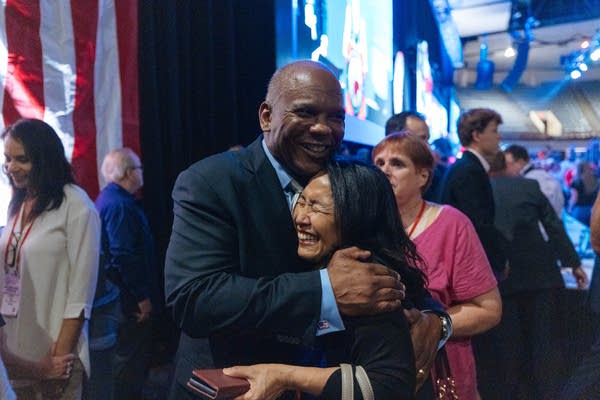
A man and woman hug backstage.
Kendall Qualls hugs a supporter after winning the endorsement for governor at the GOP convention in Duluth on Saturday.
Carly Danek for MPR News

Qualls, a former healthcare executive and think tank founder, said only a political outsider could clean up problems in St. Paul and break Republicans’ two-decade losing streak in statewide races.

“I have nothing against the Legislature, but I was in the conventional Army, and I was an artillery officer. When we can’t get it done, we know that we need the special forces,” Qualls said after winning the nomination. “The conventional forces can’t get it done after 20 years. I think at a certain time you got to say, OK, maybe we can’t get it done. Let’s call this, let’s get something different.”

That message won out after the race turned into a head-to-head showdown between him and House Speaker Lisa Demuth.

A few candidates went into the votes saying they’d go to a primary no matter what, including MyPillow CEO Mike Lindell. Qualls’ main rival, Demuth, had pledged to leave the race if someone else won the endorsement.

But she left the possibility open to filing for office after raising issues with how the voting was conducted. The hand-held clickers that delegates used to cast convention votes were called into question and required redos after doubts about the numbers were raised.

“There is no confidence in what is happening,” Demuth said as tensions grew inside the Duluth Entertainment Convention Center over the vote tallies.
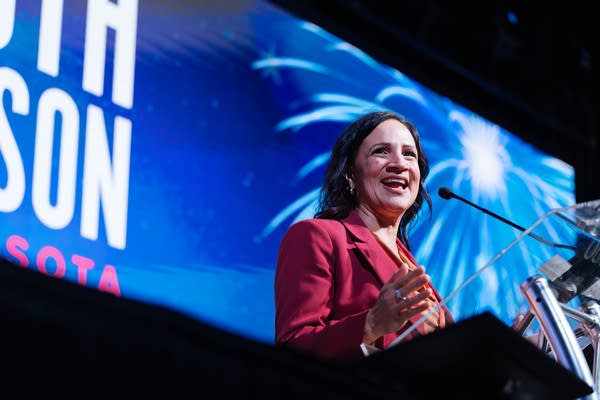
A woman speaks at a podium on stage.
Lisa Demuth concedes the endorsement for governor at the GOP convention in Duluth on Saturday.
Carly Danek for MPR News

Any candidate who wants to be on the Aug. 11 ballot must file campaign paperwork by Tuesday at 5 p.m. Demuth didn’t address her status by the time the convention ended or make any public remarks on Sunday.

Meanwhile, a U.S. Senate primary also looms. Republicans endorsed former Navy SEAL Adam Schwarze in that race, but well-known sports broadcaster Michele Tafoya has said she’ll run in a primary.

Schwarze billed himself as the candidate aligned most with GOP stances.

“You don’t have to compromise on values. We can hold life. We can support our Second Amendment rights. We can support our First Amendment rights,” he said from the stage. “We don’t have to compromise on this race.”

A man speaks with delegates while a man dressed in an Uncle Sam outfit carries a sign.
Adam Schwarze, candidate for U.S. Senate, meets to delegates on the floor at the GOP convention in Duluth on Friday.
Carly Danek for MPR News

Tafoya said she’d present the party a better chance for the open Senate seat in a general election.

“The ultimate goal is winning in November and giving Minnesota the serious leadership it deserves,” Tafoya said.

Republican delegate Dale Zoerb, of New Brighton, said he was glad to see the party bypass so-called establishment candidates. Zoerb sported a vest that said “conservative voter” on his back with a plastic knife that read “RINO” — short for Republican in name only — piercing it.

“Almost everyone that won (at the convention) was not a politician, so I am just elated,” Zoerb said. “I've donated to all but one of the candidates that won tonight, and that’s what we need to do. We can’t just say we want somebody else, we have to get involved.”

Delegate Wendy Wahl, of Thief River Falls, characterized herself as a swing voter at the convention. She said she’d be willing to reevaluate and get behind other GOP candidates if Republican primary voters picked someone else.

“All of these candidates were so great that if they happen to win, I could pivot to that,” Wahl said. “If the people think, you know, you really made a wrong choice, they can turn around and correct our choice.”

DFL convention in Rochester

Democrats didn’t have the same kind of drawn-out fights for the two offices at their convention.

Amy Klobuchar notched a first-ballot win for the party’s endorsement for governor. But there was still a faction within the convention that wanted an alternative, and they put their votes behind Kobey Layne, a progressive candidate.

Klobuchar promised to be “a transformative governor” who will support measures to “make life affordable for everyone, making our government work, getting rid of the fraud, making our economy better and creating good paying jobs."

Tim McLean, a DFL delegate from Blaine, said Democrats will field a strong candidate in Klobuchar, who stepped into the race after two-term DFL Gov. Tim Walz dropped his reelection bid in January.

McLean said while some fellow Democrats might not see her as progressive enough, she’s a candidate that has shown she can win statewide.

“She does align with most of my positions, she really does,” he said. “But in any — in the worst case, in the worst iteration of Amy Klobuchar — my God, she beats the alternatives for governor. She truly does,” McLean said.

Four people on a stage three of are waving to a crowd
Amy Klobuchar with her husband John Bessler, right, waves to the crowd with her lieutenant governor, Ben Schierer, and his wife, Tessa Schierer, left, after accepting the nomination for governor at the Minnesota DFL Convention at the Mayo Civic Center Arena in Rochester Friday.
Ken Klotzbach for MPR News

Klobuchar will still have opposition in the August primary but none with the financial wherewithal or name recognition to put her eventual nomination in doubt.

The big question mark for Democrats is the U.S. Senate race.

Lt. Gov. Peggy Flanagan easily claimed the endorsement with no opponent at the convention.

Days before the convention, U.S. Rep. Angie Craig announced she’d skip the convention and head straight to the primary. She has already filed for the ballot.

Flanagan said she is more in tune with what Democrats want in a candidate and that the endorsement would put her on track for the nomination.

"This DFL endorsement process matters because it's one of the few places in politics where grassroots organizing matters more than money,” she said.

A woman in a green suit high-fives delegates as she walks down an aisle.
Lt. Gov. Peggy Flanagan high-fives delegates as she walks to the stage at the Minnesota DFL Convention at the Mayo Civic Center Arena in Rochester Saturday, May 30, 2026.
Ken Klotzbach for MPR News

Popular party figures Minnesota Attorney General Keith Ellison and Secretary of State Steve Simon won their DFL endorsements by acclamation. They ran unopposed.

Republicans picked Minneapolis attorney Ron Schutz for attorney general and former judge Tad Jude for secretary of state.

In the open auditor’s race, Braham Mayor Nate George won the GOP endorsement while former Duluth City Council member Zack Filipovich won the DFL’s backing.




Source link

Leave a Reply

Subscribe to Our Newsletter

Get our latest articles delivered straight to your inbox. No spam, we promise.

Recent Reviews


When someone sets up their estate plan, one would hope that the probate process would result in the terms of the estate plan being carried out. State law often allows beneficiaries and heirs to change the terms of someone’s estate plan after they die.

For example, in Texas, beneficiaries can usually agree to override the terms of a decedent’s will and distribute assets as they see fit. This is usually carried out using a family settlement agreement. The Texas Estates Code has been amended to include more liberal rules that allow trust beneficiaries to amend or reform the terms of trusts.

Even though state law allows for these post-mortem changes, the changes can have significant Federal tax consequences. The taxes can be significant and, in some cases, can result in the probate estate owing back taxes to the IRS. The recent McDougall v. Commissioner, 163 T.C. No. 5 provides an example. The case involves the termination of a trust by the trust beneficiaries after the trust settlor died. The termination triggered a massive gift tax liability.

Facts & Procedural History

The taxpayers in this case were a surviving spouse and his spouse’s adult children. The surviving spouse inherited an interest in a trust from his wife when she died. The interest he inherited was an income interest, so he was entitled to interest earned on the trust assets.

The children inherited remainder interests in the trust assets. These interests entitled the children to ownership of the trust assets when the surviving spouse died.

The surviving spouse was the executor of his wife’s estate. He made a QTIP election, which we’ll address below, which deferred the estate taxes that would have been due on the death of his spouse.

Several years later, the surviving spouse and children entered into an out-of-court agreement to terminate the trust and to distribute the assets to the surviving spouse. The taxpayers filed gift tax returns taking the position that there were two gifts, one from the surviving spouse on termination of the trust to children and then one from the children to transfer the assets to the surviving spouse. According to the taxpayers these transfers essentially offset each other and resulted in no gift tax due.

The IRS audited the gift tax returns, did not agree with the taxpayers reciprocal gift argument, and issued a statutory notice of deficiency. The dispute ended up in the U.S. Tax Court, which issued the tax court opinion that is the basis of this article.

About the QTIP Election

To understand this court case, we have to start with the QTIP election and the general concept for when the QTIP is used. QTIP elections typically involve trusts, so we’ll start with the QTIP trust.

A QTIP trust is one that holds some or all of the trust assets in trust for the surviving spouse. The surviving spouse has to be entitled to all of the income from the trust property and be paid at least annually. The trust also has to limit the power to appoint the property to anyone other than the surviving spouse during their lifetime.

This type of arrangement is often used to ensure that the income of the assets is used for the surviving spouse of the settlor, the person who set up the trust, with the remainder interest passing to the settlor’s children. This helps avoid a situation where assets are used for or transfered to the surviving spouse’s new spouse or the surviving spouse’s children from outside of the marriage. So second marriages and mixed families.

The QTIP election is an election made on the settlor’s estate tax return and is one of several estate tax planning considerations that one has to consider. It is similar to the GST election and tax planning in some ways. It is typically made on the estate tax return of the first spouse to die, which is usually due within 9 months of death (with a possible 6-month extension).

The election creates a legal fiction that the surviving s…

The election creates a legal fiction that the surviving spouse owns the trust assets when really they only have an income interest. This fiction allows the settlor’s estate to claim a 100% marital deduction for estate tax purposes. This marital deduction allows the trust assets to avoid estate tax on the death of the first spouse, which is usually not allowed when the surviving spouse does not actually have an ownership interest in the property in question and the settlor spouse retains control over who gets the property when the second spouse dies.

This election and tax planning involving valuation discounts can often significantly reduce ones estate tax liability. Charitable trusts can be used for similar purposes too, if there is a charitable intent involved.

The QTIP trust is an easy way the first spouse to die can limit the surviving spouse’s ability to transfer or control the property while still qualifying for the marital deduction. Similar results can be obtained using a bypass or credit shelter trust. Other strategies usually leave the surviving spouse with some control over who gets the property on their death.

Gift Tax for the Surviving Spouse

The first question in this case was whether executing the settlement agreement to terminate the trust, the surviving spouse and children triggered a gift tax.

The U.S. Tax Court concluded that it did not, which it referenced its prior opinion in Estate of Anenberg v.
Commissioner
, No. 856-21, 162 T.C. (May 20, 2024) from earlier this year. The Estate of Anenberg stands for the proposition that a surviving spouse does not make a taxable gift when a QTIP trust is terminated and all its assets are distributed to the surviving spouse. This makes sense as the marital deduction is generally allowed when property passes to the surviving spouse and the estate tax is imposed when the surviving spouse dies.

The mechanics of the actual statutes are more complex than this. This is why the U.S. Tax Court had to analyze Section 2519 so closely, and then it just applied judicial reasoning instead of a close reading and application of Section 2519. In doing so, it concluded that the surviving spouse did not give away anything of value under Section 2519 and, alternatively, that there was an incomplete gift given that the surviving spouse ended up with the assets.

Thus, in applying these principles to the current case, the tax court concluded that the surviving spouse did not make a taxable gift when the residuary trust was terminated and its assets were distributed to him. This conclusion was reached despite the fact that the termination could be viewed as, and likely was, a disposition that should trigger gift tax under Section 2519.

Gift Tax for to the Children

The tax court then turned to the question of whether the termination of the residuary trust and transfer of the assets to the surviving spouse triggered a gift tax as to the children. The tax court concluded that it did.

The reasoning here is that the children had vested remainder interests in the trust property. They gave away the right to this property by allowing the property to be transferred to the surviving spouse. Thus, when viewed before and after the transfer, the children had a decrease in their net worth. They gave something up. The tax court concluded that this was sufficient to trigger a gift tax.

The tax court did not accept the taxpayer’s arguments about a reciprocal gift which negated any gift tax. The taxpayer’s argument was that the termination of the residuary trust resulted in a taxable gift for the surviving spouse. Then it also resulted in a taxable gift for the children for the transfer back to the surviving spouse.

As noted above, the tax court held that the first part of this argument–the gift tax for the surviving spouse–was not a gift and therefore did not trigger a gift tax. Thus, there could be no offsetting gift. The tax court also stated that there was no such concept as a reciprocal gift in the law that can be used to offset gift taxes. It noted that there is a concept of reciprocal trusts, but that that concept does not apply here.

To provide context

To provide context, we’ll briefly take a detour to discuss reciprocal trusts. The reciprocal trust doctrine is a legal principle that addresses situations where two individuals create similar trusts for each other’s benefit. This doctrine allows the IRS and courts to “uncross” or “unwind” trusts that are interrelated and leave the grantors in approximately the same economic position as they would have been if they had created trusts naming themselves as life beneficiaries.

This is similar to the economic substance doctrine that allows the IRS and/or the courts to void certain business transactions. When the IRS and/or courts apply this reciprocal trust doctrine, the result is that the trust assets are included in the settlor’s taxable estate under Sections 2036 or 2038. Again, this is not what we had in this case, so it was not applicable here according to the tax court.

    The Takeaway

    It is getting more common for beneficiaries of trusts to modify and even terminate their trusts. This can trigger significant tax liabilities, as in this case. This case helps to explain when the gift tax applies when one termites a trust. A QTIP trust can be terminated and this will not necessarily trigger gift taxes for the surviving spouse. If the termination results in the children getting their fair share of the trust assets, that may also avoid gift taxes. But as in this case, if the termination results in the surviving spouse getting more than what they otherwise would, the termination will likely trigger a gift tax for the children for the transfer to the surviving spouse.

    Watch Our Free On-Demand Webinar

    In 40 minutes, we’ll teach you how to survive an IRS audit.

    We’ll explain how the IRS conducts audits and how to manage and close the audit.  


Source link