Does the FTC Ban Apply to My Non-Compete?


On April 23, 2024, the FTC voted 3-2 to approve its final rule banning non-competes for U.S. workers. Unless the federal courts block the rule (more about that later), it will go into effect on September 4, 2024.

(Update: The federal courts did block the rule. Sort of. See Texas Federal Court Enters Limited Preliminary Injunction Staying FTC’s Noncompete Clause Ban from my friends at Morgan Lewis.)

My law practice focuses on defending non-compete and trade secret claims, so as you might imagine, that was a busy week for me.

You can imagine the text messages from clients. “Hey, did you see this news about the FTC?”

I tried not to be too sarcastic. “Uh, yeah. I heard about it.”

I had two main things to tell my clients who have non-compete agreements:

First, don’t get too excited.

Second, it’s complicated.

Yes, it’s complicated, for several reasons. But in this blog post I will make it simple. You can determine if the FTC’s ban applies to your non-compete in five easy steps.

1. Did the company’s cause of action accrue before 9/4/24?

Sorry, if you’re already a defendant in a non-compete lawsuit, the FTC rule won’t do much for you.

Section 910.3(b) says:

Existing causes of action. The requirements of this part do not apply where a cause of action related to a non-compete accrued prior to the effective date.

Generally, a claim “accrues” when all the facts necessary to support it exist. So, if you’ve already violated a non-compete—allegedly—then the cause of action has already accrued.

There may be some borderline cases where there’s a dispute about whether the non-compete was breached before or after 9/4/24. But if there’s already a pending lawsuit, it’s safe to say the cause of action already accrued, and the new rule does not apply.

2. Is the non-compete clause part of an agreement to sell a business?

Generally, courts are more willing to enforce a non-compete that is part of the sale of a business, versus a non-compete in an ordinary employment agreement. I cover this at Non-Competes in the Sale of a Texas Business.

The FTC rule recognizes this with an important exception in Section 910.3(a):

Bona fide sale of business. The requirements of this part shall not apply to a non-compete clause that is entered into by a person pursuant to a bona fide sale of a business entity, of the person’s ownership interest in a business entity, or of all or substantially all of a business entity’s operating assets.

Of course, there will be litigation over borderline cases, but if you’re non-compete is part of an agreement to sell a business, the FTC ban likely will not apply.

3. Is the non-compete ban retroactive?

But let’s say your non-compete is part of an employment agreement, and you haven’t violated it yet. Does the new rule retroactively ban your non-compete?

It depends on whether you’re a “senior executive.” If you were in a “policy-making position” and made more than $151,164 annually, then you’re a “senior executive.”

In that case, the rule does not prohibit the employer from seeking to enforce a non-compete you entered into before 9/4/24, the effective date of the rule. See Rule 910.2(a)(2).

But if you’re not a senior executive, then the rule applies, even if you entered into the non-compete before the effective date of the rule.

4. Are you in the Fifth Circuit?

So far, we’re assuming the rule actually goes into effect on September 4, 2024. That is not a certainty.

There are at least three federal lawsuits seeking to block the rule as unconstitutional and exceeding the FTC’s authority. For a good summary of these, see Analysis of FTC Non-Compete Ban Legal Challenges: Does the Ban Pass Constitutional Muster?

Two of these lawsuits are in Texas: Ryan, LLC v. FTC, Case No. 3:24-cv-00986, in the Northern District of Texas and Chamber of Commerce v. FTC, Case No. 6:24-cv-00148, in the Eastern District of Texas.

And let’s just say it’s no accident where they were filed.

I’ll save my opinion on the merits of those suits for another post. (Short version: I think a major weakness is that the arguments against the FTC rule tend to ignore the extent to which state law already imposed similar limits.)

But I will repeat the prediction I made when the rule was first proposed. I expect both the conservative Fifth Circuit and the 6-3 conservative majority on the Supreme Court will be hostile to what they will see as a partisan vote by a federal agency to sweep aside state non-compete law with the stroke of an administrative law pen.

My short-term prediction is that the rule will be blocked before its effective date of 9/4/24, and my long-term prediction is that SCOTUS will strike down the rule.

This is, admittedly, based on more on “vibes” than any detailed analysis of the merits. You can usually trust vibes when it comes to the Supreme Court.

But let’s suppose I’m wrong, and the rule goes into effect as planned. That brings us to the final and possibly most important question.

5. Is the restriction in your agreement a “non-compete clause”?

The FTC’s new Rule 910 generally declares it an “unfair method of competition” to enter into or enforce a “non-compete clause.”

But as with many things in the law, so much rides on definitions. How exactly does Rule 910 define a “non-compete clause”?

The rule defines a non-compete clause as:

(1) A term or condition of employment that prohibits a worker from, penalizes a worker for, or functions to prevent a worker from:

(i) Seeking or accepting work in the United States with a different person where such work would begin after the conclusion of the employment that includes the term or condition; or

(ii) Operating a business in the United States after the conclusion of the employment that includes the term or condition.

Thus, in simplified terms, a “non-compete clause” prohibits, penalizes, or functions to prevent a worker from seeking or accepting work or operating a business.

That’s a pretty abstract definition. Let’s make it more concrete by applying it to two typical non-compete clauses.

Non-Compete 1 says:

Employee may not work for or operate any Competing Business in the Restricted Area during the Restricted Period in the same or similar capacity that Employee served for Company.

Assume that “Competing Business” is defined essentially as the business that Company does.

Non-Compete 2 is a little more complicated. It says:

After termination of employment, Employee is free to seek or accept work or operate a business in competition with Employer.

However, Employee may not solicit or accept business from any Restricted Customer in the Restricted Area during the Restriced Period.

“Restricted Customer” means any customer Employee dealt with or received confidential information about during Employee’s last year of employment with Company.

If you know anything about non-compete law, you know that generally a non-compete must have a reasonable time limitation and a reasonable geographic limitation. So to keep our hypotheticals simple, let’s assume the “Restricted Time Period” and “Restricted Area” are reasonable.

That leaves the scope of activity restrained. Let’s look at the scope of activity of both sample non-competes.

Non-Compete 1: Generally prohibited by both current Texas law and the FTC rule

Is the scope of activity restrained by Non-Compete 1 reasonable, under current Texas law?

The short answer is no. Of course, we’re talking reasonableness, a fuzzy concept, so it is almost always open to debate. And believe me, I have this debate often in my cases, with both opposing counsel and judges. But as a general rule, the scope of activity restrained by Non-Compete 1 is too broad. It’s what Texas courts have called an impermissible “industry-wide exclusion.” I cover this in detail in The Industry-Wide Exclusion Rule in Texas Non-Compete Litigation.

Furthermore, on its face Non-Compete 1 is a “non-compete clause” as defined by the FTC. I mean, it’s pretty clear: It prohibits the employee from working for a competing business.

So, we can say two things about Non-Compete 1.

First, the FTC rule prohibits it. Second, Texas law already prohibited it (generally).

Non-Compete 2: Generally allowed by both Texas law and the FTC rule

Non-Compete 2 is more difficult. As a lawyer who represents defendants in non-compete cases, I can certainly come up with an argument that Non-Compete 2 is unenforceable under Texas law.

But honestly, it’s not likely to be a winning argument. Most judges are going to see the scope of Non-Compete 2 as reasonably limited the proper purpose of protecting the company’s goodwill and confidential information.

I cover this topic in more detail in Wolfe’s First Law of Texas Non-Compete Litigation. The short version: you can’t take your customers with you.

So, as a general rule, Non-Compete 2 is probably enforceable under current Texas law.

But is it a prohibited “non-compete clause” under the FTC rule?

Answering this question requires two steps.

Step 5a: Does the clause expressly prohibit working for or operating a competing business?

On its face, Non-Compete 2 does not expressly prohibit working for or operating a competing business.

In fact, it says the opposite: “Employee is free to seek or accept work or operate a business in competition with Employer.”

So the answer is no. But that’s not the end of the story.

Step 5b: Does the clause function to prevent working for or operating a competing business?

Remember, the definition of “non-compete clause” includes a provision that “functions to prevent” a worker from seeking or accepting work for a competing business or operating a competing business.

Enter the functional test: Regardless of how the restriction is worded, does it function to prevent Employee from going to work for a competitor?

In other words, is it a “de facto” non-compete? This was the term the FTC used in its comments when the rule was originally proposed. I explained at What Everybody’s Missing About the FTC’s Proposed Non-Compete Rule.

On this question we must consult the FTC’s comments to the final rule, in particular the comments at page 38364 of the Federal Register, Volume 89, May 7, 2024. You can also find those comments at page 23 of this PDF.

Some key FTC comments:

  • Pursuant to the term “functions to prevent,” the definition of non-compete clause also applies to terms and conditions that restrain such a large scope of activity that they function to prevent a worker from seeking or accepting other work or starting a new business after their employment ends, although they are not expressly triggered by these specific undertakings.”
  • This prong of the definition does not categorically prohibit other types of restrictive employment agreements, for example, NDAs, TRAPs, and non-solicitation agreements.
  • [T]he term “functions to prevent” clarifies that, if an employer adopts a term or condition that is so broad or onerous that it has the same functional effect as a term or condition prohibiting or penalizing a worker from seeking or accepting other work or starting a business after their employment ends, such a term is a non-compete clause under the final rule.
  • [T]he definitions three prongs—“prohibit,” “penalize,” and “function to prevent”—are consistent with the current legal landscape governing whether a particular agreement is a non-compete.

As these comments indicate, a non-solicitation agreement does not necessarily function as a non-compete, but it could.

Suppose, for example, that the Company in Non-Compete 2 sells equipment to oilfield services companies. Suppose further that Employee’s customers include the five largest oilfield services companies in the geographic area at issue, and that they account for 90% of the market there.

In that case, Non-Compete 2 would arguably function to prevent Employee from accepting employment with a competing company, because as a practical matter all the customers he would want to sell to would be Restricted Customers.

That would arguably be a “de facto” non-compete clause, generally prohibited by the FTC rule.

Or is it? The lawyer for the company seeking to enforce the non-compete will argue otherwise.

That’s where the argument is going to be.

_________

Zach Wolfe (zach@zachwolfelaw.com) is a Texas trial lawyer who handles non-compete and trade secret litigation at Zach Wolfe Law Firm (zachwolfelaw.com). Thomson Reuters has named him a Texas Super Lawyer® for Business Litigation every year since 2020.

These are his opinions, not the opinions of his firm or clients, so don’t cite part of this post against him in an actual case. Every case is different, so don’t rely on this post as legal advice for your case.


Source link

Leave a Reply

Subscribe to Our Newsletter

Get our latest articles delivered straight to your inbox. No spam, we promise.

Recent Reviews


The McLaughlin Group

There was a sketch on Saturday Night Live where Dana Carvey played news talk show host John McLaughlin.

The recurring gag was that McLaughlin would ask the guests a serious political question, each would give a thoughtful answer, and McLaughlin would shout “WRONG!”

I think about that a lot when I’m doing deposition preparation with clients in trade secrets lawsuits.

Let’s go over some common ways defendants in trade secrets lawsuits go wrong in their depositions. We’ll use our old hypothetical friend Dawn Davis as an example

1. Are the things defined as “confidential information” or “trade secrets” in the agreement actually confidential or secret?

Like most employment agreements, Dawn’s agreement with Paula Payne Windows includes a confidentiality agreement.

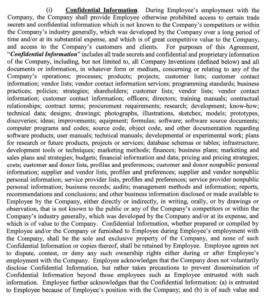
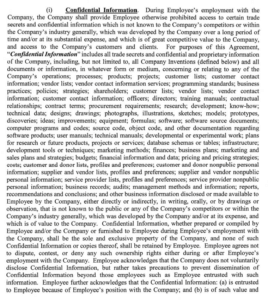
The definition of “confidential information” looks something like this:

The deposition questions about it go something like this:

Q: Can you take a look at the definition of the company’s “confidential information and trade secrets” in your agreement? Do you see that? 

A: Yes.

Q: You signed this agreement, right?

A: Yes, I signed it.

Q: So you agree that the things listed in this definition are the company’s confidential information, right?

A: Right.

WRONG!

What a difference a single letter can make.

If the question was “you agreed that the things listed in the definition are the company’s confidential information,” then yes would be an acceptable answer. That’s because generally, if you sign an agreement, you agreed to what’s in it.

But just because you signed the agreement doesn’t mean you now agree with every statement in the agreement.

See the distinction?

Yes, you may have agreed to what’s in the agreement by signing it, but just because the agreement says something is true doesn’t make it true.

Especially when it comes to a definition of “confidential information” or “trade secrets.”

The problem with this definition—and most definitions of confidential information in such agreements—is that it is both too vague and too broad.

These are slightly different things.

The definition is vague, or “indefinite,” because it is not clear what is included and what is not. For example, the definition refers to the company’s “processes” and “policies.” Which processes and policies? All of them, or just the “confidential” ones? And which ones are confidential?

Let’s say Paula Payne Windows has a process for prospecting for new customers: search on the internet for the kind of companies that buy windows, find the contact information for the person there responsible for buying windows, cold call that person, then make a note in the company’s CRM system to follow up later.

That’s a process, but is it a confidential process? Of course not. Everybody has a process like this. It’s no secret.

Is that process included in the contract’s definition of “confidential information”? It’s hard to say.

But you could read the definition literally to mean that all of the company’s processes are included in the definition of confidential information. And that brings up the second problem: the definition is overbroad.

The definition is overbroad because on its face it includes things that are not confidential.

An agreement that defines all of the company’s information as confidential would be unreasonable and unenforceable. It would be a de facto non-compete.

When you understand these two problems, you can answer deposition questions more accurately.

Q: So you agree that the things listed in this definition are the company’s confidential information, right?  

A: Not necessarily.

Q: Why not?

A: Well, first, I’m not even sure what this definition means. And second, it has things in it that are obviously not confidential information.

Q: Like what?

A: Like “processes” and “policies.” If that means all of the company’s processes and policies, then it includes things that are obviously not a secret. 

This answer won’t make the questioning lawyer happy, but you’re not there to make friends.

2. Is a customer list a trade secret?

Suppose when Dawn Davis left Paula Payne Windows, she took an Excel spreadsheet showing all her sales from the previous year, including the names of the customers. Dawn says she needed the list because the company owed her commissions, but Paula Payne Windows says the spreadsheet is a confidential customer list.

So the deposition questioning goes like this:

Q: You’re not a lawyer, are you?

 A: No.

 Q: Ok, I’m not asking for a legal opinion or anything, but do you see this definition of “trade secrets” from the Texas Uniform Trade Secrets Act?

A: Yes.

Q: The definition includes “list of actual or potential customers,” right?

A: Yes, I see that.  

Q: [in the most casual tone possible] Ok, so you understand a customer list is a trade secret, right?”

A: Yes, I understand that.

WRONG!

Perhaps we can forgive Dawn for making this mistake. I have seen licensed lawyers make this very argument to judges. “Your Honor, the definition of trade secrets in TUTSA specifically includes customer lists, so my client’s customer list is a trade secret.”

But the argument is wrong, for two reasons.

First, if you look at the whole definition of a trade secret, there’s a very important word: “if.”

A customer list is included in the list of types of things that can be a trade secret, if the rest of the elements of the definition are met (like “independent economic value”).

The first problem with the deposition question was that it ignored this important “if.”

The second problem with the argument is that it just defies common sense.

Think about it. Suppose Dawn’s spreadsheet lists just five customers, who happen to be the biggest homebuilders in her sales territory. There’s no way that’s a trade secret. All the competitors in that area know who those customers are.

If you want to know more, I cover this issue in more detail at my blog post When Is a Customer List a Trade Secret. I even cite court cases. But you get the idea.

Now that Dawn is armed with the knowledge that a customer list isn’t automatically a trade secret, let’s give her another crack at the deposition question:

Q: Ok, so you understand a customer list is a trade secret, right?”

A: No.  

Q: But it says that right there in the definition, doesn’t it? 

A: It says customer list, but there’s more to the definition.

Q: So you don’t think your customer list is a trade secret? 

A: No. Everybody in our industry knows who those customers are.

Now that we’ve avoided that confusion, let’s look at another category of information that can be a trade secret but isn’t necessarily a trade secret: prices.

3. Are the company’s prices trade secrets?

After customer lists, the next most common type of alleged “trade secret” is prices. I cover this at my blog post The Price Undercutting Theory in Trade Secrets Litigation.

Here’s how the lawyer for Paula Payne Windows might try to set it up in Dawn’s deposition:

Q: Are you working for Real Cheap Windows now?

A: Yes.

Q: Let’s say a competitor calls you up and asks you for the prices you’re charging customers this week, would you tell him?

A: Uh . . . I don’t think that has ever happened.

Q: But if it did, would you tell them?

A: I mean, I don’t think so.

Q: Why not?

A: Well it’s none of their business.

Q: And if they knew your prices they could offer the same customers lower prices, right?

A: That could happen.

Q: Can your competitors just do a Google search and find your prices?

A: No.  

Q: Right, so the prices your company charges its customers are confidential, right?

A: Yeah, I guess so.

WRONG!  

Don’t let this happen in your deposition

Everything leading up to the last question is fine, but are the prices really a secret?

Nine times out of ten, the answer will be no, at least in my experience and opinion.

That’s because in the vast majority of cases, there’s nothing to stop the customers from telling one competitor what another competitor is charging.

In fact, in many industries, it’s common for customers to do so. “Hey, Fred, Bubba’s Oilfield Supply says it can get me those frac valves for five thousand apiece this week, can you beat that?”

Unless the company has a nondisclosure agreement with the customer that says the customer must keep the company’s prices confidential, I don’t see how the company can genuinely claim the prices are a secret, or that it took the required “reasonable measures” to keep the prices secret.

Keep in mind, this is just my opinion. But it is usually correct.

Knowing that, here’s a better way for Dawn to answer deposition questions about prices:

Q: So the prices your company charges its customers are confidential, right?  

A: No.

Q: They’re not confidential? Are you saying you would just give them out to your competitors?

A: I didn’t say that.

Q: Well, if the prices aren’t confidential, why wouldn’t you share them?

A: They can easily go and ask my customer for the prices, and I can’t stop the customer from telling them. But that doesn’t mean it’s my job to help them.

So, those prices on the spreadsheet Dawn took from Paula Payne Windows, maybe they’re not so secret.

That, of course, does not mean it was a good idea for Dawn to take the spreadsheet.

4. What does the forensics show?

It’s a bad idea for departing employees to take or keep any company documents.

With the exception of their agreements with the company, which I think are generally fair game for an employee to keep. But generally, don’t take company documents when you leave!

There are multiple reasons for this, but maybe the most important one is that whatever documents the employee takes, those will be the documents the company claims contain its alleged “trade secrets” in the subsequent trade secrets lawsuit. I call this Wolfe’s First Law of Trade Secrets Litigation.

Here’s how it might go down in Dawn’s case:

Q: When you were working for Paula Payne Windows, did they provide a computer?

A: Yeah, I had a computer at the office.

Q: Did you ever use USB drives?

A: You mean like a thumb drive?  

Q: Yes. 

A: Sure, we used those all the time, like if I needed to take documents with me on a customer visit.

Q: Let me show you Plaintiff’s Exhibit 13 to your deposition. That’s a report our forensic expert prepared. Do you see that?

A: Yes.

Q: Do you see line 7 on page 2 that shows on April 7, 2023, the day after you gave notice, you plugged a Seagate thumb drive into your computer at work and copied 12 sales reports to it?  

A: Yes.

WRONG!

Dawn doesn’t have any personal knowledge of the forensic report or how it was prepared. And her recollection is probably not that specific. How can she be sure?

Here’s a better way for Dawn to answer:

Q: Do you see line 7 on page 2 that shows you copied 12 files on to a thumb drive?

A: I didn’t prepare this report.  

Q: Ok, but you see where it says that, right?

A: I see that the report says that.

Q: Well, are you denying that you copied 12 files on to that thumb drive on April 7, 2023?

A: I’m not denying there were times when I put files on a thumb drive, but I can’t remember if I copied those specific files on that specific date.  

Q: Ok, but you can’t rule it out?

A: I can’t rule it in or out. I just don’t remember.

Sticking to what you personally know is good deposition advice generally, but especially when it comes to computer forensics in a trade secrets lawsuit.

Let me stress: I am not saying Dawn should pretend like she doesn’t know or doesn’t remember if she does remember. Every witness should tell the truth. If Dawn clearly remembers, “yes, I copied 12 files on to a thumb drive on April 7, 2023,” then she should say so.

But it’s rare that the witness will remember that specifically.

In most cases, a witness in a deposition is not going to remember every little thing she did on a computer years earlier, before any lawsuit was filed. She certainly won’t remember things like the serial number of the USB drive.

And that brings up the final common deposition mistake to avoid in a trade secrets lawsuit.

5. Undermining your credibility by overstating your case

Maintaining your credibility is critically important in any lawsuit.

And if you’re a former employee defendant in a trade secrets lawsuit, it is even more important than usual. Right off the bat your credibility is under attack because you did something your former employer portrays as sneaky and underhanded. “Theft!” they will cry.

And you should expect the plaintiff’s lawyer will go into the deposition ready to set you up. It might go like this:

Q: Can you take a look at page 27 of the Paula Payne Windows Employee Handbook?

A: Ok, yes, I’m there.

Q: It says “Employees must take care not to disseminate company documents outside the company, such as sending them to personal email addresses.” Did I read that correctly?

A: Nobody ever paid attention to that.

Q: Ok, but that was the company’s stated policy, correct?

A: Yeah, I guess.

Q: Ok, so you knew it was against company policy to email yourself company documents, right?

A: Right.

Q: Did you ever do that?

A: Absolutely not. I never emailed myself company documents.

WRONG!

The answer is wrong because you already know what’s coming next: Impeachment.

The lawyer for Paula Payne Windows will show Dawn a copy of an email from her company email account to her personal Gmail account attaching a proposal to a customer.

“Oh, I forgot about that!” Dawn will say. “I was going to meet with a customer out of the office the next day, and I needed to be able to print out the proposal at home.”

A legitimate explanation, if true. But the damage will already be done.

So for questions like this, it’s important to be cautious and not overstate your case.

In this example, there are basically three possibilities:

  1. Dawn remembers emailing herself the proposal, or at least remembers emailing herself generally.
  2. Dawn has no recollection of emailing herself company documents, but knows it’s possible she did.
  3. Dawn knows for a fact she never emailed company documents to herself.

If 1 is true, then Dawn should say so.

If 2 is true, then Dawn should say something like “I don’t have a specific memory of doing that.” Then she’s leaving room for the possibility that it happened.

If 3 is true, then Dawn could say she never emailed herself company documents, but even then, she should proceed with caution.

You see, memory is a funny thing. Every litigator has experienced a client who was 100% sure of some fact or sequence of events, and then the documents show her memory is just flat wrong.

So even if Dawn is absolutely sure, it’s still a good idea to say something like “I don’t think I ever did that.”

You don’t need to overstate the good facts that are on your side.

On a scale of 1 to 14, 1 being lowest degree of likelihood, 14 being absolute metaphysical certitude, what are the chances you’ll make a mistake?

Go ahead, say your answer.

WRONG!

_______________________

Zach Wolfe (zach@zachwolfelaw.com) is a Texas trial lawyer who handles non-compete and trade secret litigation at Zach Wolfe Law Firm (zachwolfelaw.com). Thomson Reuters has named him a Texas Super Lawyer® for Business Litigation every year since 2020.

These are his opinions, not the opinions of his firm or clients, so don’t cite part of this post against him in an actual case. Every case is different, so don’t rely on this post as legal advice for your case.


Source link