When Does a Tax Return Mistake Become a Crime? – Houston Tax Attorneys


The IRS has limited resources. This is true of its human capital and its technology resources. Even with significantly more resources, the IRS would still not be able to verify every entry on every return. There are just too many taxpayers, too many types of returns, and too many calculations and entries on the tax returns.

This is why the IRS has focused on “touching as many returns” as possible. The IRS’s whole administrative system is built around this concept. It refers to being visible by making it appear that the IRS may be checking. The thought is that a visible IRS is one that encourages voluntary compliance.

But when the IRS does actually look at a tax return, it does actually identify an error, when is that error just an error? When does the error rise to the level of being a tax crime? One usually leads to civil tax penalties and the either criminal charges.

The distinction comes down to one word: willfulness. The recent United States v. Akhenaten, No. 22-13824 (11th Cir. Feb. 2026), provides and opportunity to consider how courts draw this line.

Facts & Procedural History

This case involves tax returns filed by a business owner. He operated a retail tax preparation business.

The taxpayer had an MBA and accounting degree. He even taught federal income tax classes at the college level. This included classes for C corporation and S corporation tax, which are more advanced topics than basic income tax.

The taxpayer filed tax returns for himself and his business. For his business tax returns, he reported exactly $0 in income for 2014, exactly $100 for 2015, and exactly $0 again for 2016. The IRS pulled his tax returns for audit and ultimately referred the matter for criminal investigation.

Federal prosecutors charged the taxpayer with five counts of filing false or fraudulent tax returns under Section 7206. The case proceeded to trial. The jury heard evidence about the suspicious round numbers on his returns and learned about the taxpayer’s prior tax training and teaching experience. They also heard the taxpayer testify in his own defense, where he denied knowing anything was wrong with his returns and denied intentionally filing false returns.

The jury convicted him on all five counts. The taxpayer appealed the decision. He asserted that the evidence was insufficient to prove he willfully filed false returns. The question for the appeals court was whether the government had proven the mental state required for criminal conviction or whether the evidence merely showed negligent mistakes.

The Criminal Tax Statute for False Returns

Section 7206 of the tax code sets out the criminal tax statute for filing false tax returns. The statute applies to anyone who willfully makes and subscribes any return, statement, or other document, which contains or is verified by a written declaration that it is made under the penalties of perjury, and which he does not believe to be true and correct as to every material matter.

Given the language in the statute, the government has to prove three elements beyond a reasonable doubt to secure a convision. First, the defendant has to make and subscribe to a tax return that has a written declaration that it was made under penalties of perjury. This is standard language on tax forms, so this element is usually straightforward.

Second, the defendant must not have believed the return to be true and correct as to every material matter. This means the false information must be material—it must matter to the tax calculation. A typo in an address isn’t support a criminal charge. But underreporting income by substantial amounts can as it is material.

Third, and most importantly, the defendant must have acted willfully rather than negligently. This element separates criminal conduct from mere mistakes. A taxpayer who carelessly fails to report income hasn’t necessarily committed a crime. A taxpayer who knows the income should be reported but deliberately leaves it off has may cross into criminal territory.

What Does “Willfully” Mean for Tax Crimes?

Willfulness means the voluntary, intentional violation of a known legal duty. The Supreme Court has explained that this means that the defendant had to know about the legal requirement and chose to violate it anyway.

This is different than negligence, carlessness, or even recess conduct. Negligence, carelessness, or even recklessness doesn’t satisfy this standard.

This “willful” standard sets a high bar for prosecutors. They can’t simply show the taxpayer made a mistake or should have known better. They have to prove the taxpayer actually knew they were breaking the law when they filed the return. This explains why tax audits that uncover errors usually result in civil penalties rather than criminal charges. Most errors stem from misunderstanding the tax law or poor recordkeeping. They don’t involve deliberate lawbreaking.

The willfulness requirement also explains why the IRS doesn’t routinely refer audit cases for criminal prosecution. The government has to prove beyond a reasonable doubt that the taxpayer knew their return was false when they signed it. Without this level proof, the case is a civil matter subject to civil tax fraud penalties at most.

Courts have recognized that willfulness exists on a spectrum. At one end sits the taxpayer who carefully studies the law, understands their reporting obligations, and deliberately violates them. At the other end sits the taxpayer who makes careless mistakes while trying to comply. Somewhere in the middle lies the taxpayer who suspects they should be doing something differently but doesn’t investigate further. Where exactly criminal liability begins on that spectrum depends on the facts in each case.

How Can the Government Prove Willfulness?

Prosecutors face a substantial challenge proving what someone was thinking when they prepared their tax return. People rarely confess to willfully filing false returns or leave written evidence of their criminal intent. The government must rely on circumstantial evidence to prove the required mental state.

The appellate court noted that “guilty knowledge can rarely be established by direct evidence, especially in respect to fraud crimes which, by their very nature, often yield little in the way of direct proof.” Courts permit the government to use circumstantial evidence to prove willfulness.

What kind of circumstantial evidence works? The court pointed to several categories. The suspicious nature of the numbers themselves can suggest willfulness. When a business reports exactly $0 income for one year, exactly $100 for the next year, and exactly $0 again for the third year, those round numbers suggest deliberate fabrication rather than honest accounting. Real businesses rarely have income figures that land on such perfect round numbers.

The taxpayer’s education and experience also provide circumstantial evidence. Someone with substantial tax training understands tax reporting requirements better than someone with no training. When that person files returns that violate basic tax rules, a jury can infer they knew what they were doing. The government introduced evidence that the taxpayer earned his MBA and accounting degree, worked in professional tax preparation for a living, and taught federal income tax classes covering C corporation and S corporation taxation. The court noted that someone with this background couldn’t credibly claim ignorance of basic tax reporting requirements.

Prior warnings from the IRS can also demonstrate willfulness. If the IRS previously told the taxpayer about their reporting obligations and the taxpayer continued violating them, that pattern suggests willful conduct. Similarly, attempts to conceal income or create false documentation suggest the taxpayer knew their actions were improper.

The appellate court affirmed the conviction. The evidence, viewed as a whole, permitted a rational jury to find beyond a reasonable doubt that the taxpayer willfully filed false tax returns. He crossed the line from negligent errors deserving civil penalties to willful violations meriting criminal punishment.

The Takeaway

The line between civil tax penalties and criminal prosecution rests on willfulness. Taxpayers who make negligent mistakes face financial penalties. Taxpayers who knowingly violate tax laws they understand face potential imprisonment. But proving what someone knew when they signed their tax return requires prosecutors to piece together circumstantial evidence.

This case also shows that tax professionals face a higher standard. Their expertise becomes evidence against them in criminal proceedings. The government argues their training proves they knew better. The more sophisticated their tax education, the harder it becomes to claim innocent mistake. This extends beyond formal education. Someone who has been through multiple IRS audits and received repeated warnings can’t easily claim they didn’t understand what was required. Given the rules, those who make mistakes on their tax returns and have tax knowledge, however gained, are more likely to be prosecuted and convicted for tax crimes. Those with little or no tax knowledge may end up with civil penalties.

Watch Our Free On-Demand Webinar

In 40 minutes, we’ll teach you how to survive an IRS audit.

We’ll explain how the IRS conducts audits and how to manage and close the audit.  


Source link

Leave a Reply

Subscribe to Our Newsletter

Get our latest articles delivered straight to your inbox. No spam, we promise.

Recent Reviews


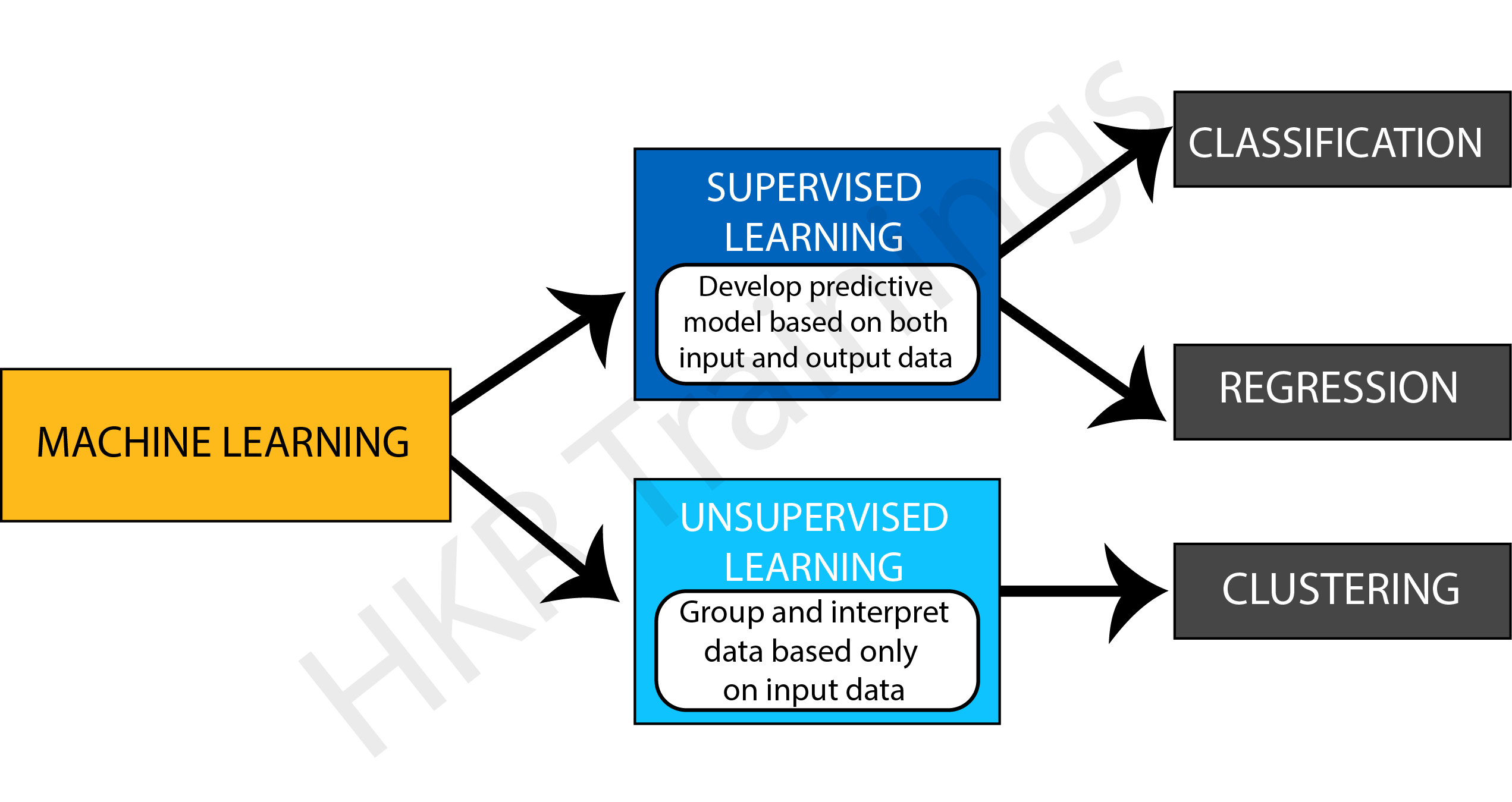
The Classification algorithm is a supervised learning method that trains data to determine the category of future observations. This is why firstly, let us understand what is supervised learning.

What is Supervised Learning

Understanding Supervised Learning

Supervised learning develops a function to predict a defined label based on the input data.

The model in Supervised Learning learns by action. During training, the model examines which label is related to the given data and, as a result, can identify patterns between the data and particular labels.

Let us understand supervised learning with an example of Speech Recognition. It is an application where you train an algorithm with your voice. Virtual assistants such as Google Assistant and Siri, which recognize and respond to your voice, are the most well-known real-world supervised learning applications.

Supervised Learning might sort data into categories (a classification challenge) or predict a result (regression algorithms). This article will specifically address everything we need to know about classification in Machine Learning.

What is Classification in Machine Learning?

The process of recognizing, interpreting, and classifying objects or thoughts into various groups is known as classification. Machine learning models use a variety of algorithms to classify future datasets into appropriate and relevant categories with the help of already-categorized training datasets.

Classification in Machine Learning

In other words, classification is a type of “pattern recognition.” In this case, classification algorithms applied to training data detect the same pattern (same number sequences, words, etc.) in consecutive data sets.

Want to Become a Master in Machine Learning? Then visit here to Learn Machine Learning Training

Types of Classification Models

There are four primary classification tasks you could come across:

  • Binary Classification
  • Multi-Class Classification
  • Multi-Label Classification
  • Imbalanced Classification

Binary Classification

The term “binary classification” refers to tasks that can provide one of two class labels as an output. In general, one is regarded as the normal state, while the other is abnormal. The following examples can assist you in better comprehending them.

For example, for email spam detection, the normal condition is “not spam,” whereas the abnormal state is “spam.” “Likewise, Cancer not found” is the normal condition of an activity involving a medical test, whereas “cancer identified” is the abnormal state.

The normal state class is usually allocated the class label 0, whereas the abnormal state class is assigned the class label 1.

Some of the popular algorithms used for binary classification are:

  • Decision Trees
  • Logistic Regression
  • Support Vector Machine
  • k-Nearest Neighbors
  • Naive Bayes

Machine Learning Training

  • Master Your Craft
  • Lifetime LMS & Faculty Access
  • 24/7 online expert support
  • Real-world & Project Based Learning

Multi-Label Classification

We refer to multi-label classification tasks as those in which we need to assign two or more distinct class labels that can be predicted for each case. A simple example is photo classification, in which a single shot may contain many items, such as a puppy or an apple, and so on.  In this type of classification, you can predict many labels rather than just one.

The most common algorithms are:

  • Multi-label Random Forests
  • Multi-label Decision trees
  • Multi-label Gradient Boosting

Multi-Class Classification

Tasks that have two or more class labels are called multi-class classification.

The multi-class classification does not differentiate between normal and abnormal results. 

In some situations, the number of class labels might be rather big. For instance, a model may predict that a photograph belongs to one of thousands or tens of thousands of faces in a facial recognition system. Examples are classified into one of several known classes.

Some of the popular algorithms used for multi-class classification are:

  • Naive Bayes
  • k-Nearest Neighbors
  • Random Forest
  • Gradient Boosting
  • Decision Trees

Imbalanced Classification

Imbalanced Classification refers to tasks in which the number of items in each class is distributed unequally. In general, unbalanced classification problems are binary classification tasks in which most of the training dataset belongs to the normal class and just a small percentage to the abnormal class.

Learners in Classification Problem

There are two types of learners in a classification problem, namely:

  • Eager Learners
  • Lazy Learners

Eager Learners

Eager learning occurs when a machine learning algorithm constructs a model shortly after obtaining training data. It’s named eager because the first thing it does when it obtains the data set is, it creates the model. The training data is then forgotten. When new input data arrives, the model is used to evaluate it. The vast majority of machine learning algorithms are eager to learn.

Lazy Learners

Lazy learning, on the other hand, occurs when a machine learning algorithm does not develop a model immediately after receiving training data but instead waits until it is given input data to analyze. It’s named lazy because it waits until it’s absolutely essential to construct a model if it builds any at all. It only saves training data when it receives it. When the input data arrives, it uses the previously stored data to evaluate the output. Instead of learning a discriminative function from the training data, the lazy learning algorithm “memorizes” the training dataset. The eager learning algorithm, on the other hand, learns its model weights (parameters) during training.

Types of Machine learning Classification Algorithms

Classification algorithms use input training data in machine learning to predict the likelihood or probability that the following data will fall into one specified category. One of the most popular classifications used to sort emails into “spam” and “non-spam” categories, as employed by today’s leading email service providers.

They are two types of classification models, namely:

  • Linear Models
  • Non-linear Models

1. Linear Models

Support Vector Machine

Support Vector Machine

The support vector machine (SVM) is a frequently used machine learning technique for classification and regression problems. It is, however, mostly employed to tackle categorization difficulties. SVM’s main goal is to determine the best decision boundaries in an N-dimensional space that can classify data points, and the optimal decision boundary is known as the Hyperplane. The extreme vector is chosen by SVM to locate the hyperplane, and these vectors are referred to as support vectors.

Logistic Regression
Logistic Regression

In logistic regression, the sigmoid function returns the probability of a label. It is used widely when the classification problem is binary, for example, true or false, win or lose, positive or negative.

Logistic regression is used to determine the right fit between a dependent variable and a set of independent variables. Because it quantifies the factors that lead to categorization, it beats alternative binary classification algorithms like KNN.

Enroll in our Machine Learning With Python Training program today and elevate your skills!

HKR Trainings Logo

Subscribe to our YouTube channel to get new updates..!

2. Non-Linear Models

Decision Tree

Decision Tree

The classification model is developed using the decision tree algorithm as a tree structure. The data is then divided down into smaller structures and connected to an incremental decision tree to complete the process. The final output looks like a tree, complete with nodes and leaves. Using the training data, the rules are learned one by one, one by one. Every time a rule is learned, the tuples that cover the rules are removed. The technique is repeated on the training set until the termination point is reached.

The tree is built using a recursive top-down divide and conquer method. A leaf symbolizes a classification or decision, and a decision node will contain two or more branches. The root node of a decision tree is the highest node that corresponds to the best predictor, and the best thing about a decision tree is that it can handle both category and numerical data.

Kernel SVM

A kernel in SVM is a function that assists in problem resolution. They provide you shortcuts so you don’t have to complete hard calculations. Kernel is remarkable since it allows us to go to higher dimensions and do smooth calculations. It is possible to work with an infinite number of dimensions with kernels.

K-Nearest Neighbor

The K-Nearest Neighbor technique divides data into groups based on the distance between data points and is used for classification and prediction. The K-Nearest Neighbor algorithm implies that data points near together must be similar. Hence, the data point to be classed will be grouped with the closest cluster.

Naive Bayes

The classification algorithm Naive Bayes is based on the assumption that predictors in a dataset are independent. This implies that the features are independent of one another. For example, when given a banana, the classifier will notice that the fruit is yellow in color, rectangular in shape, and long and tapered. These characteristics will add to the likelihood of it becoming a banana in its own right and are not reliant on one another. Naive Bayes is based on the Bayes theorem, which is represented as:

P(A|B) = (P(A) P(B|A)) / P(B)

 Here:
         P(A | B) = how likely B happens
         P(A) = how likely A happens
         P(B) = how likely B happens
         P(B | A) = how likely B happens given that A happen

Stochastic Gradient Descent

It is an extremely effective and simple method for fitting linear models. If the sample data is vast, Stochastic Gradient Descent is beneficial. For classification, it provides a variety of loss functions and penalties.

The only benefit is the ease of implementation and efficiency. Still, stochastic gradient descent has several drawbacks, including the need for many hyper-parameters and sensitivity to feature scaling.

Random Forest

Random Forest

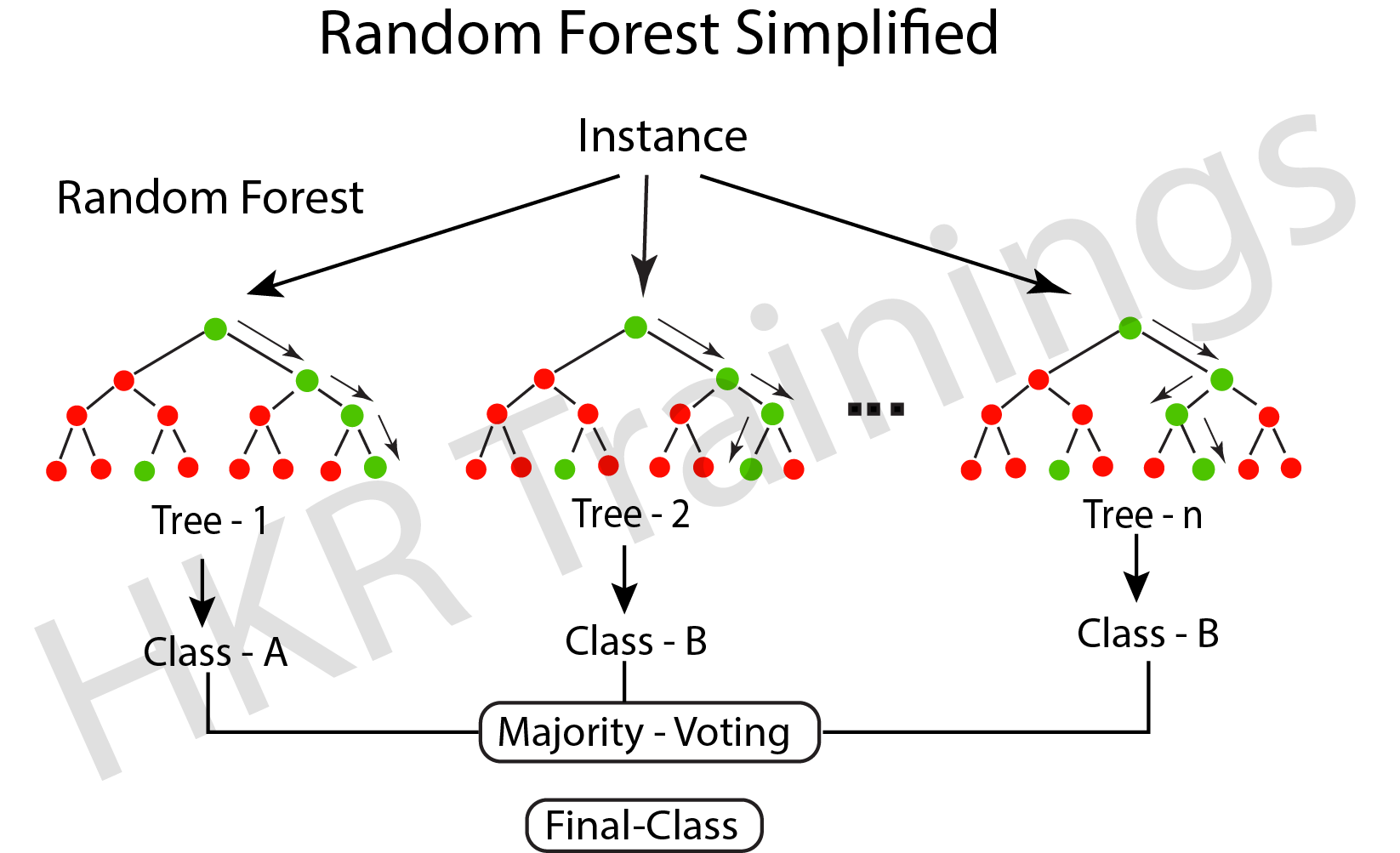
Random decision trees, also known as random forest, may be used for classification, regression, and other tasks. It works by building many decision trees during training and then outputs the class that is the individual trees’ mode, mean, or classification prediction.

A random forest (meta-estimator) fits several trees to different subsamples of data sets and averages the results to increase the model’s predicted accuracy. The sub-sample size is similar to the original input size; however, replacements are frequently used in the samples.

Artificial Neural Networks

Artificial Neural Networks

A neural network uses a model inspired by neurons and their connections in the brain to convert an input vector to an output vector. The model comprises layers of neurons coupled by weights that change the relative relevance of different inputs. Each neuron has an activation function that controls the cell’s output (as a function of its input vector multiplied by its weight vector). The output is calculated by applying the input vector to the network’s input layer, then computing each neuron’s outputs via the network (in a feed-forward fashion).

Machine Learning Training

Weekday / Weekend Batches

Conclusion

In this blog, we looked at what Supervised Learning is and its sub-branch Classification, some of the most widely used classification models, and how to predict their accuracy and see whether they are trained correctly. 

Related Articles:

Feature Selection Techniques In Machine Learning


Source link