
EU leaders call ‘urgent meeting’ as airport chaos grows


Entering summer, it seemed like a shortage of jet fuel could be the biggest problem for travelers heading to Europe. Instead, it has been ultralong lines at airports across the continent.

Travelers entering and exiting some European airports have run into massive backups amid a rocky rollout of the European Union’s new Entry and Exit System, or EES.

Launched in April, the new setup requires biometric checks for each passenger entering or leaving Schengen Area countries.

The idea: to more closely track who’s entering and leaving the EU.

But so far, the rollout of the new high-tech setup has significantly slowed passenger departures and arrivals — and fueled travel chaos.

At some of Europe’s busiest travel destinations, flyers have faced hourslong backups after landing and stressful delays while rushing to catch flights.

This past weekend, I arrived nearly three hours before my flight out of Copenhagen Airport (CPH) in Denmark. But because of the border control line I had to pass through, I barely made it to the gate before my American Airlines flight to Philadelphia started boarding.

Read more: How Europe’s EES works, and what it means for travelers

European Union EES line at Copenhagen Airport (CPH). SEAN CUDAHY/THE POINTS GUY

Airlines call for ‘immediate intervention’

The aviation industry has seemingly had enough.

Reward your inbox with the TPG Daily newsletter

Join over 700,000 readers for breaking news, in-depth guides and exclusive deals from TPG’s experts

In a public letter released Wednesday, European airports called for “immediate intervention” by EU leaders before the situation at airports deteriorates further. The group cited five-hour wait times at some hubs on busy days, along with flight delays and passengers with missed connections.

And all of this has happened before the start of the peak summer travel rush for European-based travelers.

In its own memo Thursday, low-cost carrier Ryanair called on EU leaders to suspend the EES program until September, arguing that it’s clear the new border program “is not ready for peak summer volumes.”

Related: EU plans to strengthen passenger rights, compensation rules

MARCOS DEL MARZO/LIGHTROCKET/GETTY IMAGES

“Passengers and families should not be used as guinea pigs for a half-baked passport control system that risks creating long queues, missed flights and unnecessary stress at airports this summer,” the Irish carrier said.

What is the EU doing about the backups?

So far, there are no signs that EES will go away for the summer.

In a statement to TPG Thursday, EU leaders said they had called an “urgent meeting” with industry leaders for the coming days, as the crowds grow at airports.

But the commission argued the EES impact was “limited” at most airports, and it also seemed to blame individual European countries for the recent backups.
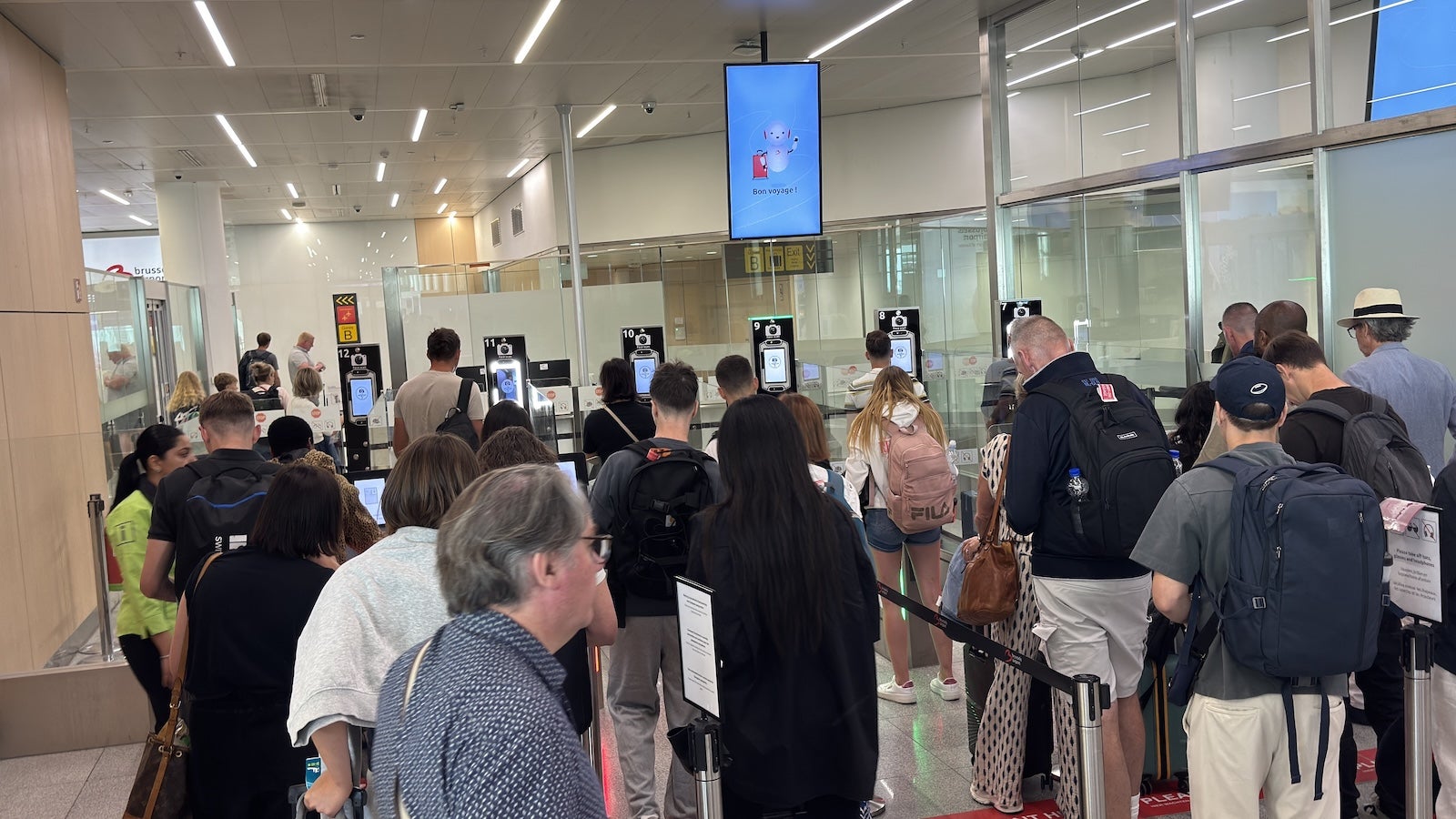
Passengers wait in an EES line in Brussels. DURSUN AYDEMIR/ANDALOU/GETTY IMAGES

“Member states are the ones who need to ensure that the necessary operational capacity is in place,” a spokesperson said. This includes “sufficient numbers of border guards” and “appropriate infrastructure.”

What should travelers flying out of EU airports do?

In the meantime, U.S. travelers currently in Europe or heading there soon should be mindful of the potential delays before going to the airport.

Arrive at the airport early, even if you don’t normally

Even if you’re a traveler who typically cuts it close when arriving for a flight, I’d get to the airport at least three hours early before an international flight — or more, if you want to completely avoid stress.

During a flight back to the U.S. from Rome in May, I arrived at Rome Fiumicino Leonardo da Vinci International Airport (FCO) two hours before departure and reached my gate with just minutes to spare.

Two hours and 45 minutes of padding was barely enough time for my June 28 departure from Copenhagen.

Be prepared to stand in line before or after your flight

Beyond that, I’d prepare for the possibility of a long wait — potentially in less-than-comfortable conditions.

In Copenhagen, the border control area was weakly air-conditioned as the region battled its latest heat wave.

Air France jet
RACHEL CRAFT/THE POINTS GUY

Buy a bottle of water after clearing security so you’ll be hydrated if you have to stand in a long line. And have water when you deplane from a long flight, too, in case the post-arrival line is long.

Don’t linger in a lounge too long

Be careful about spending too much time in an airport lounge or sit-down restaurant without knowing what line might be between you and your departure gate.

You know those social media jokes about how some travelers like to check and “make sure their gate exists” before grabbing a bite to eat? That should be the norm in Europe this summer: Make sure you can reach your gate without having to stand in a long border control line before settling in at a table for an extended preflight meal.

Related reading:


Source link

Leave a Reply

Subscribe to Our Newsletter

Get our latest articles delivered straight to your inbox. No spam, we promise.

Recent Reviews


The IRS’s historical abuses led Congress to create specific taxpayer rights, including rights stemming from collection due process (“CDP”) hearings. These administrative hearings are intended to pause IRS collection actions while the IRS Office of Appeals considers whether the collection is both lawful and warranted.

One might assume these rights extend to any liability assessed by the IRS. Since the IRS is part of the U.S. Treasury, it would seem logical that these rights would apply to any liability owed to the Treasury, especially when the Treasury delegates assessment authority for the liability from one of its sub-departments to the IRS, which is another one of its sub-departments.

The fact that a liability originated with another sub-department shouldn’t matter if that original sub-department never handles the liability because it has been fully delegated to the IRS, the other sub-department. However, as the Jenner v. Commissioner, 163 T.C. No. 7, case demonstrates, this assumption is incorrect. The case involves Foreign Bank Account Reporting (“FBAR”) penalties assessed by the IRS.

Facts & Procedural History

This case involves a couple who were assessed FBAR penalties for tax years 2005 through 2009. The penalties relate to foreign bank accounts that were not reported to the Treasury Department.

When the couple did not pay the penalties, the Treasury Department’s Bureau of the Fiscal Service (“BFS”) informed the couple that funds would be withheld from their monthly Social Security benefits through the Treasury Offset Program (“TOP”) to pay these penalties.

In response, the couple submitted Form 12153, Request for a Collection Due Process or Equivalent Hearing, with the IRS. The IRS issued a letter to the couple saying that FBAR penalties are not taxes and therefore not subject to CDP requirements.

The taxpayers filed a petition with the U.S. Tax Court under the CDP hearing procedures, which was the subject of the court opinion described in this article.

About FBAR Penalties

FBAR penalties can be imposed on U.S. persons who fail to report certain foreign financial accounts to the government. The reporting requirement generally applies if the aggregate value of all foreign accounts exceeds $10,000 at any time during the calendar year.

This reporting is done on FinCEN Form 114 (formerly TD F 90-22.1). The form is due on April 15th and there is an automatic extension to October 15th.

The amount of the penalties can be severe. Non-willful violations can result in penalties of $10,000 per violation. Willful FBAR violations can result in penalties of the greater of $100,000 or 50% of the account balance at the time of the violation. Criminal penalties can also apply in some situations. Notably, for purposes of this article, these penalties are assessed under Title 31 of the U.S. Code (which is the Bank Secrecy Act) and not under the Internal Revenue Code (which is Title 26 of the U.S. Code).

Assessment of FBAR Penalties

While FBAR penalties are not tax penalties, the IRS has been delegated the authority to assess FBAR penalties through a chain of delegation.

The Secretary of Treasury first delegated authority to the Financial Crimes Enforcement Network (“FinCEN”). FinCEN is a bureau of the Department of the Treasury that works to detect and prosecute financial crimes and money laundering. FinCEN then redelegated this authority to the IRS for FBAR penalties.

The typical assessment process begins when an IRS agent conducts an audit and proposes penalties. The IRS then issues Letter 3709 proposing the penalties, and account holders have 30 days to either pay the penalty, request an appeals conference, or provide additional information.

The taxpayer may also trigger an assessment by voluntarily submitting FBAR forms after the due date. The IRS will review the late filing and determine whether to impose penalties. When FBARs are filed through FinCEN’s BSA E-Filing System, the IRS receives this information through an information-sharing agreement with FinCEN. The IRS can then review these late filings as part of its normal examination process.

If the taxpayer files a timely request for appeals review

If the taxpayer files a timely request for appeals review, the IRS Office of Appeals has the ability to consider the proposed FBAR penalties, including whether the violations occurred, whether they were willful or non-willful, whether reasonable cause exists, and whether the penalty amounts are appropriate. Appeals officers can sustain, reduce, or eliminate the proposed penalties based on their review of the facts and circumstances.

They can also consider hazards of litigation, meaning they can take into account the IRS’s likelihood of success if the case were to proceed to court. This review is particularly important for willful FBAR penalties, where the government must prove willfulness by clear and convincing evidence in any subsequent litigation. Appeals officers may also consider the ability to pay and can help facilitate alternative payment arrangements if the penalties are sustained.

Remedies After Missing or Unsuccessful Appeal

If account holders miss the appeals deadline or receive an unfavorable appeals decision, there are still several options that may provide remedies.

For example, the account holder can challenge the administrative offset through Treasury procedures. When the Treasury’s Bureau of the Fiscal Service initiates an offset (such as withholding Social Security benefits), they must provide notice to the account holder. The account holder then has certain due process rights under Title 31, including the right to inspect records, request a review of the debt, and establish a payment schedule. They can also present evidence that the offset would create a financial hardship or that the debt is not valid or legally enforceable.

Account holders can also wait for the government to file suit to collect the penalties and raise their defenses in the collection suit. They do not have to pay the penalty and file a refund claim first with this option. This is different from tax assessments, where taxpayers typically must “pay first, litigate later.” When the government files suit to collect FBAR penalties under 31 U.S.C. § 5321(b)(2), the account holder can raise defenses such as reasonable cause, lack of willfulness, statute of limitations, or constitutional challenges. The government bears the burden of proving its case, including proving willfulness by clear and convincing evidence for willful FBAR penalties.

Collection Due Process Not Allowed

Notably absent from the discussion above are the IRS collection programs and procedures. That is the issue in this Jenner court case.

In Jenner, the tax court answers the question as to whether the traditional CDP hearings and rights are available for FBAR penalties. As noted by the court, FBAR penalties are not “taxes” under the Internal Revenue Code and CDP rights only apply to collection of “taxes.”

The court emphasized that the IRS’s authority to assess FBAR penalties does not convert them into tax liabilities. Instead, Title 31 provides its own separate procedures for assessment and collection. The collection mechanism for FBAR penalties is through civil action or administrative offset, not through IRS liens and levies that would give rise to CDP rights.

Thus, while the IRS may assess these penalties, they remain non-tax debts subject to Title 31’s collection procedures rather than the Internal Revenue Code’s collection provisions. The CDP hearing is not a viable option for contesting the assessment or underlying liability for FBAR penalties.

The Takeaway

Unless Congress changes the law, account holders who are assessed FBAR penalties by the IRS do not have fundamental rights, such as CDP rights, that are afforded to taxpayers for tax balances. This is the case even though the same agency whose abuses gave rise to the CDP hearing and CDP rights for taxpayers, the IRS, is involved in assessing FBAR penalties. The remedies outside of the IRS are there, even though they do not afford taxpayers the rights and remedies available for taxes. Account holders have to contend with this when assessed FBAR penalties by the IRS and do not agree with the assessments.

Watch Our Free On-Demand Webinar

In 40 minutes, we’ll teach you how to survive an IRS audit.

We’ll explain how the IRS conducts audits and how to manage and close the audit.  


Source link