
Ferrari And HP Made A Vivid Red Laptop With A Transparent Base Panel


Banish any memories of Ferrari’s 2004 venture into laptops. Coinciding with the Monaco Grand Prix, and with HP in tow, Ferrari is charging at the world of laptops again with a product that has an eye-watering, Tifosibaiting price of $5,599.

The HP Scuderia Ferrari AI PC is a limited-run notebook that’s the result of two years of collaboration between the PC maker and iconic car company. The laptop is unapologetically design- and engineering-centered, as you might expect, with premium materials and finishes, all backed by the reliability and technical assurance that should be typical of HP’s laptops.

When I got to check out a prototype laptop in Ferrari’s London showroom, the vivid red finish was mesmerizing. The companies have tried to capture the Rosso Magma sheen of Ferrari’s Icona Daytona SP3 — and other car models I’m less familiar with. The color effect is meant to add depth to the eye-catching finish and the palm rest has a special lenticular finish, meant to convey motion blur. 

Most of the Scuderia laptop is made of anodized aluminum with a CNC-machined finish, but if you flip it over, the base is covered in a supercar-like carbon fiber. There’s also a transparent segment, dubbed the “engine bay”, where you can see the laptop’s processor and cooling system. You’ll also make out the laser-etched number indicating which of the limited 5,000-unit run you’re looking at, as well as a few Easter eggs for Ferrari obsessives. The panel is made of Gorilla Glass, with 2,000 individually drilled holes adding further texture and visual interest.

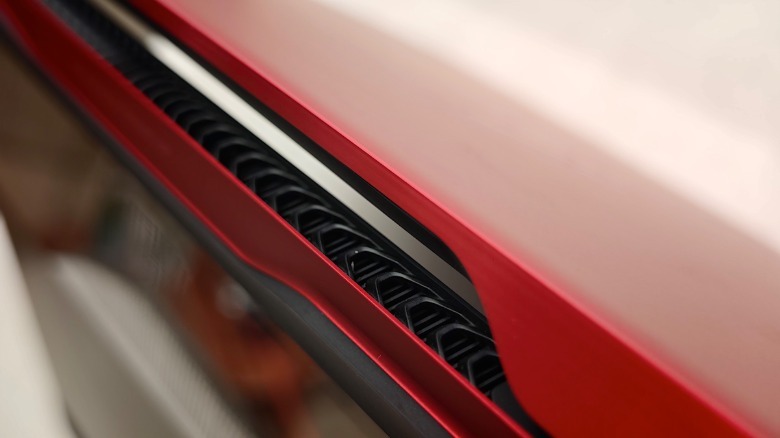
Even the hinge draws from Ferrari design — specifically, its F76 digital hypercar. The concentric louvers across the hinge are crafted to help channel airflow and keep things cool. Several stylistic choices are centered around Ferrari’s motto of “eyes on the road”; focusing on the primary experience of the user (or driver). One example of this is how, when the laptop is open, the trackpad is all but invisible, signposted by a slender lit-up line just below the keyboard.
While the laptop’s specs aren’t an afterthought, it certainly isn’t a gaming powerhouse, either. Those familiar with HP’s Zbooks will find the specs here familiar. The Scuderia Ferrari Notebook runs on an Intel Core Ultra X7 processor, with integrated Intel Arc graphics, 64GB of memory and a 1TB SSD. The 14-inch 3K OLED screen supports touch input, while the keyboard features an RGB light for each key (in Ferrari’s typeface). Those are customizable and there are a handful of preprogrammed light-up cycles if you’re feeling flashy (which, if you own this PC, you are into flashy). It’s certainly the most glamorous AI PC I’ve seen so far. It’s not underserved on connectivity options either, with two USB-C Thunderbolt 4 ports, a USB-C 10Gbps port, a USB-A port and HDMI and headphone jacks.

The Scuderia Ferrari will be available for purchase in only a handful of countries, including the US, the UK, Italy, Japan and a few others. Like Ferrari’s most desirable cars, the limited run comes with a heady price: $5,599. Diehard Ferrari (or HP) fans will get their rare laptop wrapped in a classy box, with a USB charger and a slick Poltrona Frau leather sleeve included. Naturally, it’s the same leather used in Ferrari car interiors and is almost as desirable as the laptop itself. It will go on sale later this month on June 12.


Source link

Leave a Reply

Subscribe to Our Newsletter

Get our latest articles delivered straight to your inbox. No spam, we promise.

Recent Reviews


Fact checked by Nick Blackmer

Credit: dragana991 / Getty Images
  • Saunas and steam rooms use heat to improve circulation, support muscle recovery, and reduce stress.
  • Regular heat exposure may benefit heart health, mood, and inflammation, though more research is needed.
  • Different types of saunas and steam rooms offer similar benefits, so choosing one depends on personal preference and goals.

People have been using the heat therapy from saunas and steam rooms for centuries to improve well-being and promote relaxation. Not only do these tools support muscle recovery after an intense workout, but they also boost circulation and reduce stress.

What Happens to Your Body in a Sauna?

Regular sauna use can have a positive impact on your body. Short bursts of intense heat raise your skin and body temperature, which researchers have found triggers your brain to start regulating your temperature. This activates systems in your body that control your stress levels and your hormones. You may notice changes like an increased heart rate, improved blood flow to your skin, and sweating.

Sauna use causes blood vessels to widen and may, over time, support reduced inflammation and cellular stress responses—but it’s not a direct or immediate cure-all for cell damage or inflammation.

Some researchers believe that the stress from the high heat may also mimic exercise and could be useful for people with limited mobility. However, more research is needed to fully understand the health benefits.

The Three Main Types of Saunas, Explained

There are several different types of saunas, such as dry saunas, infrared saunas, and steam rooms. Here's what you need to know about each.

Dry Sauna (Traditional Sauna)

A traditional or dry sauna offers high heat and low humidity and is usually found in local gyms and spas. Typically, the air is dry with 10% to 20% humidity, and the room is heated to a high temperature of at least 176 degrees Fahrenheit, sometimes higher.

Steam Sauna

A steam room uses water vapor to create a warm, moisture-filled room with dense, misty air. For comfort, most steam rooms operate at a lower temperature than saunas, typically around 110 to 120 degrees Fahrenheit, but can feel warmer due to the humidity. Like saunas, you can find them at gyms and spas.

Infrared Sauna

These saunas are dry saunas that emit infrared light waves to heat the body directly and do not use water or humidity. They can run a wide range of temperatures, from 113 to 165 degrees Fahrenheit. These types of saunas are popular in wellness spaces or among those who practice “biohacking.”

Potential Health Benefits and Risks of Saunas

Regular use of saunas and steam rooms can support heart health, improve circulation, and boost muscle recovery, as heat therapy increases blood flow and reduces tension.

There’s also some limited evidence that it can rid your body of impurities and heavy metals. However, more research is needed to fully understand the health benefits of heat therapy. Heat therapy is not widely studied, particularly regarding steam rooms.

The available research is promising. Here are some ways you might benefit from using a sauna or steam room.

  • Boosts heart health: A long-term, 15-year study found that visiting a sauna two to three times a week lowered the risk of dying from heart disease by 25% compared with once per week. Meanwhile, using the sauna four to seven times a week decreased this risk by 77%.
  • Enhances exercise benefits: One study found that combining regular sauna use with regular exercise can improve heart health by lowering cholesterol and blood pressure.
  • Promotes longevity: Your lifespan could potentially be longer when you use a sauna regularly, according to a 2021 review of several large studies. Researchers found that sauna use can slow aging, largely due to its cognitive, heart, and muscle benefits.
  • Improves mood: Regular sauna users may experience less depression and anxiety, and can be a useful tool for people in high-stress jobs.

Who Shouldn't Use Saunas?

While there are a number of benefits to utilizing a sauna or a steam room, these tools are not right for everyone.

For instance, people with certain heart conditions or those who are heat-sensitive may experience more adverse reactions than benefits from heat therapy.

Overuse can also cause dehydration, muscle cramps, and electrolyte loss. Consult with a healthcare provider before using a sauna or steam room, especially if you have any underlying health concerns.

Is One Type Actually Better for You?

There is little research identifying which type of heat therapy is best for overall health and well-being. Instead, both have benefits and can help you achieve your wellness goals. Most of the well-supported benefits come from heat exposure itself, rather than from the specific sauna type.

When deciding between the two, choose the sauna or steam room based on which you have the most access to—you will benefit from either. However, if you have access to both a sauna and a steam room, use the one you prefer and are more likely to stick with in order to see long-term benefits.

If your goal is health (especially heart health), consistency matters far more than the type of sauna you pick.

Which Sauna Should You Choose Based on Your Goals?

If you are fortunate enough to have regular access to both a sauna and a steam room, then you can make a choice between the two based on your goals:

  • For skin concerns: A steam room. If you suffer from dry skin or want to open your pores, the moist heat can hydrate your skin, encourage detoxification, and boost skin health.
  • For detoxification: A dry or infrared sauna. Because saunas cause you to sweat, your body may flush out toxins and impurities. There’s also some evidence that using a sauna can help rid your body of heavy metals.
  • For improved circulation and heart health: A dry or infrared sauna. These can help dilate your blood vessels and improve blood flow. These changes, when done consistently, could benefit heart health.
  • For improved breathing: A steam room. Moist heat is effective at opening your airways. Some people find that saunas are helpful for conditions like asthma.
  • For relaxation: Any. Not only does the atmosphere of saunas help reduce stress levels, but it also can improve mood and overall well-being.
  • For muscle recovery: Any. In a steam room, the moist heat will soothe sore muscles and joints and can be useful for conditions like arthritis or muscle stiffness. Meanwhile, dry or infrared saunas can promote relaxation, soothe muscle tension, and reduce pain and discomfort.


Source link