Forget Hot Girl Walks—Everyone's Using the Stair Climber Now. What Are The Benefits?


Fact checked by Nick Blackmer

Credit: Dimensions / Getty Images
  • Stair climbing works multiple lower-body muscles and engages the core to maintain stability.
  • It provides high-intensity cardio with lower joint impact than running.
  • Regular use can improve heart health, boost fitness, and burn calories efficiently in less time.

The stair climber—the machine that looks like an endless escalator you keep ascending—is a popular option at the gym for a good cardio workout. But, how effective is it, really? And what are the benefits of adding the stair climber (sometimes also called a stepmill or stairmill) to your workout?

1. Stair Climbing Gets Lots of Muscles Working

A stair climber lights your entire lower half on fire. When you go upstairs, every lower-body muscle is recruited. These include your quads, hamstrings, glutes, hip abductors, and calves.

Your core muscles are also working, including your rectus abdominis (across the front of your abdomen), obliques (sides of your abdomen), and transverse abdominis (deep muscles that wrap around the sides of your abdomen). These have to fire up to keep you steady as you climb.

2. It’s a Low-Impact (But High-Intensity) Workout

Research analyzing the heart rates (HR) of exercisers on 10 popular cardio machines found that the stair climber and treadmill spiked HR the most.

Using a treadmill and a stair climber can both be high-intensity cardio options. But for many people, a treadmill may not be the best (or safest) option. When jogging or running, both feet leave the ground simultaneously, resulting in a more forceful landing. This high impact can place significant stress on your joints, particularly if you have pre-existing hip, knee, or ankle issues.

With a stair climber, however, each step is controlled, so there is less impact than with jogging or running. Less pounding makes it more joint-friendly.

3. Stair Climbing Boosts Your Cardio Fitness

Continuous stair climbing activates a lot of big muscles, and the work to keep them moving provides a challenge to your heart and lungs. If you do this regularly, those organs adapt, get stronger, and become more efficient at using oxygen, which can boost your fitness.

In fact, women who added stair climbing to their routine for eight weeks increased their VO2 max, the gold standard for measuring cardiorespiratory fitness. They lost weight and improved their cholesterol profiles, too. A higher VO2 max has been linked to healthier hearts and longer lives.

4. It's A Time-Efficient Calorie-Burn

A stair climber can help you burn more calories in a shorter time. A study analyzed how long it took participants to burn 300 calories on several gym machines and found that a stair climber got them to burn those calories faster than on an elliptical, bike, arc trainer, rower, and other machines.

So if your goal is to burn calories, climbing stairs can help you achieve it faster.

However, compared to other steady-state cardio options, here’s how a stair climber stacks up for a 150-pound person:

  • Stair climber: Burns about 660 calories per hour
  • Running (8-minute mile pace): Burns about 842 calories per hour
  • Jogging (12-minute mile pace): Burns about 607 calories per hour
  • Walking (17-minute mile pace): Burns about 343 calories per hour

5. It’s Simple to Structure a Workout

By adjusting the intensity on your stair climber, you can change how hard you work, which can help you structure a workout. For instance, if you want to do high-intensity interval training, or HIIT, you can crank up the intensity for a short period—say, 30 seconds or one minute—and then back off to a lower intensity for your recovery period. Generally, consider keeping your work-to-rest ratio at 1:2 or 1:3. So if you do 30 seconds hard, you would go easy for 60 seconds or 90 seconds, before repeating.

You can also keep it steady-state. Just choose a more moderate intensity level that will allow you to maintain the same effort for your chosen duration.

Is It Better Than Walking?

If you’re looking for the better bang for your buck, stair climbing, as a higher-intensity activity, is going to have the edge over walking, which is a moderate-intensity activity. This means you reap the health benefits of exercise in less time.

However, ultimately, the best exercise is one you’ll actually want to do. If you love walking and are consistent with it, that’s going to be better for your health than stair-climbing workouts that you dread—and consequently skip or put off.

Potential Mistakes to Watch Out For

If you enjoy stair-climbing workouts and want to do them more, learning proper form is vital. Leaning forward or hunching over the handrails—or grasping them too tightly—can reduce activation in your lower-body muscles. Instead, hold them lightly for balance and try to keep an upright posture, with your chest up, shoulders back, and core engaged.

Because stair climbing is a high-intensity exercise, you also want to make sure you’re not jumping into too much too soon. Start at lower intensity levels so your body can get used to the movement, and keep your workouts brief. Once you get familiar with stair climbing, you can add harder intervals and make your workout longer overall.




Source link

Leave a Reply

Subscribe to Our Newsletter

Get our latest articles delivered straight to your inbox. No spam, we promise.

Recent Reviews


What is Cloud FinOps?

A functioning structure and informational flux that gathers businesses, finance, and technological operations alongside each other to drive up the businesses through cloud transformation.

It promotes data-powered decision-making in due time and results in financial responsibility. The collaboration of finance, operations, and business teams makes it possible to achieve it.

FinOps is a field that integrates principles of financial management with cloud engineering and operations to give organizations an analysis of their cloud expenditure. It also allows them to make well-versed decisions on the allocation of their cloud budget and costs. Its goal is to increase the revenue or the business value with the help of the cloud. It also helps organizations control their cloud expenditure while still maintaining the performance level, dependability, and security required to assist their business operations.

Principles of Cloud FinOps

Accountability

With a set of pre-defined KPIs and benchmarks, the teams responsible for value realization reporting and costing amendment can be held accountable. This makes decision-making a process with standards.

Business Value Realization

Decisions taken from the perspective of business make Cloud FinOps successful.

Flexibility

Encourage constant budget allocation, IT spending, and forecasting to push ahead with agile budgeting and planning procedures in the IT industry.

Clarity of Costs

All organizational levels have access to instantaneous cost and billing data.

Partnerships

For cloud finance management, collaborate with departments like IT, finance, app development, and architecture.

Fluctuating nature of the cloud

Accept the pay-as-you-go aspect of cloud and gain from providing dynamic customer service to meet their ever-changing requirements.

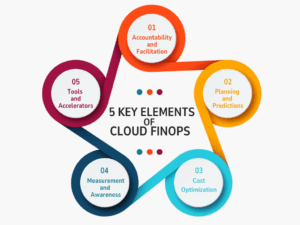
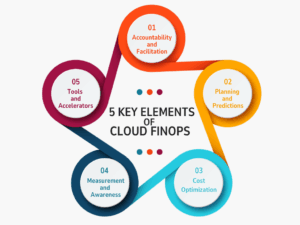
Five Key Elements that Make Cloud FinOps

5 Key Elements of Cloud FinOps

1. Accountability and Facilitation

This element centers on setting up centralized, multi-functional teams that include engineering, finance, operations, architecture, and app developers, while also setting up governance and benchmarks for cloud expenditure.

2. Planning and Predictions

For cloud planning and predictions to be effective, an organization must allocate resources, benchmark efficacy, and gain a deeper understanding of the cost drivers.

3. Cost Optimization

This element, which is an ongoing, repetitive process that focuses on identifying key cost-optimization drivers, offers a consistent methodology to manage cloud consumption in the most economical way.

4. Measurement & Awareness

This key element focuses on building a key set of KPIs and business-value metrics to calculate the transformation’s success. Customers frequently begin with a set of cost-optimization metrics before switching to unit economics or business value metrics, like cost per transaction or cost per customer served.

5. Tools and Accelerators

To sum up, using the right tools and accelerators is crucial for efficiently managing and monitoring cloud spending. It comprises:

  1. Using Google Cloud cost-management tools to examine cost and billing data in real time
  2. Creating a reporting dashboard for tracking values and managing cloud spending
  3. Putting automation scripts into place to create budget alerts and account guardrails

Benefits That Cloud FinOps Offer

Business Value Realization

Initial focus on cloud migration often leaves the business goal of infrastructure in the rear. Proper cooperation between various departments makes FinOps effective and a success. This allows the reconsideration of business values while lifting cloud management to new heights.

Better Decision Making

Making decisions to make business better than today is the whole point here. Using the insights from cloud data and financial analytics, the FinOps team is able to make informed decisions regarding the business’s cloud computing commodities. This also makes them focus on the business goals.

Art of Predictions and Cloud Reporting

FinOps teams analyze cloud spend and set standards for future cloud costs using analytics, reporting, and forecasting cloud FinOps tools. They can create budgets fittingly and evade unplanned surplus costs thanks to the jacked-up cost visibility.

Accountability for Clear Cloud Use

By providing clarity into resource ownership and cloud spending, FinOps promotes accountability while leveling the time and effort needed for research and change implementation.

Challenges That FinOps Come With

Before Cloud FinOps begins to show results, you must surpass many predicaments. These may include issues with organizational processes, technical implementation, or how the teams as a whole perceive the changes.

Governance

Incorporating new methods, tools, and challenges requires all the things to be in place and well-governed. The processes to be incorporated ought to adhere to existing laws, rules, and compliance standards. It can be challenging to describe these approaches, create policies, and implement them.

Technical Glitches

There might be considerable technical glitches in putting the suggested modifications into practice, from planning effective cost data collection and processing to putting per-instance optimizations, element migration, and access management into practice.

All of the alterations should certainly be based on practicality, as well as administering the right balance between cost-effectiveness and effort, while taking into account the gross solution’s business value.

Cultural Alterations

As the FinOps framework requires processes to be established at every level of an organization, an actual cultural transformation must take place for FinOps methodologies to be implemented successfully. This entails setting up a culture of financial responsibility and accountability while maintaining the requirements of the company and the objectives of the other players in mind.

It could be challenging to bring in this culture, as it needs not only the establishment of appropriate processes but also a shift in the team’s mentalities. So, it is a task!

From Chaos of Cloud to Clarity: An Imperative for Businesses

Cloud FinOps is the way of the future for businesses, but excessive cloud spending can undermine the very advantages that companies are trying to achieve. Cloud FinOps management transforms from a standalone finance function into a vital business capability with FinOps.

Businesses that adopt Cloud FinOps not only reduce cloud expenses but also acquire the flexibility to change course more quickly, the assurance to make more intelligent investments, and the transparency to match IT with business value.

The ability to forecast precisely, budget dynamically, and optimize continuously is not a luxury in a world where cloud usage is only increasing; rather, it is a competitive necessity.

To learn more, visit KnowledgeNile!


FAQs for Cloud FinOps

1. What is another name for FinOps?
Answer: FinOps is the blend of “Finance” and “DevOps”. It shows the collaboration between business and engineering groups. It is also known by terms like Cloud Financial Management and Cloud Financial Optimization.

2. When did FinOps start?
Answer: It began in 2019 as an open community comprising individuals and organizations where knowledge of cloud financial management could be shared.

3. What is the future of FinOps?
Answer: FinOps’s future depends on comprehensive innovation and teamwork. FinOps and ITAM combination will be essential as cloud infrastructure develops to trim the financial waste, promote sustainability, and improve AI-powered optimization.


Also Read:
Cloud Migration Process Explained in Easy Steps
Edge and Cloud Computing for IoT and Their Key Roles
What is The Distributed Cloud: Advantages and Disadvantages


Source link