Framework launches the Laptop 13 Pro with Intel’s new Panther Lake chips


Framework’s lineup of modular, repairable laptops has seen the company grow from a niche to the mainstream. Now, the company is launching a pro version of its 13-inch laptop, but it’s still held close to all of its principles. Because while this all-new version has plenty of bells and whistles, almost all of its components are still instantly compatible with the rest of the range. You can take a part from this new 13 Pro, and install it into the first-generation 13 launched back in 2021 without much fuss.

Framework Laptop 13 Pro is touted as a “ground up redesign” of the existing 13, taking into account feedback from its dedicated and passionate users. That includes a far bigger battery, new chassis, new memory, haptic trackpad and a custom touch display. It also comes in black and, even in the press images, it’s immediately clear it’s a better color for the company’s austere industrial design. CEO Nirav Patel smiled knowingly when I said it’s immediately evocative of a ThinkPad, and I mean that in the most complimentary way.

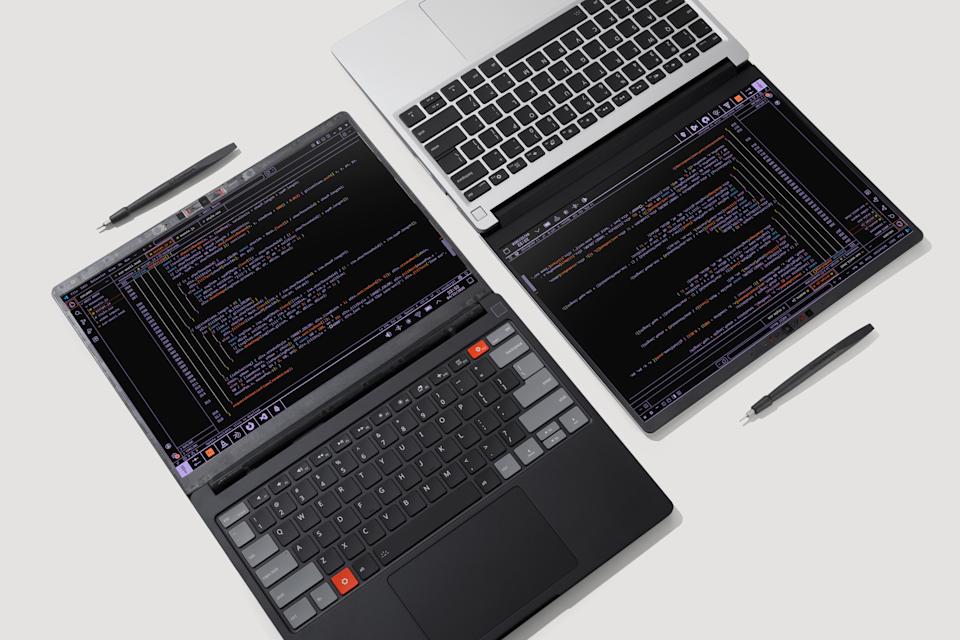
Two Framework 13 Pro models side by side.

Framework

The biggest change has been to boost the battery to 74Wh to address gripes about longevity. It’s the second time Framework has boosted the cell size, which started at 55Wh and presently runs to 61Wh. To make the battery fit, the bottom of the chassis has been redesigned, filling out the chamfers present on the existing 13. Framework says the Pro’s lifespan will hit 20 hours of uptime while streaming Netflix in 4K, and says it’ll post the videos to YouTube to prove it.

Given the redesigned lower chassis, the new battery is the one part you can’t simply drop into an older machine. “You’ll need the new bottom cover to fit,” explained Patel, “but because we’ve also increased the thickness of the battery, you have to switch over to the new input cover that has the haptic trackpad.” Patel added while you may need to pair up some parts from upgrades, there’s no component that you can’t retrofit. The new chassis means the speakers are now side-firing, and are now Dolby Atmos-certified.

The bigger battery is working in tandem with Intel’s new Core Ultra Series 3 chips which promise to be incredibly efficient. Both Intel and Framework are sure the Panther Lake silicon is going to sip at that beefy battery, but with enough grunt to play AAA games. Users will get the pick of a Core Ultra 5, X7 or X9, with the promise all of them will be able to eat a game like Cyberpunk 2077 for breakfast, lunch and dinner. At the same time, the Pro will also launch with an AMD Ryzen AI 300 series mainboard option, which are the same mainboards found on the 2025 Laptop 13.

Image of a Laptop 13 Pro with SODIMM installation

Framework

The last major shift has been in the RAM, going from regular SO-DIMMs to LPCAMM2. The newer hardware design enables the use of LPDDR5X RAM with its better power efficiency and faster memory bandwidth. And it’s not soldered to the board, so you can add in more at some unspecified future date. Which is important if, I dunno, for some reason the global RAM market suddenly crunches and you need to mortgage a kidney for a single stick.

Naturally, I wanted to know how this would impact the laptop’s thermals, Framework’s weak spot. Patel said the mainboard’s cooling has been tweaked (once again), this time with some extra help from Intel. He added the Pro he was using to run our call hadn’t spun up its fans in half an hour which, for a Framework, is a big deal. As always, I’ll reserve judgment until I’ve seen the thing in person.

The Pro is also a way for Patel to fix some of the compromises the company had to make at its genesis. “As a startup six years ago, we just didn’t have access,” said Patel, “when we go to a display vendor [now] and say ‘we want a custom panel’ they say ‘okay, let’s talk specs’ rather than ‘who are you?”’ The 13 Pro ships with a 13.5-inch, 3:2, 2,880 x 1,920 touch display with a variable refresh rate between 30 and 120Hz. Its backlight pushes all the way to 700nits, it has a 1800:1 contrast ratio and per-unit color calibration.

I was surprised the 13 Pro has touch given it’s still a 13-inch productivity notebook without a wraparound hinge. “All the way back in 2021, when we first launched, we were getting asked for touch support,” said Patel. But the company was naturally resistant, assuming touch was an unnecessary addition for a machine of this class. It was only when building the Laptop 12 did the team find it to be quite useful. “It was a slam dunk. We know people want it, we used it on the 12, we like it and it doesn’t actually cost that much. Let’s just add it in,” said Patel.

Image of the Framework 13 Pro being pointed at to demonstrate it has a touchscreen

Framework

Framework knows touchpads are a weak spot for Windows laptops when compared to those made by Apple. Consequently, the Pro 13 has a haptic touchpad with four piezo elements that, it’s hoped, will stand shoulder-to-shoulder with a MacBook Pro. The new input cover keeps the came keyboard and fingerprint sensor, wisely not touching a feature that isn’t broken and doesn’t need fixing. What is cool, however, is the more punky gray and black aesthetic on the keyboard that splits the difference between a ThinkPad and a cyberdeck. “A big part of this goes back to the idea to build the ultimate developer laptop,” said Patel.

Existing Framework owners may be concerned about how this will affect their machine’s longevity. The company might not like me saying, but to me, the Pro name is only meaningful if you’re buying a new machine off the shelf with the new features in one package. There’s nothing stopping you from upgrading your existing machine to match the pro in one go, or as your needs evolve. That’s fundamentally the company’s greatest strength, since it has committed to bringing every single one of its existing users along. But doesn’t make for the splashiest headlines when it comes to debut a new product.

Framework Laptop 13 Pro is available to pre-order today, with the first shipments due to start in June. The base-model pre-built Windows system will start at $1,699, while the DIY model will set you back $1,199.


Source link

Leave a Reply

Subscribe to Our Newsletter

Get our latest articles delivered straight to your inbox. No spam, we promise.

Recent Reviews


sap profitability analysis – Table of Content

Purpose of Profitability Analysis

One of the most difficult responsibilities in any organization is data processing and analysis. Because SAP S/4 HANA Controlling provides CO-PA without any structures or master data. As a result, you can framework and customize COPA to meet the project requirements.

Comparably, the Margin Analysis gives you the option of designing and structuring your Profitability Analysis. You can also take advantage of the extra pre-configured as well as pre-designed capabilities.

Postings were also rarely created directly in SAP Profitability Analysis. Profitability analysis, on the other hand, obtains postings from previous components. It then even farther enriches them with appropriate characteristics.

As a result, it is critical to understand where your data is coming from and how the procedures are characterized. This gives the correct information and analyses it correctly.

                    Want to Become a Master in SAP Success Factors? Then visit here to learn SAP Success Factors Certification Course from hkrtrainings

SAP Training

  • Master Your Craft
  • Lifetime LMS & Faculty Access
  • 24/7 online expert support
  • Real-world & Project Based Learning

Types of Profitability analysis

There are two types of profitability analysis in SAP S/4 HANA.

  • Costing-based COPA and,
  • Margin Analysis (Account-based CO-PA)

Costing based profitability analysis:

Costing-based profitability analysis (CBCOPA) examines profitability through the use of value fields such as material costs, discounts, revenues, and so on. These value fields can be thought of as buckets where similar values are grouped. In previous SAP releases, the most common type of profitability analysis was costing-based profitability analysis.

Costing-based profitability analysis is extremely powerful because these value fields can be defined as needed in each SAP client, providing a high degree of flexibility.

Costing-based profitability analysis has some limitations. For example, reconciling costing-based profitability analysis with financial accounting can be difficult. This is due to the fundamental nature of costing-based profitability analysis: the value fields do not correspond to the accounts used in financial accounting.

Besides that, the value flow to financial accounting and the value flow to profitability analysis differ. The basic sales process entails creating a sales order, then delivering goods and issuing an invoice to the customer. The cost of goods sold is posted with the goods issue in financial accounting, and the sales revenue is posted with the invoice.However, in a costing-based profitability analysis, the invoice document contains both the sales revenue and the cost of goods sold. As a result, at month’s end, there are discrepancies between financial accounting and profitability analysis.

Margin Analysis or Account based profitability analysis:

It is used to generate a profit margin report which is always resolved with financial accounting. It is primarily used to gather information for the departments of sales, marketing, product management, and corporate planning in order to promote internal accounting as well as decision-making.

Account-based profitability analysis (ABCOPA) collects profitability values by using accounts (cost elements). As a result, by design, it is very simple to reconcile with financial accounting. However, it had significant limitations in SAP ERP and earlier versions. The cost of goods sold could not be divided among various cost components, as is possible in costing-based profitability analysis.

       Click here to get latest SAP interview questions and answers for 2021!

In addition, variance analysis was only available for total variance, not by variance category. Prior to SAP S/4HANA, most companies chose costing-based profitability analysis, and account-based profitability analysis was sometimes implemented in parallel to facilitate the accounting reconciliation process.

SAP S/4HANA has significantly improved profitability analysis, particularly account-based profitability analysis. The benefits of costing-based profitability analysis are now available in account-based profitability analysis in SAP S/4HANA, along with easy reconciliation with financial accounting.

Account-based profitability analysis now allows for the separation of cost components. Variance categories also make variance analysis possible. As a result, in SAP S/4HANA, a profit and loss statement with a contribution margin calculation is possible, similar to costing-based profitability analysis.

                    Want to Become a Master in SAP Analytics? Then visit here to learn SAP Analytics training Course from hkrtrainings

HKR Trainings Logo

Subscribe to our YouTube channel to get new updates..!

Key components of SAP Profitability Analysis

The key components of SAP profitability analysis are:

  • Actual Posting enables you to transfer sales orders and billing documents in real time from the Sales and Distribution application component to CO-PA. Costs from cost centers, orders, and projects, as well as costs and revenues from direct postings, can also be transferred or settled from CO to the profitability segment.
  • It enables you to evaluate current information from a profitability standpoint by using the drilldown purpose in the reporting tool. It enables you to navigate a large dataset cube using various functions such as drill down and switching hierarchies.Based on the actual operating type of Profitability Analysis and the type to which the report structure is assigned, the system displays data in either value fields or accounts.
  • Planning enables you to develop a sales and profit plan. While both types of Profitability Analysis can receive actual data concurrently, there is no shared source of planning data. As a result, you always plan in accounts (account-based CO-PA) or in value fields (costing-based CO-PA).You can define planning screens for your organization using the manual planning function. This allows you to display reference data in planning, calculate equations, create forecasts, and do other things. Planning can be done at any level of detail.

SAP Training

Weekday / Weekend Batches

Conclusion

In this blog post we discussed the sap profitability analysis in depth. If you have any queries please drop them in the comments section to get them resolved.

Based on all of this, the account-based approach is the preferred method of performing profitability analysis with SAP S/4HANA. This is the default, required option for SAP S/4HANA customers; however, you can enable costing-based profitability analysis if you prefer.

However, if you are planning a new SAP S/4HANA implementation, it is recommended that you only use account-based profitability analysis. All of the advantages of the costing-based version are now available in the account-based version. It makes more sense to continue using the costing-based approach alongside the now-mandatory account-based approach for brownfield implementations.

Related Articles what is SAP SD !

Log analyst Training


Source link