High school student explores her Ojibwe identity and culture through fashion


Adrionna Otis first started making beadwork last year. The 16-year-old says her first project — a pair of earrings she made with her sister's help — took about three hours from start to finish.

“Immediately, it clicked for me,” she said. Her latest pair of earrings emulates a blooming flower. She used white beads in a circular pattern with two rows of gold beads as the edging.

Indigenous beadwork uses fine glass seed beads often sewn onto leather or cloth for jewelry, bags, clothing and other items. Otis says she mainly beads earrings, but sometimes she will venture into other projects, like a beaded phone strap.

A fashion show, Miskwaa Niigaan
Adrionna Otis reaches into a bag containing her beadwork at Fortune Bay Resort Casino on March 27, 2026, in Tower.
Chandra Colvin | MPR News

“That one took me a couple days, but it wasn't extremely hard,” Otis said.

For Otis, creating wearable items helps her feel more connected to her Ojibwe identity and culture.

She recently walked the runway in a fashion show in northern Minnesota at Fortune Bay Resort Casino, located near Lake Vermillion. The show, titled Miskwaa Niigaan, or “Red Future,” showcased Native youth and their creations.

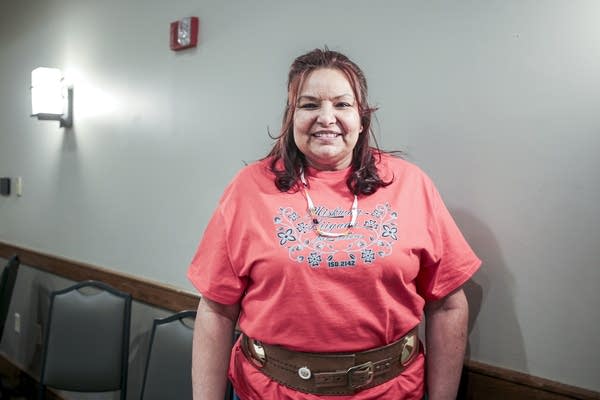
Bois Forte Band of Lake Superior Chippewa citizen Deanna Drift is the American Indian education coordinator for the St. Louis County Schools, a geographically large school district in northeastern Minnesota.

Drift says the event brought together students from across the district and the Bois Forte Band’s education and employment training program. She, alongside other organizers, put the show together to “uplift youth” through self-expression of their Native identity.
A fashion show, Miskwaa Niigaan
Deanna Drift is the American Indian Education coordinator at St. Louis County school district in northeastern Minnesota. She co-organized the fashion show, Miskwaa Niigaan, at Fortune Bay Resort Casino on March 27, 2026, in Tower.
Chandra Colvin | MPR News

“I think the main goal behind it was just to instill self-esteem and pride in who they are,” Drift said.

Exploring identity

The students shared their beadwork, ribbon skirts and regalia while a crowd of parents and community members filled the ballroom in support.

Otis says it was her first time participating in an event like the fashion show. She was nervous backstage, but she also felt excited. She traveled from the Cloquet area, where she attends South Ridge School, for the occasion.

“It makes me feel really happy to be able to be here with other people who might even be in the same boat as I am,” said Otis.

She describes herself as having mixed heritage and someone who is “white presenting.”

Otis was adopted by a family from the Fond du Lac Band of Lake Superior Chippewa. Her family of origin is from the Leech Lake Band of Ojibwe.

“Even though [I’m] adopted into a Native American family, it's been hard to figure out stuff about myself and just what my culture really is,” she said.

And it was through art and fashion that she found a sense of belonging after feeling uncertain of her identity when she was younger.
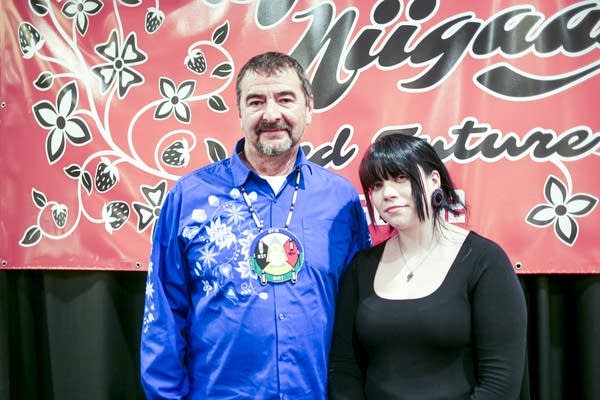
A fashion show, Miskwaa Niigaan
Earl Otis (left) attended the fashion show, Miskwaa Niigaan, to support his daughter, Adrionna Otis (right) at Fortune Bay Resort Casino on March 27, 2026, in Tower.
Chandra Colvin | MPR News

Otis has always been interested in art and fashion, and she says beadwork and exploring different forms of creativity, like making ribbon skirts, have allowed her to explore her Native identity.

Ribbon skirts are traditional handmade garments made from fabric adorned with ribbon designs and are typically worn during ceremonies or celebratory gatherings in tribal communities.

“Beading, sewing — it just really helps me feel a lot more connected,” Otis said.

Drift says she’s observed Otis having an interest in her culture — she’s taking an Ojibwe language class at her school and participates in cultural activity workshops. She recently made a floral ribbon skirt with red and black satin ribbons through a cultural workshop offered through her school, which she wore to the fashion show.

“As mentors, we look at what interests them and then really try to make that happen for them,” Drift said.

Busy parent Earl Otis attended the show. He enjoys seeing his daughter embrace beadwork and sewing.

“I like seeing her doing that a lot,” he said. “It's nice to see her get more involved now.”

Inspiring others

Before the lights dimmed to begin the show, Otis shared backstage that she wanted to inspire others to embrace their identities just as she had.

“I'm hoping I can make other people feel better about themselves, especially if there's anyone who feels the same way as me sitting in the audience,” Otis said.

Music produced by local Native artists played during the event as youth were called onto the stage one by one to show off their creations. The announcer called the powwow regalia category first.

A fashion show, Miskwaa Niigaan
Sixteen-year-old Adrionna Otis participated in the youth fashion show, Miskwaa Niigaan. She wore a floral-patterned ribbon skirt she recently made and a pair of earrings she beaded at Fortune Bay Resort Casino on March 27, 2026, in Tower.
Chandra Colvin | MPR News

Otis wore her ribbon skirt and earrings on the stage. She says she initially felt embarrassed, but that feeling went away after the first few moments of standing in front of everyone. She walked down the runway with a confident smile on her face.

Afterward, Otis shared how she felt about being on stage. She says she loved being able to be a part of the experience and to be able to share that experience with fellow students who were feeling nervous as she had been before the show.

She even felt that she may have inspired those that were in the audience.

“I definitely felt like everybody was appreciating my work, and just happy that I was there — just like I was happy all of them were there,” Otis said.

Chandra Colvin covers Native American communities in Minnesota for MPR News via Report for America, a national service program that places journalists into local newsrooms to report on undercovered issues and communities.


Source link

Leave a Reply

Subscribe to Our Newsletter

Get our latest articles delivered straight to your inbox. No spam, we promise.

Recent Reviews


The internet is changing and so is the way we search and find information. The trick behind all the search queries is nothing but a web crawler.

Yes, the machine that searches the web, retrieves data, and assists search engines such as Google in sorting the information into searchable indexes. Search engines would be nothing without crawlers. But do you know there are different types of crawlers lately?

Well, traditional crawlers like Googlebot have been using rule-based systems over the years to retrieve information and sift through links and draw results to user queries. This method is still effective, although there are a few limitations it comes with.

Let’s now introduce the new age of AI-powered crawlers, a next-generation genus of bots, based on artificial intelligence and machine learning. These crawlers do not just search the sites; they comprehend the sites. Through semantics, tone and context, they are going above and beyond in the web searching landscape.

Here in this blog, we are going to discuss the differences between traditional and AI crawlers, alongside how they will transform search in the future and share practical tips to make your content the best to thrive in today’s digital world.

So, let’s get started!

What are Traditional Crawlers? Traditional Crawlers

The old-fashioned crawlers, namely Googlebot and Bingbot are based on the following principles, scan, copy and index. They operate similar to librarians and index the information by use of HTML structures, metadata, and keywords.

    • Process: They search links, analyze code, and store page information in huge search databases.
    • Reliability: Suits well with static web sites and organized content.
    • Weakness: Problems with changing websites, with dynamic components, such as JavaScript-bulky applications, and subtle context.

As an example, a traditional crawler might not pick up the product information in a product page when it rewrites the class names or changes the structure of the product page, causing indexing errors. This has led the industry to smarter and AI-assisted means.

What Are AI Crawlers?

AI Crawlers

Intelligent crawlers go beyond bot to be more of an interpreter. Through the use of natural language processing (NLP), computer vision, and machine learning, they are able to comprehend content in a manner that can replicate human understanding.

    • Context Awareness: AI crawlers do not only read the text; however, they define meaning, tone, and purpose.
    • Flexibility: AI crawlers will be able to identify and retrieve suitable information even when a site alters the structure of the site.
    • Multimedia Intelligence: They are capable of processing video, audio and picture, and are therefore much more intelligent than bots that are rule-based.

Just think of a crawler that does not just read a blog post but knows whether it is a product review, a thought-leadership article or a how-to guide. This is the hope of AI-support crawling.

The Rising Dominance of Googlebot.

According to recent stats from Cloudflare, Googlebot is still dominating although AI crawlers are on the rise. Googlebot grew by 96 percent in May 2024-May 2025, with highs in April 2025 of 145 percent of the traffic of May 2024.

This spike was accompanying the introduction of AI Overviews by Google, which added generative answers to search results. The combination of old-style crawling with the use of AI improvements is the future of Google as the hybrid is establishing preconditions of the coexistence of the two systems.

How Does Traditional Search Work?

To value the changes, one should go back to the way the search engines used to operate:

Crawling/ Indexing– Robots search through internet sites and archive copies of pages on servers.

Ranking Algorithms– The ranking of pages depends on the relevance of the key words, back links and the freshness of the content.

Displayed Results– The Results display ads, organic links, snippets, and panels.

AI-Driven Search: A New Era

AI based search engines extend past keywords. They can:

    • Know natural language – responding to complex conversational questions.
    • Provide direct responses – eliminating the necessity to browse through several results.
    • Individualize findings – customize suggestions according to the behavior of the user.
    • Manipulate multimedia – The analysis of videos and podcasts, as well as voice recognition.

ChatGPT, Google Gemini, and Microsoft Copilot are the members of Large Language Models that can transform the search into a conversation instead of a list of search results.

AI Crawlers vs Traditional Crawlers: Key Differences

1. Understanding User Intent

Traditional Crawlers: Search query by a key word and scratch the surface without necessarily realizing what the query entails.

AI Crawlers: This is the next level, whereby the search engine goes beyond the keyword and interprets user intent, semantics and context to deliver even more useful information.

2. Scalability and Efficiency

Traditional Crawlers: Are able to construct a mass of data, but they can create duplicates or irrelevant records as they are not very aware of the context.

AI Crawlers: Smart filtering and prioritization of content, which creates a leaner and more efficient indexing which is more relevant.

3. Real-Time Adaptation

Traditional Crawlers are not good at keeping up with new structure of websites or newer technologies being introduced and thus require manual updating.

AI Crawlers): Learn and adapt in real time and recognize patterns and evolve without human interaction.

4. Content Depth and Quality

Traditional Crawlers– These are typically employed to access visible text and links, and they might not be concerned with multimedia, user-created and interactive content.

The AI crawlers use multimedia, dynamic content and even sentiment to produce a more refined view of the entire quality of pages.

Sharing Quick Wins for Crawlability

Technical SEO is essential even with the further development of AI. The following are fast fixes to increase crawlability:

Important pages should be served with server-side rendering (SSR).

    • Keep HTML lean, semantic and clean.
    • Enhance page speed- sluggish sites are conquered.
    • Provide clear, descriptive headings and titles (H1 -H3).
    • Blocking AI crawlers in robots.txt or llms.txt is not advisable.
    • Publicize verifiable factual, well formatted and prompt information.

Conclusion: Preparing for the Future of Indexing

The future of search lies at the intersection of traditional and AI crawling. While rule-based crawlers remain essential, AI-powered crawlers bring a new level of intelligence, adaptability, and context awareness.

For brands, this means rethinking SEO strategies and embracing AI Optimization (AIO) alongside Generative Engine Optimization (GEO). By preparing content for AI-driven indexing today, businesses can ensure long-term visibility, authority, and discoverability in tomorrow’s search ecosystem.

Stay updated with all the latest blog topics, here with us!

Recommended For You:

What are your Alternatives if your website has been hit by Google penalty?


Source link