While I try very hard to avoid red-eye flights, which just make the next day so painful, I recently found myself needing to take an unplanned red-eye flight from Hawaii back to the mainland when severe incoming storms cut my family’s trip short.
That was all going to be bad enough, but landing at 6 a.m. at Los Angeles International Airport (LAX) after flying with two kids through the night and facing the constraints of normal hotel check-in times (3-4 p.m.) were going to make a tough situation pretty darn miserable.
Luckily, there was a better option. Instead of spending the day as walking zombies until check-in time at our next stop, we got some of the best sleep of our lives for just $16.50 an hour by booking a day-use room at a hotel near LAX via the appropriately named website Dayuse.com.
Here’s how “day-use rooms” work and what you need to know to save your sanity and get some rest when you need a hotel room on a schedule that doesn’t follow traditional check-in and checkout times.
How a day-use hotel room works
Some hotels, especially ones at major hub airports and in big cities, offer rooms that you can book for specific hours during the day with no overnight stay included. (Note that this is different from booking a day pass to a resort hotel that does not come with a room.)
Sometimes, you can book these day-use rooms directly with the hotel, but you may have to call to get that information or book. Thankfully, there are also some websites that let you search for multiple day-use hotels at once and complete the booking on that site.
SUMMER HULL/THE POINTS GUY
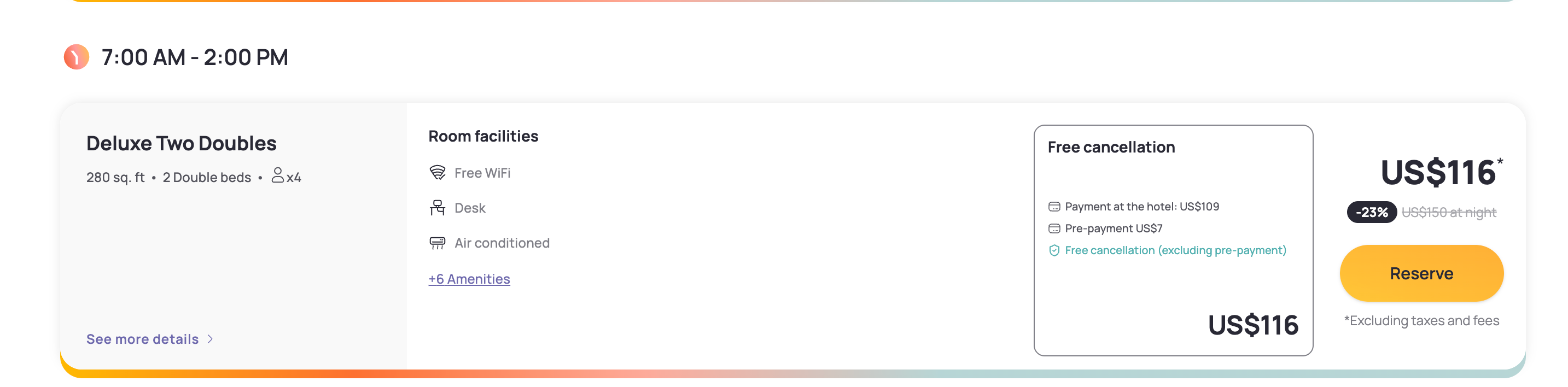
For example, on the Dayuse.com site I used to book this room, you often just pay a small fee ($7 on my booking) to book, with the bulk of the payment due directly at the hotel at check-in. On my booking, I could even cancel for free until two hours before the end of the booking time slot in case our plans changed at the last minute, which of course happens with flights.
I’ve seen day-use rooms available as early as 5 a.m. and as late as 11 p.m., and sometimes for prices that are 50% to 75% less than if you booked an overnight stay. Some of the time slots are just a few hours, while others are for pretty long chunks of the day.
While it can vary, when you book a day-use room, you often have access to on-site amenities such as the pool or gym.
Reward your inbox with the TPG Daily newsletter
Join over 700,000 readers for breaking news, in-depth guides and exclusive deals from TPG’s experts
TPG tip: If you have Marriott Ambassador elite status, pending availability, you may be able to book a room with Marriott using the Your24 service that lets you pick the 24 hours you have the room.
Booking my day-use room at an LAX hotel
I needed a room that would be ready right when we landed early in the morning. I wanted one with solid reviews and a location as close to LAX as possible. Some hotels in the area only had day-use rooms available starting at 10 a.m. or later, so, based on reviews, photos and available time slots, we booked the Sonesta Los Angeles Airport LAX from 7 a.m. to 2 p.m. for $116 (plus taxes).
DAYUSE.COM
That broke down to about $16.50 per hour of much-needed rest, which was absolutely the best money I could have spent in that moment.
It had been a while since I booked a day-use room, but I cannot say enough great things about how easy the whole process was, from getting the included shuttle from LAX to a prompt check-in process (and access to the room a few minutes early) to the comfortable beds and outstanding hours of sleep in a renovated room.
It may sound like an exaggeration, but it truly served as a reset from not only the exhaustion from the overnight flight, but really for the entire trip, as our family vacation underwent a pretty significant unplanned pivot from Hawaii to California.
Whether you are fresh off a red-eye flight, landing on the other side of the world after a long-haul flight or are otherwise in a situation where you need a room to be available at a nonstandard check-in time, a day-use hotel can be the ideal solution to that scheduling problem at a price that is often less than the cost of an overnight hotel stay.
Power BI is a set of software services, apps, and connectors that work together to turn disparate data sources into coherent, visually immersive, and interactive insights. Your data could be in the form of an Excel spreadsheet or a hybrid data warehouse that is both on-premises and cloud-based. Power BI makes it simple to connect to your data sources, visualize and uncover what matters, and share your findings with whomever you choose.
Become a Power BI Certified professional by learning this HKR Power BI Training !
What are Datasets in Power BI?
A dataset is a data collection that you can connect to or import. Power BI allows you to connect to and import all kinds of datasets, allowing you to put everything together in one place. Dataflows can also be used for sourcing the data for Datasets. Workspaces are associated with datasets, and a single dataset can be used in multiple workspaces. We have selected “My workspace” and then the “Datasets + dataflows” tab in the example below
Let us now look into the different types of Datasets in Power BI.
Types of Datasets
Datasets in Power BI are ready to report and visualize the source of data. There are five different types of datasets, each of which can be constructed in one of the following ways:
An existing data model will be connected that is not hosted in a Power BI capability.
Power BI Desktop file needs to be uploaded which includes a model.
Uploading a CSV (comma-separated values) file, or uploading an Excel workbook (Includes one or more Excel tables and/or a workbook data model).
Creating a push dataset using the Power BI service.
Creating streaming or dataset with hybrid streaming using the Power BI service.
Let us now explore different types of Datasets.
1) External-hosted models
Azure Analysis Services and SQL Server Analysis Services are the two types of externally hosted models. Installing the on-premises data gateway, whether on-premises or VM-hosted infrastructure-as-a-service (IaaS), is required to connect to a SQL Server Analysis Services model. A gateway isn’t required for Azure Analysis Services.
When there are existing model investments, such as those that form part of an enterprise data warehouse(EDW), connecting to Analysis Services makes sense. By utilizing the identity of the Power BI report user, Power BI can establish a live connection to Analysis Services, enforcing data permissions. Both tabular models and multidimensional (cubes) are supported by SQL Server Analysis Services. A live connection dataset sends queries to externally hosted models, as demonstrated in the accompanying
2) Power BI Desktop-developed models
A model can be created using Power BI Desktop, a client application for Power BI development. The model is essentially a tabular Analysis Services model. Models can be created by importing data from dataflows and blending it with data from external sources. While the characteristics of how modeling can be accomplished are outside the subject of this article, it’s crucial to note that Power BI Desktop supports three different types, or modes, of models. We are going to discuss the datasets in the coming sections.
Row-Level Security (RLS) can be used in externally hosted models and Power BI desktop models to restrict the amount of data that can be obtained for a certain user. Users in the Salespeople security group, for instance, can only see report data for the sales region(s) to which they’ve been assigned. Roles in RLS can be either static or dynamic. Static roles apply the same filters to all users allocated to the position, whereas dynamic roles filter by the report user.
3) Excel workbook models
The creation of a model is automatic when datasets are created from Excel workbooks or CSV files. To construct model tables, Excel tables, and CSV data are imported, and an Excel workbook data model is translated to produce a Power BI model. In every scenario, data from a file is imported into a model.
4) Push Dataset
A Power BI dataset that can only be created and populated using the Power BI API is known as a push dataset. However, the lack of a good user interface for creating a push dataset restricted its adoption to scenarios where a single table was inhabited with real-time data streaming.
5) Hybrid Streaming Dataset
Real-time streaming in Power BI allows you to stream data and update dashboards in real-time. Real-time data and visuals can be displayed and updated in any Power BI visual or dashboard. Factory sensors, social media sources, service usage metrics, and a variety of other time-sensitive data collectors or transmitters can all be used to collect and transmit streaming data.
Before discussing the steps of creation. It is necessary to know that there are three basic ways to retrieve data in Power BI Desktop that you will use to create your visualizations:
1) Live:
Here you will be connecting to a server that carries all the data. Although no data is sent, the model’s metadata is imported into Power BI Desktop. A query is transmitted to the server when you build visualizations, and it is then executed. The outcomes are then visualized and returned to Desktop. With SQL Server Analysis Services (SSAS) models, whether multidimensional or Tabular, live connections are commonly employed. Power BI Desktop behaves like any other thin client in this scenario, like Excel or Reporting Services (SSRS). It is not possible to make major modifications to the model, but you can add new measurements that will be available in that .pbix file.
2) DirectQuery:
You can make more modifications to the model here than you can with a Live connection. The data is kept on the server, and queries are run on the server, just like in Live. The Power BI Desktop model, for instance, allows for the creation of relationships.
3) Import:
Power Query queries are used to import the data into a Power BI Desktop file (.pbix). The data is compressed highly so it’s feasible to load records in millions into a file on your system. A model, comparable to an SSAS Tabular model, is built behind the scenes. This is the most versatile mode, as it allows you to blend data from any source. However, all data must be loaded into your model, which can take a long time to refresh.
Now, let’s move to create the dataset. Below are the steps which make you comprehend the creation of the Power BI Dataset.
1) A dataset is connected to the .pbix file where it was created one by one. When you first launch PBI Desktop, click “Get Data” to create a new dataset.
Alternatively, you can choose a source from the dropdown menu as shown below:
2) Let’s assume we imported a few tables from the WideWorldImporters SQL Server sample database (The .pbix file can be downloaded here). The tables and their relationships are visible in the Model view:
3) You can view the actual data of one table at a time in the “Data view”.
4) You can create, view, and interact with visualizations built on top of the data and model in the “Report view”.
The dataset is made up of the data as well as the model view. Now, let’s move to the different modes of Dataset available in Power BI.
Subscribe to our YouTube channel to get new updates..!
Dataset modes in the Power BI
These modes of Dataset in Power BI ascertain whether or not data is imported into the model or retained in the data source. The following are the three Dataset modes in Power BI:
Import
DirectQuery
Composite
1) Import
The most popular mode for developing datasets is the import mode. Because of in-memory querying, this mode provides incredibly quick performance. Modelers can also benefit from design flexibility and support for certain Power BI service capabilities (Quick Insights, Q&A, etc.). It’s the default mode when developing a new Power BI Desktop solution because of these advantages.
It’s crucial to realize that all imported data is saved on disk. When the data is refreshed or queried, it should be fully loaded into the memory of Power BI. Import models can yield very rapid query results once they are in memory. It’s also crucial to note that there’s no such thing as a partially loaded Import model in memory. An Import model can also integrate data from any number of supported data source types. The following image illustrates it.
2) DirectQuery
Import mode can be replaced by DirectQuery mode. Data is not imported into models created in DirectQuery mode. Instead, they are made up entirely of metadata that defines the model’s structure. If the model is queried, data is retrieved by using the native queries from the underlying data source.
3) Composite
The composite mode can blend DirectQuery and Import modes, or integrate multiple data sources for DirectQuery. The storage mode for every model table can be configured for models created in Composite mode. Calculated tables (defined with DAX) can also be used in this mode.
Import and DirectQuery modes are used in composite models to give you the best of both modes. They can blend the high query performance of in-memory models with the capacity to access near real-time data from data sources when set properly.
Conclusion: We have successfully learned that Power BI lets you connect various datasets for importing and bringing them all together in one place. In this blog, we explored the topics of Datasets in Power BI in a systematic flow by understanding Power BI, then Datasets in Power BI, different types of Datasets and models used for reporting and visualizing data, creating a Dataset for connecting files, and various modes of Datasets in Power BI.
To provide the best experiences, we use technologies like cookies to store and/or access device information. Consenting to these technologies will allow us to process data such as browsing behavior or unique IDs on this site. Not consenting or withdrawing consent, may adversely affect certain features and functions.
Functional
Always active
The technical storage or access is strictly necessary for the legitimate purpose of enabling the use of a specific service explicitly requested by the subscriber or user, or for the sole purpose of carrying out the transmission of a communication over an electronic communications network.
Preferences
The technical storage or access is necessary for the legitimate purpose of storing preferences that are not requested by the subscriber or user.
Statistics
The technical storage or access that is used exclusively for statistical purposes.The technical storage or access that is used exclusively for anonymous statistical purposes. Without a subpoena, voluntary compliance on the part of your Internet Service Provider, or additional records from a third party, information stored or retrieved for this purpose alone cannot usually be used to identify you.
Marketing
The technical storage or access is required to create user profiles to send advertising, or to track the user on a website or across several websites for similar marketing purposes.