Chef Sean Sherman's new downtown Minneapolis restaurant Indígena by Owamni opens Tuesday at the Guthrie Theater. The much-anticipated new restaurant is just a few blocks away from its predecessor, Owamni, the restaurant that earned Sherman and his team numerous accolades, including a James Beard award.
Sherman describes his work and his team’s work as storytelling.
“That’s a big core of what we’re doing. We're using food as our language. We're using food as our story and our platform. So, this for us is a stage also.”
The new place is glittery and spacious, with large banks of windows facing the riverfront. The Guthrie's main-floor restaurant had sat empty since the pandemic, a space the theater long wanted to revive.
What Sherman is building is bigger than the menu. He says Owamni was already spending over half a million dollars a year with Native fishers, ricers and farmers, and he expects Indígena to quadruple that.
Sean Sherman speaks at the preview night of Indígena by Owamni within the new space at the Guthrie Theater on Thursday.
Jaida Grey Eagle for MPR News
The new restaurant continues to hire and train chefs and prep cooks interested in working with Indigenous ingredients. Sherman says the new restaurant is the evolution of the idea that an Indigenous restaurant can support Indigenous producers, train its staff, and still grow as a business, in the hopes that others may follow.
A ‘vast food system’
Sherman hosted several events last week, including a preview event on Thursday evening. At the preview, small plates arrived in a steady stream. Among them—sweet potato donuts rolled in maple sugar and finished with wojapi, a dark berry sauce.
The dish contains no wheat flour, dairy, or cane sugar. Sherman sees those constraints as an opportunity to create with Indigenous ingredients.
“We have this vast food system that's been rather untapped because of Eurocentrism and colonialism,” Sherman said.
Lee Garman, culinary director, said the kitchen itself shaped some of the stories the restaurant is telling. He said the team inherited a pasta cooker from the previous tenant in the space, and without wheat to work with, they used it to develop sweet potato gnocchi. He describes the dish as soft, chewy and “almost marshmallowy.”
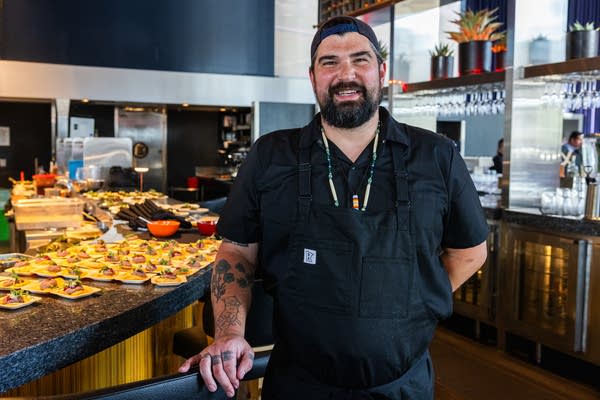
Lee Garman the Culinary Director of Indígena by Owamni poses for a portrait inside of the new Indígena space within the Guthrie Theater.
Jaida Grey Eagle for MPR News
For the bison ribeye, Garman says Linda Black Elk, an ethnobotanist on staff at the North American Traditional Indigenous Foods Systems, pointed out that pink peppercorn is native to the Americas, so the kitchen built a pink peppercorn sauce to top it.
Garman says restraint matters as much as invention. Sometimes wild rice, sourced from Ojibwe communities throughout Minnesota, is just cooked and dressed with dried berries.
“If you can just go get hand-harvested wild rice from Fond du Lac and White Earth, and from Red Lake,” Garman said, “I've never seen that on a menu, and it's kind of a homecoming for a lot of people.”
A ‘great opportunity’
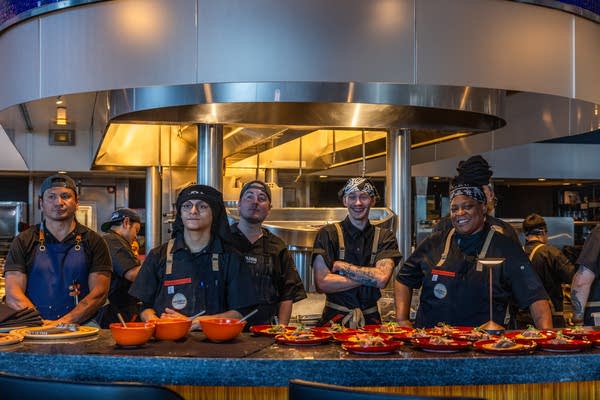
The story at Indígena is being told by a whole team. In the kitchen, prep cook Nate Ortiz fries donuts.
“They're both chocolate and sweet potato and cassava flour,” Ortiz said.
Ortiz worked at Indigenous Food Lab, the nonprofit's training kitchen, several years ago and recently returned. He found his way to Indígena through a hiring event at the Midtown Global Market.
“Great opportunity,” Ortiz said.
Braeden Laughlin worked at Owamni for two and a half years while working through college. His family is from the Bois Forte Band of Chippewa. He now works at Indígena, and he says the food he serves is meaningful to him.
“It's amazing to be able to go somewhere and see food from your own culture, when you spend your whole life never seeing a single dish from it,” Laughlin said. “It's really heartwarming to be able to see your own traditions, foods, and practices in play in real life, especially at somewhere as fancy as this.”
Guest enjoy a preview night of new dishes and drinks at Indígena by Owamni at the Guthrie Theater on Thursday.
Jaida Grey Eagle for MPR News
Decolonizing the drink menu
The same precolonial story is being told at the bar. Noel Pedraza, beverage director, builds cocktails from Indigenous ingredients, which rules out two things he says most bartenders can't work without: cane sugar and citrus.
“Citrus wasn't here on the continent before 1492, before it was introduced through colonization,” Pedraza said, “To replace that we use like a sumac tea, carries a lot of malic acid, just naturally, and kind of gives you that bright acidic note.”
Instead, the drinks are sweetened with maple, agave and honey, and they come with names that wink — Bougie Native, War Pony and My Great Grandma Was a Cherokee Princess.
Briana Patnode, a bartender at Indígena prepares a cocktail called Rez Dog at the new space within the Guthrie Theater.
Jaida Grey Eagle for MPR News
But the bar is also where the concept of decolonization gets complicated. Distilled spirits and the commercial liquor trade came with colonization, even though fermented drinks were here long before. And alcohol has a harmful history in many Native communities. Pedraza says that tension is part of the design. A large part of his program is non-alcoholic, and he says those drinks get the same care as the cocktails.
“It's not a secondary thing, you know. It's not soda water with lime, for instance. These are really well thought out and like bar craft driven non-alcoholic drinks,” Pedraza said.
He points out a nonalcoholic cocktail called Minopogwad, made with a mix of honey, hawthorn and rose.
A constant evolution
Mac McCabe tells the same story from the business side. He traveled from Maine, where he lives, to attend the preview Thursday. McCabe serves as the new restaurant’s part-time chief financial officer. He’s worked with Sherman since Owamni started several years ago. Owamni was so popular, he said, that no one ever learned its earning capacity, because it was always full and booked out for months. The new restaurant has more than twice the seating capacity.
“People were turned away sometimes for three or four weeks at a time, so to be in a situation with more than double the seating, it means anyone who wants to come can probably come,” McCabe said.
Sherman does not treat any of it as finished: the menu, the producers, the cooks coming up behind him.
“I think it's just a constant evolution,” Sherman said. “That's what I see.”
Indígena by Owamni opens for regular service Tuesday, June 23. Reservations are open through OpenTable, with walk-ins welcome after 9 p.m. A grand opening is set for July 4.
The recurring gag was that McLaughlin would ask the guests a serious political question, each would give a thoughtful answer, and McLaughlin would shout “WRONG!”
I think about that a lot when I’m doing deposition preparation with clients in trade secrets lawsuits.
Let’s go over some common ways defendants in trade secrets lawsuits go wrong in their depositions. We’ll use our old hypothetical friend Dawn Davis as an example
1. Are the things defined as “confidential information” or “trade secrets” in the agreement actually confidential or secret?
Like most employment agreements, Dawn’s agreement with Paula Payne Windows includes a confidentiality agreement.
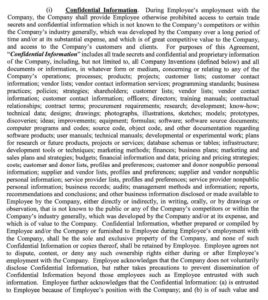
The definition of “confidential information” looks something like this:
The deposition questions about it go something like this:
Q: Can you take a look at the definition of the company’s “confidential information and trade secrets” in your agreement? Do you see that?
A: Yes.
Q: You signed this agreement, right?
A: Yes, I signed it.
Q: So you agree that the things listed in this definition are the company’s confidential information, right?
A: Right.
WRONG!
What a difference a single letter can make.
If the question was “you agreed that the things listed in the definition are the company’s confidential information,” then yes would be an acceptable answer. That’s because generally, if you sign an agreement, you agreed to what’s in it.
But just because you signed the agreement doesn’t mean you now agree with every statement in the agreement.
See the distinction?
Yes, you may have agreed to what’s in the agreement by signing it, but just because the agreement says something is true doesn’t make it true.
Especially when it comes to a definition of “confidential information” or “trade secrets.”
The problem with this definition—and most definitions of confidential information in such agreements—is that it is both too vague and too broad.
These are slightly different things.
The definition is vague, or “indefinite,” because it is not clear what is included and what is not. For example, the definition refers to the company’s “processes” and “policies.” Which processes and policies? All of them, or just the “confidential” ones? And which ones are confidential?
Let’s say Paula Payne Windows has a process for prospecting for new customers: search on the internet for the kind of companies that buy windows, find the contact information for the person there responsible for buying windows, cold call that person, then make a note in the company’s CRM system to follow up later.
That’s a process, but is it a confidential process? Of course not. Everybody has a process like this. It’s no secret.
Is that process included in the contract’s definition of “confidential information”? It’s hard to say.
But you could read the definition literally to mean that all of the company’s processes are included in the definition of confidential information. And that brings up the second problem: the definition is overbroad.
The definition is overbroad because on its face it includes things that are not confidential.
An agreement that defines all of the company’s information as confidential would be unreasonable and unenforceable. It would be a de facto non-compete.
When you understand these two problems, you can answer deposition questions more accurately.
Q: So you agree that the things listed in this definition are the company’s confidential information, right?
A: Not necessarily.
Q: Why not?
A: Well, first, I’m not even sure what this definition means. And second, it has things in it that are obviously not confidential information.
Q: Like what?
A: Like “processes” and “policies.” If that means all of the company’s processes and policies, then it includes things that are obviously not a secret.
This answer won’t make the questioning lawyer happy, but you’re not there to make friends.
2. Is a customer list a trade secret?
Suppose when Dawn Davis left Paula Payne Windows, she took an Excel spreadsheet showing all her sales from the previous year, including the names of the customers. Dawn says she needed the list because the company owed her commissions, but Paula Payne Windows says the spreadsheet is a confidential customer list.
So the deposition questioning goes like this:
Q: You’re not a lawyer, are you?
A: No.
Q: Ok, I’m not asking for a legal opinion or anything, but do you see this definition of “trade secrets” from the Texas Uniform Trade Secrets Act?
A: Yes.
Q: The definition includes “list of actual or potential customers,” right?
A: Yes, I see that.
Q: [in the most casual tone possible] Ok, so you understand a customer list is a trade secret, right?”
A: Yes, I understand that.
WRONG!
Perhaps we can forgive Dawn for making this mistake. I have seen licensed lawyers make this very argument to judges. “Your Honor, the definition of trade secrets in TUTSA specifically includes customer lists, so my client’s customer list is a trade secret.”
But the argument is wrong, for two reasons.
First, if you look at the whole definition of a trade secret, there’s a very important word: “if.”
A customer list is included in the list of types of things that can be a trade secret, if the rest of the elements of the definition are met (like “independent economic value”).
The first problem with the deposition question was that it ignored this important “if.”
The second problem with the argument is that it just defies common sense.
Think about it. Suppose Dawn’s spreadsheet lists just five customers, who happen to be the biggest homebuilders in her sales territory. There’s no way that’s a trade secret. All the competitors in that area know who those customers are.
If you want to know more, I cover this issue in more detail at my blog post When Is a Customer List a Trade Secret. I even cite court cases. But you get the idea.
Now that Dawn is armed with the knowledge that a customer list isn’t automatically a trade secret, let’s give her another crack at the deposition question:
Q: Ok, so you understand a customer list is a trade secret, right?”
A: No.
Q: But it says that right there in the definition, doesn’t it?
A: It says customer list, but there’s more to the definition.
Q: So you don’t think your customer list is a trade secret?
A: No. Everybody in our industry knows who those customers are.
Now that we’ve avoided that confusion, let’s look at another category of information that can be a trade secret but isn’t necessarily a trade secret: prices.
Here’s how the lawyer for Paula Payne Windows might try to set it up in Dawn’s deposition:
Q: Are you working for Real Cheap Windows now?
A: Yes.
Q: Let’s say a competitor calls you up and asks you for the prices you’re charging customers this week, would you tell him?
A: Uh . . . I don’t think that has ever happened.
Q: But if it did, would you tell them?
A: I mean, I don’t think so.
Q: Why not?
A: Well it’s none of their business.
Q: And if they knew your prices they could offer the same customers lower prices, right?
A: That could happen.
Q: Can your competitors just do a Google search and find your prices?
A: No.
Q: Right, so the prices your company charges its customers are confidential, right?
A: Yeah, I guess so.
WRONG!
Don’t let this happen in your deposition
Everything leading up to the last question is fine, but are the prices really a secret?
Nine times out of ten, the answer will be no, at least in my experience and opinion.
That’s because in the vast majority of cases, there’s nothing to stop the customers from telling one competitor what another competitor is charging.
In fact, in many industries, it’s common for customers to do so. “Hey, Fred, Bubba’s Oilfield Supply says it can get me those frac valves for five thousand apiece this week, can you beat that?”
Unless the company has a nondisclosure agreement with the customer that says the customer must keep the company’s prices confidential, I don’t see how the company can genuinely claim the prices are a secret, or that it took the required “reasonable measures” to keep the prices secret.
Keep in mind, this is just my opinion. But it is usually correct.
Knowing that, here’s a better way for Dawn to answer deposition questions about prices:
Q: So the prices your company charges its customers are confidential, right?
A: No.
Q: They’re not confidential? Are you saying you would just give them out to your competitors?
A: I didn’t say that.
Q: Well, if the prices aren’t confidential, why wouldn’t you share them?
A: They can easily go and ask my customer for the prices, and I can’t stop the customer from telling them. But that doesn’t mean it’s my job to help them.
So, those prices on the spreadsheet Dawn took from Paula Payne Windows, maybe they’re not so secret.
That, of course, does not mean it was a good idea for Dawn to take the spreadsheet.
4. What does the forensics show?
It’s a bad idea for departing employees to take or keep any company documents.
With the exception of their agreements with the company, which I think are generally fair game for an employee to keep. But generally, don’t take company documents when you leave!
There are multiple reasons for this, but maybe the most important one is that whatever documents the employee takes, those will be the documents the company claims contain its alleged “trade secrets” in the subsequent trade secrets lawsuit. I call this Wolfe’s First Law of Trade Secrets Litigation.
Here’s how it might go down in Dawn’s case:
Q: When you were working for Paula Payne Windows, did they provide a computer?
A: Yeah, I had a computer at the office.
Q: Did you ever use USB drives?
A: You mean like a thumb drive?
Q: Yes.
A: Sure, we used those all the time, like if I needed to take documents with me on a customer visit.
Q: Let me show you Plaintiff’s Exhibit 13 to your deposition. That’s a report our forensic expert prepared. Do you see that?
A: Yes.
Q: Do you see line 7 on page 2 that shows on April 7, 2023, the day after you gave notice, you plugged a Seagate thumb drive into your computer at work and copied 12 sales reports to it?
A: Yes.
WRONG!
Dawn doesn’t have any personal knowledge of the forensic report or how it was prepared. And her recollection is probably not that specific. How can she be sure?
Here’s a better way for Dawn to answer:
Q: Do you see line 7 on page 2 that shows you copied 12 files on to a thumb drive?
A: I didn’t prepare this report.
Q: Ok, but you see where it says that, right?
A: I see that the report says that.
Q: Well, are you denying that you copied 12 files on to that thumb drive on April 7, 2023?
A: I’m not denying there were times when I put files on a thumb drive, but I can’t remember if I copied those specific files on that specific date.
Q: Ok, but you can’t rule it out?
A: I can’t rule it in or out. I just don’t remember.
Sticking to what you personally know is good deposition advice generally, but especially when it comes to computer forensics in a trade secrets lawsuit.
Let me stress: I am not saying Dawn should pretend like she doesn’t know or doesn’t remember if she does remember. Every witness should tell the truth. If Dawn clearly remembers, “yes, I copied 12 files on to a thumb drive on April 7, 2023,” then she should say so.
But it’s rare that the witness will remember that specifically.
In most cases, a witness in a deposition is not going to remember every little thing she did on a computer years earlier, before any lawsuit was filed. She certainly won’t remember things like the serial number of the USB drive.
And that brings up the final common deposition mistake to avoid in a trade secrets lawsuit.
5. Undermining your credibility by overstating your case
Maintaining your credibility is critically important in any lawsuit.
And if you’re a former employee defendant in a trade secrets lawsuit, it is even more important than usual. Right off the bat your credibility is under attack because you did something your former employer portrays as sneaky and underhanded. “Theft!” they will cry.
And you should expect the plaintiff’s lawyer will go into the deposition ready to set you up. It might go like this:
Q: Can you take a look at page 27 of the Paula Payne Windows Employee Handbook?
A: Ok, yes, I’m there.
Q: It says “Employees must take care not to disseminate company documents outside the company, such as sending them to personal email addresses.” Did I read that correctly?
A: Nobody ever paid attention to that.
Q: Ok, but that was the company’s stated policy, correct?
A: Yeah, I guess.
Q: Ok, so you knew it was against company policy to email yourself company documents, right?
A: Right.
Q: Did you ever do that?
A: Absolutely not. I never emailed myself company documents.
WRONG!
The answer is wrong because you already know what’s coming next: Impeachment.
The lawyer for Paula Payne Windows will show Dawn a copy of an email from her company email account to her personal Gmail account attaching a proposal to a customer.
“Oh, I forgot about that!” Dawn will say. “I was going to meet with a customer out of the office the next day, and I needed to be able to print out the proposal at home.”
A legitimate explanation, if true. But the damage will already be done.
So for questions like this, it’s important to be cautious and not overstate your case.
In this example, there are basically three possibilities:
Dawn remembers emailing herself the proposal, or at least remembers emailing herself generally.
Dawn has no recollection of emailing herself company documents, but knows it’s possible she did.
Dawn knows for a fact she never emailed company documents to herself.
If 1 is true, then Dawn should say so.
If 2 is true, then Dawn should say something like “I don’t have a specific memory of doing that.” Then she’s leaving room for the possibility that it happened.
If 3 is true, then Dawn could say she never emailed herself company documents, but even then, she should proceed with caution.
You see, memory is a funny thing. Every litigator has experienced a client who was 100% sure of some fact or sequence of events, and then the documents show her memory is just flat wrong.
So even if Dawn is absolutely sure, it’s still a good idea to say something like “I don’t think I ever did that.”
You don’t need to overstate the good facts that are on your side.
On a scale of 1 to 14, 1 being lowest degree of likelihood, 14 being absolute metaphysical certitude, what are the chances you’ll make a mistake?
Go ahead, say your answer.
WRONG!
_______________________
Zach Wolfe (zach@zachwolfelaw.com)is a Texas trial lawyer who handles non-compete and trade secret litigation at Zach Wolfe Law Firm (zachwolfelaw.com). Thomson Reuters has named him a Texas Super Lawyer® for Business Litigation every year since 2020.
These are his opinions, not the opinions of his firm or clients, so don’t cite part of this post against him in an actual case. Every case is different, so don’t rely on this post as legal advice for your case.
To provide the best experiences, we use technologies like cookies to store and/or access device information. Consenting to these technologies will allow us to process data such as browsing behavior or unique IDs on this site. Not consenting or withdrawing consent, may adversely affect certain features and functions.
Functional
Always active
The technical storage or access is strictly necessary for the legitimate purpose of enabling the use of a specific service explicitly requested by the subscriber or user, or for the sole purpose of carrying out the transmission of a communication over an electronic communications network.
Preferences
The technical storage or access is necessary for the legitimate purpose of storing preferences that are not requested by the subscriber or user.
Statistics
The technical storage or access that is used exclusively for statistical purposes.The technical storage or access that is used exclusively for anonymous statistical purposes. Without a subpoena, voluntary compliance on the part of your Internet Service Provider, or additional records from a third party, information stored or retrieved for this purpose alone cannot usually be used to identify you.
Marketing
The technical storage or access is required to create user profiles to send advertising, or to track the user on a website or across several websites for similar marketing purposes.