iPad Pro M5 Review: Closer Than Ever to the Future Mac


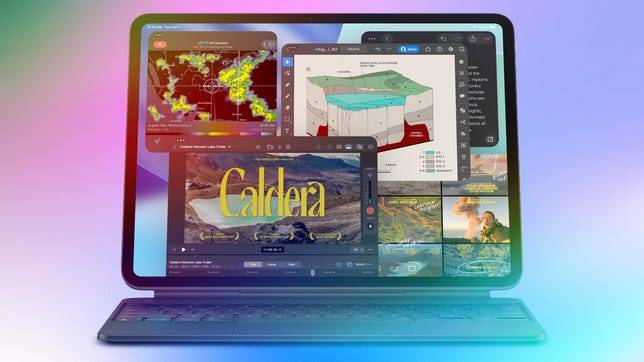
An iPad Pro displaying a number of apps on its screen

Pros

  • Same price as last year
  • More powerful M5 processor
  • Still-great OLED display
  • iPadOS 26 unleashes multitasking

Cons

  • Expensive with accessories
  • Lacks some pro tools found on Macs
  • OS browsers still feel weird to me

Editor’s note, April 29: This review was updated with information about the CNET Labs Award for Brightest Screen. The M5 iPad Pro was also awarded a CNET Editors’ Choice award on Nov. 24, 2025, for being the very best product in Apple’s iPad lineup. While its price can run very high, anyone who isn’t budget-concerned and wants the best display and performance on an iPad will find an excellent experience here. It’s not the same as a Mac, but with a keyboard case and iPadOS 26, it’s becoming extremely versatile.


I had a feeling of cynicism when Apple announced the iPad Pro with an M5 chip. Here we go again with the same iPad, just faster. I’ve felt this way for years about the Pro iPads. They’re fast, fancy and definitely not necessary.

And yet, living with the 13-inch iPad Pro with iPadOS 26 for this review, something different is happening. I’m connected to my office apps and using it like my work laptop with a Magic Keyboard. Is the iPad finally ready to replace my Mac and serve as my main computer?

There are things about this iPad Pro that I like more than my laptop. FaceID sign-ins are smooth and easy. The crisp OLED touchscreen is better for movies and better overall than any Mac for now. The M5 processor blazes. 

iPad Pro app Procreate used with Pencil Pro in office living room

The new iPad Pro is best with a Pencil Pro, but its overall proposition keeps improving by degrees over time.

Numi Prasarn/CNET

Credit the changes mostly to iPadOS 26, which you can run on other, slower iPads too. Thanks to the M5 silicon, however, multitasking really shines on the 13-inch iPad Pro. The multi-window workflow feels more natural, and in fact I’m working on it as I write these words.

Watch this: Apple’s Latest Pro iPad Isn’t a Mac Yet, but It’s Getting Damn Close

Apple’s latest chip update to M5 had a telling triple debut across MacBook Pro, iPad Pro, and Vision Pro lines. Vision is Apple’s computer of the future. MacBook Pro is Apple’s computer of the past. And the iPad Pro is so close to being my go-to computer of the present. Almost, but not quite. The browser still doesn’t feel like a Mac. But my complaints are diminishing with every year.

iPad Pro 13-inch model on a pedestal in a studio

For all the magic of the iPad accessories, you still just get the tablet and charger in the box.

Numi Prasarn/CNET

Same design outside, new chip(s) inside

The M5 iPad Pro is basically the same as the M4 model last year, but with a new M5 processor. Apple also claims it has faster 5G wireless and Wi-Fi 7/Bluetooth 6 via new CX1 and N1 modem and wireless chips. (The M4 Pro had Wi-Fi 6E and Bluetooth 5.3.) The size, thickness and weight are the same, as are Pencil Pro compatibility, cameras and price.

My general recommendation remains unchanged as well. Just like last year, you can buy cheaper iPads and get a lot of the same experience for casual use. The M5 is about powerful processing, a better Pencil, better graphics and that nicer display.

Scott Stein of CNET working on iPad Pro with keyboard, opening multiple windows

Working on an iPad Pro with Magic Keyboard is approaching being Mac-like even more than ever.

Numi Prasarn/CNET

iPadOS opens the door (er, window)

I can’t justify the high price of the iPad Pro unless it’s my main go-to computer, and iPadOS 26 helps make that possible. It has a more Mac-like window system that Apple first previewed in June, and now that I’m living on it, I see its advantages clearly. I don’t feel hampered by flow as much, and the top menu bars in apps are a bigger help in navigating functions than I expected. Really, iPadOS 26 is mostly doing what Macs can do already, and that’s a good thing.

Apple still doesn’t specify how many windows iPadOS can open at once, and it depends on the iPad hardware. I’ve never seen a functional limit on this year’s other iPads, though. 

What still feels weird on iPadOS is how the browser’s handled. iOS and iPadOS lean on apps to pull out individual functions I’d generally do in-browser on a Mac. That’s still the case now, and it makes some handoffs for particular workflows (like Google’s ecosystem of cloud tools) feel less organic on iPad. I’d love a big browser update and overhaul for future pro iPads…or, on the flipside, if that rumored touchscreen Mac does indeed come next year, maybe it should adopt a ton of iPadOS into it.

iPad Pro in keyboard case showing video of man wearing sunglasses in CNET video

Videos look great on this iPad, without a doubt.

Numi Prasarn/CNET

Great display, fast charging, speedy M5

The Tandem OLED display Apple calls Ultra Retina XDR, which Apple introduced on the M4 model last year, is vivid and great for movies. The display is also the brightest we’ve ever tested — of any tablet — reaching a peak brightness of 1,535 nits (just shy of the 1,600 nits Apple states in its specs). The 13-inch M5 iPad Pro is now the recipient of the CNET Labs Award for Brightest Screen.

The M5 iPad Pro’s thinner body helps when using it with a keyboard case, and yes, this M5 model works with the M4’s accessories and cases. The Pencil Pro has a few new tricks, including a rotating brush, but this year’s iPad Air and last year’s iPad Mini can use it too.

This iPad can charge faster, but the fast charger isn’t included. You need a separately sold adapter plug or a bigger-wattage charger of your own.

In my tests, the M5 processor looks to be a significant graphics and speed bump over the M4. In Geekbench 6 tests, the multicore benchmark number I got with the 10-core M5 is 16,116, versus 14,672 for last year’s higher-end M4 iPad Pro. That’s about 10% faster. Compared with the M3 iPad Air from earlier this year, which got a multicore score of 11,643, it’s 38% faster.

Just like last year, Apple has a more powerful processor/RAM tier for Pro models with more storage. The 256 and 512GB models have 12GB of RAM and a nine-core CPU/10-core GPU, while the 1 and 2TB models have 16GB of RAM and 10-core CPU/10-core GPUs. I tested an iPad Pro 13-inch 1TB model with the higher specs.

The M5 iPad Pro is the same price as the M4 model, and still expensive at $999 or $1,299 with 256GB of storage. The price climbs if you add more storage or accessories, and you can hit $2,000 without much effort.

Man working on iPad Pro using Pencil Pro, seeing back of iPad as he sits in chair

You can get lots of what this iPad offers in lower-priced models.

Numi Prasarn/CNET

I still say you don’t need the Pro

iPads are the best tablets, and most people will be best served by a cheaper iPad. Lots of what I like about the iPad Pro can be done at lower price levels too. Add a keyboard case to the iPad Air or even the entry-level iPad, and you can do multitasking windows and work with Pencils too. 

The fast speed, extra-vivid display, and thinner size of the Pro make the experience feel more premium. But are they worth the high price at the Pro end, and can they truly flex to become computers for everything else? The answer to that is increasingly yes, but not quite. The iPad is full of excellent creative apps, but still feels like it’s missing some of the pro Mac tools for video editing and graphics that could easily be there now. Or, make Mac and iPadOS apps for pros be truly interchangeable now. 

Do I want a MacBook that feels as good as this iPad Pro? Yeah, I do. We may be heading to that fusion zone soon enough. Or, as I finish filing this story on a Mac written entirely on an iPad Pro M5, and losing track of which computer I’m on, maybe I’m already there.


Source link

Leave a Reply

Subscribe to Our Newsletter

Get our latest articles delivered straight to your inbox. No spam, we promise.

Recent Reviews


Alteryx is a highly favored tool in data analytics due to its self-service capabilities and user-friendly interface. Many companies are actively seeking individuals proficient in Alteryx.

To establish a stable career in data analytics, consider acquiring skills in Alteryx. If you anticipate an Alteryx-related interview, a comprehensive Alteryx Interview Questions guide is available. This guide is valuable for both entry-level and experienced professionals preparing for interviews.

Now, let’s explore Alteryx interview questions categorized by experience levels.

Alteryx Interview Questions Most Frequently Asked with Answers

Basic AlterYX interview questions for freshers

1. What do you understand by Alteryx?

Ans: Alteryx is renowned as a trailblazer in data science and analytics, headquartered in Irvine, California, with a development center in Broomfield, Colorado. The company’s offerings, known for their user-friendly design, empower users to perform complex data analytics with ease, democratizing the process of data analysis across various sectors.

Learn new & advanced Architectures in AlterYX with hkr’s AlterYX Training !

2. Why would you recommend using Alteryx?

AnsAlteryx stands out for its intuitive interface, catering to users across varying degrees of expertise in business intelligence. It uniquely integrates data from diverse platforms into a single workflow, streamlining the process of data analysis and providing rapid results without the need for custom coding, making it invaluable for organizations seeking efficiency and agility in data handling.

3. What is an Analytics Gallery?

Ans: The Alteryx Analytics Gallery is a pioneering cloud-based platform for business analytics, designed with the ethos of bringing the convenience and connectivity of personal applications to business environments. It offers cloud-based workflow processing, enabling organizations to handle large datasets (Big Data) in a unified environment.

4. What Browsers Are Supported By The Analytics Gallery?

Ans: The Analytics Gallery is compatible with major browsers including Internet Explorer, Firefox, Safari, and Google Chrome, ensuring accessibility and ease of use across different user preferences.

5. What is the limit of app file size in Alteryx?

Ans: Currently, both applications and associated data in Alteryx are capped at a maximum size limit of 100MB.

6. What do you understand by the term Data Artisan?

Ans: A Data Artisan in the Alteryx context refers to a user who creates analytical applications using Alteryx Designer Desktop. These applications can then be shared within the Analytics Gallery, either publicly or privately. Data Artisans also enjoy the benefits extended to Gallery Members.

7. What is the process to run an app?

Ans: Running an app in Alteryx involves selecting the app, configuring it based on specific requirements like geocoding addresses, adding user files for demographic analysis, or choosing relevant data for your business. This customization allows for tailored analytics solutions.

8. What is the procedure to save an expression?

AnsIn Alteryx, expressions can be saved for repeated use, eliminating the need to recreate them from scratch. Users can craft expressions using variable selection and function insertion, and then save them for future use by choosing the ‘Saved Expression’ option.

We have the perfect professional AlterYX Tutorial for you. Enroll now!

Intermediate Alteryx interview questions

9. What is the process to turn on and off the annotations in Alteryx?

Ans: Alteryx provides flexibility in managing annotations. Users can toggle annotations on or off per tool, per module, or globally, offering a range of control from specific tool comments to overarching module settings.

10. Distinguish between the CrossTab tool and the Transpose tool?

Ans: Both the CrossTab and Transpose tools in Alteryx alter data orientation, but in opposing manners. The Transpose tool shifts horizontal data to a vertical format, whereas the CrossTab tool summarizes data on a group field by rotating vertical data to a horizontal axis.

Alteryx Training

  • Master Your Craft
  • Lifetime LMS & Faculty Access
  • 24/7 online expert support
  • Real-world & Project Based Learning

11. What is the way to share an app in Alteryx?

AnsSharing an app in Alteryx involves various methods. Apps published in a Studio can be accessed by other Data Artisans of that Studio, shared publicly in the Gallery, or included in a Collection for specific group access.

12. How will you describe a Viewer?

Ans: A Viewer in the Alteryx Analytics Gallery context is a user who can access and run applications published in the Public Gallery, offering a broad access range to various analytics solutions.

13. How can you publish apps in the analytics gallery?

Ans: Publishing apps in Alteryx involves transferring them from the Alteryx Designer Desktop directly into a private Studio. This process is accessible to Alteryx Designer Desktop license holders and trial users, with the latter enjoying a 30-Day Free Trial of the Studio.

14. How to discover different users to add them to a given Collection?

Ans: To add users to an Alteryx Collection, one can utilize the ‘Search users’ field within the collection or invite unregistered users via email, expanding the collaboration and sharing capabilities within the Alteryx environment.

15. What kind of users are able to run the created private applications in a Collection?

Ans: Within a Collection in Alteryx, private applications can be accessed and run by Data Artisans and Members, whereas Viewers can see these applications but are not permitted to run them.

Other Related Article: Tableau vs Alteryx

16. What is/are the biggest misconception(s) about big data in your view?

AnsA significant misconception about big data is the overemphasis on its volume. The true value of data lies not just in its size but in the insights and information it yields, highlighting the importance of effective data analysis over mere data accumulation.

17. There’s a difference between data science and data intelligence – how do you see this?

Ans: Data science, data mining, and business intelligence are better seen as a continuum of activities rather than distinct, isolated fields. They collectively contribute to a comprehensive approach to data handling and analysis.

Advanced Alteryx interview questions

18. What are the main highlights and functionalities that Alteryx offer?

AnsAlteryx Designer, as Alteryx’s flagship tool, offers a comprehensive suite for data handling and analysis, including features for data input/output, preparation, joining, predictive analytics, spatial data handling, initial data analysis, and data parsing and transformation. This range of features makes Alteryx a versatile and powerful tool for a variety of data tasks.

19. Explain the concept of Analytic Application.

Ans: Analytic Applications in Alteryx are created by Data Artisans to address specific strategic analysis questions. These pre-packaged data and analytic integrations can be published to the Alteryx Analytics Gallery for broader access and use.

20. Explain the types of reports that can be produced by an app in Alteryx.

AnsDepending on their design, apps in Alteryx can generate reports in formats like Excel, Word, HTML, and PDF, containing diverse elements such as tables, texts, charts, and maps, providing comprehensive data insights.

Take your Analytics Skills to the Next Level with HKR Alteryx training in Bangalore!

HKR Trainings Logo

Subscribe to our YouTube channel to get new updates..!


21. Explain the kinds of Spatial and Tabular Data Output that is generated by an app.

Ans:The output of an Alteryx app can vary based on its construction, potentially generating files in formats like MDB/ACCDB, CSV, DBF, MID/MIF, FlatFile, KML SHP, TAB, and YXDB, catering to a wide range of data representation needs.

22. How will you explain the concept of Member?

Ans: A Member in the Alteryx context is a user who can execute applications shared privately through Collections, with this status granted by a Data Artisan. Members also have the rights of a Viewer, allowing them to run applications in the Public Gallery.

23. Can you get support for chained apps?

Ans: Currently, Alteryx does not support the creation of chained apps, indicating a limitation in its application sequencing capabilities.

24. How can you allow users within your Alteryx tool?

Ans: Within Alteryx, users can be added to a Collection by checking an option that allows other users to share the collection. The Data Artisan who creates the Collection can monitor and manage new user additions, ensuring controlled access.

25. What kind of Apps Can you Add To an Alteryx Collection?

AnsIn Alteryx, only apps published within a Data Artisan’s Studio can be added to a Collection. These apps can also be shared in the Public Gallery, but apps from different Studios or the Public Gallery cannot be added to a personal Collection.

26. Explain the pros and cons of an Alteryx Designer?

AnsPros of Alteryx Designer include its exceptional data blending capabilities, compatibility with a wide range of databases and file types, and the unique ability to produce Tableau data extracts. It’s versatile, not limited to ETL processes, and seamlessly integrates with R for predictive modeling. Additionally, Alteryx excels in creating detailed reports with dynamic filters. However, its cons involve limitations in reading Tableau data extracts, a lack of robust support for special characters, occasional instability with concurrent user access, and a learning curve to fully understand all tools and statistical R packages.

27. What is it that the system is conveying when you get, “No Values found before GetMean()” message?

AnsWhen encountering the “No Values found before GetMean()” message, it suggests a need to review your workflow’s upstream configuration. If an Allocate Append tool is in use, ensure the spatial object selected is a polygon, not a point object. If the error originates from a Reporting Map tool, verify that Smart Tiling isn’t applied to a String field in thematic mapping.

Other Related Article: Alteryx Tools

28. How to change the field type in Alteryx?

AnsThe most effective way to change a field type in Alteryx is through the Formula tool, which provides extensive control for custom data transformations. Alternatively, the Select tool and other tools with embedded select functions can be used to adjust field types, offering flexibility in data manipulation.

29. Why do you think a company should prefer Alteryx over other open or semi-open source apps?

AnsAlteryx stands out for several reasons, making it a preferable choice over open or semi-open source alternatives. Its strong reputation and positive ratings in Gartner’s Magic Quadrants for its analytical complexity, ease of use, customer experience, product quality, and top-notch support make it an industry leader in data analytics tools.

30. How to share an app in Alteryx via social media or an email?

Ans: To share an application through internet based life or email, first, you need to tap on the application to see its subtleties. At that point, click on the Share catch to share the application through various stages like Twitter, email, Google+, and Facebook.

Alteryx Training

Weekday / Weekend Batches


31. How to deploy analytics across your organisation using Alteryx?

Ans: Alteryx Server stands out for its simplicity in both setup and configuration, whether on-premises or cloud-based. This platform can be operational on the same day it’s set up. Post-deployment, users can establish schedules and automate tasks. The Alteryx APIs offer further advantages by allowing integration with other workflows, sharing applications, and more. This tool represents a quick and efficient method for implementing analytics throughout an organization.

32. Big data is causing enterprises to find new ways to leverage information sources to drive growth. What are your suggestions?

AnsIt’s crucial to prioritize analytical decision-making. Maintaining a record of decisions made based on various data types (big, small, and others) is essential. The key is to focus on how this data can be utilized for analytical decisions that have potential benefits.

33. How can you use big data analytics or large and complex datasets to predict future customer behaviors, trends, and outcomes?

AnsUtilizing a mix of internal, external, third-party, and cloud sources can enrich the understanding of customer behavior, social media sentiment, and outcome modeling. There’s a strong emphasis on making these insights accessible to business users, especially data analysts, to address their analytical needs effectively.

34. With the amount of data increasing exponentially how can businesses sustain information and analytics capability?

 AnsBusinesses must adapt to the rapid influx of data by focusing on market agility and productivity. According to Alteryx research, many business and analytical leaders are dissatisfied with the time it takes to extract necessary information from data. Integrating data from diverse sources, including data centers, cloud applications, and even desktop Excel spreadsheets, is a significant challenge. Alteryx addresses this by offering a user-friendly, code-free environment that simplifies data integration and accelerates processing.

About Author

author-image

As a senior Technical Content Writer for HKR Trainings, Gayathri has a good comprehension of the present technical innovations, which incorporates perspectives like Business Intelligence and Analytics. She conveys advanced technical ideas precisely and vividly, as conceivable to the target group, guaranteeing that the content is available to clients. She writes qualitative content in the field of Data Warehousing & ETL, Big Data Analytics, and ERP Tools. Connect me on LinkedIn.

Upcoming Alteryx Training Online classes

Batch starts on
25th May 2026
Mon & Tue (5 Days)
Weekday
Timings – 08:30 AM IST
Batch starts on
29th May 2026
Sat & Sun (6 Weeks)
Fast Track
Timings – 08:30 AM IST
Batch starts on
2nd Jun 2026
Mon & Tue (5 Days)
Weekday
Timings – 08:30 AM IST


Source link