
Is the Citi / AA Globe Mastercard worth the annual fee?


If you’re an American Airlines flyer looking to add a new AAdvantage card to your wallet, you’ll want to be sure you can justify the card’s annual fee.

The Citi® / AAdvantage® Globe™ Mastercard® (see rates and fees) comes with a $350 annual fee. While it isn’t the highest in the Citi / AAdvantage suite, it is certainly nothing to ignore.

Do the Globe card’s perks outweigh its annual fee? Let’s dive into the benefits and see if they’re worth the price.

Welcome bonus

Points and miles enthusiasts know this well: Much of a card’s first-year value is found in a lucrative welcome offer.

Thankfully, the Citi / AAdvantage Globe Mastercard delivers.

For a limited time, applicants can earn 90,000 bonus miles after spending $5,000 on purchases in the first four months from account opening.

American Airlines’ Airbus A321XLR. SEAN CUDAHY/THE POINTS GUY

Per TPG’s May 2026 valuations, this bonus is worth $1,440.

Domestic award tickets on American Airlines start at 5,000 miles one-way on short-haul routes, so a family of four could potentially book two round-trip itineraries with 90,000 miles. If luxury is more your speed, you can also maximize this bonus for first-class seats on Japan Airlines for 80,000 miles.

The Globe card’s bonus alone is worth four times more than its $350 annual fee.

Reward your inbox with the TPG Daily newsletter

Join over 700,000 readers for breaking news, in-depth guides and exclusive deals from TPG’s experts

Still, you’ll want to receive more ongoing value from your card to justify holding it year after year. Let’s get into the annual benefits and see how they help reduce the effective annual fee.

Related: What is a credit card welcome offer? How they work and how to maximize value

Lounge passes

Citi / AAdvantage Globe cardholders receive four Admirals Club airport lounge passes each year. One pass is required per adult; up to three children under 18 years old can join one adult on the same pass.

You can use lounge passes at multiple lounges within 24 hours when you’re flying on American Airlines or a Oneworld partner airline, such as Alaska Airlines, British Airways or Cathay Pacific.

ZACH GRIFF/THE POINTS GUY

Day passes for Admirals Club access cost $79 when purchased outright. At face value, the four passes included with this card are worth $316 annually.

If you’re able to maximize all four passes, this perk nearly offsets the Globe card’s $350 annual fee by itself.

Related: 5 ways to ensure you have lounge access before your next flight

Turo credit

The annual fee can also be easier to justify by maximizing the Citi / AAdvantage Globe‘s Turo credit.

With this perk, you can receive up to $30 per Turo car rental, up to eight times per year, for a total of $240 each year.

Turo car rental. TARAH CHIEFFI/THE POINTS GUY

If you can get the full value of this credit, it helps cut the Globe’s $350 annual fee by more than half. However, you’ll have to book eight separate car rentals per year.

It’s worth noting that Turo rentals are generally not covered by rental card insurance policies from credit cards, since it’s considered a peer-to-peer car-sharing platform. Because of this, you likely wouldn’t be able to use the Globe’s rental car insurance on a Turo rental if something went wrong, which is a major protection gap to consider.

Still, if you enjoy renting from Turo, that $240 is solid value.

Related: My experience with Turo: Car rental convenience at a great price

Splurge Credit

One of the most flexible benefits on the Citi / AAdvantage Globe is its “Splurge Credit.”

This benefit is worth up to $100 annually and allows you to choose two merchants from the following list:

  • 1stDibs
  • AAdvantage Hotels
  • Future Personal Training
  • Live Nation (exclusions apply)
Rock band performing on stage at night club
JORDI SALAS/GETTY IMAGES

This credit is issued on a calendar year basis, so if you apply for the card in the middle of the year, you could potentially double-dip in your first cardholder year to receive $200 in value.

This perk partially reduces the effective annual fee, though you’ll want to stack it with another benefit to fully offset it.

Related: I asked TPG staffers how they manage credit card statement credits — here are 4 tips

AA inflight purchases credit

With the Citi / AAdvantage Globe, you’ll receive up to $100 in statement credits each calendar year on inflight purchases when you buy with your card on American Airlines flights.

Keep in mind the benefit applies only to domestic AA flights and is not available on codeshare flights operated by another airline.

And, since American Airlines has rolled out free Wi-Fi on many of its planes, the value of this perk isn’t as great as it once was.

EMILIA WRONSKI/THE POINTS GUY

Like the Splurge Credit, this benefit is issued on a calendar-year basis. So, in your first cardholder year, you can potentially maximize your earnings by using it shortly after approval and again after Jan. 1.

This $100 benefit will help offset about a third of the $350 annual fee, so you’ll want to stack it with another to get a full return on your annual fee.

Related: American Airlines passengers can use AAdvantage miles for inflight purchases

Global Entry/TSA PreCheck credit

If you haven’t already received a Global Entry/TSA PreCheck credit through another card, this benefit included on the Citi / AAdvantage Globe is worth up to $120 every four years.
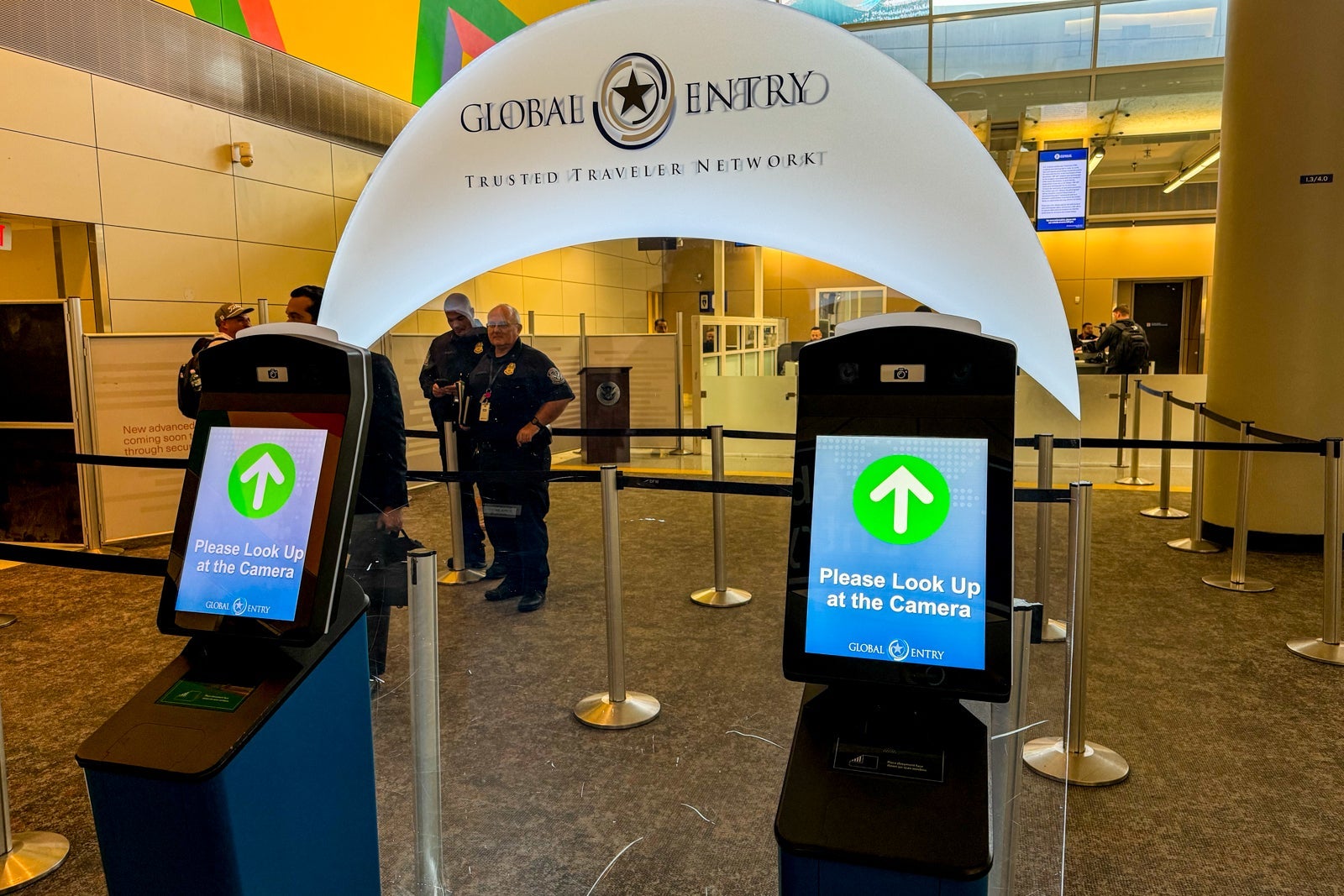
CBP Global Entry
SEAN CUDAHY/THE POINTS GUY

Even if you have already signed up for Global Entry, you can share this benefit with someone who hasn’t gotten it yet. Simply use your card to pay for anyone’s application fees.

This perk helps justify a third of the card’s $350 annual fee on its own.

Related: Global Entry vs. TSA PreCheck: Which is more beneficial?

First checked bag free on AA flights

Citi / AAdvantage Globe cardholders receive their first checked bag free on domestic American Airlines flights for themselves and up to eight companions traveling with them on the same reservation.

Person picking up suitcase
IAM ANUPONG/GETTY IMAGES

The quantifiable value of this benefit depends on how often you fly AA domestically and whether you have others checking one bag with you.

It costs $50 one-way to check a bag on American Airlines (or $45 if you pay online), so if you check a bag for at least seven flights in a year, you’ll receive enough value to cover the cost of the Globe’s $350 annual fee with this benefit alone.

Related: Airline baggage fees: How much it costs to check a bag on major US airlines

Bottom line

If you’re able to maximize at least two or three of the Globe card’s perks each year, you can offset its $350 annual fee. And, the lucrative welcome bonus is worth more than four times the annual fee.

So if you can redeem your AAdvantage miles at a high value, the annual fee can easily be worth it. If you rarely fly American Airlines or find the credits included on the Globe difficult to redeem, this card isn’t worth it for you.

However, whether you’re a frequent or occasional AA flyer, occasional Admirals Club lounge guest or someone who can use up multiple statement credits, this card could be a great choice. Consider your travel habits and preferences to see if that $350 is worth it.


Apply here: Citi / AAdvantage Globe Mastercard


Source link

Leave a Reply

Subscribe to Our Newsletter

Get our latest articles delivered straight to your inbox. No spam, we promise.

Recent Reviews


In most litigation, each party pays their own attorney fees regardless of who wins the case. This “American Rule” applies even when one party is clearly right and the other clearly wrong.

But litigation against the government, such as tax litigation, presents a unique inequity. When taxpayers are forced to defend against an incorrect IRS position, they effectively pay twice–once through their taxes that fund the IRS’s litigation costs (including the courts, government attorneys, and administrative proceedings), and again for their own defense. As taxpayers in this situation often ask: “Why should I have to pay for both sides of the litigation when I was right all along?”

The recent decision in Ankner v. United States, No. 2:2021cv00330 (M.D. Fla. Nov. 19, 2024) provides an opportunity to consider the rules for recovering attorneys’ fees from the IRS.

Facts & Procedural History

This case involved penalties assessed under Section 6700 against a group of companies that operated a captive insurance program.

The IRS has long challenged captive insurance programs. The IRS claimed this program didn’t qualify as “insurance” for tax purposes, making the tax deductions for their clients’ premium deductions improper. After a lengthy IRS audit and administrative process, the taxpayer filed suit in federal district court and the case proceeded to a jury trial.

The jury completely rejected the IRS’s position, finding that the taxpayer was not liable for any penalties and ordering refunds of all penalties previously paid. The taxpayer then filed a motion to recover their attorney fees under Section 7430. The taxpayer sought to recover $5,601 in administrative costs and $129,750 in litigation costs, which was the subject of this court opinion.

Attorney Fee Awards in Tax Litigation

Section 7430 allows courts to award reasonable administrative and litigation costs, including attorney fees, to prevailing parties in tax cases. However, there are some requirements.

First, there are limits on who can recover. Individual taxpayers must have a net worth under $2 million and business taxpayers have to have a net worth under $7 million and fewer than 500 employees.

Second, not all costs are recoverable. The hourly rate for attorney fees is capped at $125 (adjusted for inflation), though higher rates may be allowed in limited circumstances. But these rates are much lower than the prevailing rates for tax attorneys. Thus, even with an award of attorneys fees, the taxpayer is not going to be made whole.

Recoverable costs can include expert witness expenses, reasonable costs for studies and analysis, and court costs. These costs are also limited by timing. Administrative costs can be recovered from the earliest of: (1) the IRS Appeals Office decision, (2) the notice of deficiency, or (3) the first letter proposing a deficiency that allows for Appeals review. Litigation costs cover the period after court proceedings begin. This excludes time for the IRS audit or tax return submission or processing.

The “Substantially Justified” Defense

The biggest hurdle is often the “substantially justified” defense. Even if a taxpayer wins their case, they cannot recover fees if the IRS shows its position was “substantially justified.” This term means that the IRS had a reasonable basis in both law and fact.

Substantial justification means justified in substance or in the main — that is, justified to a degree that could satisfy a reasonable person. In other words, it means a reasonable basis both in law and fact. The courts have said that a party’s position can be substantially justified but incorrect, as long as a reasonable person could think that the position was correct.

This must be evaluated at two distinct points:

  • The administrative stage – when the IRS takes its position through Appeals
  • The litigation stage – when the IRS or Department of Justice attorneys handle the case

In Ankner, while the IRS conceded administrative costs (suggesting its position wasn’t justified at that stage), it successfully argued its litigation position was substantially justified because it was following established precedent at the time. The jury’s rejection of that position didn’t automatically make it unjustified.

This result is due to the procedure

This result is due to the procedure. The request for attorneys fees is submitted by a motion that is filed with the court. This was not a question submitted to the jury. This differs from state tax litigation practice in Texas, for example, where the jury decides both the merits and whether attorneys fees should be awarded.

The Texas approach recognizes that the jury, having heard all the evidence, is best positioned to determine whether the government’s position was reasonable. This leads to more frequent fee awards, as juries who find the government’s position meritless are likely to also find it unreasonable. In Ankner, had the question been presented to the jury that had just rejected every aspect of the IRS’s case, the jury would have no doubt awarded attorneys fees to the taxpayer.

Strategic Use of Qualified Offers

One way around the “substantially justified” defense is making a “qualified offer” under Section 7430(g).

As shown in the recent Mann Construction v. United States case, even a $1 qualified offer can work. If the taxpayer makes a qualified offer that the IRS rejects, and then obtains a judgment for less than the offered amount, they can recover fees regardless of whether the IRS’s position was justified.

To be valid, a qualified offer must:

  • Be in writing
  • Specify the offered amount
  • Be designated as a “qualified offer”
  • Remain open until the earlier of: 90 days, trial date, or rejection
  • Be made after the 30-day letter but before 30 days pre-trial

Taxpayers should consider submitting qualified offers if they meet the net worth requirements noted above. This can put some pressure on the IRS to actually resolve the case expeditiously and, hopefully, in the taxpayer’s favor.

The Takeaway

This case shows that winning at trial doesn’t guarantee attorney fee recovery under Section 7430. The fact that this question is left to the judge, rather than the jury that heard all the evidence, makes it harder for taxpayers to recover their fees. Taxpayers need to carefully document their case from the administrative stage forward and consider making qualified offers to preserve their ability to recover fees. While jury verdicts remain important, the “substantially justified” standard means taxpayers must think strategically about fee recovery from the outset of their case. Making qualified offers early in the process, even nominal ones, may help secure fee recovery if successful.

Watch Our Free On-Demand Webinar

In 40 minutes, we’ll teach you how to survive an IRS audit.

We’ll explain how the IRS conducts audits and how to manage and close the audit.  


Source link