Minnesota lawmakers work to define grooming in new law


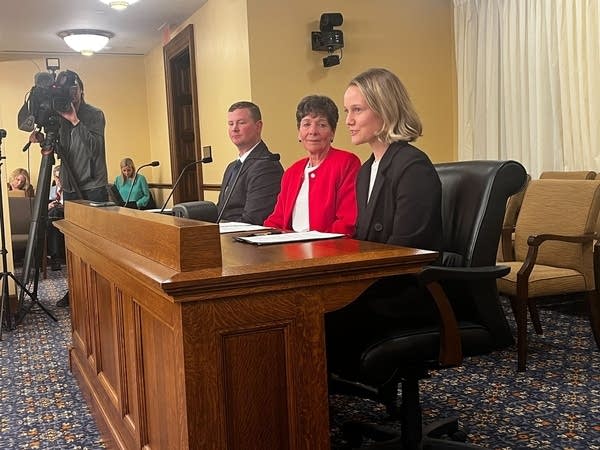
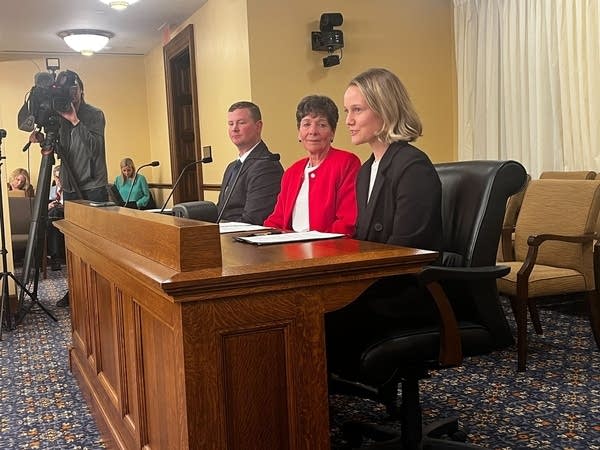
Two women and a man sit at a wooden desk to give a testimony in a conference room.

Minnesota lawmakers working now to write a law to prevent grooming of children by adults in schools are parsing through the same questions district administrators, sports officials, caregivers and others have struggled for years to answer: What is grooming and how do we stop it?

Experts say it’s incredibly difficult to recognize, legislate and prevent this aspect of child abuse — but it’s not impossible.

“The difficulty with grooming is that most of us can't identify it,” said Dr. Mark Hudson, a Children’s Minnesota physician who specializes in handling cases tied to possible child abuse.

“The things that are grooming are things that are normal activities oftentimes, and that’s where making specific grooming legislation is really hard,” Hudson added. “Then you have to get into intent.”

Writing law around it is especially complicated because the abuse often happens over years with actions that in isolation seem harmless.

Grooming is “a pattern of boundary-crossing behaviors that is about building trust, secrecy and then dependency. It’s rarely dramatic, it’s rarely the things that would even trigger as a red flag,” said Monica Rivera, vice president of education and research at Safe Sport, a nonprofit created in the wake of sexual misconduct at USA Gymnastics.

“It often looks like special attention, isolated one-on-one time, private communication, bending small rules in ways that seem harmless, giving preteens and teenagers a space to talk about things that are taboo, like sex and relationships. But it’s actually creating an environment where those boundaries are blurred,” said Rivera, whose group offers a guide to help parents recognize grooming.

Hannah LoPresto, a former student at Eagan High School who’s testified in support of the bill at the Capitol, cited her own experience with a band teacher who, according to an investigative police report, had a “pattern of predatory grooming behaviors … with numerous students” going back a decade in two school districts.

She described it as a feeling of deep confusion that leaves victims detached and trapped.

“It’s this whole other world you live in that's separate from your own, where they convince you that all of these things are true that aren’t true. And it’s what slowly pulls you away from your friends and family and support network,” LoPresto said.

‘The environment that we’re in’

Lopresto, Rivera, Hudson and other advocates and experts agree that it’s important for people to understand what grooming is, but they say actually preventing grooming and abuse has less to do with being able to recognize the manipulation, and more to do with creating the conditions that make grooming and abuse impossible.

Rivera believes abuse prevention in schools should be approached the same way institutions prevent fires.

“The restaurant industry has food inspectors. We have fire inspectors that go in and look at the environment to determine, is this a safe environment. Schools should be audited for safeguarding the same way that we are auditing them for fire safety,” Rivera said.

At Safe Sport, educating people on what grooming looks like is key. The organization also has a process for investigating accusations of abuse, maintains a database of sports professionals who have violated the organization’s code of conduct and does regular audits of its registered members to ensure safety standards are being upheld.

“It’s less about spotting the specific behaviors and more about looking at the environment that we're in,” Rivera said. “It’s important to be able to know how to put out a fire, but we spend a lot of energy also looking at what kinds of environments are combustible, and how do we need to maintain those environments.”

Hudson, the Minnesota Children’s physician, sees the Safe Sport model as an answer. He wants schools to implement easily identifiable safety standards such as restricting the types of communications between staff and students” and rules that define “what activities need to be easily interruptible and observable,” said Hudson.

“If you’re seeing that happening, that needs to be reported, and needs to be reported not just to your principal, right?” Hudson explained. “And then, why not make everybody aware of those rules? Why not have signs up around the schools so the kids know those rules, and that the parents know those rules and stuff.”

‘Long past time’

The vast majority of child sex abuse that happens does not occur in a school setting. Still, child abuse at the hands of an educator is not outside the norm for American students.

A study published in 2022 found rates of child abuse by educators affected nearly 12 percent of the almost 7,000 students surveyed. The vast majority of abusers were male and academic teachers and the vast majority of students experiencing the misconduct were female. Only 4 percent of those abused reported their experiences.

The anti-grooming legislation currently working its way through the Minnesota Legislature has many of the hallmarks experts say are necessary to prevent grooming in schools.

If approved, the bill would make grooming a felony and an offense that triggers the automatic revocation of a teaching license in Minnesota.

It would require police to notify the state teacher licensing board when an educator is convicted of grooming or other crimes triggering the automatic revocation of teaching licenses.

The law would also require the Minnesota Department of Education to develop training on grooming for mandatory reporters and prohibit school employees and volunteers from being alone with students during field trips.

MDE would also be allowed to investigate allegations of student maltreatment older than three years, a current provision that hamstrung the department’s ability to investigate LoPresto’s allegations.

While the bill doesn’t cover all the bases experts say are necessary to prevent grooming, they say it covers important ground.

“It's important to have it on the books,” said Elizabeth Jeglic, a professor of psychology at the John Jay College of Criminal Justice in New York who recently worked with lawmakers in Vermont to pass what she considers model anti-grooming legislation.

“Everybody now has to do criminal records checks. And so if you run it, and then there's a charge for grooming, that's already a red flag to you that something has happened,” she said.

For LoPresto, it’s important that Minnesota’s criminal code address not just assault, but the process of grooming itself, which she believes should be a felony.

“Often, when I share that I was groomed and sexually assaulted, most people focus in on the sexual assaults as being the most horrific and impactful, LoPresto told lawmakers. “But for me, the five-plus years of grooming were even more harmful to my long-term health and well-being.”

For now, Minnesota lawmakers on both sides of the aisle seem to be in agreement that passing legislation to prevent grooming is a priority.

At a recent Senate hearing, Sen. Mary Kunesh, DFL-New Brighton, thanked lawmakers and testifiers for working to pass anti-grooming legislation.

“It’s long past time for us to have addressed this issue of grooming, not just in our school setting, but … it extends into day care and child care,” she said.

“Grooming is certainly a serious, serious offense, and there are many people that have gotten away with it mostly because the legal framework has not been there,” she added. “This really lays that framework for that.”





Source link

Leave a Reply

Subscribe to Our Newsletter

Get our latest articles delivered straight to your inbox. No spam, we promise.

Recent Reviews


Think of a physician writing a complicated patient report in mere seconds, a financial analyst outlining global market rules in a few minutes, or a legal department scanning thousands of contracts for compliance in mere minutes. This is not the plot of a science fiction film; it is the actual consequence of enterprise generative AI tools being utilized today. But in industries like healthcare, finance, and legal services, where a single mistake can have serious consequences, the excitement about AI is mixed with caution.

How can these powerful tools be used without breaking strict rules? Let’s explore how enterprise generative AI tools are making waves in regulated sectors, not by ignoring the rules, but by working safely within them.

What is Enterprise Generative AI Tools?

Enterprise generative AI tools are advanced AI platforms. They are built for large organizations. They help create, deploy, and manage generative AI applications, like chatbots, content generators, and intelligent agents, while keeping everything secure and under control.

Key Characteristics:

Scalability: It handles lots of data and users.

Security & Compliance: It meets industry regulations (e.g., GDPR, HIPAA, SOC 2).

Governance: It allows companies to check and control how AI behaves.

Customization: It can be designed to fit specific business needs.

Why Do Regulated Industries Need Gen AI?

Regulated industries have to follow strict rules. Whether it is GDPR, HIPAA, DORA, and FINRA, organizations must keep up with changing laws while maintaining operational efficiency. Gen AI tools offer:

  • Automated compliance monitoring
  • Real-time document summarization and analysis
  • Faster approvals and reduced review cycles
  • Enhanced customer experience through intelligent agents

For example, AI agents can now track rule changes, analyze their impact, and suggest updates. This saves time and avoids fines.

Key Use Cases Across Industries

In fields like finance, healthcare, law, and government, it is important to protect data and follow the rules. Here, enterprise-grade AI tools make sure that generative AI is used without compromising sensitive information. Also, it delivers automation, insights, and productivity.

1. Financial Services – AI chatbots and agentic systems help customers with complex financial planning, while backend tools scan content for compliance issues and suggest improvements.

2. Healthcare – Gen AI apps ensure patient communications meet legal and readability standards, improving both compliance and care quality.

3. Insurance – AI-driven underwriting and claims processing have reduced lead times from weeks to minutes, boosting customer satisfaction and operational speed.

4. Retail & CPG – AI tools check visual and written content for regulatory compliance, including FDA and ESG standards, ensuring brand integrity.

A Look at Specific Enterprise Generative AI Tools

Although many `solutions are tailored, a number of platforms have come to the forefront in offering secure, enterprise-grade generative AI. These are not consumer offerings but highly complex systems for big organizations.

1. Microsoft Azure OpenAI Service

Industries in which it is used: Finance, Healthcare, Government

Key Features: 

  • Secure access to GPT models in Azure’s compliant cloud
  • Built-in governance, content filters, and abuse monitoring
  • Supports deployment in Azure Government regions

Why It is Relevant: Enables powerful LLM use with full control over data and compliance.

2. Google Vertex AI

Industries in which it is used: Pharma, Finance, Retail, Public Sector

Key Features: 

  • Access to 150+ foundation models (Gemini, Claude, Imagen)
  • SOC 2/HIPAA compliance, data governance, and agent orchestration
  • Tools for RAG, model tuning, and secure deployment

Why It is Relevant: Unified platform for building secure, explainable AI agents and apps.

3. IBM Watsonx

Industries in which it is used: Banking, Healthcare, Government

Key Features: 

  • watsonx.governance for lifecycle management and auditability
  • watsonx.ai for custom LLMs and agents
  • watsonx.data for secure hybrid data integration

Why It is Relevant: Designed for responsible AI with strong governance and transparency.

4. AWS Bedrock

Industries in which it is used: Healthcare, Legal, Manufacturing, Finance

Key Features:

  • Access to multiple models (Claude, Titan, Llama) via unified API
  • Serverless architecture with built-in compliance and encryption
  • Automated reasoning checks to prevent hallucinations

Why It is Relevant: Scalable, secure AI development with enterprise-grade safeguards.

5. Anthropic Claude

Industries in which it is used: Financial Services, Healthcare, Public Sector

Key Features:

  • Safety-first design with Constitutional AI
  • Used by Deloitte and IBM for compliance-heavy workflows
  • Supports agentic AI and secure deployment

Why It is Relevant: Trusted for mission-critical tasks in regulated environments.

6. ChatGPT Enterprise

Industries in which it is used: Legal, Finance, Healthcare, Government

Key Features:

  • SOC 2 compliant, no data used for training
  • Role-based access, audit logs, and encryption
  • Integrations with DLP and eDiscovery (electronic discovery) tools

Why It Is Relevant: Secure, scalable AI for internal support and knowledge tasks.

7. Microsoft 365 Copilot

Industries in which it is used: Legal, Healthcare, Finance, HR

Key Features:

  • Integrated across Word, Excel, Outlook, etc.
  • Copilot Studio for secure agent creation and governance
  • Real-time monitoring, DLP, and role-based access

Why It Is Relevant: Automates documentation and reporting with enterprise-grade compliance.

8. Perplexity AI Enterprise

Industries in which it is used: Legal, Research, Government

Key Features:

  • Real-time, citation-backed answers with zero data retention
  • SOC 2 Type II, GDPR, HIPAA compliant
  • Secure search across internal and external sources

Why It Is Relevant: Ideal for regulated knowledge work with airtight data privacy.

Apart from these tools there are other different tools which belong to different categories and are used for specific purposes, such as

1. Writing Generators – Focused on content creation, marketing, and communication:

  • Jasper: Maintains brand voice
  • Anyword: Optimizes marketing copy
  • Shortwave: Email drafting and summarization

2. AI Notes Tools – Designed for personal productivity and knowledge management:

  • Notion AI: Smart note-taking and organization
  • Mem: Context-aware note management

3. AI Video Tools – Used for creative and training content:

  • Runway: Generative video creation
  • Wondershare Filmora: AI-assisted video editing

4. AI Image Tools – For visual content creation and editing:

  • Midjourney: High-quality image generation
  • Adobe Photoshop (AI): AI-powered photo editing

5. AI Voice & Audio Tools – For voiceovers, audio content, and creative sound design:

  •  ElevenLabs: Realistic voice generation
  •  Suno: Converts text to audio creatively

6. AI Presentation Tools – Automates slide creation and business decks:

  •  Beautiful.ai: Design automation
  •  Pitch: Sales and business presentations

7. AI Website Builders – For fast, automated website creation:

  •  Wix: AI-assisted site building
  •  Framer: Design-focused AI web builder

8. AI App Builders – Helps build internal or customer-facing apps:

  • Microsoft Power Apps: Enterprise-grade app creation
  • Pico: Automated app building

How Are These AI Tools Designed for Trust and Safety?

Enterprise generative AI tools are built for secure, private, and compliant use. These tools run on a company’s private cloud or on-premises servers. They make sure that the sensitive data stays protected and is not used to train public models.

These tools also offer accountability features like audit trails and explainability. They allow users to check how decisions are made.

Understanding the Unique Challenge: Innovation Meets Regulation

In regulated industries like healthcare, finance, and law, compliance is important. Traditional tech adoption has been slow due to risks like data breaches and loss of trust. Enterprise generative AI tools solve this by working within secure environments and following industry-specific rules automatically.

Responsible AI Implementation

  • Choose the Right Partner: Look for vendors with strong security and compliance credentials.
  • Human Oversight: AI supports, but humans make final decisions that make sure of safety and accuracy.
  • Transparency: Informing users about responsible AI use builds trust and confidence.

Road Ahead for Enterprise Generative AI

Enterprise generative AI is just beginning to transform regulated industries. These tools reduce burnout, boost accuracy, and uncover insights from complex data. With the evolution of regulations, AI will become smarter and safer.

By prioritizing security and human oversight, regulated sectors are setting a new standard for ethical innovation, aiming for a future that is more efficient, secure, and equitable.

To learn more, visit KnowledgeNile!


FAQs

1. What is generative AI and its tools?
Answer: Generative AI creates content such as text, images, or code based on intelligent algorithms. AI tools ChatGPT, Claude, and Gemini, which help users to automate work and enhance efficiency.

2. What products are you supposed to use for your generative AI business?
Answer: Use safe, enterprise generative AI tools for your business, such as ChatGPT Enterprise, AWS AI, or Microsoft Copilot that provide privacy, compliance, and scalability for regulated sectors.


Also Read:

Gen AI vs NMT: Is Generative AI a Real Challenge for the Translation Industry?
How Generative Engine Optimization is Redefining the Future of Search Marketing?


Source link