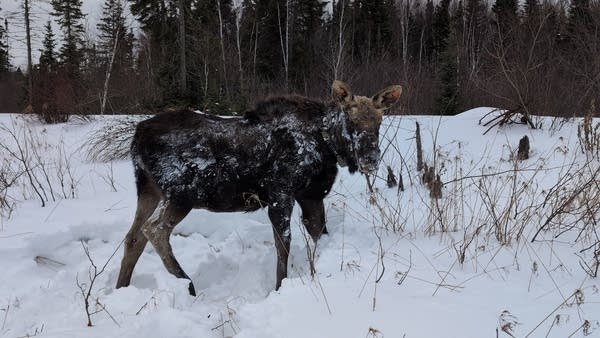
There’s a new effort afoot in northern Minnesota to better understand why the state’s moose population has remained stubbornly flat since it declined sharply about 15 years ago.
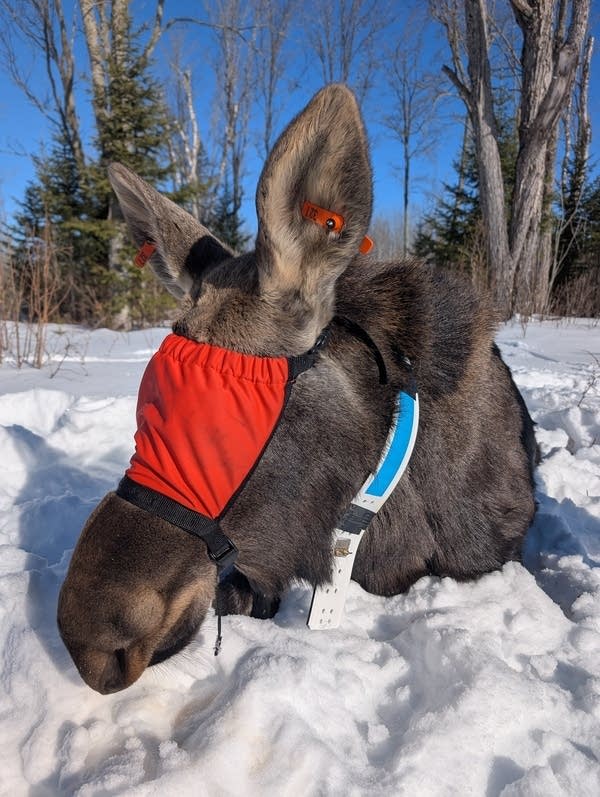
The Northern Moose Alliance also wants to better engage the public about scientists’ efforts to recover the iconic animal’s numbers in the northwoods. This winter, they placed GPS collars on 60 young moose, around nine months of age, that will allow them to track the animals as they grow to full adulthood.
Those “in-between” years, before juvenile moose become full-grown adults, represent a gap in research in the state. And those years are critical. They often determine whether a young moose survives long enough to join the breeding population and, ultimately, help moose numbers start to grow again.
“This project is aimed at really looking at what's happening with those younger moose,” said Michelle Carstensen, wildlife health program supervisor at the Minnesota Department of Natural Resources. “Are there challenges to getting them to one year old? When do they really reproduce? And how many calves are they contributing to the population?”
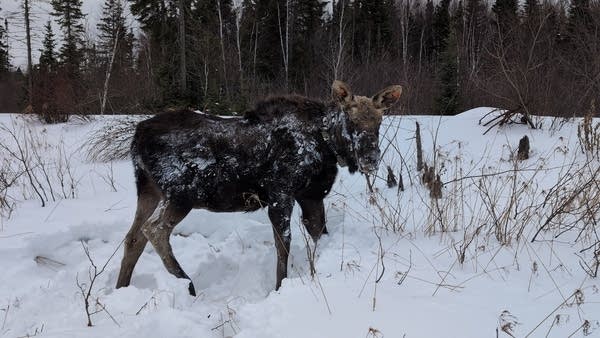
By teasing out answers to those questions, scientists from state, tribal, academic and nonprofit partners hope to gain clues that might allow wildlife and land managers to create better moose habitat in specific locations that could improve the odds of young moose surviving and becoming productive adults.
Collaring Moose
The project’s first phase began this winter, when researchers placed the tracking collars on young moose across the state’s core moose range, stretching roughly from Two Harbors to Ely to Grand Portage at the tip of the Arrowhead region.
Those collars will allow researchers to closely monitor their movements. They’re also equipped with mortality sensors that send notifications via satellite when a moose stops moving for six hours. Researchers will then investigate to determine the cause of death.
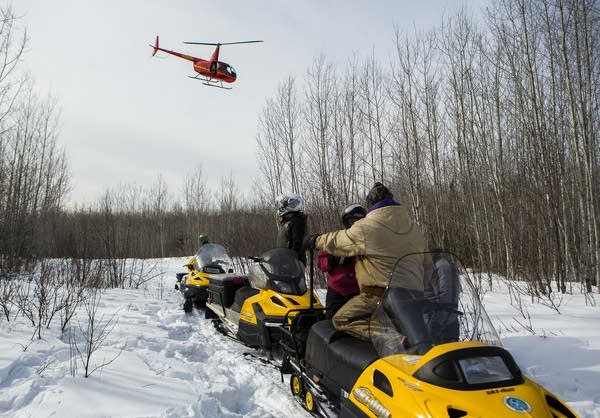
The group partnered with a helicopter capture company to perform the work. When crews spotted a young moose from the air using thermal imaging, they hovered above and shot it with a tranquilizing dart to sedate it.
They landed, attached the collar and quickly collected biological samples and assessed their overall health–including how many parasites, especially winter ticks, they were infested with.
The work was conducted during intense periods of extreme cold, high winds and poor visibility.
“We’re flying in a helicopter with no doors,” said Seth Moore, the director of natural resources for the Grand Portage Band of Lake Superior Chippewa, one of the partners in the project. “So you have a wind chill that is absolutely brutally cold.”
But the work was successful. No moose died during the collaring effort– which is something that plagued the Minnesota Department of Natural Resources when it placed research collars on adult moose and calves over a dozen years ago, part of a landmark study that attempted to pinpoint the reasons behind the moose population’s crash in northeast Minnesota from nearly 9,000 animals 20 years ago to about 4,000 today.
“We're monitoring them daily for their survival,” Carstensen said. “I'm going to knock on wood, but so far, we haven't had a mortality.”
Researchers said the young moose they collared appeared healthier than anticipated. But they’re entering the most challenging time of the year.
They’ve made it through the majority of winter, but they’re still waiting for green-up to bring better forage with more nutritional value. Winter ticks are taking their last big blood meal.
It’s also the time of year when wolves can be most dangerous to moose. When a crust layer develops on top of deep snow during freeze-thaw cycles, moose will “post-hole right through” because they’re so heavy, Carstensen said. But wolves can run on top.
“As the winter fades and spring appears, wolves get that advantage, and it tends to be at a time when moose can be weaker,” said Carstensen. That’s why April tends to be a prime month for moose to die from predation.
“And they're usually taking advantage of young moose that are coming out of winter in the poorest condition, old moose or moose that have other pre-existing health conditions, like brain worm or really heavy tick loads,” Carstensen added.
More moose?
Earlier research has confirmed the many factors that contributed to northeast Minnesota’s plummeting moose population.
Winter ticks cause severe blood loss and energy depletion. Parasites, including liver flukes and brainworm–which is transmitted by white-tailed deer– further diminish moose health. Wolves and bears – which target moose calves – also threaten moose, especially when they’re already weakened by disease or parasites.
There’s no smoking gun. But scientists widely agree that climate change is the overarching culprit for moose decline in Minnesota, the southernmost part of their range. Mild winters have allowed ticks and deer to expand their range northward. Moose also suffer from heat stress in the summer.
Despite those challenges, moose numbers have stabilized at around 4,000 over the past decade.
“Stability is good. Reversing a decline and getting to stable is a great first step,” said Morgan Swingen, wildlife biologist for the 1854 Treaty Authority, an intertribal natural resources agency based in Duluth that’s co-leading the project along with the DNR. “But we would like to see the population increase again, and in order to do that, we need to have reproduction and survival happening.”

The hope is that by learning the challenges young moose face, wildlife and land managers can develop more specific strategies that give moose the best chance at recovering.
If they find that moose are struggling to reproduce, for example, that could mean better habitat or forage is needed in specific locations. If researchers find young females are having plenty of calves, but those calves are having trouble surviving, that could suggest action may be needed to manage deer populations to control parasites, or bear or wolf numbers because of predation concerns.
Researchers plan to place more collars on young moose the next two winters and track the animals for six years. The work is supported by a $1.8 million grant from state lottery proceeds through the Minnesota Environment and Natural Resources Trust Fund.
Northern Moose Alliance scientists are also asking people to share trail camera photos of moose to help track hair loss caused by winter ticks. Researchers plan to share updates and videos highlighting their field work.
“People care deeply about moose,” said Tom Irivine, executive director of the National Parks of Lake Superior Foundation, another project partner. “We want the public to be able to follow along and become part of the solution to protecting this cherished and iconic species.”