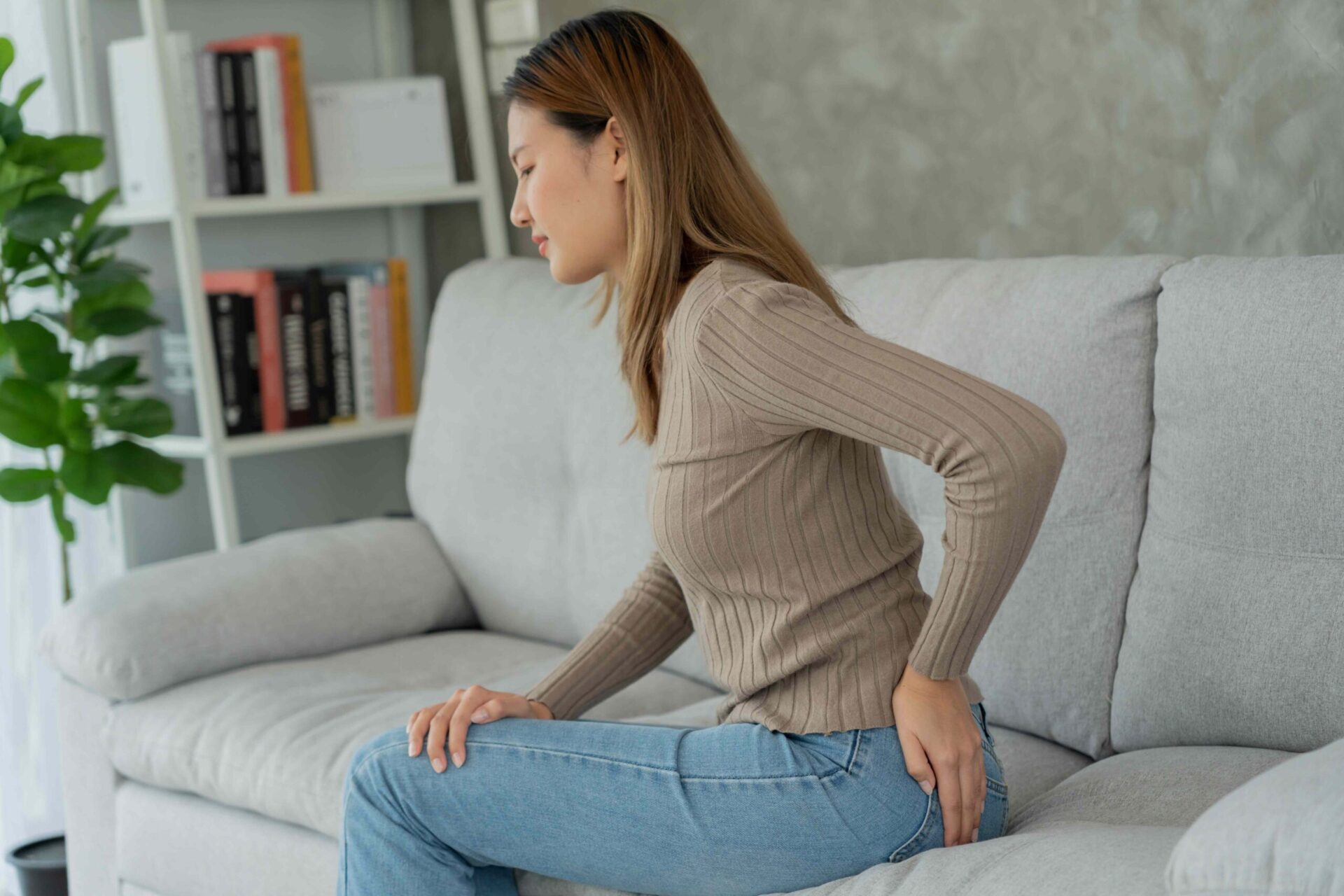
:max_bytes(150000):strip_icc():format(jpeg)/Health-GettyImages-1487718836-bf34b5f7aee24a86802d803bccabdc29.jpg "Asian Female hand holding her bottom because having abdominal pain and hemorrhoids, health care, constipation, Anatomical, suffering from pain, abdominal, bowel problem, bloody diarrhea, stomach ache")
Credit: Nuttawan Jayawan / Getty Images
- The American Gastroenterological Association recently issued new guidance on the diagnosis and treatment of hemorrhoids.
- Increasing fiber intake and limiting time spent on the toilet are two of the main recommendations.
- If you suspect a hemorrhoid, consult a doctor to rule out other causes and discuss treatment options.
Hemorrhoids are incredibly common, affecting about one in 20 Americans—and half of adults over 50. The condition can be internal or external, but both involve swelling of veins around the anus or lower rectum. This swelling can cause uncomfortable symptoms like itching, pain when sitting, or bleeding during bowel movements.
Now, the American Gastroenterological Association (AGA) has issued new guidance for the diagnosis and treatment of hemorrhoids. The guidance, which co-author Waqar Qureshi, MD, told Health is the first of its kind, is intended for clinicians. But its three main recommendations for first-line therapies are simple enough for patients to follow at home: increase fiber intake, avoid straining, and limit prolonged time on the toilet.
Here’s what to know about each.
1. Consuming More Fiber
Increasing fiber is the AGA’s first recommendation for people with hemorrhoids—and for good reason, Qureshi said. Low-fiber diets are associated with chronic constipation, which is a major risk factor for developing hemorrhoids in the first place.
“Fiber acts as a great equalizer for digestion,” said Keely M. Voytovich, MD, a colon and rectal surgeon at Texas Colon & Rectal Specialists. “If you’re constipated, it helps soften and move stool more easily; if you have diarrhea, it adds bulk and improves consistency.”
In the short term, maintaining regular, soft bowel movements can help relieve straining (more on this next), lessening symptoms such as pain, itching, and bleeding from inflamed veins. In the long term, increasing fiber intake reduces the risk of hemorrhoid recurrence, Qureshi said.
The Academy of Nutrition and Dietetics recommends about 14 grams of fiber for every 1,000 calories consumed. That equates to about 25 to 28 grams per day for women and 28 to 34 grams per day for men. However, if you’re constipated or have hemorrhoids, your doctor may recommend even more.
You can consume more fiber by incorporating foods like whole grains, legumes, fruits, vegetables, nuts, and seeds into your diet. If you’re not used to a high-fiber diet, it’s best to add it in gradually to help prevent side effects like bloating and gas.
2. Avoiding Straining
There is some physical effort involved in having a bowel movement, of course, but Voytovich said that too much straining can make inflamed rectal veins swell, worsening symptoms.
Qureshi added that straining also increases the likelihood of hemorrhoid prolapse, a condition in which the lining of the rectum protrudes through the anus. It “signals more advanced disease,” he said.
There are several ways to avoid straining, including dietary changes. As mentioned, a high-fiber diet can soften stool and prevent straining. It’s also important to stay well hydrated—research has linked adequate hydration to lower rates of constipation, which can contribute to straining.
Beyond diet, adjusting your position on the toilet or using a prop like a toilet stool can help. A squatting position, with your knees higher than your hips, is considered optimal for reducing strain.
3. Limiting Time Spent on the Toilet
Just like straining, hanging out on the toilet for too long can increase pressure in the rectum, Qureshi said. That can lead to swelling and enlargement of hemorrhoids.
Sometimes it may be a good idea to give your body a few moments to relax when you first sit on the toilet—but Qureshi said not to dawdle for too long. In general, you want to aim for less than five minutes on the toilet. “Don't sit and read on the toilet seat or scroll through your smartphone," he said.
Beyond Lifestyle Changes
If you suspect you have hemorrhoids but aren’t sure, talk with your doctor. Some hemorrhoid symptoms can also be signs of other, more serious conditions.
To determine if it's hemorrhoids, the AGA guidance recommends performing an anoscopy whenever possible—a typically in-office procedure that uses a lighted, tube-like instrument to examine the inside of the anus. If it is hemorrhoids, there are options if lifestyle changes aren’t enough. “Hemorrhoids can be treated painlessly, quickly, and effectively in the office without the need for anesthesia,” Qureshi said.
According to the new guidelines, two minimally invasive procedures—hemorrhoid banding and infrared coagulation—are safe, effective, and easy to perform. For more severe cases, surgery may be an option.
“The sooner hemorrhoids are treated,” Qureshi stressed, “the better the outcome.”