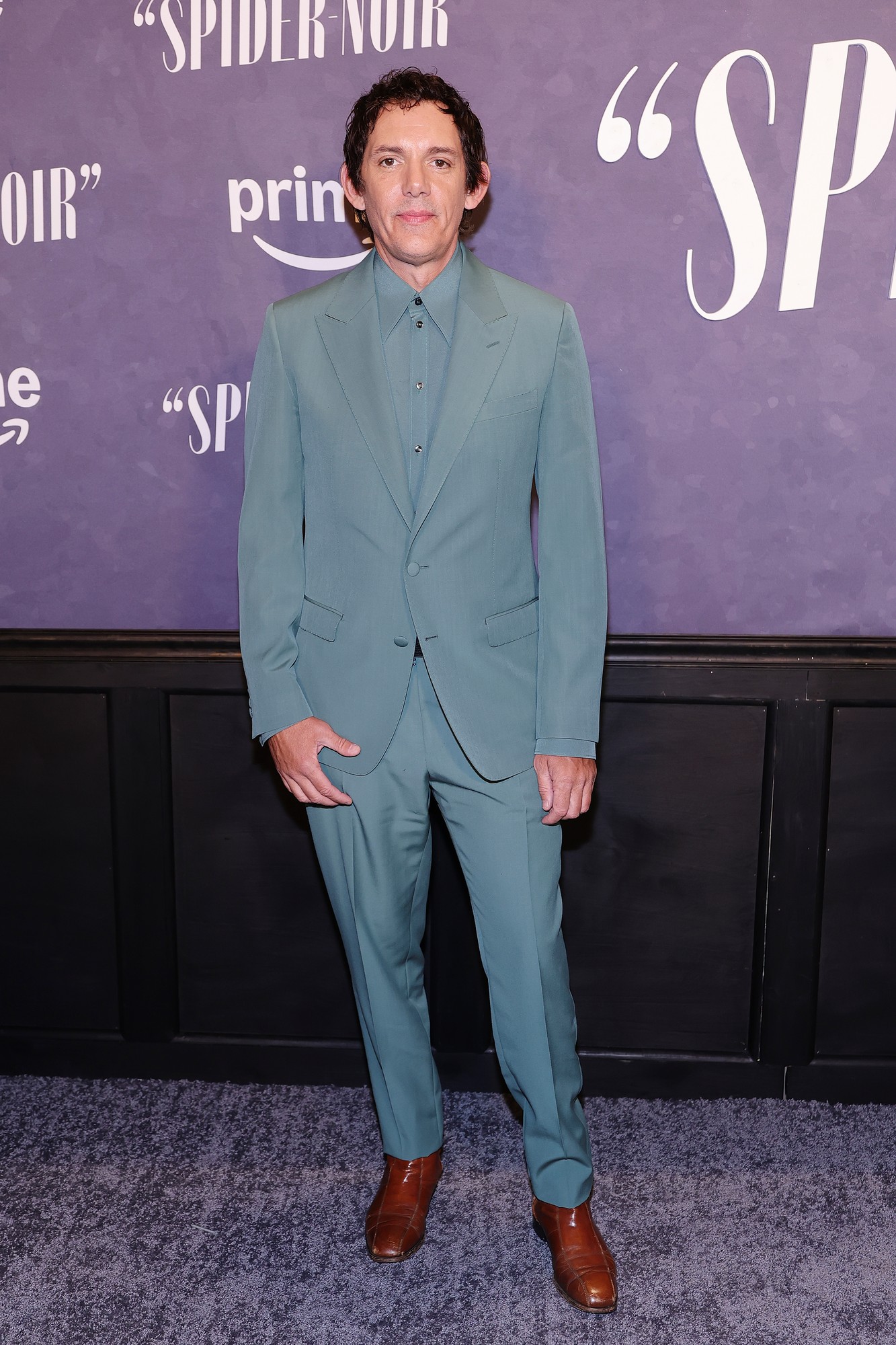
Nicolas Cage is stepping out for the world premiere of his new Prime Video series!
The 62-year-old Oscar-winning actor had the support of wife Riko Shibata at the premiere of Spider-Noir on Wednesday evening (May 13) held at Regal Times Square in New York City.
Credit: Getty
Many other cast members were also in attendance
Fellow cast members in attendance at the world premiere included Andrew Caldwell, Jack Huston, Brendan Gleeson, Abraham Popoola, Lamorne Morris, Karen Rodriguez, Lukas Haas, and Li Jun Li.
Credit: Getty
What is Spider-Noir about?
Spider-Noir “tells the story of Ben Reilly (Cage), a seasoned, down on his luck private investigator in 1930s New York, who is forced to grapple with his past life, following a deeply personal tragedy, as the city’s one and only superhero.”
Credit: Getty
There’s two ways to watch the new show!
Spider-Noir is set to debut on May 27th on Prime Video, and it will be available to watch in two ways – “Authentic Black & White” and “True-Hue Full Color.”
I was watching a Ford truck commercial—you know, the kind that airs during Monday Night Football—and the theme was how good solid blue-collar Americans who own small welding businesses and wear plaid flannel shirts always give 100%. Cue Bob Seger, “Like a Rock.”
Oh wait, that was Chevy. But you get the idea.
Anyway, Ford has obviously gone soft. Anyone who follows sports or business figures on social media knows that giving 100% is for losers. Winners give 110% every day. I know this from watching Shark Tank and that Michael Jordan documentary.
This idea is not limited to athletes and self-made billionaires. There’s another group that really likes to say that you need to exert the maximum possible effort, stretching yourself to the limit, every time, all the time.
The 110% mentality in law practice
Lawyers, of course. Especially in the BigLaw world. It’s a standard part of the culture.
Just ask that prominent “law-bro” recruiter who’s always giving cringey advice. Or that firm that billed a bazillion hours on the Twitter lawsuit.
I chalk up this 110% rhetoric mainly to marketing. It’s the image law firms want to sell to their clients, and also to their associates. They want clients to think they go all out, all the time, and they want associates to feel guilty when they don’t bill as many hours as humanly possible.
I’ve always been kind of skeptical about this idea. For starters, I just don’t think it’s realistic to demand maximum effort, 25 billable hours a day, for days on end. Anybody who has worked in a law firm knows this just doesn’t really happen.
I mean, we’re talking about practice. Not a game . . .
But lately I’ve been thinking about a different objection to the “always be grinding” mentality in law firm culture: does it actually result in better performance?
I hypothesize that lawyers and other professionals might actually perform at a higher level if they ditch the 110% approach.
To test this hypothesis, I did an experiment.
My scientific experiment
I went to the park to test how far I could kick a soccer ball. But here’s the key: I did it two ways.
First, I thought about kicking the ball as hard as I possibly could.
Second, I relaxed and thought about kicking the ball hard, but not as hard as I could.
To keep it scientific, I repeated the experiment multiple times. I mean, like at least three times.
I don’t even need to tell you what happened.
Yes, of course, I got more distance with the second approach. Maybe not every single time, but definitely most of the time.
The same experiment works with driving a golf ball off the tee. If you play golf at all, you already know this. When you walk up to the tee box thinking “I’m going to smack the crap out of this ball,” the result is almost always bad. Unless you are John Daly. But I digress.
The point is that the experiment illustrates a principle well known to sports psychologists, the “85 Percent Rule.”
The 85 Percent Rule
Here’s what people who coach elite athletes already know. Let’s say you tell a world-class sprinter to run the 100-meter dash at 85% effort. Often that results in a faster time than trying to run at 100% effort.
Now, of course, this isn’t a highly scientific theory, and you can quibble with the details. But that’s not the point.
The point is that athletes often get better results when they don’t try as hard as they possibly can.
What gives? Why is that?
The theory is that when elite athletes concentrate on exerting the maximum possible effort, they tense up, and their performance suffers. When they think about giving 85%, they relax and perform better.
Could the same principle hold true for lawyers, and other professionals?
Anecdotal evidence and my own personal experience suggest the answer may be yes.
Do the most effective lawyers give 110 percent?
Have you ever watched a lawyer in the courtroom who just seems to be trying too hard? It can be hard to watch. They’re going all out to try to persuade the judge or jury to go their way, but instead they just sound desperate, or overly aggressive.
And don’t get me started on law firms over-working a file.
On the other hand, think about the most persuasive lawyers you have seen in action. Did they seem like they were straining to exert themselves as much as humanly possible? Or did they seem relaxed and confident?
You don’t even have to say anything, I already know what the best lawyers are like.
Like a rock.
______________________
Zach Wolfe (zach@zachwolfelaw.com)is a Texas trial lawyer who handles non-compete and trade secret litigation at Zach Wolfe Law Firm (zachwolfelaw.com). Thomson Reuters has named him a Texas Super Lawyer® for Business Litigation every year since 2020.
These are his opinions, not the opinions of his firm or clients, so don’t cite part of this post against him in an actual case. Every case is different, so don’t rely on this post as legal advice for your case.
To provide the best experiences, we use technologies like cookies to store and/or access device information. Consenting to these technologies will allow us to process data such as browsing behavior or unique IDs on this site. Not consenting or withdrawing consent, may adversely affect certain features and functions.
Functional
Always active
The technical storage or access is strictly necessary for the legitimate purpose of enabling the use of a specific service explicitly requested by the subscriber or user, or for the sole purpose of carrying out the transmission of a communication over an electronic communications network.
Preferences
The technical storage or access is necessary for the legitimate purpose of storing preferences that are not requested by the subscriber or user.
Statistics
The technical storage or access that is used exclusively for statistical purposes.The technical storage or access that is used exclusively for anonymous statistical purposes. Without a subpoena, voluntary compliance on the part of your Internet Service Provider, or additional records from a third party, information stored or retrieved for this purpose alone cannot usually be used to identify you.
Marketing
The technical storage or access is required to create user profiles to send advertising, or to track the user on a website or across several websites for similar marketing purposes.