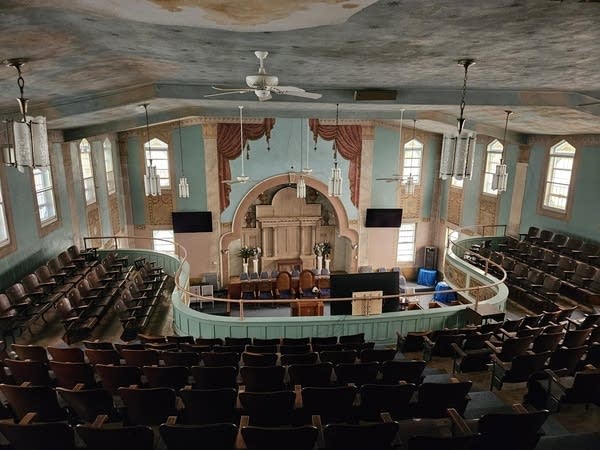
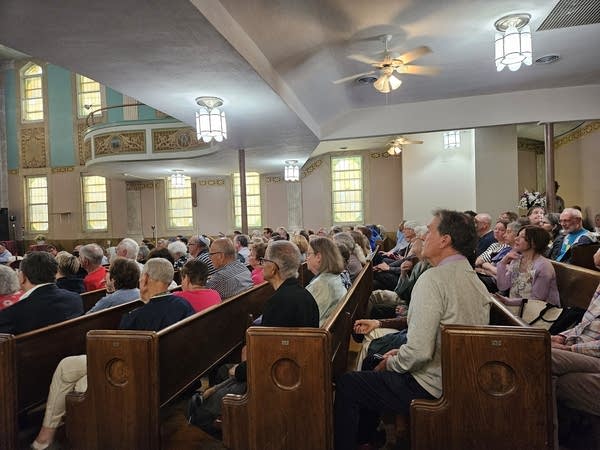
Nearly 200 people, most with Jewish ancestry, packed a north Minneapolis Pentecostal church on Sunday afternoon.
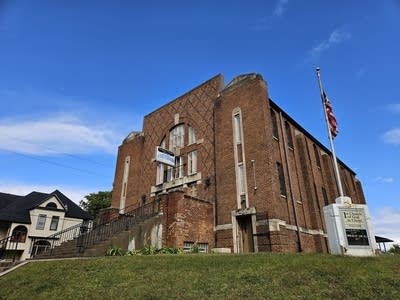
The building, 100 years old this year, has significance to both Jewish and Black history in the area.
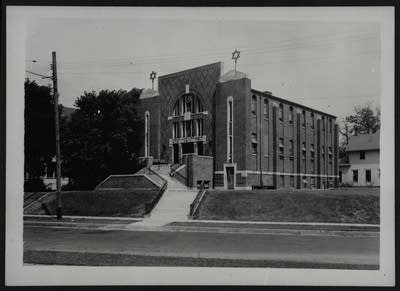
Constructed in 1926 as Tifereth B'nai Jacob Synagogue, the building at 810 Elwood Avenue North was purchased by an African American Pentecostal congregation and rechristened as the First God of Church in Christ — Graham Temple in 1957.
The church hosted a centennial event with Jewish religious leaders and historians Sunday afternoon, with exhibits and talks exploring the building’s past and present.
For many, it was like coming home.
David Sussman, a 77-year-old from Minnetonka, recalled visiting the synagogue during High Holidays with his grandparents who lived on the northside. He never thought he’d return.
“It kind of makes me feel good knowing that the old neighborhood is still here and it’s vibrant and it’s functioning,” Sussman said.
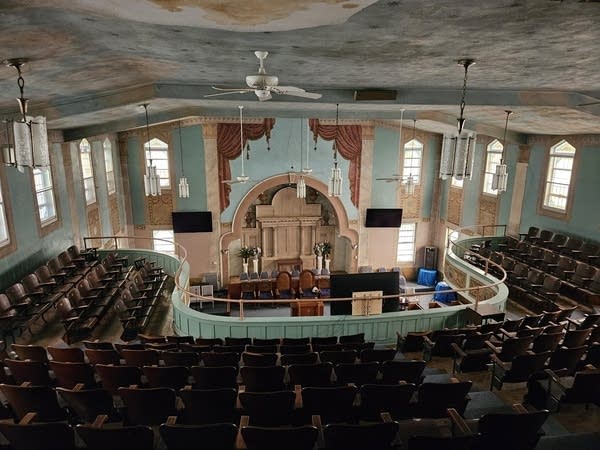
Jewish art still adorns the interior of the unassuming church atop a small hill. The church preserved much of its original art and architecture.
Paintings with trompe l’oeil motifs and zodiac images line its walls. The ceiling features stars and a night sky against a blue background. A wooden Torah ark — an ornamental structure to hold sacred texts — sits at the sanctuary’s center.
Enough of the original building, both outside and inside, remained to qualify for the National Register of Historic Places in 2024, a designation that could help the building’s current inhabitants raise funds to support their home and preserve its history.
“It's exciting for both of our narratives and our stories,” said Tierre Webster, senior pastor at the First Church of God in Christ, in a September interview. “They so much mirror each other in this community.”
Webster hopes historical designation will also allow the church to create a museum telling the story of Jewish and African American plight in the neighborhood.
“It's a wonderful example of Jewish and Black cooperation,” said Marilyn Chiat, an art and architectural historian who helped apply for the building’s historical designation. “It's a positive story. We don't get too many of those these days.”

Shared stories
The building marks the second synagogue in Minnesota to receive historical designation, according to Chiat. It’s also the third African American congregation in the state to be recognized.
Chiat said the building is “representative of a time” and the “role of community on the northside.”
She described north Minneapolis in the late 1800s and early 1900s as a slum with cheap housing that became a landing place for both Orthodox Jewish immigrants fleeing persecution by the Russian Empire and African Americans moving north as Reconstruction ended in the South and Jim Crow laws became the norm.
Chiat said Minneapolis at the time was notorious for its antisemitism and racism.
“There were housing covenants restricting both Jews and Blacks as to where they could live,” Chiat said, referring to what are now approximately the Near North and Willard-Hay neighborhoods of north Minneapolis. “It was far more difficult for African Americans than for Jews, but it was difficult for both of them, and that is how the northside began.”
Chiat said the two communities lived and worked closely together. Tifereth B'nai Jacob Synagogue founders had socialist leanings and fundraised for local causes like the Phyllis Wheatley House, she said. Chiat figures that relationship made it easier for Graham Temple to purchase the building in 1957.
Three couples from the Tulsa, Okla., area founded the Christian congregation in 1923 and moved to Minnesota during the Great Migration. First God of Church in Christ – Graham Temple marked the denomination’s first house of worship in the state.
North Minneapolis resident Jerome Nunn said his family attended the church when he was growing up and it held a critical role in the neighborhood.
“It was a gathering place for people to support one another, for families to support one another and to just establish their footing as a lot of people migrated to the North,” Nunn said.