Outdoor Ed program teaches hands on learning, healing


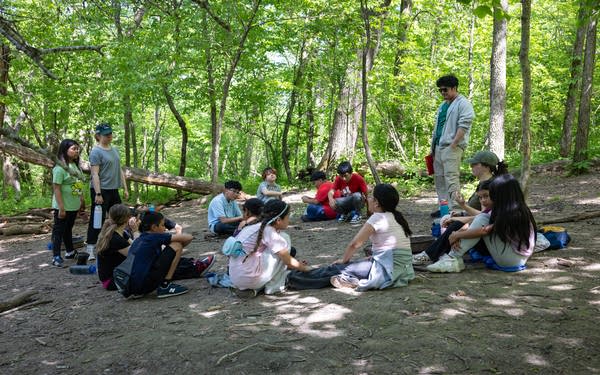
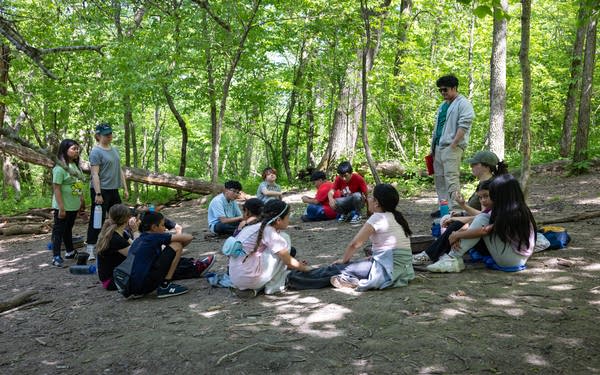
Students listening to an instructor outside

In the woods of southeast Minnesota, outdoor educator Kat Anderson taught a group of 5th graders how to start a fire.

“We want to gather as many of these teeny, teeny, tiny sticks as possible,” Anderson instructed them. “We want to think of our fires as a hungry baby. The baby needs to be constantly fed, or else it's going to cry.”

These students attend Academia In Lak’ech (which until recently was named Academia Cesar Chavez), a dual Spanish immersion charter school in St. Paul. But they took a break from classroom learning recently to travel to Eagle Bluff Environmental Learning Center near Lanesboro. Over the course of two days, the children learned how to build teamwork, their own self confidence, plus hands-on science and nature lessons.

The trip had barely begun, and student Gabby Roman was already enjoying the change of scenery.

“I've been having a really good time. Nature kind of helps you calm yourself down. I feel really comfortable,” Roman said.
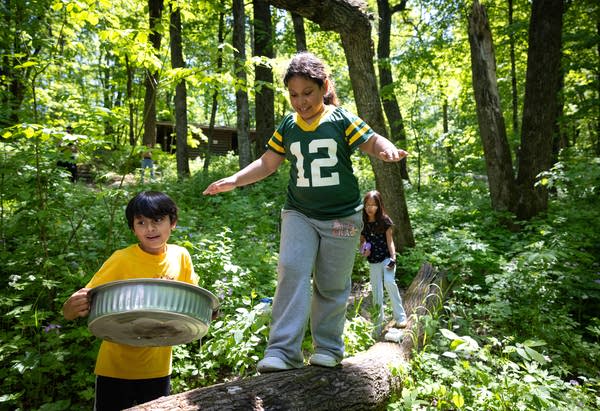
Two students exploring the forest
Bella Arias, a 5th grader at Academia In Lak’ech school in St. Paul explores the forest at Eagle Bluff Environmental Learning Center near Lanesboro on May 26.
Ken Klotzbach for MPR News

Calm is exactly what these kids needed after a frightening and tumultuous winter and spring.

Many students at Academia In Lak’ech are immigrants or the children of immigrants and most speak Spanish at home.

During the Trump administration’s immigration crackdown called Operation Metro Surge, many Lak'ech families went into hiding out of fear of being detained and deported, said Norma Garcés, who is the school’s executive director and superintendent. Parents stayed home from work and students retreated to online learning.

Getting out of the Twin Cities and into nature was a welcome departure from the state of anxiety and uncertainty Lak’ech students lived in for months.
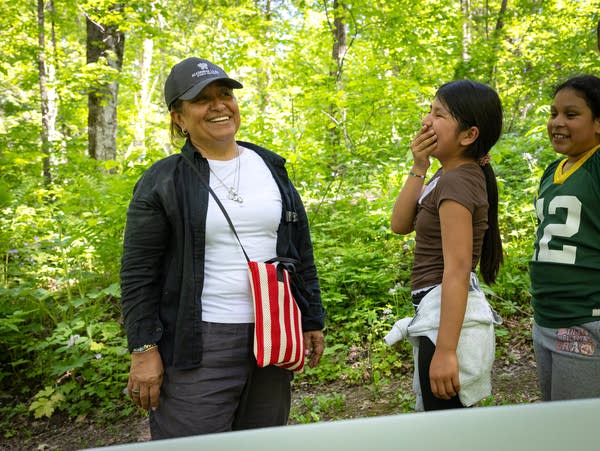
A woman laughing with students
Norma Garcés, executive director and superintendent of Academia La Paz, which includes Academia In Lak'ech school in St. Paul, laughs with Nidia Vazquez, middle, and Bella Arias, right, at Eagle Bluff Environmental Learning Center near Lanesboro on May 26.
Ken Klotzbach for MPR News

"We know culturally that being outdoors and being here is healing, so our kids need a lot of healing right now,” Garcés said. “Our families need a lot of healing, our teachers need a lot of healing. So part of being here is part of the healing process."

Making outdoor experiences more accessible

Garcés says this trip would have been unaffordable to the school and the students’ families without the help of a new program called Outdoor School for All. The Legislature created it last year, providing nearly $900,000 in grants to schools across the state for experiences like this. That grant money is covering about 40 percent of the Lak'ech school's cost.

Schools must show financial need for grant funding through a rigorous application process and the money can be used to cover expenses such as transportation and teachers’ extra time, as they often plan field trips like this while off the clock, said Colleen Foehrenbacher, who is executive director of Eagle Bluff, one of five accredited outdoor education programs in Minnesota.

A woman stands on a porch overlooking a river
Colleen Foehrenbacher, executive director at the Eagle Bluff Environmental Learning Center, poses for a portrait on a bluff overlooking the Root River near Lanesboro, Minn. on Tuesday, April 18, 2023.
Ben Hovland | MPR News file

She was among the outdoor educators who lobbied the Legislature last year for the grant funding. She said the goal is to make the experience more accessible to more kids – especially those from disadvantaged families and urban areas – and to show them what’s possible in their futures.

“It could lead to somebody deciding they want to go into the legislature to protect the environment, it could lead to somebody going into a natural resources career,” she said. “It could lead to a family starting to have a garden in their backyard."

So far, the program allowed about 2,000 more students to attend outdoor education programs around the state this year.

Friendship is necessary for survival

While Lak’ech’s students had a challenging few months earlier this year, the immigration crackdown they endured taught them a lot about their community and the importance of supporting each other in difficult times, said Garcés.

She said she saw that empathy on full display at Eagle Bluff, while the kids learned survival skills.

"It's interesting in survival, right now they're teaching them, ‘What would you take to survive?’ And one of the items [the kids say] is friendship,” Garcés said. “The kids are like, ‘you're not going to survive by yourself. We need to stay friends in order to survive’."
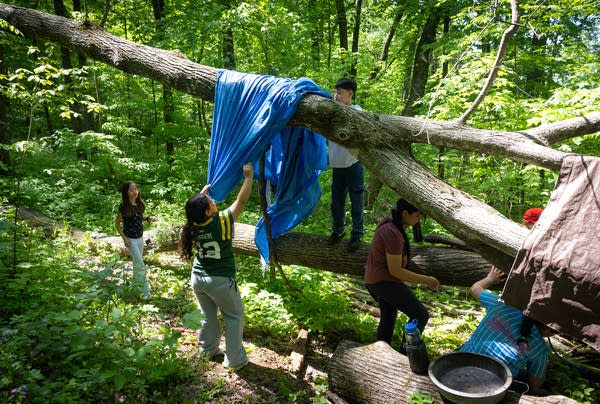
Students building a shelter
Fifth grade students from Academia In Lak'ech school in St. Paul work to build a shelter at Eagle Bluff Environmental Learning Center near Lanesboro on May 26.
Ken Klotzbach for MPR News

Back outside, 10-year-old Jason Isaac is building a shelter. He said food and water are obvious things he needs to survive. But so, too, is friendship.

“It might be hard to survive [on your own], because you have to collect everything by yourself,” Isaac said.

Right now, the Outdoor School for All program is a pilot that only covers excursions for students from 4th to 12th grade. In coming years, supporters hope to secure more funding from the legislature so kids as young as kindergarten can attend, too.




Source link

Leave a Reply

Subscribe to Our Newsletter

Get our latest articles delivered straight to your inbox. No spam, we promise.

Recent Reviews


What is SAS?

SAS stands for Statistical Analytics System. It is a software system developed to accommodate complex analytics, data techniques and other mathematics, but is mostly used by big companies, especially in the banking, health and insurance sectors. SAS is not open-source, this is not free but it is not affordable either, and this is the greatest deterrent to business owners and start-ups that would have been able to do so.At present SAS is expanding its platform to include emerging technologies like AI and machine learning tools as well. Moreover, it also provides services related to custom intelligence, risk management and identifying, big data functionalities, etc. 

Why SAS?

Since SAS has been developed primarily for industrial and commercial purposes, this may not be the greatest option for beginners or solo data analysts to discover except if their main objective is to think about working in an industrial environment and to have new skills to be more competitive in the current industry. For all those who wish to learn SAS computing for free, a free version of SAS known as SAS University is available for educational purposes only and not for industrial applications. 

Become a SAS Certified professional by learning this HKR SAS Training !

Features of SAS:

The exciting features of the SAS are:

  • SaS is not a free platform or even an open source.
  • It integrates the functionalities or capabilities of AI and machining learning techniques.
  • SAS comes with high data security and stability.
  • Moreover SAS provides excellent customer service, technical support and maintenance services as well.
  • As it is compatible with cloud platforms, commands can be easily processed in the cloud.

SAS Training

  • Master Your Craft
  • Lifetime LMS & Faculty Access
  • 24/7 online expert support
  • Real-world & Project Based Learning

What is Python?

Python is an open-source object-oriented programming language which has become exceptionally successful with data analysts and software engineers. Python is recommended as it endorses, among many others, organized, object-oriented and operational programming and incorporates current infrastructure.Python comes with libraries to support a variety of data manipulation functions, including data integration, information extraction, business intelligence, visual analytics, and artificial intelligence. The libraries of the python are: pandas, Numpy, tensorflow, matplotlib, etc.

Why Python?

The simple truth that Python is perhaps the most popular language between many software developers and project managers helps make it simple to master, interpret, and then use. Python provides a sleek comprehensible syntax that makes it more convenient for newbies because they don’t go into a lot of programming. This provides people an opportunity to plan mostly on learning the other operations of data science.

  Become a python Certified professional  by learning this HKR Python Training !

Features of Python:

The attractive features of python are:

  • Python is easy and simple to learn programming language as it requires menial coding. 
  • It comes with more number of libraries
  • It comes with extensive support for many other operating systems like Mac platforms, Linus and Windows.
  • Python is a highly scalable, interpreted and fastest programming language.
  • Moreover, python comes with great features such as  visualization, data analytics, and data manipulation functions as well.
HKR Trainings Logo

Subscribe to our YouTube channel to get new updates..!

Comparison between SAS vs Python:

Now let us compare the SAS and python in detail.

Python:Python, on the other hand, is quick to understand thanks to its simple function. However, instead of an interactive GUI like the one in SAS, Python has an IPython notebook that allows students to access code.

SAS:For individuals who are really experienced with SQL, mastering the fundamental SAS language is possible due to a growing Emphasis. Prior to actually writing code, an adult should first acquaint himself/herself with the SAS GUI interface. There is no need to have previous knowledge to learn SAS.

Python: Python becoming an open source platform and it is very much free to download it. However they won’t provide any tech support or guarantee documents for the users. It is mostly preferred by the small and medium sized organizations due to its flexibility and transparency of the systems.

SAS:SAS is a licensed option and is more expensive as well. This SAS platform is equipped with mutli[le features which can be used only after the purchasing and upgrades. Most of the big IT companies rely on it.

  • Data Science capabilities:

Python:In the field of data science, Python language succeeds in the analysis of complex data. Libraries also including Scikit Learn, Pandas, and NumPy, and Matplotlib for visual representation, end up making it an alternative for beginners who want to undertake a career in data science.

SAS:SAS also typically includes data science abilities, such as simultaneous data analysis, access to and strategic planning of datasets through an interconnected SQL database system.

  • Libraries and tools supported:

Python:Python includes many other libraries for web design, software development, data science and visualization, desktop GUI programming, as well as machine learning and AI frameworks. Python is therefore a great option for exploiting and envisioning huge amounts of data.

SAS:SAS provides a variety of built-in business intelligence, data storage, graphical and computational tools that make it a better platform for manipulating data, especially on stand-alone data centres or devices. Although SAS could be used to determine outcomes very well, it is not as great as Python in terms of data visual representation as it cannot create special statistics. 

Python:Python is a powerful device that is not restricted to data analytics and software engineering functionality, creating a broader market for individuals with Python tech skills.

SAS:For a long time, SAS held the largest market share, and in particular the organizational market. However, the economy is continuously shifting toward these open-source technologies, which is why Python has grown exceptionally in prominence.

  • Application advancements:

Python:Due to its open nature of Python, the introduction of innovative features and methodologies is fast compared to SAS. Although there are opportunities for sustainable development since they’re not well-tested due to their accessible ability to contribute.

SAS:SAS is introducing a new edition in the type of software releases or rollouts. As it is granted a license, all functionalities and updates are well tested. It’s much less likely to be an error especially in comparison to Python.

Python:Python has a fierce challenge with graphics bundles such as VisPy, Matplotlib. But, compared to SAS, it’s still complex.

SAS:SAS includes system graphical capabilities. But this is extremely practical. Making any customization is a difficult task to achieve. We need to comprehend the SAS Graph package rigorously to configure it.

Top 30 frequently asked SAS Interview Questions !

Python:Python is recommended by start-ups, small and medium-sized technology companies since it provides advanced features for handling large unorganized data sets at no cost. It even has AI and machine learning abilities.

SAS:SAS is mostly embraced by large corporations whose major worry is high stability, better security and devoted customer support, not the expense of the application.

Python:Python is continuously replaced with the latest features from the community, making the latest developments quicker than SAS.

SAS:SAS will only be amended when a new version is rolled out.

SAS Training

Weekday / Weekend Batches

Conclusion:

The technology is changing towards transmission. Second, tools like Python are flexible and most recommended for data science. SAS is much more appropriate to statistical analysis and business intelligence. For this reason, it would have been more beneficial for a beginner interested in exploring data science to understand Python. But adding SAS to their knowledge base would give newbies more possibilities.

Related Articles:

  1. Python Partial Functions
  2. Python Split Method
  3. SAS Programming
  4. SAS BI Tools
  5. SAS Vs Tableau


Source link