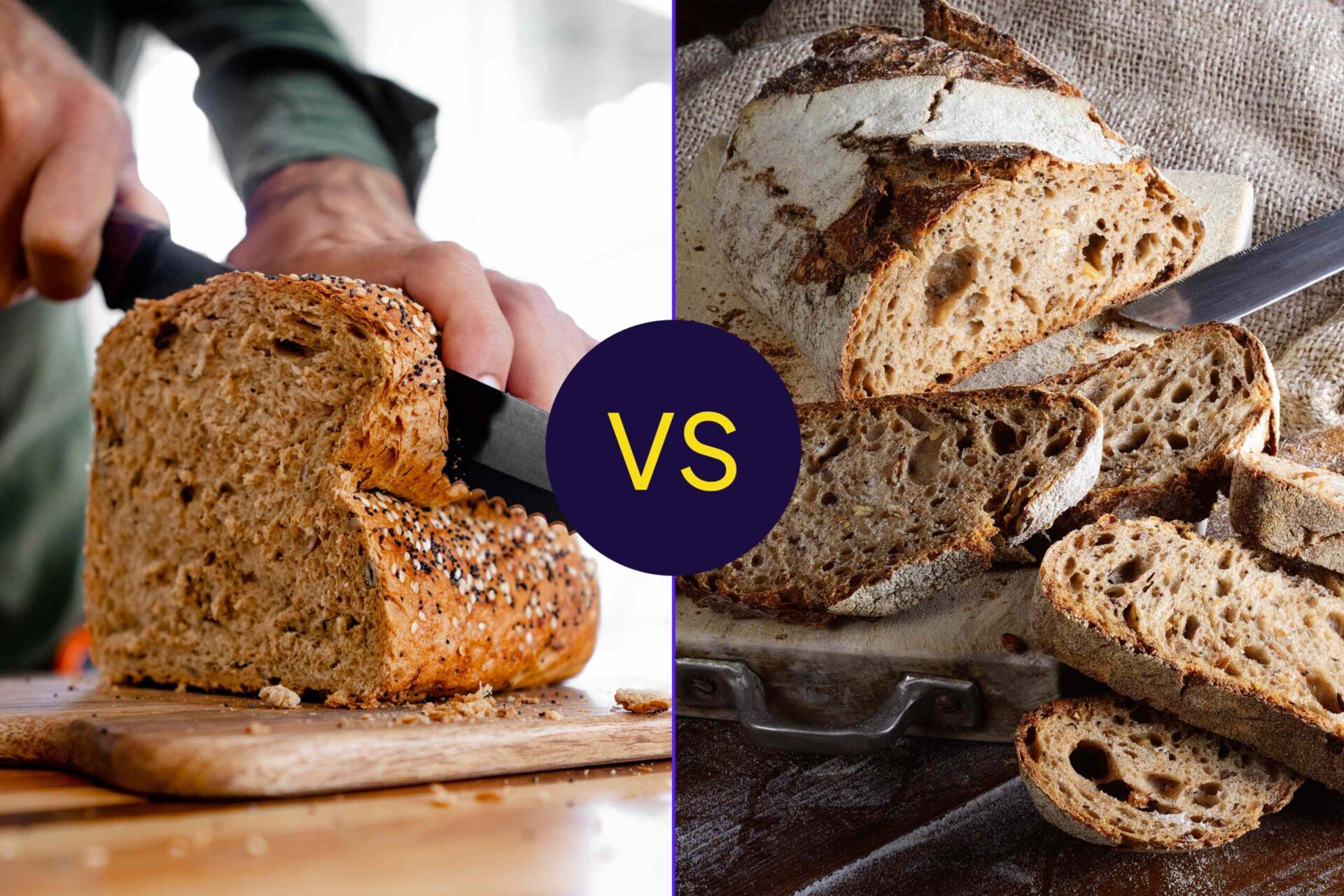
Rye vs. Whole Wheat Bread: Which Is Better for Blood Sugar, Heart Health, and Digestion?


Rye and whole wheat are both good sources of fiber, but rye may have an edge in benefits.Credit: Health / Getty Images
Rye and whole wheat are both good sources of fiber, but rye may have an edge in benefits.
Credit: Health / Getty Images

At a Glance

  • Rye and whole-wheat bread are both healthy whole-grain choices that support metabolic, digestive, and heart health.
  • Rye bread has a lower glycemic index (GI) than whole wheat, making it a better choice for blood sugar control.
  • Whole wheat bread is rich in insoluble fiber, which helps prevent digestive constipation.

Whole wheat and rye bread are both nutritious whole-grain options, but they have slightly different nutritional profiles. Rye is especially rich in soluble fiber, which helps maintain steady blood sugar. Whole wheat bread provides more protein, supporting muscle health and promoting fullness.

Nutrition Comparison

Rye and whole wheat bread have similar nutrient profiles. However, exact numbers can vary by brand, recipe, and slice size. Here’s how the nutrition of one slice (32 grams) of whole wheat versus rye bread compares:

Rye Whole Wheat
Calories 83 kcal 81.5 kcal
Fiber 1.9 grams (g) 1.9 g
Carbohydrates 15.5 g 13.8 g
Fat 1.1 g 1.1 g
Protein 2.7 g 3.95 g
Sodium 193 milligrams (mg) 144 mg
Iron 0.91 mg 0.82 mg

Rye Is a Better Choice for Blood Sugar Management

How quickly your blood sugar rises after eating bread depends on its glycemic index (GI), a measure of how rapidly a food increases blood sugar. Rye bread generally has a lower GI than whole wheat bread, especially when made from whole-grain rye, making it a better choice for keeping blood sugar stable.

Whole-grain rye is digested more slowly, so glucose enters the bloodstream gradually rather than all at once. This helps prevent rapid increases in blood sugar. Research also suggests rye may produce a “second-meal effect,” meaning blood sugar can remain more stable for several hours after eating.

Whole wheat bread is also a healthy whole-grain option and can support blood sugar management better than white bread. Choosing dense, minimally processed whole wheat breads, such as sprouted varieties, may have a lower GI than softer, highly processed loaves.

Rye May Offer Slightly More Heart Health Support

Whole wheat and rye bread are both heart-healthy options, but rye may offer a slight advantage. Rye bread contains more soluble fiber. Soluble fiber binds to cholesterol in the digestive tract and helps remove it from the body. This lowers LDL cholesterol, helping reduce build-up in the arteries and protect against heart disease.

Research suggests that regularly eating whole-grain rye bread can reduce total and LDL cholesterol compared to wheat-based bread. Even so, replacing refined white bread with either whole rye or whole wheat bread supports better heart health.

Both rye and whole wheat breads provide potassium and magnesium. These minerals help relax blood vessel walls and improve blood flow. Potassium also helps balance the effects of sodium, supporting healthy blood pressure and easing strain on the heart.

Rye Has Longer-Term Digestion Benefits

A fiber-rich diet supports digestive health. Fiber adds bulk to stool, promotes regular bowel movements, and feeds beneficial gut bacteria. Rye and whole wheat breads both support digestion and can help prevent constipation, but rye may be better for long-term digestive health.

Rye bread may offer an advantage for gut health because of its fiber composition. Rye contains more soluble fiber than whole wheat and is rich in arabinoxylans, a group of fibers that add bulk to stool and help waste move through the intestines, which can help prevent constipation. Fibers in rye are prebiotics, meaning they feed beneficial gut bacteria. When gut bacteria ferment these fibers, they produce short-chain fatty acids (SCFAs) that support overall gut health.

Whole wheat bread contains mostly insoluble fiber. This fiber helps move food through the digestive tract and keeps bowel movements regular. Whole wheat can still support healthy gut bacteria, but rye appears to have a stronger prebiotic effect and may do more to nourish beneficial bacteria in the gut.

Rye May Aid Weight Management Better

Choosing the right bread can support weight management by helping control hunger and calorie intake throughout the day. Both whole wheat and rye breads are better choices than refined white bread, but rye may offer a slight advantage due to its fiber content and dense texture.

Rye contains unique fibers that stay in the digestive system longer than those in whole wheat. This slows digestion and helps you feel full longer. Some research suggests diets rich in high-fiber rye foods may support modest weight and body fat reduction compared to refined wheat products, possibly by influencing appetite and gut health. Certain fibers in rye are fermented by gut bacteria into compounds that may help regulate hunger hormones and reduce food intake.

Whole wheat bread also supports weight management because wheat is a nutrient-dense whole grain. It provides fiber and protein, which promote fullness and steady energy. Although whole-grain rye bread may be a better choice for weight management, portion size and overall calorie intake matter more than choosing one type of whole-grain bread over another.

Which Should You Choose?

Rye bread has a nutritional edge in several areas, particularly for blood sugar control, heart health, and digestive regularity. If you have diabetes or high cholesterol, whole-grain rye bread may be the better choice. Varieties made with whole rye grains, such as pumpernickel, are generally highest in fiber.

Whole wheat bread is still a healthy choice, providing fiber, vitamins, minerals, and protein. No matter which type you choose, ingredients matter. Look for breads that list “whole rye flour” or “whole wheat flour” as the first ingredient. Products that also contain intact whole grains, such as cracked rye or wheat kernels, may provide additional fiber.​


Source link

Leave a Reply

Subscribe to Our Newsletter

Get our latest articles delivered straight to your inbox. No spam, we promise.

Recent Reviews


The internet is changing and so is the way we search and find information. The trick behind all the search queries is nothing but a web crawler.

Yes, the machine that searches the web, retrieves data, and assists search engines such as Google in sorting the information into searchable indexes. Search engines would be nothing without crawlers. But do you know there are different types of crawlers lately?

Well, traditional crawlers like Googlebot have been using rule-based systems over the years to retrieve information and sift through links and draw results to user queries. This method is still effective, although there are a few limitations it comes with.

Let’s now introduce the new age of AI-powered crawlers, a next-generation genus of bots, based on artificial intelligence and machine learning. These crawlers do not just search the sites; they comprehend the sites. Through semantics, tone and context, they are going above and beyond in the web searching landscape.

Here in this blog, we are going to discuss the differences between traditional and AI crawlers, alongside how they will transform search in the future and share practical tips to make your content the best to thrive in today’s digital world.

So, let’s get started!

What are Traditional Crawlers? Traditional Crawlers

The old-fashioned crawlers, namely Googlebot and Bingbot are based on the following principles, scan, copy and index. They operate similar to librarians and index the information by use of HTML structures, metadata, and keywords.

    • Process: They search links, analyze code, and store page information in huge search databases.
    • Reliability: Suits well with static web sites and organized content.
    • Weakness: Problems with changing websites, with dynamic components, such as JavaScript-bulky applications, and subtle context.

As an example, a traditional crawler might not pick up the product information in a product page when it rewrites the class names or changes the structure of the product page, causing indexing errors. This has led the industry to smarter and AI-assisted means.

What Are AI Crawlers?

AI Crawlers

Intelligent crawlers go beyond bot to be more of an interpreter. Through the use of natural language processing (NLP), computer vision, and machine learning, they are able to comprehend content in a manner that can replicate human understanding.

    • Context Awareness: AI crawlers do not only read the text; however, they define meaning, tone, and purpose.
    • Flexibility: AI crawlers will be able to identify and retrieve suitable information even when a site alters the structure of the site.
    • Multimedia Intelligence: They are capable of processing video, audio and picture, and are therefore much more intelligent than bots that are rule-based.

Just think of a crawler that does not just read a blog post but knows whether it is a product review, a thought-leadership article or a how-to guide. This is the hope of AI-support crawling.

The Rising Dominance of Googlebot.

According to recent stats from Cloudflare, Googlebot is still dominating although AI crawlers are on the rise. Googlebot grew by 96 percent in May 2024-May 2025, with highs in April 2025 of 145 percent of the traffic of May 2024.

This spike was accompanying the introduction of AI Overviews by Google, which added generative answers to search results. The combination of old-style crawling with the use of AI improvements is the future of Google as the hybrid is establishing preconditions of the coexistence of the two systems.

How Does Traditional Search Work?

To value the changes, one should go back to the way the search engines used to operate:

Crawling/ Indexing– Robots search through internet sites and archive copies of pages on servers.

Ranking Algorithms– The ranking of pages depends on the relevance of the key words, back links and the freshness of the content.

Displayed Results– The Results display ads, organic links, snippets, and panels.

AI-Driven Search: A New Era

AI based search engines extend past keywords. They can:

    • Know natural language – responding to complex conversational questions.
    • Provide direct responses – eliminating the necessity to browse through several results.
    • Individualize findings – customize suggestions according to the behavior of the user.
    • Manipulate multimedia – The analysis of videos and podcasts, as well as voice recognition.

ChatGPT, Google Gemini, and Microsoft Copilot are the members of Large Language Models that can transform the search into a conversation instead of a list of search results.

AI Crawlers vs Traditional Crawlers: Key Differences

1. Understanding User Intent

Traditional Crawlers: Search query by a key word and scratch the surface without necessarily realizing what the query entails.

AI Crawlers: This is the next level, whereby the search engine goes beyond the keyword and interprets user intent, semantics and context to deliver even more useful information.

2. Scalability and Efficiency

Traditional Crawlers: Are able to construct a mass of data, but they can create duplicates or irrelevant records as they are not very aware of the context.

AI Crawlers: Smart filtering and prioritization of content, which creates a leaner and more efficient indexing which is more relevant.

3. Real-Time Adaptation

Traditional Crawlers are not good at keeping up with new structure of websites or newer technologies being introduced and thus require manual updating.

AI Crawlers): Learn and adapt in real time and recognize patterns and evolve without human interaction.

4. Content Depth and Quality

Traditional Crawlers– These are typically employed to access visible text and links, and they might not be concerned with multimedia, user-created and interactive content.

The AI crawlers use multimedia, dynamic content and even sentiment to produce a more refined view of the entire quality of pages.

Sharing Quick Wins for Crawlability

Technical SEO is essential even with the further development of AI. The following are fast fixes to increase crawlability:

Important pages should be served with server-side rendering (SSR).

    • Keep HTML lean, semantic and clean.
    • Enhance page speed- sluggish sites are conquered.
    • Provide clear, descriptive headings and titles (H1 -H3).
    • Blocking AI crawlers in robots.txt or llms.txt is not advisable.
    • Publicize verifiable factual, well formatted and prompt information.

Conclusion: Preparing for the Future of Indexing

The future of search lies at the intersection of traditional and AI crawling. While rule-based crawlers remain essential, AI-powered crawlers bring a new level of intelligence, adaptability, and context awareness.

For brands, this means rethinking SEO strategies and embracing AI Optimization (AIO) alongside Generative Engine Optimization (GEO). By preparing content for AI-driven indexing today, businesses can ensure long-term visibility, authority, and discoverability in tomorrow’s search ecosystem.

Stay updated with all the latest blog topics, here with us!

Recommended For You:

What are your Alternatives if your website has been hit by Google penalty?


Source link