Should you get an airline card to offset bag fees? We did the math


To offset rising fuel surcharges, U.S. airlines have recently raised checked bag fees. So now, for a round-trip flight, you can expect to pay about $100 extra per person for each checked bag.

As someone who doesn’t have elite status from staying loyal to a specific airline and likes to book basic economy for the least expensive flight itineraries, I can say from experience that paying almost $100 in bag fees — if not more — can really dampen a traveler’s cost-saving plans.

While I know you might be thinking, “Just don’t check a bag,” it’s not a feasible solution for every getaway. Plus, as a points and miles enthusiast, I’m also now weighing the fact that some airlines have placed restrictions on earning rewards on basic economy flights.

Basically, I want to have my cake and eat it too — without paying a ton of extra cash.

That’s why I’ve invested in several cobranded cards, and if you plan to travel at least twice a year — especially with one or two specific airlines that operate out of your hometown airport — it may make sense for you, too.

Here are the lowest-annual-fee airline cards that include a checked bag that may be worth considering.

Related: Higher fares are here: What it means for booking spring, summer flights

Save on American Airlines checked bag fees

American bag fees for standard fares:

  • $50 for your first checked bag ($45 if prepaid online)
  • $60 for your second checked bag ($55 if prepaid online)

Reward your inbox with the TPG Daily newsletter

Join over 700,000 readers for breaking news, in-depth guides and exclusive deals from TPG’s experts

American bag fees for basic economy:

  • $55 for your first checked bag ($50 if prepaid online)
  • $65 for your second checked bag ($60 if prepaid online)

An American Airlines plane taxis at Philadelphia International Airport (PHL). SEAN CUDAHY/THE POINTS GUY

Recommendation: Citi® / AAdvantage® Platinum Select® World Elite Mastercard®

  • Annual fee: $0 introductory annual fee for the first year, then $99 thereafter
  • Checked bag perk with card: First checked bag free for you and up to 4 travel companions; only on domestic flights
  • Basic economy fare earning rate: Earn 0 AAdvantage miles
  • Basic economy fare earning rate with the AAdvantage Platinum Select: 2 miles per $1 spent on eligible American flights
  • Main cabin fare earning rate for non-elite members: 5 miles per $1 spent on American flights

Final thoughts: If you fly round-trip at least once per year, you will pay $100 per person to check your bag when you book a basic economy fare ($100 if prepaid online). This card has an annual fee of $99 (starting in your second cardholder year), which is less than the cost of checking your bag. Plus, you can enjoy additional travel perks, such as earning 2 miles per $1 spent on American flights in basic economy, Preferred boarding and more.

To learn more, check out our review of the AAdvantage Platinum Select card.

The information for the Citi / AAdvantage Platinum Select has been collected independently by The Points Guy. The card details on this page have not been reviewed or provided by the card issuer.

Save on United Airlines checked bag fees

United bag fees:

  • $50 for your first checked bag ($45 if prepaid online)
  • $60 for your second checked bag ($55 if prepaid online)

United Boeing 787 parked at the gate in Adelaide, Australia
United Boeing 787 parked at the gate in Adelaide, Australia. ANDREA M. ROTONDO/THE POINTS GUY

Recommendation: United℠ Explorer Card (see rates and fees):

  • Annual fee: $0 introductory annual fee for the first year, then $150 thereafter
  • Checked bag perk with card: Primary cardmember plus one companion can each check a bag for free
  • Basic economy fare earning rate: Earn 0 United MileagePlus miles
  • Basic economy fare earning rate with the United Explorer card: 3 miles per $1 spent on United flights
  • Standard fare mileage earning for non-elite members: 3 miles per $1 spent

Final thoughts: If you plan to fly with United at least two times per year (round-trip) and check a bag, which would cost $200 or $180 if you prepay online, the United Explorer Card could be a good match for you. Plus, as a cardholder, you’ll earn the same number of miles (3 miles per $1 spent on United flights) when booking basic economy with this card as travelers who are booking standard fares with no MileagePlus status. Additionally, you can enjoy other travel perks, such as two United Club lounge passes per year.

To learn more, check out our review of the United Explorer Card.

Save on Delta Air Lines checked bag fees

Delta bag fees:

  • $45 for your first checked bag
  • $55 for your second checked bag
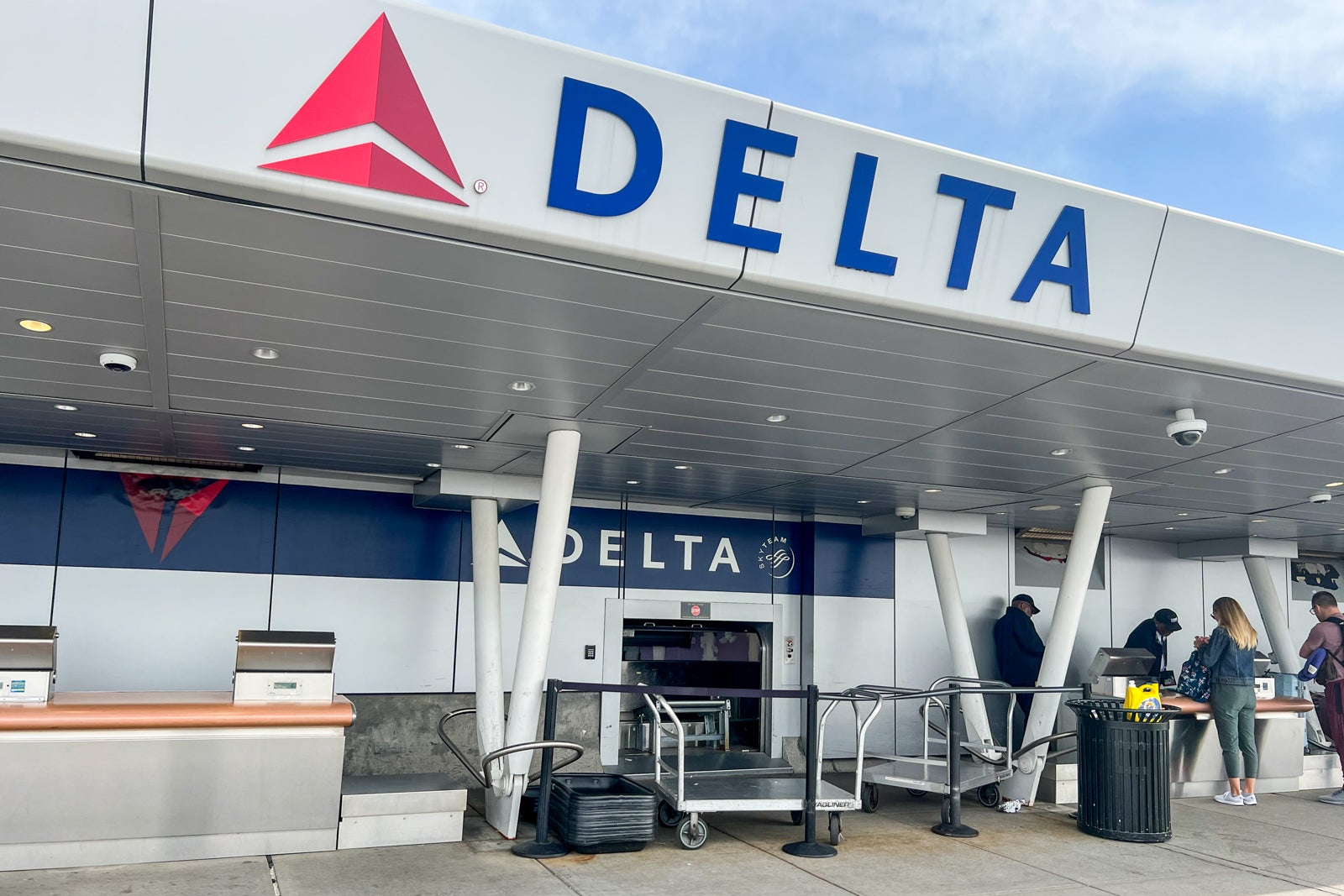
Delta signage at JFK
Airport, Bag, Clothing, Footwear, Handbag, Person, Shoe, Terminal, AccessoriesCLINT HENDERSON/THE POINTS GUYDelta Air Lines Premium Economy Boeing 767-400 JFK to LHR

Recommendation: Delta SkyMiles® Gold American Express Card

  • Annual fee: $0 introductory annual fee for the first year, then $150 thereafter (see rates and fees)
  • Checked bag perk with card: First checked bag free on Delta flights for you and up to eight travel companions (must be on the same cardmember’s reservation)
  • Basic economy fare earning rate: 0 Delta SkyMiles
  • Basic economy fare earning rate with the Delta SkyMiles Gold card: 2 miles per $1 spent on Delta flights
  • Standard fare (Main Classic) mileage earning for non-elite members: 5 miles per $1 spent on Delta flights

Final thoughts: If you fly round-trip at least two times a year with Delta, this card will offset the $180 checked bag fees. Plus, you’ll earn 2 miles per $1 spent on basic economy Delta flights as opposed to earning 0 Delta SkyMiles when booking this fare. Cardholders also receive other perks, such as 15% off award flights and up to $100 in statement credit every calendar year for Delta Stays (the airline’s hotel travel portal; you must use your card to book).

To learn more, check out our review of the Delta SkyMiles Gold Amex Card.

Save on Southwest Airlines checked bag fees

Southwest Bag fees:

  • $45 for your first checked bag
  • $55 for your second checked bag
A Southwest plane at BWI
A Southwest Airlines Boeing 737 at Baltimore/Washington International Thurgood Marshall Airport (BWI). SEAN CUDAHY/THE POINTS GUY

Recommendation: Southwest Rapid Rewards® Plus Credit Card (see rates and fees)

  • Annual fee: $99
  • Checked bag perk with card: First checked bag free on Southwest flights for you and up to eight travel companions (must be on the same cardmember’s reservation)
  • Basic fare earning rate: 2 Rapid Rewards points per $1 spent on Southwest flights
  • Basic fare earning rate with the Southwest Rapid Rewards Plus Card: 4 points per $1 spent on Southwest flights

Final thoughts: Southwest’s former “two checked bags fly free” policy is long gone. So, if you plan to take at least two round-trip flights per year with the airline, investing in the $99 annual fee card may be worth it. Aside from the free checked bag benefit (for up to eight travel companions), cardholders also get to select their seat up to 48 hours prior to departure. With selecting a seat now costing extra, a new-ish policy (and a hot topic for the airline), Southwest flyers may find value with this card.

To learn more, check out our review of the Southwest Rapid Rewards Plus Credit Card.

Save on Alaska Airlines checked bag fees

Alaska bag fees:

  • $45 for your first checked bag
  • $55 for your second checked bag
alaska airlines plane
Alaska Airlines plane pushes back in Seattle. SEAN CUDAHY/THE POINTS GUY

Recommendation: Atmos™ Rewards Ascent Visa Signature® credit card

  • Annual fee: $95
  • Checked bag perk with card: First free checked bag for cardholder and up to six travel companions (must be on the same cardmember’s reservation)
  • Basic fare (Saver) earning rate: 30% of miles flown (number of Atmos Rewards points you’ll earn)
  • Basic fare earning rate with the Atmos Rewards Ascent credit card: 3 points per $1 spent on Alaska and Hawaiian flights
  • Standard fare (Main cabin) mileage earning for non-elite members: 1 point per 1 mile flown (distanced-based)*

*Coming later in 2026, Atmos Rewards will be changing the way members earn points.

Final thoughts: If you plan to check a bag with Alaska or Hawaiian Airlines at least twice a year, this card will pay for itself. Aside from the free checked bag, cardholders will earn 3 Atmos Rewards points per $1 spent on Alaska and Hawaiian Airlines flights and can enjoy travel perks such as preferred boarding and 20% back on eligible inflight purchases.

To learn more, check out our review of the Atmos Rewards Ascent Visa Signature credit card.

Bottom line

Not even taking into account all of the cards’ additional travel benefits and their welcome bonus offers, these low-annual-fee cobranded cards can save you money if you plan to fly with a carrier and check a bag at least once or twice a year. And, if you’re always traveling with a companion, cobranded airline cards can save you significant money if you and your companion both plan to check bags.

Even if fuel surcharges do eventually go down, don’t expect airlines to lower their checked bag prices. This, unfortunately, has become the new travel norm.

As a regular traveler, I personally have Southwest, American Airlines, Delta and Atmos credit cards (United is not a major operator at my hometown airport). Though I don’t use each of these cards regularly, they stay tucked away in my wallet, mainly for when I have to book a flight and want to take advantage of the card perks, like a free checked bag for my partner and me.

To learn more about how to save on additional fees, check out our full list of credit cards that offer a free bag as a perk.

For rates and fees of the Delta Gold Amex, click here.


Source link

Leave a Reply

Subscribe to Our Newsletter

Get our latest articles delivered straight to your inbox. No spam, we promise.

Recent Reviews


What is DevOps?

By utilizing a combination of tools, processes, and ideas referred to as devops, software development and delivery can be completed more quickly and effectively. The term “development” and “operations,” or DevOps, combines the two academic disciplines. In the DevOps culture, developers and operational staff should collaborate and communicate effectively. DevOps aims to automate and streamline the software development process. DevOps has the advantages of reducing the software development cycle and improving software quality. DevOps also helps to increase software stability and lower the likelihood of errors. Increased productivity, cheaper expenses, and better software quality are just a few benefits of DevOps.Any firm that wants to remain competitive in the market must implement DevOps, which is an important component of the current software development process.

 Become a DevOps Certified professional by learning this HKR DevOps Training!

What is Python?

The Python programming language includes several characteristics that make it useful and easy to use. Python is an interpreted, general-purpose programming language. Guido van Rossum created the design on December 3, 1989, adhering to the adage “There’s only one way to do it, and that’s why it works.” Python’s syntax enables programmers to write less code than they would in languages like C++ or Java in order to express ideas. Python has dynamic typing and garbage collection. Procedural, object-oriented, and structured programming paradigms are among the ones it supports.

Become a Python Certified professional by learning this HKR Python Training!

DevOps Training

  • Master Your Craft
  • Lifetime LMS & Faculty Access
  • 24/7 online expert support
  • Real-world & Project Based Learning

Python for DevOps

Python is an effective programming language that is widely used in a variety of industries. Python has gained ground in the DevOps community recently. A group of procedures known as “DevOps” enables companies to reliably and swiftly build software. Python is frequently used in DevOps because it is easy to learn and has a variety of powerful libraries that can be utilised for automation and monitoring. You might be wondering how Python can help your work if DevOps is new to you. In this article, we’ll offer you a brief overview of some of the ways Python may be used for DevOps.

Reasons For Using Python For DevOps:

Python is a well-liked programming language that has a reputation for being readable and easy to learn. It has gained popularity and acceptance in the DevOps world as a scripting and task automation language. There are many reasons why Python is used for DevOps, however, some of the most common ones are its

  • Versatility– Python is a versatile language that can be used for a variety of purposes, from simple automation projects to complex scripts.
  • Popularity – A significant development community is accessible to support your project because it is a commonly used language.
  • Easy to learn– For those who are new to DevOps, Python is a good choice because it is easy to use and very simple to master.

These are some of the most frequent justifications for using Python for DevOps, however there are many more.

  • Python is a powerful language
  • A well-liked programming language is Python. We can create scripts for the enhanced development life cycle thanks to the wide range of Python libraries.
  • The frameworks needed to create understandable, well-structured automation programmes are provided by Python.
  • Python is especially effective for orchestration and infrastructure automation.
  • Python’s ease of use makes it possible to produce utilities more quickly.
  • Because of its adaptability and flexibility, Python has an adaptable feature that makes experimenting with new tools and technologies straightforward.
  • Despite Ruby’s ability to do some things that Python can do, Python is still preferred because of its simple syntax and readability.

If you want to Explore more about DevOps? then read our updated article – DevOps Tutorial

HKR Trainings Logo

Subscribe to our YouTube channel to get new updates..!

Subscribe

How Python And DevOps Work Together?

Python is a popular language for DevOps because it is legible, dependable, and easy to grasp. DevOps is not a Python-only discipline, but the two can work very well together. Let’s examine the numerous Python DevOps applications, such as monitoring, automation, and others. Python is a versatile language that can be applied to a variety of tasks, such as automating standard DevOps procedures like testing and deployment. Python can also be used for monitoring tasks like activity logging and measuring server performance. Python is a great language for beginners in DevOps because it’s easy to learn.

How Python is Used in DevOps?

Python is used in DevOps to serve several purposes. Let us learn about a few of them

Monitoring

Powerful scripting languages like Python are frequently utilized in many different industries, including DevOps. Monitoring activities are routinely automated using Python. In DevOps, monitoring refers to the process of keeping track of a system’s performance and health. Python-based programmes are widely used for automation, however it can be done manually. Python is a well-liked alternative for monitoring since it is straightforward to use and can be rapidly integrated with other tools and systems. Python has various libraries that may be used for monitoring, making it a particularly effective tool for DevOps. Python is just one of the many tools and programming languages used in DevOps, but it is incredibly important to the process. Python is a great choice for the job of monitoring because of its adaptability and simplicity. DevOps professionals can use it to do their tasks more quickly and more efficiently.

CI/CD and Configuration Management Pipelines

Python is rapidly replacing other languages as the standard for DevOps automation. It is adored for its adaptability, usability, and potent libraries. Due to the fact that it can be used for both scripting and automation, Python is a popular choice for DevOps. Python is an excellent alternative for organizations who are new to DevOps because it is very simple to learn. Last but not least, Python has a robust ecosystem of tools and modules that may be applied to a range of DevOps tasks. CI/CD stands for Continuous Integration/Continuous Delivery in the field of DevOps. Code updates are automatically built, tested, and pushed to production using the CI/CD process.

[ Related Article : AWS Devops Tutorial ]

Deployment

Python is a versatile language that may be used for web development, scientific computing, data analysis, artificial intelligence, and other applications. Python’s simplicity and readability have helped it gain appeal in the DevOps sector during the past few years. Several deployment techniques, including automation and configuration management, can be utilised with Python. Python can assist you in managing your infrastructure more successfully by automating tedious tasks. It can also be used to write original scripts that automate specific procedures. Overall, Python is a powerful tool that could simplify and hasten the deployment process for you.

Cloud Automation

Python is an extremely capable programming language with many features that make it perfect for cloud automation and DevOps. For instance, because Python is an interpreted language, it can be used without first compiling code. This might be helpful for testing and troubleshooting code modifications. There are a tonne of materials available for learning and using Python because of its sizable and active community. Python can also be used to automate a number of cloud-based tasks, such as deploying code changes, setting cloud resources, and checking the status of cloud services. DevOps teams can utilize Python to build scripts that automate these processes, allowing for a shorter development and deployment cycle.Overall, Python is a flexible language that may be applied to a wide range of cloud computing tasks.

Extending DevOps Tools

Python is widely used to enhance already existing DevOps solutions. For instance, many DevOps tools accept plugins or custom scripts built on the Python programming language. Using these technologies allows you greater freedom and customization. DevOps typically uses Python to automate procedures. Errors could be reduced and processes could be sped up as a result. Python can be a useful tool in DevOps for expanding existing tools and automating procedures, all things considered. As a result, your DevOps processes might become more reliable and effective.

It is platform-independent

The DevOps sector uses Python, a potent scripting language. Python may be used with any operating system due to its platform independence. Python is a wonderful choice for DevOps since it can automate processes on a variety of platforms. For DevOps engineers who are new to scripting, Python is a fantastic alternative because it is also fairly simple to learn. Furthermore, because Python is an interpreted language, scripts can be run immediately from the command line without having to first go through a compilation process. As a result, Python scripts are now more flexible and straightforward to run on different systems. Overall, Python is a great platform for DevOps since it is user-friendly and cross-platform. Python doesn’t need to be compiled before use and can be used to automate tasks across a variety of platforms.

Simple syntax

Python is a potent programming language that automates tedious tasks, lowers the likelihood of mistakes, and saves time. For software deployments, builds, and configuration management in DevOps, it is often used. Its concise syntax makes it easy to comprehend and use, yet its comprehensive libraries allow for powerful programming. Python’s simple syntax can be used in applications for DevOps. Python allows for the automation of all but the most common DevOps jobs.

Flexible and easily maintainable scripts

Python’s popularity as a scripting language is in part due to how straightforward and flexible it is. Python scripts can be used for a variety of DevOps tasks, including task automation and infrastructure management. Python is the ideal language for DevOps specialists since it is simple to read, understand, and maintain. The extensive standard library of Python and its community-supported modules also make it straightforward for DevOps specialists to automate a wide range of tasks. Python is a crucial scripting language for DevOps experts because of how widely used and efficient it is.

Lightweight

Python is a versatile language that can be used in a range of settings, such as web development and DevOps. One aspect of Python’s popularity in the DevOps world is the use of lightweight characteristics. The term “lightweight” in DevOps refers to the amount of code required to carry out a particular task. Python’s incredibly condensed syntax allows for a lot to be done with very little code. This is beneficial when working in a DevOps environment where efficiency and speed are crucial. Of course, Python isn’t the only language that can be utilised in DevOps. But the fact that it is seen as a rapid and efficient language is one factor in its acceptability in society.

Prepare for DevOps Interview? Here Are Top DevOps Interview Questions and Answers

DevOps Training

Weekday / Weekend Batches

 Conclusion:

Python is a strong programming language that is being used widely in many different industries. One of the most popular sectors for Python programmes is DevOps. The DevOps model for software development places a strong emphasis on collaboration, automation, and communication between software engineers and IT professionals. Python is commonly used in DevOps due to its ease of learning and abundance of useful modules that may automate procedures. Python can be used by DevOps professionals to automate a number of tasks, including code deployment, configuration management, and infrastructure provisioning. Python may be used to manage and monitor a variety of systems. DevOps professionals may work more swiftly and productively with Python.

Related Articles:


Source link