Sony Begins Age Verification for PlayStation Users in the UK and Ireland


PlayStation owners in the United Kingdom and Ireland are being asked to verify their age to keep using certain features on their consoles. This process is in response to a UK law intended to protect children from online predators

The process, outlined on Sony’s website, applies to every PlayStation user based in the UK and Ireland, and has already rolled out. Verification will be mandatory starting June 2026, and a failure to verify will prevent PlayStation owners from accessing social features such as voice chat, text messaging, and party and group sessions.

There are three ways users can verify their age. They can submit a government-issued document such as a passport, driver’s license or national ID; complete a facial scan that estimates age from a selfie; or allow a check against the age they registered with their mobile carrier. Sony is using Yoti, the same identity service Microsoft adopted when Xbox rolled out its own age checks in July 2025 to comply with the same law.

Those who choose not to go through the age verification process won’t be locked out of their consoles — they can still play their games, use the PlayStation Store, access trophies and enjoy most single-player experiences. 

But anyone who doesn’t comply with the process won’t be able to access the previously mentioned social features, livestreaming to YouTube and Twitch, or third-party chat integrations such as Discord, until their age is verified. There could also be in-game features in certain games that are locked out, such as content sharing among players or in-game chat. Sony warns that additional restrictions could follow as individual publishers update their systems.

The policy requiring age verification is the UK’s Online Safety Act, which requires online platforms to shield children from harmful content and to verify users’ ages. 

There’s been a concerted push for age verification by child safety groups and governments to curb the possible threats to children from online predators. 

The Kids’ Internet and Digital Safety Act, a bipartisan bill introduced in March, includes a section dedicated to video game providers that would require them to institute safeguards for children. 

Earlier this month, Roblox, a popular gaming platform played by millions of children in the US, settled lawsuits to the tune of $35 million with Nevada, Alabama and West Virginia over child safety complaints. Roblox began rolling out its own age verification after it faced more than 140 lawsuits filed in 2025 that alleged the company knowingly allowed child predators to target minors on its platform. 


Source link

Leave a Reply

Subscribe to Our Newsletter

Get our latest articles delivered straight to your inbox. No spam, we promise.

Recent Reviews


What is Network Security?

The planning and implementation of network security procedures to preserve the integrity of networks and programs against hacking and illegal access is indeed a subcategory of information/cyber security. It defends the organization’s IT structure and network-accessible services against a wide range of cyber threats, including viruses, Trojan, spyware, spam ware, malware, and more. Network security includes user credentials, internet connectivity, firewalls, backups, and encryption. A network security professional’s goal is to make the system more secure by offering technical assistance using intrusion detection systems, encrypting, firewalls, and digital certificates, among other things.

Wish to make a career in the world of JNCIA? Start with JNCIA Training !

What is Cyber Security? 

Cyber security is a broad word that refers to all areas of the internet. It is a subcategory of data security that is concerned with defending the authenticity of systems, devices, and programs against assault, damage, or illegal access from the outside. It refers to a collection of approaches, technologies, and procedures for defending systems and networks from cyber-attacks. It protects networks against unwanted electronic access by putting in place a variety of security mechanisms and controls. All inbound and outbound network traffic is monitored by cyber security professionals to limit the danger of cyber assaults while also protecting the firm from unauthorized system use.

Wish to make a career in the world of Cyber Security? Start with Cyber Security Training! 

Cyber Security Training

  • Master Your Craft
  • Lifetime LMS & Faculty Access
  • 24/7 online expert support
  • Real-world & Project Based Learning

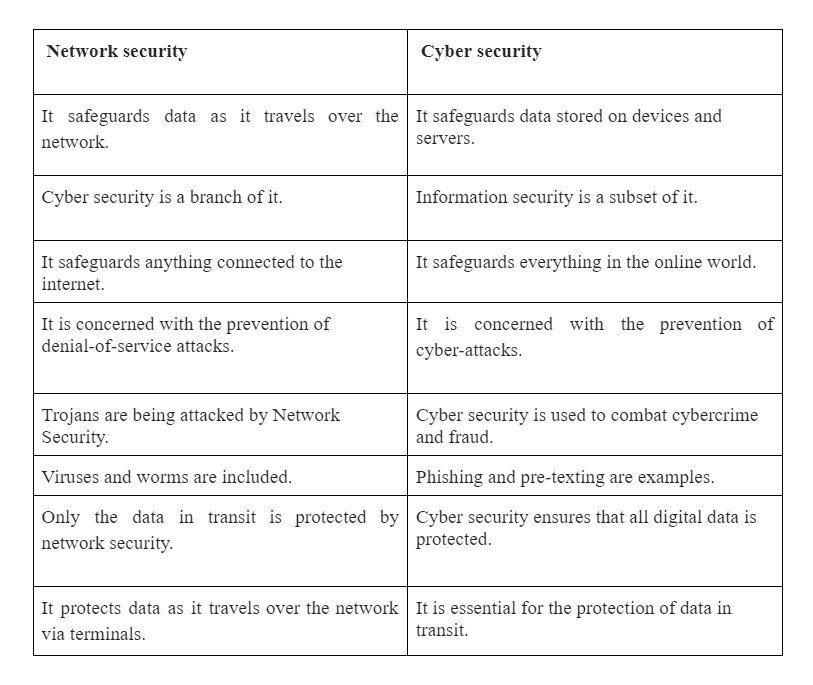
(Network Security vs Cyber security) Difference Between Both

1. Definition

Cyber security is a branch of information security that refers to a set of strategies and methodologies for preventing harm, attack, or illegal access to networks, devices, programs, and data. Cyber security, to put it simply, is the process of defending internet-connected devices and networks against digital threats. The process of safeguarding files and folders in a computer network from misuse, hacking, and illegal access to the system is known as network security. Network security is a subcategory of cyber security that guards against unwanted access to your system and network-accessible resources.

2. Security

While the phrases are interchangeable, they are vastly distinct in nature of security. If you see an organization as a walled castle, network issues are associated with keeping the peace within the castle walls and defending the organization’s sovereignty from network-related threats. Cyber security, on either hand, safeguards a company against external risks such as those posed by the internet. It defends an organization’s systems, networks, and applications against all types of digital attacks, such as phishing, baiting, and so on. The goal of network security is to secure an organization’s IT infrastructure from internet dangers such as viruses.

Wish to make a career in the world of Forescout Administrator ? Start with Forescout Administrator Training

3. Data

Network security becomes a component of cyber security, but cyber security is indeed a broad word like data security. While the authenticity of data and programs is the most important factor in both circumstances, cyber security emphasizes threat monitoring and detection to a higher extent. Network security is primarily concerned with protecting an organization’s IT network from the inside, while cyber security is concerned with protecting an organization’s information security technologies (ICT) against cybersecurity threats that exploit system weaknesses. Network security includes firewalls, user names and passwords, backup, and encryption.

If you have any doubts on Cyber Security, then get them clarified from Industry experts on our Cyber Security Tutorial !

Acquire Cyber Security certification by enrolling in the HKR Cyber Security Training in Banglore!

HKR Trainings Logo

Subscribe to our YouTube channel to get new updates..!

4. Security Expertise

Cyber security experts or analysts are those who, by their knowledge and experience of databases, firewalls, network security, and encryption, are fully responsible for defending network infrastructure and related systems. An expert in cyber security control, detection, and recovery is a cyber security professional. A security professional’s primary responsibility is to monitor all inbound and outbound traffic and to collaborate with other departments within the company to manage risk assessment tools and technology. A network security professional’s job includes securing the organization’s IT infrastructure, which contains data assets, financial data, and other confidential data

Network security and Cyber security

frequently asked Cyber security Interview questions and Answers !!

Cyber Security Training

Weekday / Weekend Batches

Conclusion

In brief, cyber security is an important part of information security dealing with data security during retention and transmission, while network security is indeed a subdivision of cyber security concerned with securing an organization’s IT infrastructure and limiting access to it. Both phrases are frequently used interchangeably, with the exception that cyber security is a much larger term, whereas network security is one component of information/cyber security.

Related Articles

  1. Cyber Security VS Data Science
  2. Cyber security Technologies


Source link