A little girl sat in an office chair with her knees folded beneath her in a small courtroom of the Fort Snelling Immigration Court. She wore a sparkling purple dress with a matching bow, and rested her elbows on the table across the room from a federal government attorney arguing for her family’s deportation. She listened quietly as an immigration judge set a date to consider her family’s asylum claim and then told her family, “Thank you very much, you’re free to go.” That is, until her family’s next scheduled hearing on Sept. 2, which could decide whether they'll be allowed to stay in the country.
The girl’s family was the subject of just one of 118 hearings scheduled at the state’s immigration court on Wednesday. The majority of the cases involve immigrants presented with orders for removal by the U.S. Department of Homeland Security.
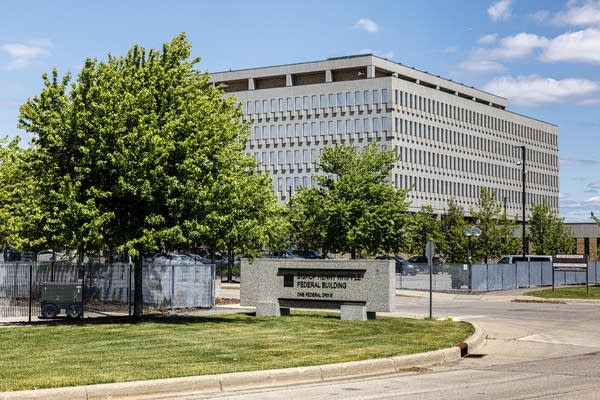
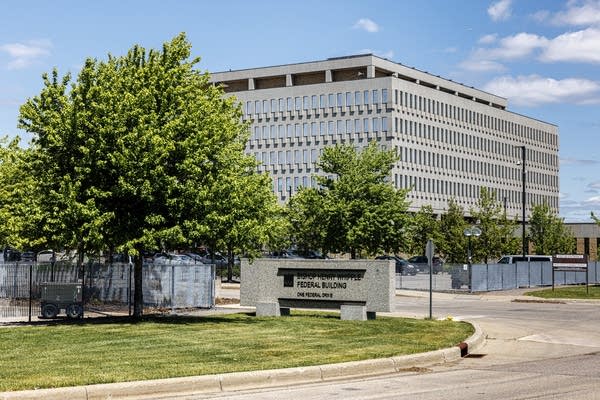
Immigration and Customs Enforcement may not be as present on Minnesota streets as it was this winter. But inside the Whipple Federal Building on most weekdays, the immigration court is quietly enacting President Donald Trump’s mass deportation efforts.
Amy Lange has been running the Immigration Court Observation Project at the Advocates for Human Rights since 2019. She and other court observers wait outside the building for it to open at 8 a.m. each weekday. They pass through security and make their way to the courthouse lobby, the only place where the day’s court hearings are posted.
Once there, the volunteers start scrawling down basic info for each hearing: Who is appearing, what country they’re from and any other biographical details they can glean from the coded schedule to help them follow along in court. Observers in each courtroom take notes as the rapid-fire hearings progress.
Courtroom doors used to always be open when observers arrived. But these days, Lange said, sometimes judges start hearings before observers can get into the courtroom. Some judges even require observers to sit in the front row.
“There's just a general mistrust and a general sense by several judges that they don't want to be under scrutiny,” Lange said.
Judges face higher workloads as administration pushes deportation goals
Immigration courts are different from other court systems in the United States. Judges are employees of the federal government’s executive branch, and the Trump administration has fired more than 100 judges, almost 15 percent of the total, since he retook the office.
According to NPR News, the Trump administration has said judges under the Biden administration were too lenient with granting asylum or other statuses to those seeking to stay in the U.S.
Advocates suspect these judges didn’t show enough deference to the administration’s immigration goals.
“We have a lot of empathy for the fact that they've really lost the role of neutral adjudicator,” Lange said of immigration judges. “It's a pretty horrible job right now, but the public has to be able to see what is happening — we are the people that they are serving.”
There is legislation in Congress right now to make immigration courts more independent of the executive branch, but it faces obstacles to pass both houses of Congress.
Advocates say immigration judges, including those in Minnesota, are being saddled with higher workloads and that immigrants seeking asylum are facing bigger obstacles as the executive branch, which controls the immigration court system, seeks to meet their stated goals of deporting a million people a year and attempting to address the backlog of more than 3 million cases in the country’s immigration courts.
Around the country, advocates are reporting that the federal government has been engaging in what attorneys call “mega masters” hearings. That’s defined loosely as a hearing where more than 100 people are called in the same time slot.
Vanessa Dojaquez-Torres, of the American Immigration Lawyers Association (AILA), said the packed dockets can make it more challenging for immigrants to challenge their deportations. If, for instance, someone misses a proceeding because they didn’t receive the mail notification, a judge can automatically order them removed, expediting the process and helping the government more quickly meet its goal of removal. It can also be challenging to find an attorney under the shorter timelines judges are often setting.
“Many people are in removal proceedings that will decide their whole lives. It will decide whether they're deported to a country that might not be safe for them. It will decide whether they are allowed to stay in the United States with family,” Dojaquez-Torres said. “The stakes are very high.”
The high caseloads in immigration courts brings with it more possibility for errors and less due process for immigrants, Dojaquez-Torres said.
Many of those in immigration court have been put into removal proceedings from the Department of Homeland Security. The courts exist for people to explore their options for relief, Dojaquez-Torres said, often through asylum claims, although people can also apply for green cards or petition to cancel the removal if they meet certain requirements.
‘Deck is stacked against our clients’
Under the current Trump administration, rules have been tightened that make it more challenging for immigrants to be granted their asylum cases. At the Minnesota immigration court, federal data compiled by the Transactional Records Access Clearinghouse shows that just about 2 percent of asylum cases have been granted so far this year, whereas the rate for 2023 was about 13 percent.
Brian Aust has worked as an immigration attorney for the last quarter century. He said he’s been alarmed by how difficult it can be to win cases that seemed like sure bets just a few years ago.
“It feels like the deck is stacked against our clients who are seeking relief in the immigration courts,” Aust said. “Let's be honest, the immigration court is now advertising itself as an instrument in what I not so affectionately refer to as ‘the deportation machine.’”
The Trump administration has regularly used its rulemaking abilities to issue decisions that can complicate asylum claims. Even when courts have pushed back on administration policies after long legal battles, the administration has quickly released new decisions that immigrants and their attorneys then have to adapt to.
“Attorneys, I think, are creatures of routine and predictability,” Aust said. “Things are just constantly changing and shifting and moving, and as far as policies and guidance and whatnot, we just don't know whether we're coming or going on some days.”
Free legal help available, but immigrants aren’t entitled to legal representation
On Wednesday, Judge Sarah Mazzie at Fort Snelling Immigration Court quickly moved through her morning hearings, correcting home addresses and informing immigrants from mostly Spanish-speaking countries like Ecuador and Mexico of their legal options. People had come from as far away as New Jersey to attend the hearings, most of which lasted just a handful of minutes.
Like other judges in the court, Mazzie gives people a list of possible free legal services. But some judges also warn people in their courts that the attorneys on that list are swamped, and that they’ll likely need to hire outside representation.
The country’s immigration court system also differs from criminal courts because people aren’t entitled to legal representation. Data from recent years shows that people who are able to obtain legal counsel are successful in immigration court almost three times as often as those who represent themselves.
A French citizen named Ching who asked to be identified only by his first name to avoid endangering his immigration case, said he’s built a life for himself in St. Paul since 2017, but discovered that his legal status was under threat after a divorce.
Like many people in court, he balked at the cost of a private lawyer, which can reach about $10,000. He is planning to take his chances representing himself, despite the odds. His hearing is set for the end of October.