Top 40 Frequently Asked Jmeter Interview Questions [Updated]


JMeter is a tool developed for testing. It is an Open Source Performance Testing Framework. Numerous IT organizations are utilizing JMeter as their business arrangement. In the IT industry all around the globe the development of this tool is coming up fast and according to the latest review, JMeter has a net worth of $180 million however it is most likely to develop to more than $5 billion by the end of 2020. As the testing business develops the need for prepared experts in the field of testing will also develop. These testers need to develop a skill set that can help them become the best brains of their field. This involves learning about various testing techniques and the testing toools.

So on the off chance that you need to construct a sizzling career in the IT industry, at that point, JMeter Developer is a magnificent alternative.

When you will go on to discover job vacancies related to JMeter, you will see that you are required to appear for an interview. Here in this blog, we have decoded some of the most popular JMeter Interview Questions. This blog will give you the list for both JMeter Interview Questions for Freshers as well as the JMeter Interview Questions for Experienced Professionals.

Most Frequently Asked JMeter Interview Questions

What is the way to oversee sessions & treats in JMeter environment?

Ans: Sessions and treats can be supervised in JMeter by utilizing design segments, similar to, HTTP Cache Manager gives a final offer to clear the treats in every essentialness and also grant to incorporate customer determined treats. 

HTTP Cache manager offers you the chance to clear hold after each cycle as essential in the load tests and forestall the number of segments which can be taken care of in the store.

Get ahead in your career by learning  JMeter Course through hkrtrainings JMeter Certification Training


What is the role of a Timer and are the different kinds of timer.

Ans: The testers in a JMeter environment use the timers to get a postponement between requests. Some of the Timers used are the Constant Timer, Gaussian self-assertive Timer, Synchronizing Timer, Uniform Random Timer, and so on.

What do you mean by Plan a Test?

Ans: There are sure components that are valuable in a presentation test. Test Plan is only a coherent parcel that contains each one of those test components. Some regular models are Assertions, string bunches just as samplers.

Name the kinds of protocols that can be worked upon in JMeter.

Ans: For testing web applications, JMeter utilizes Web conventions, for example, https just as HTTP. With regards to testing the administration applications, both Rest and SOAP are upheld by JMeter. What’s more, it underpins fttp and JDBC for investigating the uses of the database. Another regular convention that JMeter handles is the Lightweight Directory Access Protocol (LDAP). Additionally, the conventions for testing the mail servers, for example, IMAP and SMTP are good with JMeter.

What are your views of JMeter when compared with other tools?

Ans: The best thing is its GUI, which is straightforward and automatic compared to different apparatuses. It doesn’t make a difference in which stage you use on PCs. Like other devices, it doesn’t confront any similarity issues. Likewise, it’s an unreservedly accessible device because of its open-source nature. JMeter has a remarkable element in it that many different apparatuses require. For example, it may be used effectively for robotized testing of the applications. The extensible nature makes it just the best as contrasted with others. What’s more, it licenses a simultaneous examination without any problem. All the test plans can be set up in XML design in JMeter.

What do you gather when we say the configuration element?

Ans: Configurable Element permits you to make defaults and factors to be utilized by Samplers. It tends to be utilized to include or adjust demands made by the Samplers. It will get executed toward the start of the degree before any Samplers present in a similar range. Hence, we can say that entrance to an arrangement component is just permitted from inside the branch where it is available.

Can you list down the highlights of Configuration elements?

Ans: Some of the amazing highlights of Configuration Elements are-

1. CSV Data Set Config: It bolsters perusing line by line from a record and parting the line into factors. 

2. HTTP Authorization Manager: You can indicate at least one client logins for site pages that are confined utilizing server validation. 

3. Java Request Defaults: Using this you can set default esteems for Java testing. 

4. HTTP Cookie Manager: The Cookie Manager component has two capacities: 

I. It stores and sends treats simply like an internet browser. 

ii. Second, you can physically add a treat to the Cookie Manager. Be that as it may, if you do this, the treat will be shared by all JMeter strings. 

5. HTTP Request Defaults: It lets you set default esteems to be utilized by your HTTP Request controllers. 

6. HTTP Header Manager: It empowers you to include or abrogate the HTTP demand headers.

What are the JMeter Assertions? Are there any types of Assertion?

Ans: In Apache JMeter, an Assertion can be utilized to approve the reaction of the solicitation that you have sent to the server. The assertion is where you check anticipated outcomes with the genuine aftereffect of the solicitation at run time. If you have to apply a statement on a specific Sampler, at that point include it as an offspring of that Sampler.

Yes, there are different kinds of Assertions in JMeter and the ones that are often used are

JMeter Assertions

Shed some light on Spike Testing and the way it can be done in JMeter.

Ans: Suddenly expanding the number of clients at one point of use and afterward checking its conduct at that interim is Spike trying. 

In JMeter, Spike testing can be performed utilizing Synchronizing Timer. This clock continues obstructing the strings until a specific number of strings get saved. It at that point discharges them without a moment’s delay along these lines making huge prompt burden.

If you want to Explore more about JMeter? then read our updated article – JMeter Tutorial

. How does the concept of Concurrent user hit work in JMeter?

Ans: A simultaneous tester hit is a point at which an exceptionally enormous number of clients conflict for a comparative occasion of the application under lost test all the while. It is because this simultaneousness point is viewed as which makes the virtual clients hold up until others are as of now running the contents.

Jmeter Training

  • Master Your Craft
  • Lifetime LMS & Faculty Access
  • 24/7 online expert support
  • Real-world & Project Based Learning

. Explain why you should apply for a Regular Expression Extractor.

Ans: In JMeter, the tester can use the Standard Expression to isolate a couple of characteristics capably from the responses to use it to review the subsequent or second reinforcement purposes. Common Expression is used in both Preprocessors and Post-Processors.

. What is the maximum number of strings you can use in a string gathering?

Ans: It depends upon the orchestrated execution of your structure, including a processor, JVM, chosen memory and so forth. Contrastingly conflicting, which influences this is the number of segments in your test plan, for example, the number of designed parts or processors, and it also depends upon whether you are using GUI/Non-GUI Mode.

. Describe the concept of Beanshell Scripting.

Ans: BeanShell is a light Java scripting that the testers utilize in JMeter to pan out some basic tasks. BeanShell samplers can perform different assignments with the help of some light coding. You can print out the string number, get the execution of the current sampler done, bring the treats and so forth.

. Explain the concept of the CA declaration.

Ans: When you are working on HTTPS affiliation requires support to affirm the affiliations which get set up when the program hits the web server. JMeter produces it unexpectedly to get the SSL traffic to record the exercises. You need this support in your compact to record the exercises.

. Explain the order in which the execution order of the test plan elements is conducted in JMeter.

Ans: Here is the hierarchy of execution order related to JMeter test plan elements,
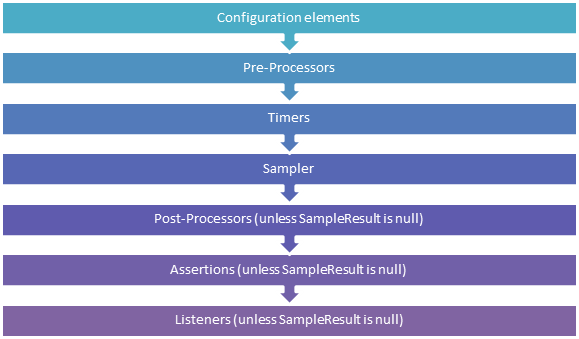
JMeter test plan

. What does it mean to ensure reliability in JMeter?

Ans: If you want to create different process workflows in JMeter, you will need to create reusable test scripts and you can do that with the test fragment element of JMeter as it acts like a library of reusable scripts.

. What is the way to capture the script of an Authentication Window in JMeter environment?

Ans: The tester can easily capture the windows  script in JMeter by making a record by executing the following

  • First you need to Threadgroup in Test Plan and afterward make HTTPProxyServer in Workbench
  • Next, set the port number in the Global Setting box and adjust your association setting in IE as the local host address.
  • Then you can begin http intermediary server in JMeter and run your application for login.

 Explore JMeter Sample Resumes! Download & Edit, Get Noticed by Top Employers!

. Distinguish between Apache JMeter and LoadRunner.

Ans:

Apache JMeter and LoadRunner

. What exactly do you know about a Workbench in Jmeter?

Ans: Commonly while taking care of the undertakings in JMeter, the requirement for putting away the test components is felt. Workbench stores them all on an impermanent premise. Notwithstanding the testing components, there are sure non-test components that are additionally present in it. There is a program in this device that helps in arranging these components essentially. Keeping anything on the Workbench doesn’t mean it is put away in the memory forever.

. Explain the Ramp-up period?

Ans: With regards to testing the stacking of an application, just a couple of clients are viewed as then for adequately examining the conduct of the application. This likewise infers a great deal of helpful data to know the general execution of the application. It takes some time in making all the clients in the running state. This timeframe is, for the most part, called the Ramp uptime. It is unique concerning various applications relying upon the general number of clients.

HKR Trainings Logo

Subscribe to our YouTube channel to get new updates..!

. Discuss the essential components in a Thread Group of JMeter.

Ans: There are five main parts of a thread group in JMeter and they are as follows-

Controller: which controls the whole progression of string gathering 

Assertion: This is liable for a time the board. Fundamentally, it checks whether the reaction is there inside the predetermined time or not. 

Sampler: Its assignment is to send various solicitations to the server 

Configuration elements: It oversees data identified with the solicitations that are to be coordinated with samplers 

Listeners: Its errand is to spare the ultimate result of the run.

. What are the benefits of using JMeter?

Ans: It is truly dependable and informed that consistently ensures mistake-free outcomes. Its similarity with all the applications makes it best in playing out its assignment. JMeter is an open-source device and along these lines, clients need not stress over the expense. Learning and utilizing this instrument isn’t at all a serious deal. Likewise, customization of the JMeter apparatus to fit the specific needs isn’t at all a serious deal. There are a few instructional exercises and online networks to assist that with canning help to dispose of any issue that announces its essence during the procedure.

. Explain what Apache JMeter is.

Ans: JMeter is one of the Java instruments which are utilized to perform load testing customer/server applications. Apache JMeter is open source programming, a 100% pure Java work area application intended to load test functional conduct and assess the execution of the application.

. What is the reason for which one should utilize JMeter?

Ans: It tends to be utilized to dissect the complete server execution under substantial load. JMeter can be utilized to test the presence of both static assets, for example, JavaScript and HTML, just as unique assets, for example, JSP, Servlets, and AJAX. JMeter gives an assortment of graphical examinations of performance-related reports.

. Name some of the primary elements of the JMeter tool.

Ans:

Test Plan:

A test plan is the top-level assortment of JMeter, it is responsible for clarifying grouping of steps executes at run time. The last test plan made up of at least one Thread Groups, Sampler, rationale controllers, audience members, clocks, attestations, and setup components. Every Sampler can be gone before by at least one Pre-processor component, trailed by the Post-processor component, as well as the Assertion component. It gets stored in the Java Management Extensions (JMX) group.

Test Fragments:

This particular element called the Test Fragments is an alternate kind of component situated at a similar level as the Thread Group component. It is prominent from a Thread Group in that it isn’t performed except if it is referenced by either a Module Controller or an Include_Controller. This component is ethically for code re-use inside the Test Plans.

Listeners:

In JMeter listeners encourage watchers to see Samplers bring about the type of tables, diagrams, trees or straightforward content in some log documents and give pictorial access to the information gathered by JMeter about those experiments as a Sampler part of JMeter is executed. Listeners offer a way to gather, spare, and view the consequences of a test plan and store results in XML design, or an increasingly productive (yet less definite) CSV position. Their yield can likewise be seen legitimately inside the JMeter reassure.

Timers:

If you want to execute load/stress testing on a given software, you are utilizing strings, controllers and samplers then JMeter will simply shoot your application with relentless solicitations. This isn’t a genuine condition or normal for genuine traffic. JMeter string sends demand ceaselessly between every sampler. This not actually what you need. We can include a timer component that will allow us to characterize a period to hold up between each solicitation.

Configuration Elements:

Configuration Element refers to the basic components where you can gather the corporate setup estimations of all samplers like web server’s hostname or database URL and so forth.

. Do listeners have a type? If yes then what are the types of listeners that are available in JMeter?

Ans: Yes, there are various kinds of listeners that are accessible to a tester in JMeter. They are-

  • Aggregate Graph
  • Aggregate Report
  • Assertion Results
  • Backend Listener
  • BeanShell Listener
  • BSF Listener
  • Comparison Assertion Visualizer
  • Generate Summary Results
  • Graph Results
  • JSR223 Listener
  • Mailer Visualizer
  • Monitor Results
  • Response Time Graph
  • Saves Responses to a file
  • Simple Data Writer
  • Summary Report
  • View Results in Table
  • View Results Tree

. What do you mean by Thread Groups and Samplers?

Ans: A JMeter thread group is an underlying phase of the test plan. The name Thread Groups refers to a gathering of Threads. Under this gathering, each string mimics one genuine client solicitation to the server.

In JMeter, the testers are presented with 2 kinds of controllers: Samplers and Logical Controllers. Therefore, Sampler is a kind of controller in JMeter.

In JMeter, the Samplers encourage JMeter’s architecture to convey unequivocal sorts of solicitations to the server. It recreates a client’s solicitation for a page from the objective server. So, to profit, POST, GET, and DELETE work on an HTTP administration, the client can include an HTTP Request sampler. Aside from the HTTP Request sampler, there are even other kinds of samplers.

. What are Logical controllers?

Ans: This element of JMeter called the Logic Controllers chooses the request for preparing Samplers in a Thread. It offers a system to control the progression of the string gathering. Rationale Controllers encourage redo the rationale that JMeter uses to determine when to send demands. Rationale Controllers can modify the request for demands originating from their child components.

. Discuss the Pre-Processing Elements of Apache JMeter.

Ans: A Preprocessor in JMeter is something that will occur before a sampler executes a request. They are regularly used to adjust the settings of a Sample Request not long before it runs.

. Discuss the Post-Processing Element of Apache JMeter.

Ans: As the name suggests, the post-processors occur after a sampler has executed a request in the JMeter test script.

Jmeter Training

Weekday / Weekend Batches

. Highlight some of the great features of Apache JMeter.

Ans: JMeter is loaded with amazing features such as Scalability, mobility, etc are just some of these many features. It is Java-based methodology and along these lines, it underpins all applications dependent on the equivalent. It is workable for the clients to have an ultimate result in graphical or in unthinkable structure. Test contents can be made quickly and this is a result of playback highlighting that JMeter is outfitted with. Likewise, a client needs not to stress over the conventions that can be tried through this instrument.

. How does the Apache JMeter work?

Ans: JMeter mimics various clients sending solicitation to the Application Under Test. When JMeter mimics demands, the server reacts and Jmeter begins gathering information. Jmeter spares all the reactions and dependent on the server reaction it brings measurements back. These insights show the execution of the AUT as different organizations according to the prerequisites.

Therefore, with the assistance of JMeter, we can reproduce load on server, system or items which are originating from various machines to execute true situations.

. What is it that you gather by the words- configuration elements?

Ans: Altering the requests that frequently originate from samplers is a significant undertaking in JMeter. The equivalent is performed with the assistance of setup components. They can likewise be utilized with regards to incorporating the sampler demands with the information got from the CSV document.

. How is the number of threads in a Thread Group configured?

Ans: The “Number of Threads (users)” parameter in the Thread Group enables us to specify the desired number of threads. This establishes the number of virtual users that will be simulated during the test.

. What is Loop Count in a Thread Group?

Ans: Describe the significance of a Thread Group’s Loop Count.

The number of times each thread within the Thread Group will run the test plan is determined by the Loop Count. For instance, if the loop count is set to 5, the test plan will be repeated 5 times before being finished by each thread.

. How can a Thread Group be configured to stimulate various user behaviors?

Ans: To simulate various user behaviors, the Thread Group can use one of the controllers offered by JMeter, like the Random Controller or Throughput Controller. You can alter the requests made by virtual users by putting various samplers under these controls.

. What role does a Thread Group’s Scheduler checkbox play?

Ans: You can choose the test’s duration by enabling the Scheduler checkbox. The Start Time, End Time, and Duration options allow you to choose how long the test should run when the Scheduler is turned on.

. What is the Purpose of the Stepping Thread Group?

Ans: You can arrange a steady ramp-up of threads using the Stepping Thread Group plugin for JMeter. It is beneficial to gradually increase the server’s load because this makes it easier to spot performance bottlenecks.

. In a Thread Group, how do you set a particular delay between thread iterations?

Ans: To set a delay between each thread’s iterations, use the Constant Timer or the Uniform Random Timer in the Thread Group. These timers add a pause between each request that a thread makes in succession.

. Why should action be taken in the event of a Thread Group Sampler error?

Ans: The behavior of JMeter when a sampler (for example, an HTTP request) runs into an error is controlled by the “Action to be taken after a Sampler error” option in the Thread Group. After encountering an error, you have the option of either continuing the tesr or stop it completely.

nclusion:

This is it! This is pretty much what you can expect at your interview. You can expect many of these questions in your interview related to JMeter.

Go through this guide thoroughly, if you have any doubts, feel free to get back to us. Happy Reading and All the best!

About Author

author-image

As a Senior Writer for HKR Trainings, Sai Manikanth has a great understanding of today’s data-driven environment, which includes key aspects such as Business Intelligence and data management. He manages the task of creating great content in the areas of Digital Marketing, Content Management, Project Management & Methodologies, Product Lifecycle Management Tools. Connect with him on LinkedIn and Twitter.

Upcoming Jmeter Training Online classes

Batch starts on
27th Jun 2026
Mon – Fri (18 Days)
Weekend
Timings – 10:30 AM IST
Batch starts on
1st Jul 2026
Mon & Tue (5 Days)
Weekday
Timings – 08:30 AM IST
Batch starts on
5th Jul 2026
Mon – Fri (18 Days)
Weekend
Timings – 10:30 AM IST


Source link

Leave a Reply

Subscribe to Our Newsletter

Get our latest articles delivered straight to your inbox. No spam, we promise.

Recent Reviews


The Internet of Things (IoT) is a network of physical objects or individuals referred to as “things” that are equipped with software, electronics, networks, and sensors to capture and share data. The aim of the Internet of Things is to expand internet access from mainstream devices such as laptops, phones, and tablets to relatively basic devices such as toasters.

In this article, you can go through the set of IoT interview questions most frequently asked in the interview panel. This will help you crack the interview as the topmost industry experts curate these at HKR training.

Most Frequently Asked IOT Interview Questions

Let us have a quick review of the IoT interview questions.

IoT Basic Interview Questions

What are the fundamental components of IoT?

Ans: The four fundamental components of an IoT system are:

  • Sensors/Devices: Sensors or devices are essential components for gathering real-time data from the environment. Almost all of this information may be complicated in any manner. It may be a basic temperature control sensor or a video feed.
  • Connectivity: The information gathered is submitted to a cloud infrastructure. The sensors should be linked to the cloud through a variety of communication channels. Mobile or satellite networks, Bluetooth, WI-FI, WAN, and other networking systems are examples of these mediums.
  • Data Processing: Once the data is collected and transferred to the cloud, the software product processes the information. This method can be as easy as testing the temperature or readings from equipment such as air conditioners or heaters. However, it can also be incredibly challenging, such as detecting objects using computer vision on video.
  • User Interface: The data must be open to the end-user in any manner, which can be done by setting off alarms on their phones or giving them updates by email or text message. The consumer can sometimes need an app that actively controls their IoT device.

What is Pulse Width Modulation?

Ans. PWM refers to Pulse Width Modulation and is an analog signal that differs when the signal stays high. The user can alter the time proportion as the signal can be high or low.

What are the challenges of IoT?

Ans: Important challenges of IoT are:

  • Insufficient testing and updating.
  • Concern regarding data security and privacy.
  • Software complexity.
  • Data volumes and interpretation.
  • Integration with AI and automation.
  • Devices require a constant power supply which is difficult.
  • Interaction and short-range communication.

What are mostly used IoT protocols?

Ans: The mostly used IoT protocols are:

  • XMPP.
  • AMQP.
  • Very Simple Control Protocol (VSCP).
  • Data Distribution Service (DDS).
  • MQTT protocol.
  • WiFi.
  • Simple Text Oriented Messaging Protocol(STOMP).
  • Zigbee.

What is WSN?

Ans: WSN stands for Wireless Sensor Network in its full form. It’s a network of notes generated to map and analyze the application’s physical parameters.

Become a master of IoT by going through this HKR IOT Online Training !

What is Zigbee?

Ans. Zigbee is similar to Bluetooth, used within a complex system for low power function, high security, and robustness.

What is Z-Wave?

Ans: Z-Wave is an Internet of Things (IoT) application that utilizes low-power RF communication. It’s built for things like lamp controllers and controls that are used in home automation.

What is MQTT?

Ans: MQTT stands for Message Queue Telemetry Transport Protocol in its full form. It’s a communications protocol for monitoring devices in the Internet of Things.

What are the various types of antennas designed for IoT devices?

Ans: Various types of antennas designed for IoT devices are:

  • Chip Antenna.
  • PCB Antenna.
  • Wire Antenna.
  • Proprietary Antenna.
  • Whip Antenna.

. What are the types of IoT?

Ans: The following are the different types of IoT:

1) Commercial IoT – This IoT system is mainly used in the industries like transport, healthcare, etc. 

2) Military Things (IoMT) – These types of IoT applications are mostly used in the military area, such as surveillance bots, etc.

3) Consumer IoT – This type of IoT is generally used in everyday work, such as home appliances, light fixtures, etc.

4) Infrastructure IoT – This IoT system helps establish connectivity in smart cities, such as sensor management. 

5) Industrial IoT – It mainly helps in industrial fields such as manufacturing, energy, smart agriculture, etc.

. What is Asset Tracking?

Ans: The method of keeping track of physical properties and information is referred to as asset tracking or asset management.

. What is the basic difference between the IoT network and Wireless Sensor Network?

Ans: Things attached to the wireless network and collecting data or tracking the environment are part of the Wireless Sensor Network. The Internet of Things (IoT) is made up of.

  • WSN.
  • Internet.
  • Cloud Storage.
  • Web or mobile application.

. What is Shodan?

Ans: Shodan is an IoT monitoring application that will help you find out which of your computers are online. It helps you to keep track of all of the machines that have direct Internet connectivity.

. Define Arduino.

Ans: Arduino is a free electronics application that contains both hardware and software that is simple to use. It has a microcontroller that can read sensor data and programmatically control the motors.

. What are IoT test approaches?

Ans: IoT test approaches are: 

1) Usability.

2) IoT Security.

3) Connectivity.

4) Performance.

5) Compatibility Testing.

6) Pilot Testing .

7) Regulatory Testing, and 

8) Upgrade testing.

. What Python libraries used in Raspberry Pi to control GPIO pins?

Ans: RPi.GPIO is the python libraries used in Raspberry Pi to control GPIO pins.

IoT Training

  • Master Your Craft
  • Lifetime LMS & Faculty Access
  • 24/7 online expert support
  • Real-world & Project Based Learning

. What is PWM?

Ans: Pulse Width Modulation (PWM) is an acronym for pulse width modulation. In an analog way, pulse width modulation helps one to adjust the length of time the signal is high. We can adjust the proportion of time the signal is high relative to when it is low over a constant time interval, even if the signal can either be high (usually 5V) or low (ground) at any given time.

IoT Intermediate Interview Questions

. What is the basic difference between the IoT network and Wireless Sensor Network?

Ans: Items attached to the wireless network and collecting data or tracking the environment are part of the Wireless Sensor Network. The Internet of Things (IoT) is made up of:

  • WSN.
  • Internet.
  • Cloud Storage.
  • web or mobile application.

. Explain the types of testing in IoT?

Ans: The following are a list of IoT testing types:

  • Usability Testing: Users use a wide variety of devices of varying shapes and forms. Also, one user’s experience differs from another’s. As a consequence, in IoT testing, it’s vital to determine the system’s usability.
  • Compatibility Testing: The Internet of Things (IoT) framework will connect a wide variety of devices. The software and hardware specifications of these tools differ. As a consequence, the number of potential combinations is immense. As a consequence, it’s crucial to verify the IoT system’s compatibility.
  • Reliability and Scalability Testing: Building an IoT test system that includes a simulation of sensors using virtualization software and technology requires reliability and scalability.
  • Data Integrity Testing: Since IoT research necessitates a vast volume of data and its implementation, it’s essential to verify data integrity.
  • Security testing: Many users of the IoT community have access to a vast volume of data. As a result, it is essential to authenticate users and enforce data privacy controls as part of security testing.
  • Performance Testing: Performance testing is crucial for developing and implementing a strategic approach to IoT testing.

. Mention suitable databases for IoT.

Ans: Suitable databases for IoT are:

  • influx DB.
  • Apache Cassandra.
  • RethinkDB.
  • MongoDB.
  • Sqlite.

. What is the importance of the Internet of Everything?

Ans: Internet of Everything is important because:

  • People, processes, things, and data are all pulled together to make network links meaningful and vital.
  • It turns data into practices, allowing companies to build new skills and opportunities.

Related Article: Future Scope of IoT

. Define IoT Contiki

Ans: Internet of Things (IoT) Contiki is a software program developed especially for small Internet-connected devices. It is used in accordance with process power bandwidth, power, and memory constraints. Contiki assists in program management, resource management, process management, communication, and memory management.

. What is the default operating system of Raspberry Pi, May I use any other operating systems?

Ans: Yeah, we can use Windows and any Linux operating system built for Arm-based devices, but Raspbian is the Raspberry Pi’s default operating system.

. How to run Raspberry pi in headless mode?

Ans: SSH can be used to run the Raspberry Pi in headless mode. The most recent operating system has an inbuilt VNC server, which can be used to take a remote desktop on the Raspberry Pi.

. What are the popular software IDEs are using in IoT?

Ans: Each prototype system family has its production IDE, such as the Arduino IDE, Keil IDE, GCC compilers, and so on

What popular hardware prototypes are used in IOT?

Ans: The following hardware prototypes are used within IoT: Raspberry Pi, Arduino, and ARM Cortex Family.

. What are the available models in Raspberry Pi?

Ans:  The modes in Raspberry are as follows:

  • Raspberry Pi 1 model B.
  • Raspberry Pi 1 model A.
  • Raspberry Pi 1 model B+.
  • Raspberry Pi 1model A+.
  • Raspberry Pi Zero.
  • Raspberry Pi 2.
  • Raspberry Pi 3 model B.
  • Raspberry Pi Zero W.

. What is Bluetooth Low Energy (BLE) Protocol for an Internet of Things (IoT)?

Ans: Nokia first implemented this protocol in 2006 as wibree. Because of the unique Bluetooth, this protocol is also known as Bluetooth Smart. It provides the same spectrum coverage with a substantial reduction in intensity intake. It has a similar bandwidth to Zigbee, which uses the same narrow spacing. Low electricity latency and reduced complexity allow it more suited for use in low-cost microcontrollers.

. State the differences between Arduino and Raspberry pi.

Ans: The difference between Arduino and Raspberry pi is:

Arduino:

  • Arduino is an open, programmable USB microcontroller.
  • Raspberry pi is a credit card size computer.

Raspberry pi:

  • It can execute one program at a time.
  • Users can run more than one program at a time.

. What impacts will the Internet of Things (IoT) have on the Transportation Sector?

Ans: Transportation infrastructure is becoming more and more interconnected. New automobiles are equipped with features such as global positioning systems (GPS) and in-vehicle entertainment, and advanced driver assistance systems (adas), which use sensors inside the vehicle to assist the driver with tasks such as parking and emergency braking.

. What is the programming language supported by MongoDB?

Ans: The following are the list of programming languages supported by MongoDB.

  • Actionscript info.
  • C.
  • C#.
  • C++.
  • Clojure info.
  • ColdFusion info.
  • D info.
  • Dart info.
  • Delphi info.
  • Erlang.
  • Go info.
  • Groovy info.
  • Haskell.
  • Java.
  • JavaScript.
  • Lisp info.
  • Lua info.
  • MatLab info.
  • Perl.
  • PHP.
  • PowerShell info.
  • Prolog info.
  • Python.
  • R info.
  • Ruby.
  • Scala.
  • Smalltalk.

. What are the most used sensors types in IoT?

Ans: 

  • Temperature sensors.
  • Proximity sensor.
  • Pressure sensor.
  • Gas sensor.
  • Smoke sensor.
  • IR sensors.
  • Motion detection sensors.

. What are the hardware communication interfaces present in the Arduino board?

Ans: It has several communication protocols like I2C, SPI, Serial, PWM and etc.

. Can NodeMCU act as a web server?

Yeah, using the Arduino library ESP8266WebServer. This is an ESP8266 catalogue. For other NodeMCU boards, related libraries are also available.

IoT Advanced Interview Questions

. Explain how you insert bulk data in MongoDB, and can write the query for that?

Ans:

query:

var huge= db.iotCollection.initializeUnorderedBulkOp();

huge.insert({location:”India”, count:456,  polls:456});

huge.insert({location:”Russia:, count:567, polls:567});

huge.insert({location:”China”, count:789,  polls:789});

huge.insert({location:”USA”, count:123, polls:123});

huge.execute()

. What is Bluegiga APX4 protocol for an Internet of Things?

Ans: Due to their compliance with coexistence protocols, Bluegiga and wireless can be used together without interfering. The bluegiga apx4 is based on a 450mhz arm9 processor and supports both Bluetooth and Wi-Fi.

HKR Trainings Logo

Subscribe to our YouTube channel to get new updates..!

. What are the economic impacts of the increased application of IoT?

Ans: IoT has been seen to have a positive effect on multiple industries’ economic standards.IoTs can significantly decrease labor and energy costs by promoting effective resource utilization and reducing response time and human interventions. This, in essence, will help big companies improve their supply chains, making for lower-cost commodity delivery. This not only helps companies make more money, but it’s also a perfect way to boost the current production infrastructure. Overall, IoT scalability is excellent, and as a result, IoT implementations save money in the long run.

. How does IoT influence the development of smart cities?

Ans: IoT devices’ intuitive features, coupled with improved network interaction, allow IoT to facilitate infrastructure planning flexibility, transparency, and performance. The Internet of Things also enable energy-efficient initiatives to take off. Overall, because of the various benefits that IoT offers, the government should work to construct smart cities all over the world.

Intelligent energy grids, automated waste management systems, smart houses, enhanced protection systems, improved traffic control mechanisms, advanced security features, water-saving mechanisms, and many more are all possible with the Internet of Things. IoT has allowed public utilities and urban planning to be highly intuitive due to the two-pronged blessings of artificial intelligence and creativity. Smart homes and smart cities have resulted as a result of these innovations.

. What are the top five Machine-to-Machine (M2M) applications in the world?

Ans:

  1. The biggest seems to be asset tracking and monitoring in some form or another (stolen automobiles, fleets, construction systems, wood pellets, tank level tracking, and many others.).
  2. Insurance telematics is enormous because it allows insurance companies to reduce risk and force higher/more appealing pricing.
  3. Utilities/automatic meter reading/clever grids – In the intervening period, there has been a lot of regulation, and financial support put into this. Because the requirements and business case are driven in so many various ways, there are many countrywide solutions.
  4. Consumer demand drives the automotive industry, which is also very broad.
  5. mHealth is still present, although it is not as large as it should be.

. What is the difference between a wireless sensor network (WSN) and the Internet of Things(IoT) network?

Ans:

WSN: IoT packages are built based on the Wi-Fi sensor culture. WSN is a network of programmed motes to look at, analyze, or track physical parameters of utility.

e.g., Motes put in agricultural land track temperature, humidity, and likely soil moisture. They capture data, which is then analyzed to assess crop yields, consistency, and quantity.

IoT: The internet of things (IoT) is a network of physical objects that can be handled and tracked through the internet. Today, just as with winning, you’ll come across the monitoring of physical criteria in its implementation. However, the preferred consequences are a bit different. M2M is at the core of IoT; it’s far more than merely applying the information to everyday devices.

e.g., The system attached to your thermostat measures the ambient temperature and changes it to the most suitable environment for you.

. How might Internet Address (IPv6) affect the development and implementation of the Internet of Things?

Ans:

The technological boundaries of the most commonly adopted variant of the network protocol (IP) are barriers to IoT advancement. IP is a set of rules that computers use to transmit and retrieve data over the internet, and it requires a unique address that any connected device or object should be able to communicate with. Model four (ipv4) is probably the most commonly used. It has a potential of around four billion addresses and is approaching saturation, with few new addresses available in many areas.

Version 6 (ipv6) provides for a substantial rise in the number of IP addresses available. The maximum number of specific addresses permitted by IPv4 is 4.2 billion, which is inadequate to include even one address for each of the 7.3 billion people on the planet. According to an evaluation, IPv6 would support over 1038 addresses or more than a thousand billion trillion addresses per person.

. What impacts will the Internet of Things (IoT) have on the Health Care Sector?

Ans: The Internet of Things (IoT) has various uses in the healthcare sector, including fitness monitoring and treatment and telemedicine and telehealth. Lengthy health care and training is also offered by using a medical age and the internet. Medical devices, which may be wearable or non-wearable, implantable, injectable, or ingestible, can continuously track a patient’s vital signs, medical conditions, or other health and wellness indicators.

. What is IoT Thingworx?

Ans: Thingworx may be a platform for rapidly developing and launching sensible, connected devices. Its advanced IoT development tools assist with property, analysis, production, and other facets of the IoT development process.

. What are the dangers and difficulties that we ought to know about with regards to the Internet of Everything?

Ans: The dangers and difficulties that everybody ought to know about with regards to the Internet of Everything are:

  • Security.
  • System blockage.
  • Power utilization at the pinnacles.

. What is the application of IoT in Law enforcement?

Ans: The Internet of Things enhances law enforcement and surveillance, as well as the legal system. The technology increases transparency, distributes relevant information, and prevents unwanted human interference.

Remote monitoring, logged footage of violations and electronic ticketing can also help make effective solutions to issues by using technologies in the workplace. For example, you can replace the light in-person reviews of suspicious activities with remote observation, logged footage of violations, and electronic ticketing. It also eliminates misconduct by eliminating human management and opinion in the case of a few breaches.

. What is IoT GE-PREDIX?

Ans: GE (General Electric) Predix could be a software system platform for information assortment from industrial instruments. It offers a cloud-based PaaS (platform as a service) that enables industrial-grade analytics for optimising operations and controlling performance. It uses a prevalent method to link data, individuals, and instrumentation.

. Should the customers be worried about security and protection issues considering the measure of information Internet of Things (IoT) gathers?

Ans: Many people are worried about the possibility of sensitive information falling into the wrong hands due to the various measurements of data collected by smart home gadgets, wearable devices, and wearables. The increased number of passages often poses a security danger.

The Federal Trade Commission has expressed its worries and advised companies to play it safe to protect their consumers. On the other hand, the FTC lacks the experience to approve IoT device guidance, so it’s unknown how many companies can take its recommendations seriously.

For example, Apple demands that businesses producing products for its HomeKit platform provide end-to-end encryption, authentication, and security. The organization also stated that it does not obtain any customer information relevant to HomeKit embellishments.

. What might be the effect of the Internet of Things hands on market, do you see any conceivable activity cuts?

Ans: To be especially obtuse about this, we will be faced with work cuts under which machines will take care of a portion of the positions that require continuity and precision. On the plus side, people can learn new skills to command machines and build their own space. This has become the rule of nature; we have everything to help us lose weight, and then we have another problem to deal with in a few months or days. As a consequence, I see this as an ideological approach to coping with our daily problems.

. What are the distinctive parts where the Internet of Things can really enhance the present procedures?

Ans: Any handle where profitability, precision, or process enhancement are needed can be linked to the Internet of Things process.With the aid of creativity and cutting-edge technologies, this can be done for a fraction of the actual working rate.

Network of items may be related or have already begun adding their advantages to the corresponding grades, which we can likely see more of in the future:

  1. Agriculture.
  2. Manufacturing.
  3. Healthcare.
  4. Energy.
  5. Transportation.
  6. Security.
  7. Data improvement.

. What impacts will the Internet of Things (IoT) have on the Energy Sector?

Ans: IoT may affect all facets of production and delivery, for example, by making oil wellheads and pipelines easier to track. As IoT modules are incorporated into electrical grid components, the resulting infrastructure is called the “smart grid.”This implementation of IoT helps utilities help control the flow of electricity and increase grid operations’ potency.

. What impacts will the Internet of Things (IoT) have on the Agriculture Sector?

Ans: The agricultural industry should take advantage of the Internet of Things through precision agriculture to increase productivity and potency while decreasing costs and reducing environmental effects. For farming operations, it requires a comprehensive review of extensive, usually time-based details on temperature, soil and air quality, installation, pest populations, crop maturity, and other factors such as machinery and labor costs and availability. Field sensors track soil moisture and beam balance, and they may use them in combination with position technology to fine-tune irrigation and fertilization.

. What is meant by

Ans. “Thingful” is a search engine for the Internet of Things that uses millions of public IoT data resources. It also enables secure interoperability among the different IoT objects through the internet. It uses these resources to provide a geographical index of real-time data from linked devices across the globe. Using it, the managers of IoT can quickly locate and analyze the patterns, anomalies, and trends to resolve various issues.

. What is meant by GPIO?

Ans. GPIO refers to General Purpose Input/Output and is a helpful programmable pin. It helps to control the input or output signals programmatically. Moreover, GPIO is a common interface to link other electronic devices or systems with the microcontrollers.

. Define the Network’s importance in IoT?

Ans. The network is essential to IoT and offers an intelligent system that builds the most robust infrastructure. Also, it provides higher scalability to connect and coordinate devices with other channels through the internet.

IoT Training

Weekday / Weekend Batches

. What is meant by the Internet of Things Gateway?

Ans. IoT Gateways can connect with different IoT devices, equipment, and sensors to the cloud-based platform along with data processing. The gateway is a central hub for different IoT devices and connects them to the cloud. In this way, it converts the communication of the devices and helps in data analysis to create valuable insights.

. Explain the various IoT communication models?

Ans. IoT is all about connecting various devices through the internet to share meaningful data. Most IoT devices connect with other devices through various communication models. These communication models show the actual process of communication and its working strategy. There are different communication models available in IoT:-

  • Request Response Model
  • Push-Pull Model
  • Publisher-Subscriber Model
  • Exclusive Pair Model

. Distinguish between IoT and IIOT?

Ans. Let us know the key points of differences between IoT and IIOT.

IoT – IoT refers to the Internet of Things that connects devices and sensors through the internet. It is primarily helpful for automating home appliances, devices, sensors, etc., and it has a human-centric service model. IoT supports many human-oriented apps, and the communication transmits through wireless devices. Moreover, it serves medium to high data quality. 

IIOT- It (IIOT) refers to the Industrial Internet of Things. Its (IIOT) service model is machine-centric. The model is generally helpful in industrial areas. The model supports industry-level applications. Moreover, the quality of data it serves is high to very high, and the data transmits through both wireless and wired channels.

. List out the various IoT Protocol layers stack?

Ans. IoT protocols ensure the safety of data connection between linked devices and also provide data protection. They include- 

  • Datalink Layer
  • Application Layer
  • Transport Layer
  • Network Layer
  • Physical Layer

. Name the various CAN Frames in IoT?

Ans. CAN stands for Controller Area Network, and the following are the various types of CAN frames – Remote Frame, Data Frame, Overload Frame, and Error Frame.

. Define Thermocouple sensor?

Ans. It is a specific sensor helpful to measure the temperature by coupling or joining together two metal pieces. It measures the temperature between the two pieces of metals joined at one end. Moreover, it is a robust, easy-to-use, and very cost-effective temp measuring sensor that is available in different types. Further, it is best suitable for different applications like industrial, scientific, home appliances, etc.

About Author

author-image

As a Senior Writer for HKR Trainings, Sai Manikanth has a great understanding of today’s data-driven environment, which includes key aspects such as Business Intelligence and data management. He manages the task of creating great content in the areas of Digital Marketing, Content Management, Project Management & Methodologies, Product Lifecycle Management Tools. Connect with him on LinkedIn and Twitter.

Upcoming IoT Training Online classes

Batch starts on
28th Jun 2026
Mon – Fri (18 Days)
Weekend
Timings – 10:30 AM IST
Batch starts on
2nd Jul 2026
Mon & Tue (5 Days)
Weekday
Timings – 08:30 AM IST
Batch starts on
6th Jul 2026
Mon & Tue (5 Days)
Weekday
Timings – 08:30 AM IST


Source link