:max_bytes(150000):strip_icc():format(jpeg)/health-wiwik-glp-obesity-mariana-d27ebf7ea6ac49e6b6ce2d6b35c3d311.jpg "A person featured in a healthrelated presentation discussing GLP1s for obesity")
Credit: Design by Health
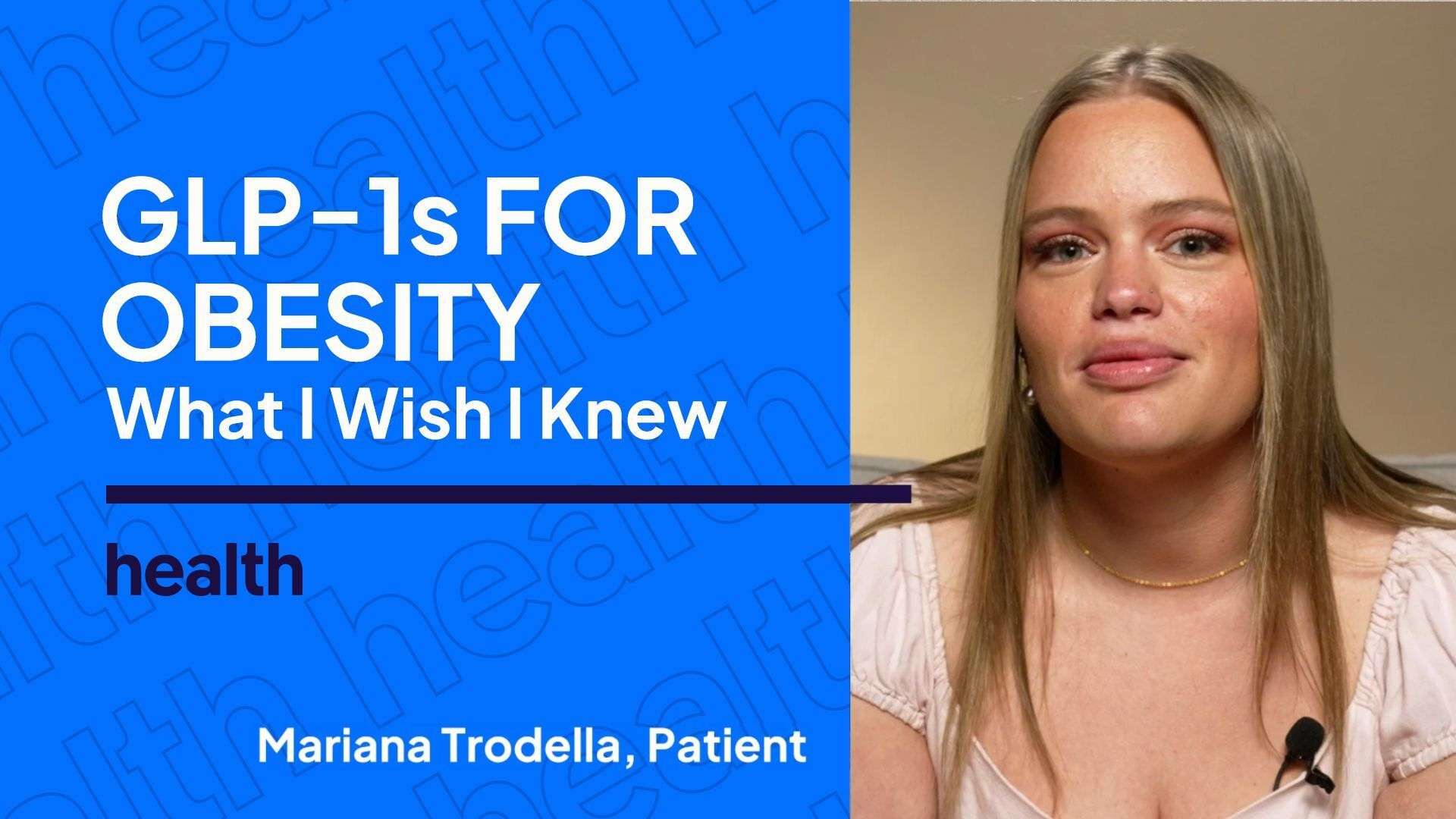
For as long as she can remember, Marianna Trodella has been acutely aware of her weight. Trodella was diagnosed with obesity around the age of 10 and went on Weight Watchers for the first time before she even reached high school. As she got older, she tried several weight-loss programs but was never able to lose weight through exercise and diet alone.
“It gets frustrating, because there are so many people outside saying, ‘Just lose the weight,’” Trodella told Health. “Nobody understands that it’s not that simple.”
After the COVID-19 pandemic, Trodella reached her peak weight of around 330 pounds and a body mass index (BMI) of 55.3. Upon learning about GLP-1s, she decided to try one for herself. “It completely changed my life,” she said. Now, after a year and a half of using the medication alongside lifestyle changes, Trodella has lost 134 pounds and built sustainable health habits she plans to stick with.
You were diagnosed with obesity at a young age. What was that like for you?
Marianna Trodella: My doctor took me into a room privately. It was my first experience with a doctor without a parent there. She wanted to ask me some questions about my habits. What do you eat at home? What do you do for activities? I was a very active child. I danced, I cheered, I played softball, I did theater. I was moving a lot. It was very confusing for me.
That was the first time that I had heard the word “obese.” Being so young, I didn’t understand what that meant, medically. I just knew that I was a fat kid.
Around the same time, we had Wii Fit at home. You step on the scale, and it tells you—loud, in front of everybody in the room—where you are on the weight scale. I remember playing that game with my friends, stepping on it, and it telling me I was obese. And then having friends step on it afterward and not hear that. That stuck with me.
I have this one distinct memory—I might have been in 4th or 5th grade. I wore a uniform to school. It was a hot summer day, and a few of us went to a friend’s house. I didn’t have a change of clothes. My friend was able to give clothes to the other girls. And [I remember] her mom coming in the room and digging through her closet, trying to find something that would fit me, and ultimately me having to wear some of her mom’s clothes. The room went quiet. My friends didn’t know how to react. I didn’t know how to react. That was one of those moments where I was like, This is a really big part of my life. This is not normal. This is something that nobody else is dealing with. I remember going home and crying to my mom about it, not knowing, ”Why me?”
What do you wish someone had told you back then? What would have been helpful for you to hear?
Trodella: I wish I knew that this was something I could change. You hear adults saying, “You need to lose the weight,” but nobody was showing me how.
I will never understand why my doctor didn’t intervene. When the conversation in the doctor’s office came to weight, it was always, “Exercise, better diet, better lifestyle.” And I always thought, Well, how are you going to help me?
I wish society in general, the people in my life, were just a little more mindful that I have feelings. When people who are not obese tell you to “Just lose the weight,” it doesn’t feel very sensitive. If you’re not in my closest circle or a medical professional, talking to somebody casually about their weight is kind of inappropriate. I didn’t like when it was brought up. I would change the subject. I think a lot of people assumed it was something I didn’t care about because I wasn’t outwardly talking about it. In my mind, I was like, If we’re not talking about my weight, then my weight isn’t a problem.
What did treatment look like as you got older?
Trodella: There were small things my mom did to try to help; we joined a gym together when I was younger. But I’m the one who has to put in the work.
You see things on TV about weight loss programs—shows on TLC about people who are struggling with obesity. I realized this is something people put in a lot of effort to change. I had seen people on Weight Watchers. I was like, “This is something that I want to try.”
I was never able to lose more than 20 pounds at a time. As somebody trying to lose more than 100 pounds, you get frustrated. You see a little bit of progress, then you stop. You get lazy, life gets in the way, or you plateau.
Weight Watchers, the Jenny Craig diet, the South Beach Diet—you can’t fully rely on a program like that unless you’re putting in the effort. It takes years. It takes commitment. Being obese my whole life, the motivation just wasn’t there. It’s not something I had ever lived without.
What led you to consider trying a GLP-1?
Trodella: When the pandemic was over, I said, I’m going to really lock in. I did research on calorie deficits, what I should be eating, and joined the gym.
I was able to lose that same 20 pounds that I’ve been playing with my whole life. Then, I hit a plateau. The scale was not moving. I was back at that point where I was really, really frustrated.
That’s when the conversation of GLP-1s was big on social media. I remember seeing a video of a girl who looked like me. She had my hair color. She had my body type in her “before” pictures. And she had lost almost 175 pounds. She was sharing a bit of her story. She was very similar to me—she could lose 20–30 pounds with lifestyle changes but was never able to move past that. I said, This is maybe worth exploring.
I’m not diabetic. I’m not pre-diabetic. When you’re 330 pounds, you’re not the standard bill of health, but otherwise, I had no underlying health problems. I was like, How does this work for somebody who is otherwise healthy? I started seeing that this was something people were able to access just with a high BMI.
Those medications are very expensive. My insurance would not cover it, even though I had an obese BMI. I ended up finding a company that has 24-hour access to meet with telehealth professionals. I spoke to a woman from that company for a really long time, asked questions about risk, explained the whole history of my weight loss struggle, and had to do a full evaluation—submitting my BMI, my bone mass. I ended up getting approved for a much lower price point.
How did you approach your GLP-1 journey?
Trodella: I said, If I’m going to do this, I’m not going to rely on a medication. I’m going to go to the gym three to five times a week. I’m going to eat in a strict calorie deficit. I didn’t want to do it the wrong way and cause any health complications. I want to build sustainable habits.
I joined Weight Watchers again to get used to tracking what I was eating, setting my protein goals, my water goals, my fruit and vegetable goals. Making sure I get at least 30 minutes of exercise a day, even if that’s just going for a walk.
I was considered a fast responder. I owe a lot of that to the work I was putting in. In the beginning, I was losing anywhere from one to five pounds a week. Now, a year and a half later, I’m weaning myself off my GLP-1. I’m trying to lose maybe 20 more.
And now, I’ve built the habits. I’ve trained myself to eat healthier. I know what to do at the gym. Now that I’ve seen progress and know what I’m capable of, I’m so much more motivated to stick with it. Hopefully, this is something that I’ll keep up for the rest of my life. I’m committed. I’m in.
What do you wish people knew about GLP-1s?
Trodella: It’s not magic. A lot of people think that it’s taking the easy way out. I feel as though I’m an example of somebody who had tried everything prior. This was a lifetime of effort with no results. Genetically speaking, my body was not able to do this on its own. It needed the help.
All of the negative comments that I see online come from people who say, “Why don’t you just go to the gym?” I have. ”Why don’t you just eat healthier?” I’ve done that. “Why don’t you just do it on your own?” I feel like I am doing it on my own.
Most people who are on a GLP-1 are not looking at it as some magic weight-loss tool. If you don’t put in the effort, the medication isn’t going to work.
Has your life changed in any surprising ways since starting treatment?
Trodella: I’m still considered plus-size, but after losing 134 pounds, everything about society has changed.
I feel like my voice is taken much more seriously in the professional world. Networking, dating, all of these spaces always felt a little uncomfortable and closed off for me. I always felt like an outsider, the person that guys didn’t want to talk to at the bars.
You don’t realize that the world around you has been treating you a little off until they start treating you better. I feel like I’m just a little bit more respected. And that makes me sad for younger me.
If you could go back and talk to your younger self, what would you tell her?
Trodella: I wish I could tell the younger version of myself, “You’re going to do it.” For so many years, I assumed that I wouldn’t.
But I also wish I could tell her to not be so hard on yourself. Try to be a little kinder to yourself throughout the process. I’d just get so uncomfortable and resentful talking about it.
I almost wish that I could grab her and be like, Girl, there are other options! Advocate for yourself! Find a doctor that you like! Find somebody that will help you! If I had really advocated for myself and expressed my deep concerns and desires to my doctors, maybe this is something that I could have done for myself a long time ago.