:max_bytes(150000):strip_icc():format(jpeg)/Health-GettyImages-2203370161-5de5549c34334c5e8f9e57abec9d089c.jpg "A man seated in a chair performs a leg exercise indoors near a window in a welllit room with plants and a mirror")
Credit: ingwervanille / Getty Images
- Building strong muscles around your knee joint can help support joint mobility and stability required for everyday movement.
- Chair exercises are a low-impact way to strengthen your legs without putting excessive stress on your joints.
- Consistency is more important than intensity when it comes to building strength and maintaining mobility for years to come.
As you age, maintaining strength around your knee joint becomes increasingly important for mobility, balance, and long-term independence. You don’t need a gym membership or expensive equipment to strengthen the muscles that surround and support your knees—just look for a sturdy chair at home.
1. Seated Knee Extensions
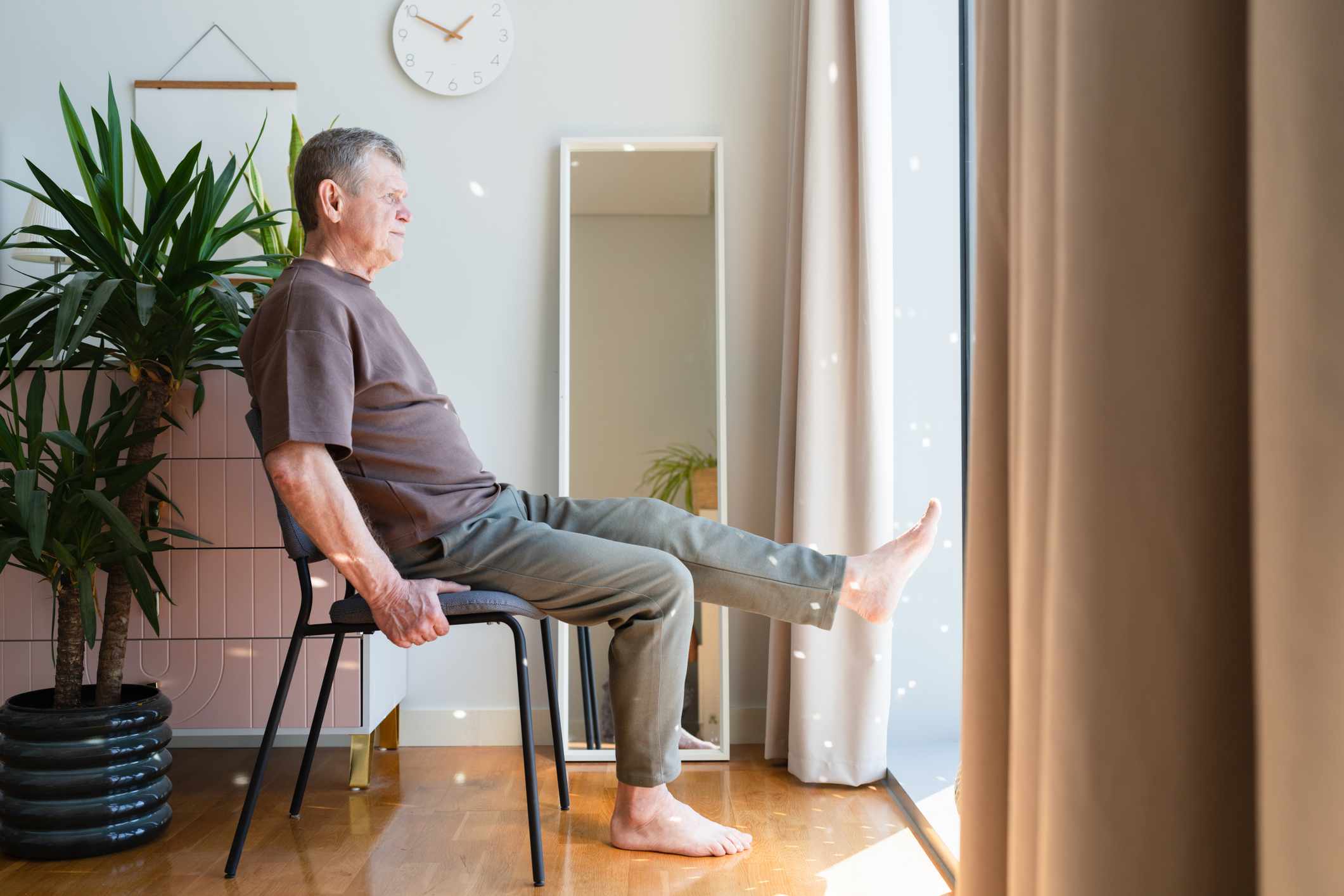
This exercise works your quadriceps, also known as your hip flexors, or the muscles on the front of your thighs. Your quadriceps play a key role in supporting your knee joint.
Since your quadriceps help control movements such as standing up from a chair, walking, and climbing stairs, keeping this muscle group strong may reduce strain on your knee joint during daily activities.
To perform this exercise:
- Sit tall in a sturdy chair with both feet flat on the floor.
- Slowly straighten one knee until your leg is extended fully straight in front of you.
- Hold for 1-2 seconds before lowering back down slowly and with control.
- Perform three sets of 10 repetitions on each side.
Adjust the sets and reps to your fitness level, starting small and working up to the recommended amount if needed. Once you reach this number and the movement becomes easier, you can add ankle weights for additional resistance.
2. Seated Marches
Seated marches strengthen your hip flexor muscles, which can improve knee strength and prevent knee pain.
Additionally, this exercise improves lower-body coordination and endurance. It also increases blood flow to your lower extremities and can help you maintain the leg strength needed for walking on both flat and uneven surfaces.
To perform this exercise:
- Sit tall in a sturdy chair with both feet flat on the floor.
- Lift one knee up toward your chest as high as you comfortably can, then slowly lower it back down.
- Repeat on the opposite side, alternating sides, for three sets of 10 repetitions
As the movement becomes easier, you can add ankle weights for additional resistance.
3. Seated Heel Raises
Although heel raises primarily work your calf muscles, they also help support your knee joint by improving your overall lower-leg strength and stability.
Strong calf muscles can lead to better balance and more push-off power during walking, which can make you feel more stable and make everyday movements feel easier.
To perform this exercise:
- Sit tall in a sturdy chair with both feet flat on the floor.
- Keep the balls of your feet on the floor as you lift your heels as high as possible.
- Pause briefly before slowly lowering your heels back down to the ground so your feet are flat.
- Perform three sets of 10 repetitions.
As the movement becomes easier, you can add ankle weights for additional resistance.
4. Seated Hamstring Curls
This exercise works your hamstrings, or the muscles on the back of your thigh. These muscle groups work closely together with your quadriceps to support healthy knee function.
Strengthening your hamstrings may improve knee stability by supporting the backside of the joint, improving muscle balance throughout your legs.
To perform this exercise:
- Sit near the front edge of a sturdy chair with both feet flat on the floor.
- Slide one foot back underneath the chair as far as you comfortably can while keeping your toes on the floor.
- Slowly return to the starting position.
- Complete three sets of 10 repetitions.
As the movement becomes easier, you can add ankle weights for additional resistance.
5. Seated Straight-Leg Holds
This exercise involves an isometric muscle contraction, which is when you activate a muscle and hold the muscle contraction without actually moving the joint. Exercises involving isometric contractions can be especially helpful if you experience discomfort during dynamic movements and exercises, which require more joint movement.
This exercise can be useful if you are returning to exercise after an injury, are looking to rebuild strength after a period of inactivity, or simply want a lower-impact alternative.
To perform this exercise:
- Sit tall in a sturdy chair with one foot flat and the other leg extended straight in front of you.
- Tighten the muscles on the front of your thigh as you hold the leg parallel to the floor for 5-10 seconds.
- Lower and repeat on the other side.
- Complete 10 repetitions on each side.
As the movement becomes easier, you can add ankle weights for additional resistance.
How To Get The Most Benefit From Chair Exercises
For best results, try to perform these exercises at least two to three times per week. Start with the number of repetitions you are most comfortable with and find manageable, and gradually increase as your strength improves.
Pay close attention to how your body responds and feels during and after the exercises. Mild muscle fatigue is normal, but sharp or worsening joint pain is not. Pairing strength exercises with regular walking, stretching, and balance training can further support knee health and overall mobility to prolong independence as you get older.
Maintaining strong knees is about more than exercise. It’s about making everyday activities like climbing stairs, standing up from a chair, and walking more comfortable and confident for many years to come.