6 Supplements That May Help Support Your Heart Health, According to a Pharm D


Medically reviewed by Jeffrey S. Lander, MD

Omega-3 fatty acids, CoQ10, and red yeast rice are some supplements that may help your heart.Credit: Ekaterina Goncharova / Getty Images
Omega-3 fatty acids, CoQ10, and red yeast rice are some supplements that may help your heart.
Credit: Ekaterina Goncharova / Getty Images
  • There is limited evidence supporting the use of supplements for heart health.
  • Supplements that may help include omega-3s, fiber, garlic, red yeast rice, and coenzyme Q10.
  • If you’re considering a supplement for your heart health, talk to a healthcare provider.

There are several dietary supplements on the market that claim to keep your heart healthy, but the research supporting their use is limited. While more research is needed on their effectiveness, here are six supplements that are commonly used to support heart health.

1. Omega-3 Fatty Acids

Credit: MirageC / Getty Images

Omega-3 fatty acids are polyunsaturated fats that support several body systems, such as your heart, lungs, and immune system. They are found naturally in foods like fatty fish and flaxseed but are also sold as dietary supplements. Fish oil, krill oil, cod liver oil, and algal oil contain omega-3s, and there are also prescription-strength omega-3s available.

People often take omega-3 supplements to support heart health. The supplements are widely believed to lower your risk of cardiovascular disease (CVD), but the evidence supporting this benefit is mixed.

How it may help the heart: There is research that shows omega-3s can lower your triglyceride levels, especially if you take more than 2 grams per day. This can indirectly lower the risk of heart issues, such as heart attacks or strokes, since high triglycerides are a risk factor for CVD. Because of this, healthcare providers often recommend prescription-strength omega-3 products like Lovaza or Vascepa for people with very high triglycerides.

2. Coenzyme Q10

Credit: chuchart duangdaw / Getty Images

Coenzyme Q10—or CoQ10—is a substance the body naturally produces. It is also sold as a dietary supplement that people believe may support heart health.

How it may help the heart: There is some evidence that CoQ10 is beneficial for people with heart failure. Studies have shown that the supplement may improve ejection fraction (how much blood the heart's left ventricle pumps out with each heartbeat) and cardiac function, while also reducing cardiac stress. Among people with heart failure, coenzyme Q10 has also been shown to improve symptoms and outcomes, such as cardiovascular deaths and hospitalizations.

3. Garlic

Credit: Iryna Imago / Getty Images

Garlic has a long history of use for health conditions due to its medicinal properties, which include anti-inflammatory, antioxidant, and antimicrobial effects. As a dietary supplement, garlic is often promoted to help with high cholesterol, high blood pressure, and diabetes.

How it may help the heart: Some research has shown that garlic can slightly improve blood pressure and cholesterol, which lowers the risk of CVD. However, it may only be effective in people who have existing high cholesterol levels or high blood pressure. More research is needed to determine the benefits of garlic supplements.

4. Fiber

Credit: Roberto Machado Noa / Getty Images

Dietary fiber comes from plant-based foods like fruits, vegetables, nuts, and seeds. Although it is best to get fiber naturally from nutritious foods, you may consider fiber supplements like psyllium or beta-glucan if you aren't consuming the recommended amount.

How it may help the heart: Studies have shown that high-fiber diets can lower the risk of heart attack, stroke, and CVD. Fiber helps the body flush out toxins, lower cholesterol, and encourage weight loss—all of which lower your risk of heart disease.

5. Red Yeast Rice

Credit: Professor25 / Getty Images

Red yeast rice is a fermented rice product that contains monacolin K, a compound that is structurally identical to the cholesterol medication lovastatin. Lovastatin is a statin drug that decreases cholesterol to lower the risk of heart attack and stroke.

How it may help the heart: Red yeast rice can effectively lower cholesterol levels, and it may also reduce your risk of heart disease. However, the amount of monacolin K in red yeast rice products varies greatly, as some products contain very little of the compound and others have large amounts. Because you can't tell how much monacolin K is in each product, healthcare providers don't always recommend red yeast rice supplementation. Some red yeast rice products may also contain a toxin that can cause kidney damage.

6. Green Tea Extract

Credit: PAVEL IARUNICHEV / Getty Images

Green tea extract is a decaffeinated green tea mixture that is sold as a dietary supplement.

How it may help the heart: There is some evidence that green tea extract can help improve cholesterol and blood sugar levels, which may help lower the risk of CVD. And when consumed as part of a heart-healthy diet, green tea may reduce the risk of heart disease by promoting weight loss and increasing "good" high-density lipoprotein (HDL) cholesterol. However, other studies have shown that green tea does not affect HDL cholesterol. Ultimately, more research is needed to determine the impact of green tea extract.

How To Choose a Supplement

It is usually recommended to get all of the nutrients your body needs through your diet. However, if you're looking for a supplement to boost your heart health, here's what to do:

  • Find out if the supplement is worth taking: According to the American Heart Association, there isn't enough evidence to support the use of supplements for heart health. Because of this, it is important to talk to a healthcare provider if you are considering starting a supplement.
  • Look for a product that's been third-party tested: The U.S. Food and Drug Administration (FDA) isn't required to review supplements for safety or effectiveness before they are sold. Therefore, the supplements you buy may contain unsafe ingredients. To reduce this risk, look for supplements that are tested by a third-party organization, such as NSF International or USP. This ensures that what is listed on the label is what is actually in the product.
  • Find out if the supplement is safe for you: Dietary supplements can interact with your existing medications or medical conditions. Before starting a supplement, talk to your healthcare provider to make sure it is safe for you.




Source link

Leave a Reply

Subscribe to Our Newsletter

Get our latest articles delivered straight to your inbox. No spam, we promise.

Recent Reviews


AI systems today are used to perform almost all types of tasks; they can search, recommend, and share answers for a massive amount of data. However, one major concern is that machines do not fully understand the context.

This is where the need for embedding models that allow semantic search, share powerful AI responses, recommendation engines, or retrieve information at scale, and more comes in. These models are widely used for transforming text, images, and other data types into vectors that capture semantic meaning.

Thus, the best embedding models are widely adopted by organizations today to perform powerful tasks. With so many options available in the market, it’s a challenging task to pick the right embedding model for building high-performance AI systems. To make your job easy, we’ve covered the top 5 open-source embedding models in this blog post that you can start using in 2026.

Understanding Embedding Models

Embedding models play a key role in converting text, images, code, and other data into vectors that capture their semantic meaning rather than keywords. With this, machines can accurately understand context, similarity, and user intent.

The following are some of the use cases of embedding models:

  • Powering search
  • Recommendation engines
  • Retrieval-Augmented Generation (RAG) systems

Why Choose Open-Source Embedding Models?

Embedding models stand as a cornerstone in building a memory system or rag system that determines how accurate information is stored, retrieved, and understood. If you’re looking for maximum optimization, flexibility, and control, open-source models are an ideal option.

They are domain-specific, can run anywhere, and are useful for preventing vendor lock-in. Alongside, open-source embedding models can meet stringent data, latency, and budget constraints.

Another big win is that these models provide greater transparency and better debugging capabilities and come with better explanatory capabilities.

List of Top 5 Open-Source Embedding Models

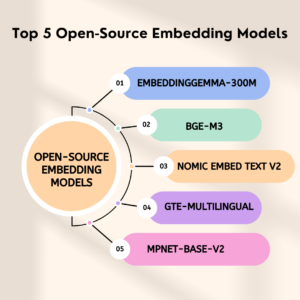
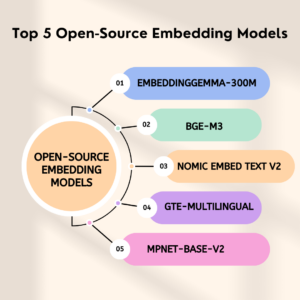
1] EmbeddingGemma-300M

Embedding Gemma 300M is a lightweight multilingual embedding model created by Google DeepMind to allow efficient and high-quality text representation. The model is based on Gemma3 but uses only 300 million parameters; it still delivers good results in multilingual retrieval and semantic similarity tasks. A very small size is ideal when implementing AI apps in on-device solutions and edge environments.

Key Features:

  • Lightweight model optimized for real-time applications
  • 100+ languages for multi-lingual and cross-lingual tasks
  • Faster embedding generation
  • Low memory usage (200 MB or below)

Best for: Multilingual text retrieval and embedding tasks on edge devices with fewer resources.

2] bge-m3

Another top-ranking open-source embedding model, bge m3 from BAAI, is mainly used in hybrid lexical-semantic search systems that need flexibility. The multi-representation encoder is designed to facilitate dense, sparse, and hybrid vector retrieval.

It is very flexible with complex search conditions and long document processing. It provides a comprehensive understanding of context by combining different retrieval methods in a single pipeline, thereby enhancing search coverage and relevance.

Key Features:

  • Optimized for long-document processing
  • Flexible integration across advanced AI systems
  • Helps in improving contextual search by combining different retrieval techniques

Best for: Multilingual semantic search, production-ready RAG systems, and more.

Top 5 Open-Source Embedding Models

3] Nomic Embed Text V2

Nomic Embed Text V2 is a popular multilingual embedding model from Nomic AI; it’s built for scale. This model can ideally handle longer inputs than many smaller models. It relies on a Mixture-of-Experts (MoE) architecture to produce high-quality, efficient text embeddings. The feature of large multilingual datasets is trained to offer high efficiency and scalability of semantic search, RAG, and recommendation use cases.

Key Features:

  • Right execution in BEIR and MIRACL.
  • Supports programmable embedding size (768 to 256)
  • Entirely open-source, and training data and model weights provided

Best for: Multilingual semantic search and scalable RAG systems requiring efficiency and flexibility.

4] GTE-Multilingual

gte-multilingual-base is a dense retrieval model that supports more than 70 languages; it is used in cross-lingual search and global content discovery. This open-source embedding model offers high-quality multilingual retrieval accuracy, but its broad language coverage may lead to slightly higher latency than highly tuned single-language models.

Key Features:

  • Cross-linguistic retrieval of 70+ languages
  • Good search and knowledge discovery accuracy on a larger scale
  • Can process different types of content in international systems

Best for: Multilingual knowledge bases, international search systems, and international customer support systems.

5] MPNet-Base-V2

MPNet-Base-V2 is mainly a transformer-based embedding model, which is highly optimized for semantic similarity, clustering, and content understanding tasks. It can capture contextual meaning but can be slower to infer and less precise in exact-match retrieval than a more specific retrieval model.

Key Features:

  • Good semantic similarity and clustering
  • Good at analytics, suggestions, and deduplication
  • Rich contextual insight into textual content

Best for: Semantic analytics, recommendation engines, and content similarity detectors.

Final Words on Top Open-Source Embedding Models

Here, we have understood the top embedding models and how they power AI systems in different ways. Knowing each of these in detail can help you choose the best one for your requirements in 2026. No matter if you’re building a memory agent or a research assistant, it all depends on the model for how fast, scalable, and efficient it is.

Check out our website to stay tuned to more trending blog topics.


FAQs

1. Why use open-source embedding models?
Answer:
They offer customization, flexibility, and lower cost without vendor lock-in.

2. Are open-source embedding models reliable?
Answer:
Yes, most of them provide a high degree of accuracy and functionality in search, RAG, and AI apps.


You might like:

Top 6 Open Source TTS Engine

Top 8 Open Source Facial Recognition Software

What Are Some Of The Best Open-Source Speech Recognition Software


Source link