
Muskie plan encourages anglers to track the fish


Man holds a large muskie at a lake

Muskie are notoriously elusive and clever fish, often stalking a lure right up to the boat without biting. For Jim Doyle, the thrill of muskie lies in the hunt.

“It’s the pursuit,” said Doyle, the Muskies Inc., Twin Cities chapter president. “It’s fishing for hours and hours and hours and not knowing when the next cast is going to produce something that is a near life-changing event.”

Doyle, along with other private clubs, businesses, local and tribal governments and researchers, spent the past three years working with the state developing the Department of Natural Resources’ long-range plan for muskie, short for muskellunge. It's the first long-term plan since 2008 and runs through 2040.

The goals include:

  • Improving muskie fisheries

  • Expanding fingerling and yearling production

  • Continuing the Twin Cities metro area program for tiger muskie

  • Debunking misconceptions that muskie deplete other fish populations.

Natural Resources fisheries section manager Brad Parsons said the biggest changes are about efficiency. While the past plan prioritized stocking new fisheries, the new plan will focus on elevating the state’s current and premier muskie waters.

“We’re not ruling out new waters, but we want to focus on the muskie waters we currently have and improving fishing in those lakes, rather than trying to expand into more lakes,” Parsons said.

The department will focus on lakes Minnetonka, Vermillion and Mille Lacs, which the plan identifies as “core lakes.” Those three represent the largest stocked muskie waters in the state and are among the most desirable to anglers, according to the plan.

“These waters historically absorbed substantial fishing pressure due to their unique size, habitat characteristics, geographic locations and the exceptional fisheries contained within them,” the plan reads. “These lakes have many access points and nearby services anglers may desire such as fuel, restaurants and retail. Vermilion and Mille Lacs lakes also have a storied history, economically driven by the many vacation resorts on their shores.”

Leech Lake was not included since it is overseen by the Leech Lake Band of Ojibwe.

Ben Olsen, co-owner of Thorne Brothers Custom Rod and Tackle in Blaine, who helped craft the plan, said smaller lakes will still receive their promised stock. But the health of the core lakes is imperative.

"They are getting the first priority in terms of stocking, in terms of management, in terms of study,” Olsen said. “And that is primarily a function of pressure and usage, right? Those are the three most heavily fished lakes."

From fingerlings to yearlings

Inserting a small electronic tag
A Minnesota Department of Natural Resources fisheries supervisor inserts a small electronic tag into a muskie. The tag is similar to those used to identify cats and dogs.
Dan Gunderson | MPR News

To move to more efficient stocking, Natural Resources will shift from stocking primarily fingerlings to more yearlings.

Fingerlings are young muskie ranging from one inch to one year of age, according to Rob Jost, owner of the Minnesota Muskie Farm outside Alexandria. Fingerlings stocked by Natural Resources in October tended to average between 10 and 11 inches.

Yearlings are winterized and kept until the following season; they range from about 16 to 20 inches in size.

While grown muskie are an apex predator in lakes, fingerlings are particularly vulnerable to predators such as birds and otters. Production goals can also be hard to meet with the limited growing season, especially in northern Minnesota.

“We participated in a project in coordination with the DNR to look at that specifically in the southern part of the state, testing yearling and fingerling stocking on Lake Minnetonka, White Bear Lake and Bald Eagle Lake to look at survival of those fish over about a decade,” Doyle said. “It showed that there’s a much more effective way to produce and stock those fish, so that we get adult fish out the other end of the process at a better cost.”

Yearlings can cost triple what fingerlings cost given their needs, but the survival rate can be tenfold. In theory, that means more muskie. And to back up that theory, states such as Pennsylvania and New Jersey have seen success switching.

“If that fish is surviving anywhere from five to 10 times better, the cost benefit is certainly there,” Parsons said.

Tiger muskie

As part of the plan, the state will continue its program stocking tiger muskie — a cross between a muskie and northern pike — in lakes near the Twin Cities metro area. Tiger muskie can be easier to catch and offer urban and beginning anglers a chance to hook their first fish, according to Parsons.

“It’s really to provide that big fish trophy opportunity close to home here in the metro,” he said. “Tiger muskies tend to grow a little faster; they don’t tend to live quite as long. We’re focusing on fewer lakes with the tiger muskie management but making sure that it’s in lakes where it’s successful and lakes where we’re able to document the use people are finding.”

Since 2001, the state has relied on private muskie farms like Jost’s to assist raising tiger muskie. Now, Jost is the only one remaining in Minnesota and one of just two private muskie farms in the country.

Muskie in water
A muskie in Lake Mille Lacs.
Eric Bakke

While tiger muskie are somewhat easier to raise than the Leech Lake strain — often considered the gold standard of Minnesota muskie — Jost said it is still difficult work.

He starts with tens of thousands of fry he purchases from Natural Resources. They’re kept in water recirculating tanks of varying size until they can be moved to one- to two-acre ponds.

From the fry he starts with, Jost said he hopes to see around 10 percent mature to fingerling stocking size.

“It’s rewarding getting the fish up to a stockable size and actually deliver to a lake, watch the fish swim away and see how excited the people are who raised the money to buy them — watch the kids get excited,” Jost said. “That’s the ultimate goal: to sell your fish and put them in the water. That’s pretty cool.”

Natural Resources does buy some of his stock, but the bulk is private organizations such as Thorne Bros. and Muskies Inc., who funded the program for several years through contests and fundraisers, including raising $75,000 in 2025. Olsen said the state continuing to allow private groups to bolster tiger muskie stocking was welcome news.

"If we hit our quotas and the DNR produces its numbers and we’re allowed some private stocking on top of that, we will have good fisheries," he said.

Fish fears

For years, muskie have been controversial. They’re large, almost prehistoric looking predators.

Anglers of other species such as walleye and crappie feared they would deplete fish populations. Others feared they would attack swimmers with their prominent teeth.

“Muskie have been, at various times, a somewhat controversial fish,” Parsons said. “But we’ve really ramped up in the last 15 years or so the science that shows that muskie are a very, very functional part of the ecosystem. They’re not an indiscriminate predator.”

Recent studies have reached the same conclusion. A 2020 Natural Resources survey of stocked fish in lakes Bald Eagle, North Star and Shamineau found pike and largemouth bass consumed much more other fish than muskie. On Bald Eagle, pike, bass and walleye ate more than double what muskie did.

“We really did a lot of research in the last decade or so about muskie diets, their role in the ecosystem, and I think we’re in a really good spot with the public understanding that where these fish occur. They’re not only a tremendous fishing resource, but they’re good for the lake ecology as well,” Parsons said.

Part of the problem with gauging the role muskie play in lake ecosystems is the difficulty in studying their populations.

Most lakes don’t have refined population numbers because, unlike other species, they are solitary and move around. Catching one muskie is difficult enough, hence the moniker the “fish of 10,000 casts.”

Asking anglers to help

Population estimates vary but often range one muskie to every one to five surface acres per lake. That means a lake the size of Minnetonka could hold anywhere from 3,000 to 14,500 muskie.

Olsen said this is where anglers come in.

“If we want to maintain these fisheries for a long time, getting the DNR the data they need, we can do it more efficiently now with social media and the way we are connected,” Olsen said.

Natural Resources and other management agencies have either started or will begin multiple studies.

One on Leech Lake asks anglers to take a fin clip and deposit it at one of several sites around the lake. Researchers will genetically map the clippings to gain insight into the population.

Fish stocked by Natural Resources will also contain passive integrated transponder, or PIT, tags, similar to the ones people put in their pets. Anglers can scan the fish they catch and share that data with the department.

“So many of us, myself included, like to complain,” Olsen said. “Here’s a chance to put your money where your mouth is. If you don't like the data that's being generated, you have an opportunity in Minnesota, in a lot of cases, across a lot of fisheries, to have some input into how our fisheries are managed. I would just really encourage people to pay attention to that stuff and take advantage whenever possible.”

Muskies Inc. and Thorn Bros. have handed out dozens of free PIT tag scanners. Doyle said anglers should keep a scanner in their tacklebox, noting that at around $30, the tech costs less than most lures.

“They're a low-cost way to really collect a lot of information to help manage the resource,” he said.

With more data and the rest of the plan, Doyle said he hoped Minnesota fisheries would thrive into the future so he could continue sharing the hobby he’s loved for more than three decades.

“No matter how long you do it, it’s that explosion of energy and excitement after a long pause of not much going on,” he said. “Just almost not being able to believe your eyes that something swam up to the boat or hit my lure. It never gets old.”




Source link

Leave a Reply

Subscribe to Our Newsletter

Get our latest articles delivered straight to your inbox. No spam, we promise.

Recent Reviews


The McLaughlin Group

There was a sketch on Saturday Night Live where Dana Carvey played news talk show host John McLaughlin.

The recurring gag was that McLaughlin would ask the guests a serious political question, each would give a thoughtful answer, and McLaughlin would shout “WRONG!”

I think about that a lot when I’m doing deposition preparation with clients in trade secrets lawsuits.

Let’s go over some common ways defendants in trade secrets lawsuits go wrong in their depositions. We’ll use our old hypothetical friend Dawn Davis as an example

1. Are the things defined as “confidential information” or “trade secrets” in the agreement actually confidential or secret?

Like most employment agreements, Dawn’s agreement with Paula Payne Windows includes a confidentiality agreement.

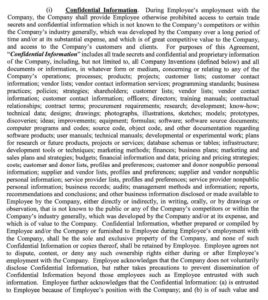
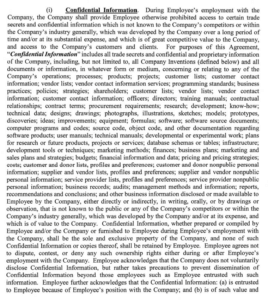
The definition of “confidential information” looks something like this:

The deposition questions about it go something like this:

Q: Can you take a look at the definition of the company’s “confidential information and trade secrets” in your agreement? Do you see that? 

A: Yes.

Q: You signed this agreement, right?

A: Yes, I signed it.

Q: So you agree that the things listed in this definition are the company’s confidential information, right?

A: Right.

WRONG!

What a difference a single letter can make.

If the question was “you agreed that the things listed in the definition are the company’s confidential information,” then yes would be an acceptable answer. That’s because generally, if you sign an agreement, you agreed to what’s in it.

But just because you signed the agreement doesn’t mean you now agree with every statement in the agreement.

See the distinction?

Yes, you may have agreed to what’s in the agreement by signing it, but just because the agreement says something is true doesn’t make it true.

Especially when it comes to a definition of “confidential information” or “trade secrets.”

The problem with this definition—and most definitions of confidential information in such agreements—is that it is both too vague and too broad.

These are slightly different things.

The definition is vague, or “indefinite,” because it is not clear what is included and what is not. For example, the definition refers to the company’s “processes” and “policies.” Which processes and policies? All of them, or just the “confidential” ones? And which ones are confidential?

Let’s say Paula Payne Windows has a process for prospecting for new customers: search on the internet for the kind of companies that buy windows, find the contact information for the person there responsible for buying windows, cold call that person, then make a note in the company’s CRM system to follow up later.

That’s a process, but is it a confidential process? Of course not. Everybody has a process like this. It’s no secret.

Is that process included in the contract’s definition of “confidential information”? It’s hard to say.

But you could read the definition literally to mean that all of the company’s processes are included in the definition of confidential information. And that brings up the second problem: the definition is overbroad.

The definition is overbroad because on its face it includes things that are not confidential.

An agreement that defines all of the company’s information as confidential would be unreasonable and unenforceable. It would be a de facto non-compete.

When you understand these two problems, you can answer deposition questions more accurately.

Q: So you agree that the things listed in this definition are the company’s confidential information, right?  

A: Not necessarily.

Q: Why not?

A: Well, first, I’m not even sure what this definition means. And second, it has things in it that are obviously not confidential information.

Q: Like what?

A: Like “processes” and “policies.” If that means all of the company’s processes and policies, then it includes things that are obviously not a secret. 

This answer won’t make the questioning lawyer happy, but you’re not there to make friends.

2. Is a customer list a trade secret?

Suppose when Dawn Davis left Paula Payne Windows, she took an Excel spreadsheet showing all her sales from the previous year, including the names of the customers. Dawn says she needed the list because the company owed her commissions, but Paula Payne Windows says the spreadsheet is a confidential customer list.

So the deposition questioning goes like this:

Q: You’re not a lawyer, are you?

 A: No.

 Q: Ok, I’m not asking for a legal opinion or anything, but do you see this definition of “trade secrets” from the Texas Uniform Trade Secrets Act?

A: Yes.

Q: The definition includes “list of actual or potential customers,” right?

A: Yes, I see that.  

Q: [in the most casual tone possible] Ok, so you understand a customer list is a trade secret, right?”

A: Yes, I understand that.

WRONG!

Perhaps we can forgive Dawn for making this mistake. I have seen licensed lawyers make this very argument to judges. “Your Honor, the definition of trade secrets in TUTSA specifically includes customer lists, so my client’s customer list is a trade secret.”

But the argument is wrong, for two reasons.

First, if you look at the whole definition of a trade secret, there’s a very important word: “if.”

A customer list is included in the list of types of things that can be a trade secret, if the rest of the elements of the definition are met (like “independent economic value”).

The first problem with the deposition question was that it ignored this important “if.”

The second problem with the argument is that it just defies common sense.

Think about it. Suppose Dawn’s spreadsheet lists just five customers, who happen to be the biggest homebuilders in her sales territory. There’s no way that’s a trade secret. All the competitors in that area know who those customers are.

If you want to know more, I cover this issue in more detail at my blog post When Is a Customer List a Trade Secret. I even cite court cases. But you get the idea.

Now that Dawn is armed with the knowledge that a customer list isn’t automatically a trade secret, let’s give her another crack at the deposition question:

Q: Ok, so you understand a customer list is a trade secret, right?”

A: No.  

Q: But it says that right there in the definition, doesn’t it? 

A: It says customer list, but there’s more to the definition.

Q: So you don’t think your customer list is a trade secret? 

A: No. Everybody in our industry knows who those customers are.

Now that we’ve avoided that confusion, let’s look at another category of information that can be a trade secret but isn’t necessarily a trade secret: prices.

3. Are the company’s prices trade secrets?

After customer lists, the next most common type of alleged “trade secret” is prices. I cover this at my blog post The Price Undercutting Theory in Trade Secrets Litigation.

Here’s how the lawyer for Paula Payne Windows might try to set it up in Dawn’s deposition:

Q: Are you working for Real Cheap Windows now?

A: Yes.

Q: Let’s say a competitor calls you up and asks you for the prices you’re charging customers this week, would you tell him?

A: Uh . . . I don’t think that has ever happened.

Q: But if it did, would you tell them?

A: I mean, I don’t think so.

Q: Why not?

A: Well it’s none of their business.

Q: And if they knew your prices they could offer the same customers lower prices, right?

A: That could happen.

Q: Can your competitors just do a Google search and find your prices?

A: No.  

Q: Right, so the prices your company charges its customers are confidential, right?

A: Yeah, I guess so.

WRONG!  

Don’t let this happen in your deposition

Everything leading up to the last question is fine, but are the prices really a secret?

Nine times out of ten, the answer will be no, at least in my experience and opinion.

That’s because in the vast majority of cases, there’s nothing to stop the customers from telling one competitor what another competitor is charging.

In fact, in many industries, it’s common for customers to do so. “Hey, Fred, Bubba’s Oilfield Supply says it can get me those frac valves for five thousand apiece this week, can you beat that?”

Unless the company has a nondisclosure agreement with the customer that says the customer must keep the company’s prices confidential, I don’t see how the company can genuinely claim the prices are a secret, or that it took the required “reasonable measures” to keep the prices secret.

Keep in mind, this is just my opinion. But it is usually correct.

Knowing that, here’s a better way for Dawn to answer deposition questions about prices:

Q: So the prices your company charges its customers are confidential, right?  

A: No.

Q: They’re not confidential? Are you saying you would just give them out to your competitors?

A: I didn’t say that.

Q: Well, if the prices aren’t confidential, why wouldn’t you share them?

A: They can easily go and ask my customer for the prices, and I can’t stop the customer from telling them. But that doesn’t mean it’s my job to help them.

So, those prices on the spreadsheet Dawn took from Paula Payne Windows, maybe they’re not so secret.

That, of course, does not mean it was a good idea for Dawn to take the spreadsheet.

4. What does the forensics show?

It’s a bad idea for departing employees to take or keep any company documents.

With the exception of their agreements with the company, which I think are generally fair game for an employee to keep. But generally, don’t take company documents when you leave!

There are multiple reasons for this, but maybe the most important one is that whatever documents the employee takes, those will be the documents the company claims contain its alleged “trade secrets” in the subsequent trade secrets lawsuit. I call this Wolfe’s First Law of Trade Secrets Litigation.

Here’s how it might go down in Dawn’s case:

Q: When you were working for Paula Payne Windows, did they provide a computer?

A: Yeah, I had a computer at the office.

Q: Did you ever use USB drives?

A: You mean like a thumb drive?  

Q: Yes. 

A: Sure, we used those all the time, like if I needed to take documents with me on a customer visit.

Q: Let me show you Plaintiff’s Exhibit 13 to your deposition. That’s a report our forensic expert prepared. Do you see that?

A: Yes.

Q: Do you see line 7 on page 2 that shows on April 7, 2023, the day after you gave notice, you plugged a Seagate thumb drive into your computer at work and copied 12 sales reports to it?  

A: Yes.

WRONG!

Dawn doesn’t have any personal knowledge of the forensic report or how it was prepared. And her recollection is probably not that specific. How can she be sure?

Here’s a better way for Dawn to answer:

Q: Do you see line 7 on page 2 that shows you copied 12 files on to a thumb drive?

A: I didn’t prepare this report.  

Q: Ok, but you see where it says that, right?

A: I see that the report says that.

Q: Well, are you denying that you copied 12 files on to that thumb drive on April 7, 2023?

A: I’m not denying there were times when I put files on a thumb drive, but I can’t remember if I copied those specific files on that specific date.  

Q: Ok, but you can’t rule it out?

A: I can’t rule it in or out. I just don’t remember.

Sticking to what you personally know is good deposition advice generally, but especially when it comes to computer forensics in a trade secrets lawsuit.

Let me stress: I am not saying Dawn should pretend like she doesn’t know or doesn’t remember if she does remember. Every witness should tell the truth. If Dawn clearly remembers, “yes, I copied 12 files on to a thumb drive on April 7, 2023,” then she should say so.

But it’s rare that the witness will remember that specifically.

In most cases, a witness in a deposition is not going to remember every little thing she did on a computer years earlier, before any lawsuit was filed. She certainly won’t remember things like the serial number of the USB drive.

And that brings up the final common deposition mistake to avoid in a trade secrets lawsuit.

5. Undermining your credibility by overstating your case

Maintaining your credibility is critically important in any lawsuit.

And if you’re a former employee defendant in a trade secrets lawsuit, it is even more important than usual. Right off the bat your credibility is under attack because you did something your former employer portrays as sneaky and underhanded. “Theft!” they will cry.

And you should expect the plaintiff’s lawyer will go into the deposition ready to set you up. It might go like this:

Q: Can you take a look at page 27 of the Paula Payne Windows Employee Handbook?

A: Ok, yes, I’m there.

Q: It says “Employees must take care not to disseminate company documents outside the company, such as sending them to personal email addresses.” Did I read that correctly?

A: Nobody ever paid attention to that.

Q: Ok, but that was the company’s stated policy, correct?

A: Yeah, I guess.

Q: Ok, so you knew it was against company policy to email yourself company documents, right?

A: Right.

Q: Did you ever do that?

A: Absolutely not. I never emailed myself company documents.

WRONG!

The answer is wrong because you already know what’s coming next: Impeachment.

The lawyer for Paula Payne Windows will show Dawn a copy of an email from her company email account to her personal Gmail account attaching a proposal to a customer.

“Oh, I forgot about that!” Dawn will say. “I was going to meet with a customer out of the office the next day, and I needed to be able to print out the proposal at home.”

A legitimate explanation, if true. But the damage will already be done.

So for questions like this, it’s important to be cautious and not overstate your case.

In this example, there are basically three possibilities:

  1. Dawn remembers emailing herself the proposal, or at least remembers emailing herself generally.
  2. Dawn has no recollection of emailing herself company documents, but knows it’s possible she did.
  3. Dawn knows for a fact she never emailed company documents to herself.

If 1 is true, then Dawn should say so.

If 2 is true, then Dawn should say something like “I don’t have a specific memory of doing that.” Then she’s leaving room for the possibility that it happened.

If 3 is true, then Dawn could say she never emailed herself company documents, but even then, she should proceed with caution.

You see, memory is a funny thing. Every litigator has experienced a client who was 100% sure of some fact or sequence of events, and then the documents show her memory is just flat wrong.

So even if Dawn is absolutely sure, it’s still a good idea to say something like “I don’t think I ever did that.”

You don’t need to overstate the good facts that are on your side.

On a scale of 1 to 14, 1 being lowest degree of likelihood, 14 being absolute metaphysical certitude, what are the chances you’ll make a mistake?

Go ahead, say your answer.

WRONG!

_______________________

Zach Wolfe (zach@zachwolfelaw.com) is a Texas trial lawyer who handles non-compete and trade secret litigation at Zach Wolfe Law Firm (zachwolfelaw.com). Thomson Reuters has named him a Texas Super Lawyer® for Business Litigation every year since 2020.

These are his opinions, not the opinions of his firm or clients, so don’t cite part of this post against him in an actual case. Every case is different, so don’t rely on this post as legal advice for your case.


Source link