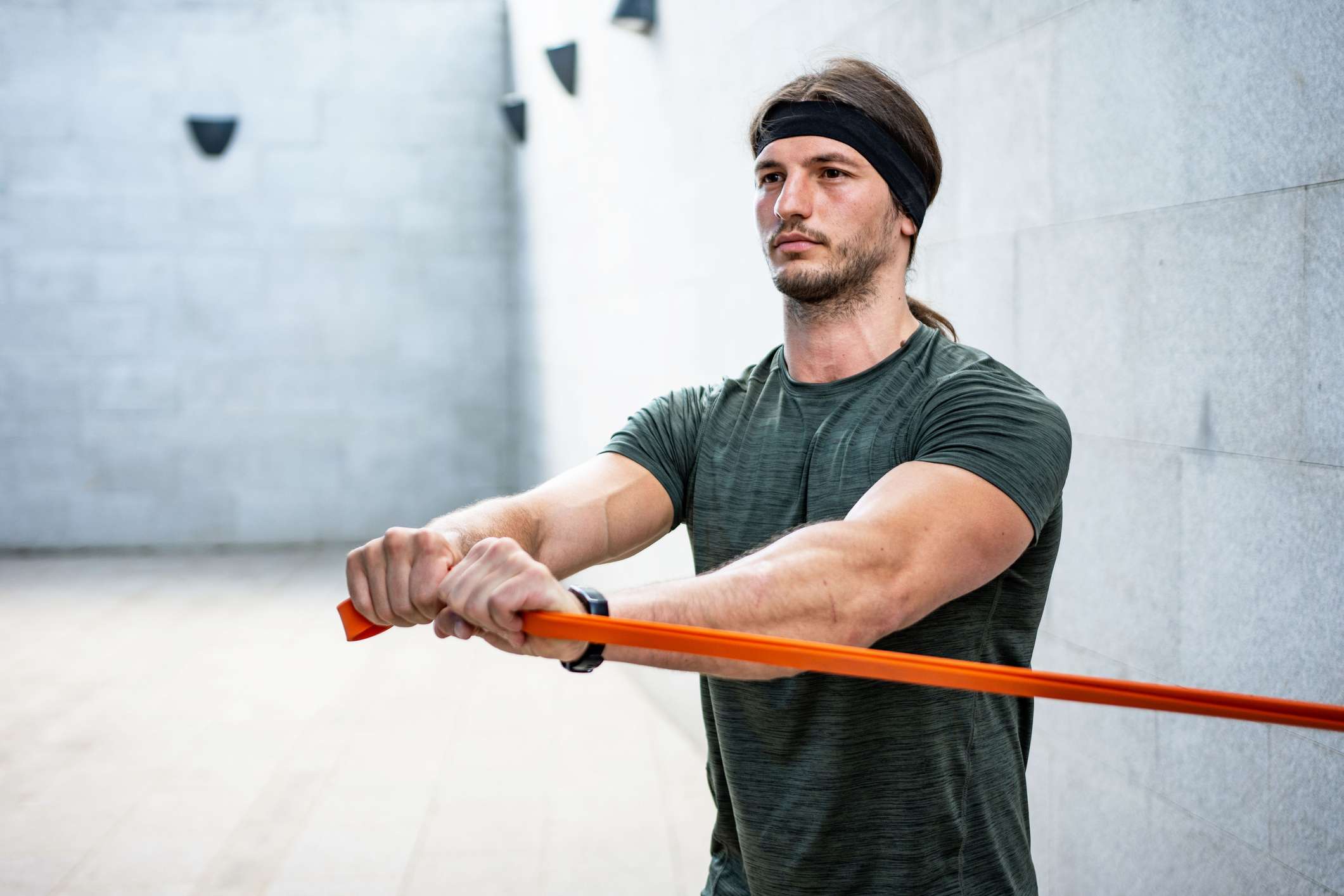
:max_bytes(150000):strip_icc():format(jpeg)/Health-GettyImages-1405777872-09acf0414e31454a908cf4859d4318eb.jpg "Person exercising with a resistance band standing in an outdoor setting")
- The Pallof press is an exercise that challenges your core to resist rotational movements.
- This movement activates and strengthens your abdominal muscles, glutes, shoulders, and muscles responsible for maintaining good posture.
- This exercise places less stress on your spine and can improve balance, posture, performance, and everyday movement mechanics.
There are plenty of core workouts that include motions like twisting, crunching, and bending. However, some of your most functional core strength lies in your ability to resist rotational stress and movement. That’s where the Pallof press exercise comes in. It may seem simple, but this exercise can challenge your core muscles in ways that Russian twists don’t.
Why Swap Russian Twists for Pallof Press
Russian twists have long been a staple in many core workouts, especially in online fitness routines and group fitness classes. This exercise targets rotational strength and endurance by practicing repeated spinal rotation, often with an added load or to fatigue.
If you have a history of low back pain, poor rotational control, or overall limited trunk mobility, exercises like Russian twists that involve repeated loaded twisting may not be the most effective or comfortable movement to improve core strength.
The Pallof press exercise offers a different approach.
Rather than using a rotational movement, the Pallof press resists rotational movement. As you press the resistance band or cable band away from your body, your core muscles are working to prevent your trunk from twisting. This exercise builds anti-rotation strength, or your body's ability to remain stable when outside forces are trying to push or pull you out of alignment.
Anti-rotational strength is important during everyday movements like picking up a child, carrying groceries, pushing a stroller, or changing directions while you’re running or walking.
What Exactly Is a Pallof Press?
The Pallof press—named after physical therapist John Pallof—is a resisted core exercise performed in a standing or kneeling position with a resistance band or cable machine held at chest height.
To perform the exercise:
- Start standing or kneeling sideways to the anchor point with your feet (or knees, if kneeling) hip-width apart.
- Hold the handle of the cable machine or the resistance band at your chest with both hands, just about at the level of your sternum or breast bone.
- Engage your core muscles and press your hands straight out in front of you as you exhale.
- Pause, holding your arms extended as your body resists being pulled towards the anchor.
- As you inhale, slowly bring your arms back to the starting position.
If you’re new to core and anti-rotation training, start with 2-3 sets of 8-12 controlled repetitions on each side using a light resistance band. Be sure to focus on your posture, breathing, and form.
If you notice any pain or discomfort, consider working with a licensed physical therapist who can help you find the right mechanics and progression.
How Is the Pallof Press Different?
The Pallof press trains your core differently because it stabilizes the deepest core muscles, as they all work together to perform the exercise.
The Pallof press challenges your:
- Transverse abdominis muscle, or the deep abdominal “corset” muscle
- Internal and external oblique muscles, which are responsible for controlling rotation
- Multifidus, or small spinal stabilizing muscle
- Glutes, which help control the alignment of your hips and pelvis
- Scapular stabilizing muscles, which control and support posture and shoulder positioning
Since this exercise requires your trunk to remain still while your arms move, your nervous system also learns how to maintain optimal spinal alignment under load.
That kind of stability can help improve your performance with other exercises in the gym as well as functional movements you perform in your everyday life.
Is the Pallof Press Better for Your Spine?
For most people, the Pallof press can be a more spine-friendly option for improving core strength. However, this may depend on your goals, level of function, and injury history.
Russian twists involve a lot of repeated rotation and bending, especially if you perform them quickly or with improper form. This can create more harm than benefit, especially if you experience:
- Low-back pain or discomfort
- Disc-related symptoms
- Postpartum core weakness
- Poor rotational control
- Hypermobility or flexibility
The Pallof press encourages you to keep a neutral spine, brace through your core muscles, and control outside rotational forces being put on your body.
However, this does not mean Russian twists are “bad.” They simply train your core muscles in a different way. The Pallof press emphasizes control and stability first.
For many individuals, especially beginners, control and stability can help build a better foundation for other movements.
Who Should Add the Pallof Press to Their Workout?
The Pallof press can help support a variety of fitness goals. People who may benefit from adding the Pallof press to their routine include:
- Casual exercisers looking to build foundational core strength
- Runners looking to improve trunk control
- Heavy lifters looking for more stability when lifting heavy loads
- New parents or grandparents who spend time carrying children
- Older adults working on balance and fall prevention
Since the Pallof press is low-impact and easily adjustable to your level of function, it is simple enough for beginners but still challenging enough for advanced athletes when loaded correctly.
How To Make the Pallof Press More Challenging
Once the standard version feels too easy, some progression options include:
- Increase the resistance: A heavier band or cable can create a stronger, more challenging rotational pull.
- Extend the pause: Hold the press for 5-10 seconds and increase the time under tension when the challenge feels appropriate.
- Change your base of support: Try to perform the exercise in tall kneeling, half-kneeling, split stance, or even single-leg stance. The less stable your base is, the harder your core has to work to resist rotation.
- Add movement: Additional variations include performing an overhead Pallof press, lateral walks with a Pallof hold, squat to Pallof press, and marching Pallof presses. These variations can challenge your core during real-world movement patterns.
Should You Stop Performing Russian Twists?
Not necessarily.
Russian twists are still an effective exercise when performed correctly, especially for athletes who need rotational power.
However, if your goal is better posture, improved lifting mechanics, more functional core strength, or fewer low back flare-ups, the Pallof press may deserve a permanent spot in your workout routine.





:max_bytes(150000):strip_icc():format(jpeg)/Health-GettyImages-1359002988-c5035308e08d4f738370002f8c2c837b.jpg "A person holding a bowl with sliced carrots and apple pieces on their lap")