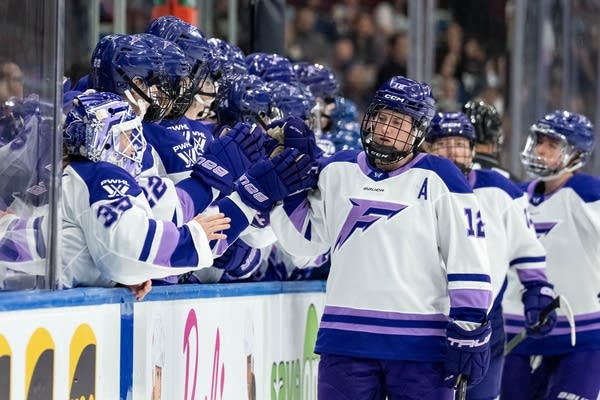
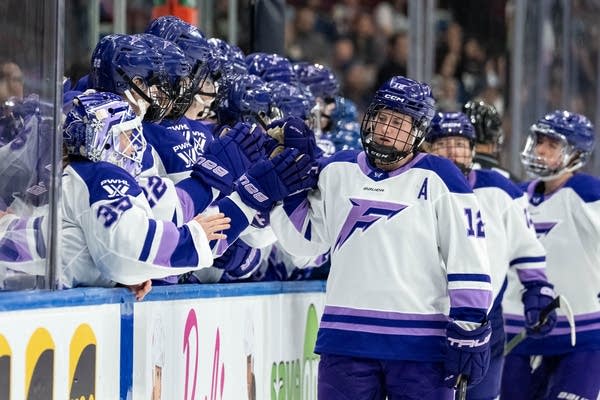
So much for the complaints raised last summer about the PWHL's expansion process favoring the league’s newest franchises in Seattle and Vancouver.
After a five-month, 120-game regular season featuring record crowds, women’s hockey enjoying a significant post-Olympic boost and with more expansion on the horizon, the Walter Cup playoff semifinalists are made up exclusively of the league’s old guard.
The four-team field is led by the Minnesota Frost seeking to three-peat. They open their best-of-five series at Montreal on Saturday against the Marie Philip-Poulin-led Victoire, who have failed to carry over regular-season success into the playoffs in each of the league’s first two seasons.
The Boston Fleet return following a one-year absence, with a new coach, Kris Sparre, and following Hilary Knight’s offseason departure to Seattle. Boston opens its series at home on Thursday facing the Ottawa Charge — the PWHL’s two other teams to reach the final, before losing to Minnesota.
“The experience absolutely helps,” captain Kendall Coyne Schofield said of the Frost, who still feature a veteran core despite the offseason departures of key defenders Sophie Jaques and Claire Thompson to Vancouver.
“We have a handful of players in the room who have won. And if they haven’t won in the PWHL, they’ve won before coming to the PWHL,” Coyne Schofield said. “And those who haven’t played in a best-of-five series yet, I think they’ll figure it out quickly.”
Lower seeds have had the edge
If the past means anything, records and standings don’t matter. The lower-seeded team has won each of six playoff series, with Minnesota winning the Cup twice after finishing fourth.
This year, the Frost finished third only to be selected by the two-time regular-season champion Victoire as their semifinal opponent. In doing so, Montreal avoided a rematch of its four-game semifinal series loss to Ottawa last year.
“There’s no team in this league that is easy to beat,” coach Kori Cheverie said, without providing insight into Montreal's decision to choose Minnesota. “We landed on Minnesota, and we’re looking forward to that opportunity.”
Montreal swept its four-game regular-season series against Minnesota — with two wins in overtime.
Though the Victoire and Fleet each finished with 62 points, Montreal had the tiebreaking edge in having one more win. Boston struggled in going 0-0-4 against Ottawa this season.
Victoire (22-6-2, including 6 OT wins) vs. Frost (16-9-5, 3 OT wins)
Montreal closed the season on a 15-1-2 run, and went 11-1-1 at home (not including neutral site games). The Victoire allowed a league-low 41 goals and feature Canadian national team goalie Ann-Renee Desbiens, who led the PWHL in most every category, while finishing second with seven shutouts.
Overshadowing Montreal’s regular-season dominance through three seasons is the Victoire having yet to win a playoff series. Aside from losing to Ottawa last year, they were swept by Boston in 2024, with all three games decided in overtime.
“Obviously, coming into the playoffs, we’ve struggled,” said Poulin, who returned for the regular-season finale after missing 10 games with a lower-body injury. “But every year is a new year, it’s a new team, and we’re truly excited.”
The Frost scored a league-leading 91 goals. Led by MVP candidate Kelly Pannek and her PWHL-leading 16 goals and 33 points, Minnesota had the league's top-three point producers rounded out by Taylor Heise (30) and Britta Curl-Salemme (29).
Minnesota features the veteran goalie tandem of Maddie Rooney (9-5-2) and Nicole Hensley (7-4-2).
Fleet (21-5-4, 5 OT wins) vs. Ottawa (17-12-1, 8 OT wins)
Boston features a mix of experience and youth and is led by goalie Aerin Frankel, who backstopped the U.S. to a gold medal at the 2026 Milan Cortina Olympics.
Frankel set a PWHL record with eight shutouts and finished mere percentage points behind Desbiens with a 1.17 goals-against average and .953 save percentage.
Megan Keller, who scored the U.S. gold medal-clinching goal in overtime against Canada, led PWHL defenders with 22 points. Defender Haley Winn finished second in the rookie scoring race with 19 points, and led all rookies in averaging 26:45 of ice time per outing.
The mid-season addition of forward Jessie Eldridge in a trade with Seattle provided the Fleet scoring depth to complement Alina Muller and Susanna Tapani.
The Charge closed 4-0 and clinched their playoff berth with a season-ending 3-0 win over Toronto. And they get a boost in welcoming back coach Carla MacLeod, who returns after taking a five-game leave to focus on her breast cancer treatments.
Ottawa is led by captain Brianne Jenner and a blueline group that includes Emily Clark and Jocelyn Larocque.
In net is Gwyneth Philips, Frankel’s Team USA backup.
Philips was the PWHL’s playoff MVP last year after allowing 13 goals in eight outings, and finished this season third with 16 wins, fourth with a .931 save percentage and fifth with a 2.12 goals-against average.




:max_bytes(150000):strip_icc():format(jpeg)/coffeevsenergydrink-738dcdca64dd44cf913c6acb21f2dc44.jpg "A cup of coffee and a metal can side by side with a VS icon in the middle")