
Iran's foreign minister leaves Pakistan, then Trump cancels U.S. delegation's travel


An Iranian woman walks past symbolic belongings laid on the ground at Valiasr Square in Tehran on April 24, 2026, in tribute to the schoolgirls in Minab killed in an airstrike.

An Iranian woman walks past symbolic belongings laid on the ground at Valiasr Square in Tehran on April 24, 2026, in tribute to the schoolgirls in Minab killed in an airstrike.
An Iranian woman walks past symbolic belongings laid on the ground at Valiasr Square in Tehran on April 24 in tribute to the schoolgirls in Minab killed in an airstrike.
AFP via Getty Images

After a day-long visit to Pakistan, Iran's foreign minister Abbas Araghchi has left, prior to the arrival of a U.S. delegation, say Pakistani officials.

The White House had earlier confirmed that U.S. special envoy Steve Witkoff and President Donald Trump's son-in-law Jared Kushner would travel to Pakistan Saturday for a new round of peace talks.

But according to a post on his Truth Social account, Trump has said he was now canceling the U.S. delegation's Saturday trip. This decision, first reported by Fox News, came just minutes after Pakistani officials said Iran's Foreign Minister had left Islamabad.

Araghchi had arrived Friday in the capital Islamabad, where Pakistan had hosted direct U.S.-Iran talks earlier this month. His spokesperson, Esmaeil Baqaei, had denied that a direct meeting with the U.S. was planned.
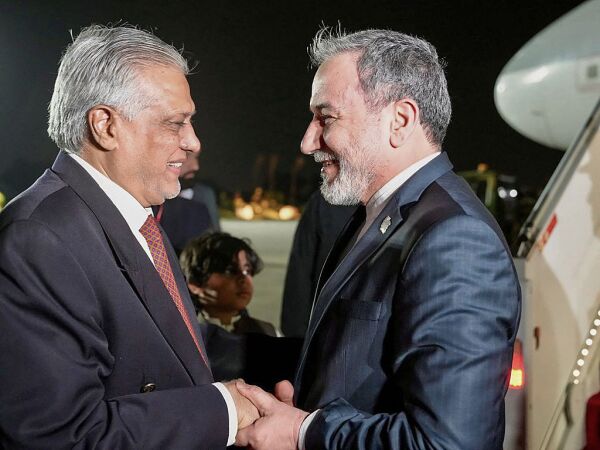
This handout photo released by the Iranian foreign ministry shows Pakistan's Foreign Minister Ishaq Dar (L) greeting his Iranian counterpart Abbas Araghchi upon his arrival in Islamabad on April 24, 2026.
This handout photo released by the Iranian foreign ministry shows Pakistan's Foreign Minister Ishaq Dar (L) greeting his Iranian counterpart Abbas Araghchi upon his arrival in Islamabad on April 24.
Iranian Foreign Ministry | AFP

"Iran's observations would be conveyed to Pakistan," he wrote on X.

The news of U.S. and Iranian officials planned travel to Pakistan had come the same day that Israel's military said it attacked southern Lebanon, targeting sites it says belong to the Iran-backed Lebanese militant group Hezbollah. The militant group also fired rockets into Israel.

That was despite President Trump's announcement that Israel and Lebanon agreed during White House talks Thursday to extend the ceasefire by three weeks. Hezbollah was not involved in the negotiations and has opposed them.

The shaky Israel-Lebanon ceasefire is linked to broader U.S. efforts to draw its war with Iran to a close. Tehran has insisted that the fighting in Lebanon remain paused as a precondition for further peace talks with the United States.

Trump had unilaterally extended the ceasefire with Iran earlier this week, hours before it was set to expire, without indicating a new expiration date.

Iran has dismissed that extension as "meaningless," saying the continued U.S. naval blockade of Iranian ports is a violation of the deal and that the Iranian delegation will not return to the negotiating table until the blockade is lifted.
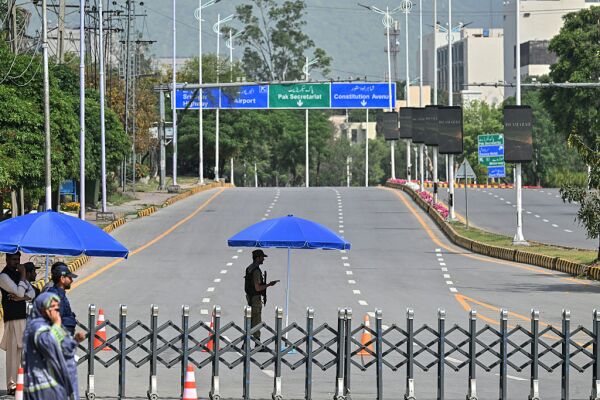
Security personnel stand guard at a closed road leading to the Serena Hotel in the Red Zone area of Islamabad on April 23, 2026.
Security personnel stand guard at a closed road leading to the Serena Hotel in the Red Zone area of Islamabad on April 23.
Asif Hassan | AFP via Getty Images

Here are the latest updates on Day 57 of the conflict in the Middle East:

Possible Iran talks | NATO rift | Mines in Hormuz | New sanctions | Pope Leo


Witkoff and Kushner cancel trip to Pakistan for Iran talks: Fox News

According to Fox News, President Trump has told one of their reporters he was canceling the U.S. delegation's planned trip to Islamabad today. This came minutes after Pakistani officials said Iran's Foreign Minister had left Islamabad.

But Friday White House press secretary Karoline Leavitt, had said on Fox News that President Trump was dispatching Witkoff and Kushner to Islamabad "to go hear" what the Iranians have to say.

"We're hopeful that it will be a productive conversation and hopefully move the ball forward towards a deal," she had said, adding that the Iranians asked for the talks.

Vice President Vance, who led the U.S. delegation last time, is not planning to travel this weekend, she said.

"The vice president remains deeply involved in this entire process, and he'll be standing by here in the United States, along with the president and the secretary of state, Marco Rubio, and the entire national security team for updates," Leavitt said.
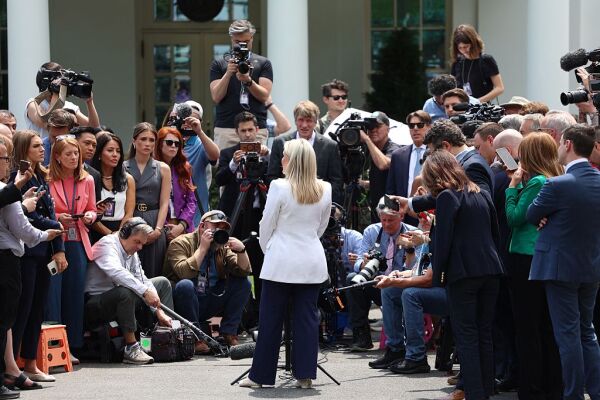
White House Press Secretary Karoline Leavitt speaks to the press at the White House in Washington, DC, on April 24, 2026. US envoys Steve Witkoff and Jared Kushner will head to Pakistan on April 25 for a new round of talks with Iran on ending the war, Leavitt told Fox News.
White House Press Secretary Karoline Leavitt speaks to the press at the White House in Washington, DC, on April 24. US envoys Steve Witkoff and Jared Kushner will head to Pakistan on April 25 for a new round of talks with Iran on ending the war, Leavitt told Fox News.
Alex Wroblewski/AFP via Getty Images

Iran's foreign minister, Abbas Araghchi, had arrived in Islamabad Friday. "Purpose of my visits is to closely coordinate with our partners on bilateral matters and consult on regional developments," he said announcing the trip on social media. He noted he would also visit Oman and Russia.

Araghchi did not say if he would participate in talks with the U.S. A statement from Pakistan's Foreign Ministry said Araghchi was meeting senior Pakistani officials.

On Thursday, President Trump said he was in no hurry to reach a deal to end the U.S.-Israeli war with Iran. "I don't want to rush. I want to take my time," Trump told reporters, adding that he was prepared to wait for "the best deal."


Spain shrugs off reported Pentagon memo looking to penalize NATO allies for Iran war stance

On Friday, Spain's prime minister pushed back against reported U.S. plans to penalize NATO allies who refused to support the U.S. in its war with Iran.

The Reuters news agency reported on Thursday about the existence of an internal Pentagon memo, prepared by top Pentagon official Elbridge Colby, outlining measures that the U.S. could take to retaliate against what it called "difficult" allies.

NPR has not independently reviewed the document. When asked about the reported memo, Pentagon Press Secretary Kingsley Wilson declined to comment on "internal deliberations," but said the department is working to ensure the president has "credible options to ensure that our allies … do their part."
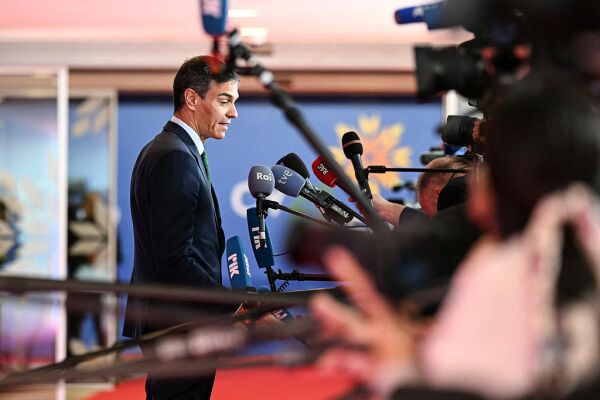
Spain's Prime Minister Pedro Sanchez speaks to journalists as he arrives for an informal meeting of the European Council in Nicosia on April 24, 2026.
Spain's Prime Minister Pedro Sanchez speaks to journalists as he arrives for an informal meeting of the European Council in Nicosia on April 24.
Nicolas Tucat | AFP via Getty Images

While no NATO member volunteered to join combat operations, Spain has been the most defiantly opposed to the war, deeming it illegal and refusing to allow the U.S. to use bases on Spanish territory.

Reuters reported that the confidential communication singled out the Spanish government, suggesting it could be suspended from NATO, and that Spain and others might be blocked from top positions inside the alliance.

At a European Union summit, Spanish Prime Minister Pedro Sanchez was asked about the Reuters report. "We don't work on the basis of emails," he responded, speaking in Spanish. "We are working on official documents and positions, made in this case by the United States government."


Mines in the Strait of Hormuz

Trump said on social media Thursday he had ordered the U.S. Navy to "shoot and kill any boat" trying to lay mines in the Strait of Hormuz.

Speaking at a Pentagon news conference on Friday morning, Defense Secretary Pete Hegseth reiterated the president's threat, saying such vessels were "acting like pirates, acting like terrorists."

"They're the ones who lay indiscriminate mines," he said.

Hegseth also derided Washington's allies in Europe for not joining the U.S.-Israeli war. "We are not counting on Europe," he told reporters. "But they need the Strait of Hormuz much more than we do and might want to start doing less talking and having less fancy conferences in Europe and get in a boat."

"This is much more their fight than ours," he added.

A Pentagon assessment shared in closed-door briefings with Congress indicates it could take up to six months to fully clear Iranian-laid mines from the Strait of Hormuz, according to a U.S. official who spoke on condition of anonymity because they were not authorized to speak publicly.

People sit on the beach with ships in the distance on April 24, 2026 in Kish Island, Iran.
People sit on the beach with ships in the distance on April 24 in Kish Island, Iran.
Getty Images

The threat of being attacked in the strait has had a tremendous effect on global shipping. Some vessels with links to Iran made attempts to move through the strait, but others are staying away after Iran attacked three ships with gunfire earlier this week and seized two.

Around 20,000 seafarers have also been stuck aboard their ships since the start of the war.

"There are a substantial number of tanker shipowners that [are keeping] their vessels away from the Middle East," Basil Karatzas, who heads the maritime consulting company Karatzas Marine Advisors, told NPR.

The disruption goes beyond oil. Helium, fertilizer and aluminum, which are all critical elements for industry and farming, have been held up in the Gulf, causing global shortages and driving up costs.


U.S. sanctions China-based oil refinery and firms and tankers accused of shipping Iran's oil

The U.S. Treasury Department said Friday it was imposing sanctions on an independent oil refinery in China, Hengli Petrochemical (Dalian) Refinery Co., Ltd., that it said was helping sustain Iran's oil economy.

The Treasury also said its Office of Foreign Assets Control is targeting about 40 shipping firms and vessels that it said are part of a clandestine network of tankers, working on behalf of Tehran to bypass international sanctions.

"At President Trump's direction, Treasury will continue to constrict the network of vessels, intermediaries, and buyers Iran relies on to move its oil to global markets. Any person or vessel facilitating these flows—through covert trade and finance—risks exposure to U.S. sanctions," Treasury Secretary Scott Bessent said in a statement.

Separately, the Trump administration extended a waiver of the Jones Act, in an attempt to help with domestic supplies of gasoline and other refined oil products.

The initial 60-day waiver of the act was meant to help companies adapt to the global disruption in oil supplies caused by the Iran war. Experts say it does make it easier to ship fuels from U.S. refineries to U.S. customers, but the effect on gas prices for consumers is minimal.


Pope Leo urges U.S. and Iran to return to talks

Pope Leo XIV called on the United States and Iran to return to the negotiating table Friday, calling for renewed talks to end the war.

Speaking to reporters aboard the papal plane after a trip to Africa, Leo urged leaders to adopt what he called "a culture of peace."

He called the negotiations between Iran and the United States "complex," but urged all sides to remain committed to dialogue.

He said he was carrying a photograph of a young Muslim Lebanese boy killed in Israel's recent attacks against Hezbollah in Lebanon. The same child had been photographed holding a sign welcoming the pope during his visit to Lebanon last year.

"When conflicts arise," Leo said, "the question is how to promote the values we believe in without the deaths of so many innocents."


Resident Mohamad Ali Hijazi holds his damaged family photo album amid the rubble of destroyed buildings at a residential area in Tyre on April 23, 2026.
Resident Mohamad Ali Hijazi holds his damaged family photo album amid the rubble of destroyed buildings at a residential area in Tyre on April 23.
AFP via Getty Images

Copyright 2026, NPR


Source link

Leave a Reply

Subscribe to Our Newsletter

Get our latest articles delivered straight to your inbox. No spam, we promise.

Recent Reviews


Taxpayers often submit refund claims when they discover that they overpaid their taxes. Taxpayers usually do this by submitting a formal refund claim using the IRS’s prescribed forms. But this is not always required.

In many cases, taxpayers will submit so-called “informal refund claims” to the IRS during the course of an IRS audit. The IRS treats these informal claims as a refund claim as if the proper tax forms were filed. Given that the tax forms are often not used for informal claims, there may be less certainty as to what the taxpayer’s claim entails. The informal claim itself may just be various business records, complications, etc. or a myriad of other records that the taxpayer submits to the auditor.

This leads to the question as to whether the “variance doctrine,” which can prohibit taxpayers from litigating certain claims in court if they differ substantially from the taxpayer’s position on audit, applies to informal refund claims. The recent Express Scripts, Inc. v. United States, No. 4:21-cv-00035-HEA (E.D. Mo. Feb. 24, 2025) case provides an opportunity to consider this question.

Facts & Procedural History

The taxpayer in this case is a pharmacy benefit manager. It processes prescription drug claims for health plan sponsors and operates mail-order pharmacies.

During an IRS examination, the taxpayer submitted informal claims to the IRS auditor for Section 199 domestic production tax deductions that it omitted from its originally-filed tax returns.

As part of this process, the company provided the IRS with detailed workpapers and memoranda categorizing various revenue streams. These documents specifically identified certain “rebate” revenue and portions of their “mail claims” revenue (those manually entered into their system) as non-qualifying revenue streams that should be excluded from their Domestic Production Gross Receipts (“DPGR”) calculations. The taxpayer took the same positions in the formal administrative refund claims they later filed with the IRS for refunds for the years 2010, 2011, and 2012.

Nearly a decade after the initial claims, the taxpayer determined that both the rebate revenue and manually entered mail claims were qualifying for the Section 199 deduction. The taxpayer filed suit seeking refunds of federal income taxes for tax years 2010, 2011, and 2012, claiming it properly qualified for the Section 199 tax deduction for its rebate revenue and manually entered mail claims.

The government moved to dismiss the portions of the refund claims relating to rebate revenue and manually entered mail claims, arguing that the taxpayer was barred by the “substantial variance doctrine” from including revenue streams in tax litigation when they had specifically excluded them during the administrative claims process.

The Framework for Tax Refund Claims

Section 7422(a) allows taxpayers to sue the government for tax refunds. This is one of the permissible means to litigate a tax issue.

Section 7422 states that no suit for tax recovery can be maintained in any court “until a claim for refund or credit has been duly filed with the Secretary, according to the provisions of law in that regard, and the regulations of the Secretary established in pursuance thereof.”

This is the foundation for what courts often call the “pay first, litigate later” system for tax disputes. Under this framework, taxpayers must first pay the disputed tax, then file an administrative refund claim with the IRS, and only afterward can they pursue litigation if the IRS denies their claim or fails to act within six months.

The treasury regulations provide specific requirements for these administrative refund claims. Treasury Regulation § 301.6402-2(b) states that a claim “must set forth in detail each ground upon which a credit or refund is claimed and facts sufficient to apprise the commissioner of the exact basis thereof.” This regulation serves as the foundation for the substantial variance doctrine that limits what taxpayers can argue once they get to court.

What Is the Substantial Variance Doctrine?

The substantial variance doctrine operates as a jurisdictional limitation on tax refund litigation. As articulated in Lockheed Martin Corp. v. United States, 210 F.3d 1366, 1371 (Fed. Cir. 2000), which involved a research tax credit, a taxpayer is barred from presenting claims in a tax refund action that “substantially vary” the legal theories and factual bases set forth in the tax refund claim presented to the IRS.

The doctrine has two distinct branches: one addressing legal theories and another addressing factual bases. For legal theories, the rule states that “any legal theory not expressly or impliedly contained in the application for refund cannot be considered by a court in which a suit for refund is subsequently initiated.” This means taxpayers cannot pursue entirely new legal arguments in court that weren’t presented to the IRS.

The factual variance branch, which was at issue in the Express Scripts case, prohibits taxpayers from substantially varying the factual bases raised in their refund claims. This rule is not all that strict. Minor factual variations are permitted. Taxpayers cannot introduce entirely new factual elements that the IRS never had an opportunity to consider.

Why Does the Variance Doctrine Exist?

The substantial variance rule serves three primary purposes. First, it gives the IRS notice as to the nature of the claim and the specific facts upon which it is predicated. This notice function ensures that the IRS understands exactly what the taxpayer is claiming and why.

Second, it gives the IRS an opportunity to correct errors administratively. This purpose reflects the preference for resolving tax disputes at the administrative level rather than through costly litigation.

Third, it limits any subsequent litigation to those grounds that the IRS had an opportunity to consider and is willing to defend. This purpose helps ensure that courts aren’t faced with entirely new claims that the IRS never had a chance to review.

These purposes reflect the fundamental principle that tax litigation over refund claims is meant to be a review of the IRS’s administrative determination, not an entirely new proceeding where taxpayers can raise new issues.

Applying the Variance Doctrine to Informal Claims

Most refund claims follow the formal procedures outlined in IRS regulations, typically involving the filing of Forms 1040X for individuals, Forms 1120X for corporations, etc. However, courts have long recognized the “informal claim doctrine,” which allows taxpayers to satisfy the administrative claim requirement through less formal means.

An informal claim can suffice when it puts the IRS on notice that the taxpayer is seeking a refund, describes the legal and factual basis for the refund, and has some written component. IRS audits often provide opportunities for taxpayers to make these informal claims as part of the examination process.

The taxpayer in this case made its initial claims through informal claims during an IRS examination, providing detailed workpapers and memoranda. But does the variance doctrine apply differently to informal claims than to formal ones?

The answer is no. Courts have consistently held that the substantial variance doctrine applies equally to informal claims. In fact, the requirements for specificity can be even more important for informal claims, as the IRS must be able to determine from sometimes less structured submissions exactly what the taxpayer is claiming. This case is an example of the court applying the variance doctrine to informal claims.

Merely Additional Evidence of the Amount

The taxpayer argued that the variance doctrine did not apply as the inclusion of rebates and manually entered pharmacy claims merely represented “additional evidence” of the amount of their Section 199 deduction. They contended that because they were still seeking the same Section 199 deduction, there was no substantial variance in their legal theory.

The court rejected this argument, focusing on the fact that the taxpayer had “specifically excluded these amounts throughout the entire administrative claims period and indeed, through this action until it was asserted in the expert reports.” The court found that the taxpayer’s addition of this revenue “changes the facts upon which the IRS assessed Plaintiffs’ claims.”

The court emphasized that Express Scripts “specifically declined to include these items in its claim. As such, the IRS was not given the opportunity to review whether they were properly designated as gross receipts.” Because the IRS never had the opportunity to consider whether these additional revenue streams qualified for the deduction, the substantial variance doctrine barred their inclusion in the litigation.

What if the IRS Reviews the Position on Audit?

The taxpayer also argued that the IRS had waived the substantial variance doctrine by considering the allocation of DPGR. This approach reflects a strategy sometimes used in tax audits where taxpayers argue that the IRS has effectively waived technical requirements by addressing the merits of a claim.

The court rejected this waiver argument on factual grounds, noting that the taxpayer had “specifically exempted the rebates and manually entered mail pharmacy claims” from consideration, so the IRS “could not have considered the merits of these claims because they were not before the IRS for examination.”

The court’s reasoning highlights a critical point: taxpayers cannot claim waiver based on the IRS’s consideration of issues that were never actually presented to the IRS. The waiver argument can only work when the IRS actually considers facts or theories that were raised in the administrative claim.

The Takeaway

This case shows how important it is to provide clear detail and consistency when submitting tax refund claims to the IRS. This includes informal claims submitted to the IRS on audit. Taxpayers who specifically exclude certain factual bases from their administrative refund claims—whether formal or informal—may not be able to later include those bases in litigation, even if their legal theory remains unchanged. The substantial variance doctrine operates as a jurisdictional bar in these cases, which can serve to deny the taxpayer their day in court.

Watch Our Free On-Demand Webinar

In 40 minutes, we’ll teach you how to survive an IRS audit.

We’ll explain how the IRS conducts audits and how to manage and close the audit.  


Source link