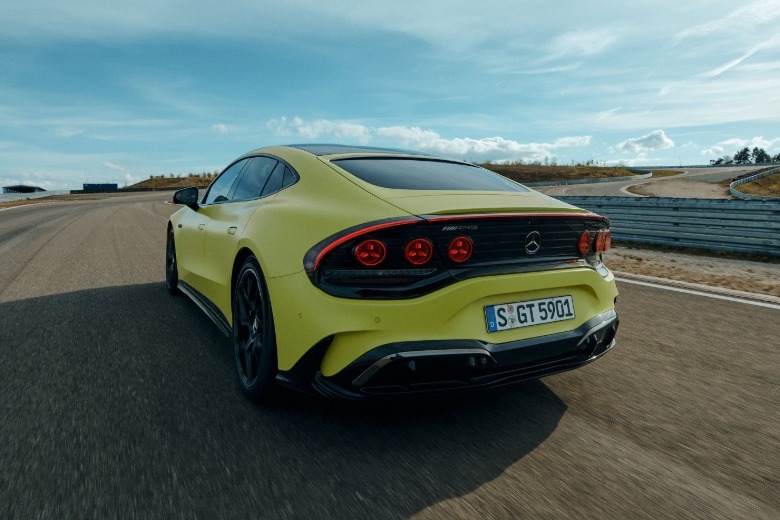

Mercedes-AMG is known for its performance sedans like the GT63 SE Performance that comes with a complex 4.0-liter V8 biturbo hybrid powertrain. Now, the company has come up with its most powerful vehicle ever, but took a completely different route to get there. The new GT 4-Door Coupé is an 1,153 hp, purely electric beast with an all-new thin and lightweight powertrain.
To build a vehicle that could take on Porsche’s electric Taycan, Mercedes-AMG came up with the 800-volt AMG.EA platform. It uses three new “axial-flux” motors that marry high-power with reduced weight and size. The front motor is just 3.5 inches thick but redlines at over 15,000 rpm and only kicks in for extra performance or regenerative braking. The two rear motors (each about 3.2 inches high) are married to a single-speed transmission and can hit just over 13,000 rpm. The entire powertrain weighs just 309 pounds.
 Mercedes-AMG
Those tiny motors, mated with the 106kWh battery, can pump out quite some power, though. The GT55 variant outputs a maximum of 805 hp and 1,328 lb-ft of torque, while the GT63 version produces 1,153 hp and 1,475 lb-ft of torque. That will power the GT63 from 0 to 60 mph in 2.0 seconds, beating Porsche’s 940 hp Taycan Turbo S by 0.3 seconds. Should you pine for a throaty ICE engine sound, the GT models can artificially emulate an AMG V8, including the gear changes.
The GT 4-Door users a new type of battery, developed in collaboration with the company’s Formula 1 program. It uses very long (four+ inch) cylindrical cells that allow for a high energy density of 298Wh/kg, along with long life and fast charging performance Mercedes-AMG said. It also has a non-conductive oil cooling system designed to keep the cells at uniform temperatures.
Operating at 800 volts and up to 800 amps, the GT 4-Door can charge at over 600 kW, which would take it from 10 to 80 percent full in 11 minutes. Mercedes-AMG says the GT55 and GT63 models (which both use the same capacity battery) are rated at 370 to 470 miles on Europe’s WLTP cycle, equating to over 300 miles of EPA range.
 Mercedes-AMG
To accommodate all that horsepower, the GT 4-Door has multilink front and rear suspensions, with the standard air suspension bolstered by electronic dampers and AMG’s Active Ride Control. For everyday driving, the car will be slowed mainly by regenerative braking, but during more sporty maneuvers, the 5,400 pound vehicle can be hauled to a stop with carbon-ceramic disc brakes in front and rear steel rotor discs in the rear.
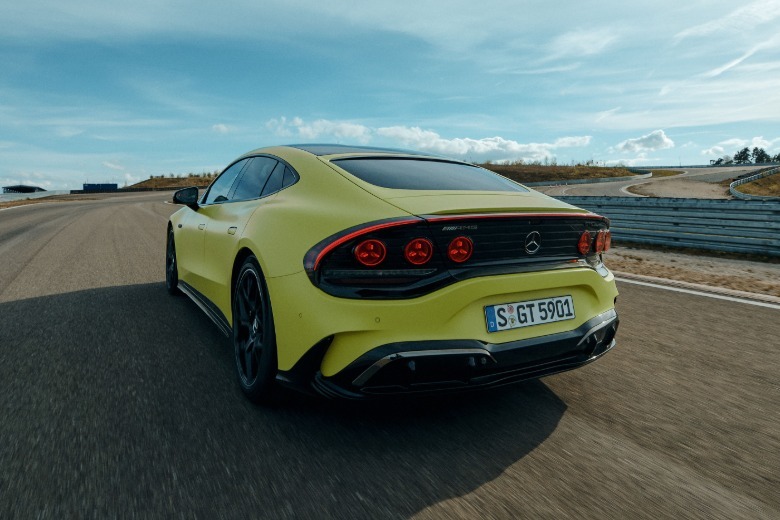
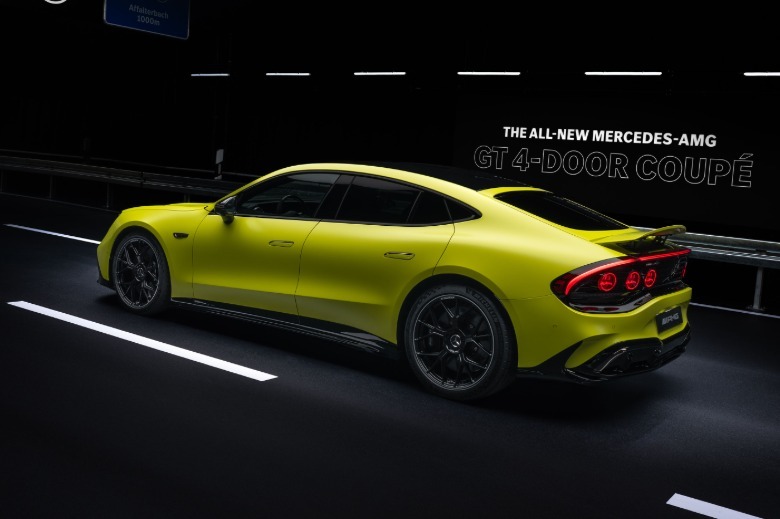
Outside, the GT 4-Door has a curvy aerodynamic design with a 0.22 drag coefficient, featuring bulgy fenders, a panoramic glass roof and elegant strakes along the hood and side. It looks and is quite long, five inches more than the Taycan. Up front are running lights in the shape of Mercedes’ three-pointed star, along with a large grille which is mostly cosmetic but allows air to enter below, controlled by louvers, for battery cooling. The rear taillights (all six of them) also show Mercedes’ logo, just in case onlookers weren’t quite sure of the brand.
 Mercedes-AMG
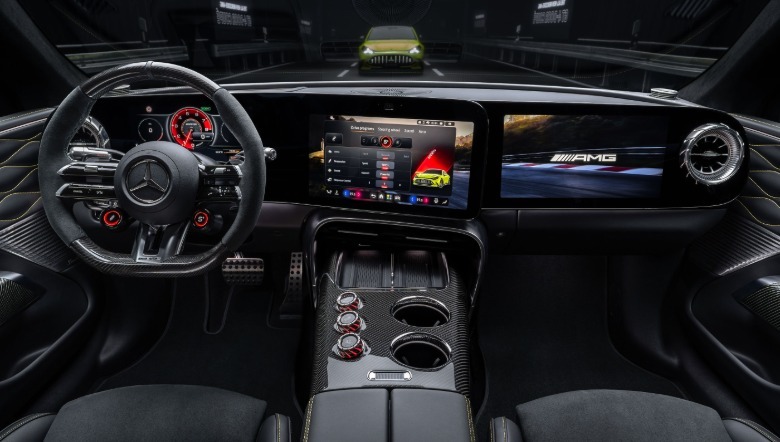
The sporty interior features bolstered seats and a large central screen, along with a dedicated front passenger display. The battery configuration, along with the length, allows for plenty of passenger space. The driver can choose from no less than seven drive modes, nine traction control settings and a warm-up feature alerts the driver when the tires and motors are at the ideal temperature. There’s even a panel that delivers stats on your racetrack performance.
The 2027 Mercedes-AMG GT55 4-Door Coupe will arrive later this year, while the higher-performance GT63 version will go on sale in 2027. Prices haven’t been revealed, but Porsche’s Taycan Turbo S can reach well over $200,000. Since the GT63 is likely to outperform it, you can guess it’ll be priced in that neighborhood as well.

Stephan is the sports journalist for the Maple Grove Report.