NASA targets a September launch for its next big space telescope


NASA’s next eye into the cosmos is due to leave our planet later this year. The agency says it’s targeting an early September launch for the Nancy Grace Roman Space Telescope. Roman (for short) has a field of view 100 times larger than Hubble’s.

The September date is the earliest possible launch for Roman. NASA says it will go up (aboard a SpaceX Falcon Heavy rocket) no later than May 2027.

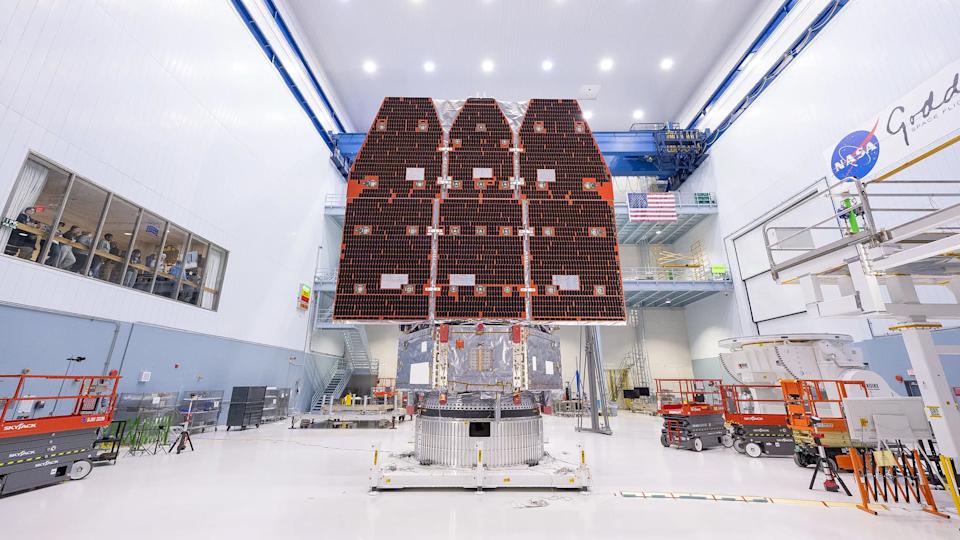
The Nancy Grace Roman Space Telescope, named after NASA’s first chief astronomer and “mother” of Hubble, was introduced in 2016. (Back then, it was known as the Wide Field Infrared Survey Telescope, or WFIRST.) The telescope’s mirror is roughly the same size as Hubble’s, but it can capture sections of the sky at least 100 times larger than its predecessor.

The Roman telescope, sitting inside a white NASA hangar

NASA

“Roman will work in tandem with NASA observatories such as the James Webb Space Telescope and Chandra X-ray Observatory, which are designed to zoom in on rare transient objects once they’ve been identified, but seldom if ever discover them,” Julie McEnery, Roman’s senior project scientist, said in 2023. “Roman’s much larger field of view will reveal many such objects that were previously unknown. And since we’ve never had an observatory like this scanning the cosmos before, we could even find entirely new classes of objects and events.”

After leaving our atmosphere, Roman will set course for a vantage point nearly 1 million miles from Earth. There, it will rely on a pair of instruments to study space. The first is a 300.8-megapixel camera that captures light from visible to near-infrared. There’s also a high-contrast coronagraph that will allow it to capture exoplanets that would otherwise be blocked by starlight.

Roman’s mission: “to settle essential questions in the areas of dark energy, exoplanets and astrophysics.” Despite decades of study, astronomers know surprisingly little about dark energy, which makes up about 68 percent of the universe’s contents. And while scientific discoveries are cool and all, you’ll be pleased to know that Roman is also sure to beam back more dazzling pictures of our cosmos.


Source link

Leave a Reply

Subscribe to Our Newsletter

Get our latest articles delivered straight to your inbox. No spam, we promise.

Recent Reviews


Learn the difference between accountability and responsibility — and why building a more accountable team starts with what you do as a leader.

Do you want your team to be more accountable?

If you’re like most of the CEOs I work with, you do.

You want clear ownership. You want clear communication. You want consequences for missing targets.

But here’s what most CEOs miss: holding accountability is your responsibility, not theirs.

In this essay, I’ll explain the difference between accountability and responsibility, and share the questions you need to ask to make sure you’re doing your part.

What is accountability?

I define accountability as the ability to account for one’s actions and decisions.

There are two sides to accountability: 

  • Being accountable: that’s the person giving an account.
  • Holding someone accountable: that’s the person they are giving it to.

The most common form of accountability is a report that shows:

  1. The numbers
  2. The story behind them. 

In fact, the word account can refer to numbers (think accounting) or stories (an account of what happened).

Reporting is powerful because it forces people to check in on their goals, what they’ve done, and what to do next. And great reports can create a self-managing system where the report does a lot of the heavy-lifting.

Accountability has benefits: it helps people remember and focus on their goals, and it can maximise their learning. Plus, it keeps stakeholders informed.

However, accountability is only half of the equation.

The other part is responsibility, and without it, accountability isn’t nearly as helpful.

What is responsibility?

I define responsibility as the ability to respond with effective actions and decisions.

So is the manager or the teammate responsible for getting results? 

This needs to be crystal clear:

  • Your team is responsible for getting results.
  • You are responsible for the team itself.

Your team is responsible for planning their work, making commitments, and solving problems in order to get results.

However, you are responsible for selecting the right people, communicating expectations, and supporting them as best you can.

Accountability is a service. It’s goal is to increase a person’s level of responsibility.

Haven’t you craved some accountability so you followed through on something important?

It actually starts with you, not them.

The first step in driving accountability is to check in with your responsibilities first: 

  • Have you selected the right people? 
  • Have you communicated expectations? 
  • Have you supported them and provided them with accountability?

Because the consequences you want aren’t actually on them, they are on you.

Answering these questions? That’s accountability.

Actually doing something about them? That’s taking responsibility.

Related Reading: 

Originally published on February 25th, 2026


How do top founders actually scale?

I’ve coached CEOs for 10,000+ hours—here’s what works.
Join 17,000+ founders learning how to scale with clarity.

Unsubscribe any time.


Source link